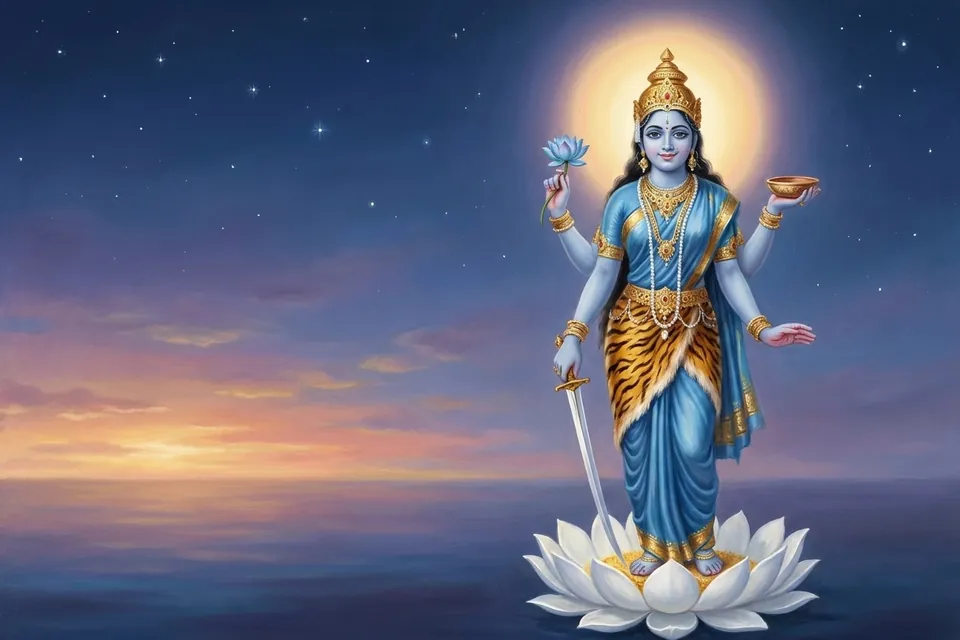
Stotra · Maa Tara
Tara Kavacham
तारा कवचम्
- Shloka 1
कोटितन्त्रेषु गोप्या हि विद्यातिभयमोचिनी । दिव्यं हि कवचं तस्याः शृणुष्व सर्वकामदम् ॥ १ ॥
Kotitantreshu gopya hi vidyatibhayamochini, divyam hi kavacham tasyah shrinushva sarvakamadam.
This vidya, kept hidden in countless Tantras, frees one from great fear. Now listen to her divine kavacha, which grants all wishes.
Word by word
- Shloka 2
प्रणवो मे शिरः पातु ब्रह्मरूपा महेश्वरी । ललाटे पातु ह्रीङ्कारो बीजरूपा महेश्वरी ॥ २ ॥
Pranavo me shirah patu brahmarupa maheshvari, lalate patu hrinkaro bijarupa maheshvari.
May the Pranava (Om), Maheshvari in the form of Brahman, protect my head. May the syllable Hreem, Maheshvari in the form of the seed syllable, protect my forehead.
Word by word
- Shloka 3
स्त्रीङ्कारो वदने नित्यं लज्जारूपा महेश्वरी । हूङ्कारः पातु हृदये भवानीरूपशक्तिधृक् ॥ ३ ॥
Strinkaro vadane nityam lajjarupa maheshvari, hunkarah patu hridaye bhavanirupashaktidhrik.
May the syllable Streem, Maheshvari in the form of modesty, always protect my face. May the syllable Hoom, which holds the power of Bhavani's form, protect my heart.
Word by word
- Shloka 4
फट्कारः पातु सर्वाङ्गे सर्वसिद्धिफलप्रदा । खर्वा मां पातु देवेशी गण्डयुग्मे भयापहा ॥ ४ ॥
Phatkarah patu sarvange sarvasiddhiphalaprada, kharva mam patu deveshi gandayugme bhayapaha.
May the syllable Phat, giver of the fruit of all siddhis, protect all my limbs. May Kharva, ruler of the devas who removes fear, protect my two cheeks.
Word by word
- Shloka 5
निम्नोदरी सदा स्कन्धयुग्मे पातु महेश्वरी । व्याघ्रचर्मावृता कट्यां पातु देवी शिवप्रिया ॥ ५ ॥
Nimnodari sada skandhayugme patu maheshvari, vyaghracharmavrita katyam patu devi shivapriya.
May Maheshvari of the deep-set belly always protect my two shoulders. May the Devi dear to Shiva, wrapped in a tiger skin, protect my waist.
Word by word
- Shloka 6
पीनोन्नतस्तनी पातु पार्श्वयुग्मे महेश्वरी । रक्तवर्तुलनेत्रा च कटिदेशे सदाऽवतु ॥ ६ ॥
Pinonnatastani patu parshvayugme maheshvari, raktavartulanetra cha katideshe sadavatu.
May Maheshvari of full, raised bosom protect my two sides. May she of red, round eyes always guard the region of my hips.
Word by word
- Shloka 7
ललज्जिह्वा सदा पातु नाभौ मां भुवनेश्वरी । करालास्या सदा पातु लिङ्गे देवी हरप्रिया ॥ ७ ॥
Lalajjihva sada patu nabhau mam bhuvaneshvari, karalasya sada patu linge devi harapriya.
May Bhuvaneshvari with lolling tongue always protect my navel. May the Devi dear to Hara, of fierce mouth, always protect my private parts.
Word by word
- Shloka 8
पिङ्गोग्रैकजटा पातु जङ्घायां विघ्ननाशिनी । प्रेतखर्परभृद्देवी जानुचक्रे महेश्वरी ॥ ८ ॥
Pingograikajata patu janghayam vighnanashini, pretakharparabhriddevi januchakre maheshvari.
May she with a single fierce tawny matted lock, the destroyer of obstacles, protect my shins. May Maheshvari who holds a skull bowl protect my kneecaps.
Word by word
- Shloka 9
नीलवर्णा सदा पातु जानुनी सर्वदा मम । नागकुण्डलधर्त्री च पातु पादयुगे ततः ॥ ९ ॥
Nilavarna sada patu januni sarvada mama, nagakundaladhartri cha patu padayuge tatah.
May she of blue complexion always protect my knees. Then may she who wears serpent earrings protect my two feet.
Word by word
- Shloka 10
नागहारधरा देवी सर्वाङ्गं पातु सर्वदा । नागकङ्कधरा देवी पातु प्रान्तरदेशतः ॥ १० ॥
Nagaharadhara devi sarvangam patu sarvada, nagakankadhara devi patu prantaradeshatah.
May the Devi wearing a garland of serpents protect my whole body at all times. May the Devi wearing serpent ornaments protect me in lonely open places.
Word by word
- Shloka 11
चतुर्भुजा सदा पातु गमने शत्रुनाशिनी । खड्गहस्ता महादेवी श्रवणे पातु सर्वदा ॥ ११ ॥
Chaturbhuja sada patu gamane shatrunashini, khadgahasta mahadevi shravane patu sarvada.
May the four-armed one, destroyer of enemies, always protect me while I travel. May Mahadevi holding a sword always protect my ears.
Word by word
- Shloka 12
नीलाम्बरधरा देवी पातु मां विघ्ननाशिनी । कर्त्रिहस्ता सदा पातु विवादे शत्रुमध्यतः ॥ १२ ॥
Nilambaradhara devi patu mam vighnanashini, kartrihasta sada patu vivade shatrumadhyatah.
May the Devi clad in blue, the remover of obstacles, protect me. May she who holds the cleaver always protect me in disputes and among opponents.
Word by word
- Shloka 13
ब्रह्मरूपधरा देवी सङ्ग्रामे पातु सर्वदा । नागकङ्कणधर्त्री च भोजने पातु सर्वदा ॥ १३ ॥
Brahmarupadhara devi sangrame patu sarvada, nagakankanadhartri cha bhojane patu sarvada.
May the Devi who bears the form of Brahman always protect me in battle. May she who wears serpent bracelets always protect me while I eat.
Word by word
- Shloka 14
शवकर्णा महादेवी शयने पातु सर्वदा । वीरासनधरा देवी निद्रायां पातु सर्वदा ॥ १४ ॥
Shavakarna mahadevi shayane patu sarvada, virasanadhara devi nidrayam patu sarvada.
May Mahadevi whose ear ornaments are corpses always protect me while I lie down. May the Devi seated in the hero's posture always protect me in sleep.
Word by word
- Shloka 15
धनुर्बाणधरा देवी पातु मां विघ्नसङ्कुले । नागाञ्चितकटी पातु देवी मां सर्वकर्मसु ॥ १५ ॥
Dhanurbanadhara devi patu mam vighnasankule, naganchitakati patu devi mam sarvakarmasu.
May the Devi holding bow and arrows protect me when obstacles crowd around. May the Devi whose waist is adorned with serpents protect me in all my work.
Word by word
- Shloka 16
छिन्नमुण्डधरा देवी कानने पातु सर्वदा । चितामध्यस्थिता देवी मारणे पातु सर्वदा ॥ १६ ॥
Chhinnamundadhara devi kanane patu sarvada, chitamadhyasthita devi marane patu sarvada.
May the Devi holding a severed head always protect me in the forest. May the Devi seated in the midst of the pyre always protect me in the fierce rite called marana.
Word by word
- Shloka 17
द्वीपिचर्मधरा देवी पुत्रदारधनादिषु । अलङ्कारान्विता देवी पातु मां हरवल्लभा ॥ १७ ॥
Dvipicharmadhara devi putradaradhanadishu, alankaranvita devi patu mam haravallabha.
May the Devi wearing a leopard skin protect my children, wife, wealth and all that is mine. May the richly adorned Devi, beloved of Hara, protect me.
Word by word
- Shloka 18
रक्ष रक्ष नदीकुञ्जे हूं हूं फट् सुसमन्विते । बीजरूपा महादेवी पर्वते पातु सर्वदा ॥ १८ ॥
Raksha raksha nadikunje hum hum phat susamanvite, bijarupa mahadevi parvate patu sarvada.
Protect me, protect me in groves by the river, O you who are joined with Hoom Hoom Phat. May Mahadevi in the form of the seed syllable always protect me on mountains.
Word by word
- Shloka 19
मणिभृद्वज्रिणी देवी महाप्रतिसरे तथा । रक्ष रक्ष सदा हूं हूं ओं ह्रीं स्वाहा महेश्वरी ॥ १९ ॥
Manibhridvajrini devi mahapratisare tatha, raksha raksha sada hum hum om hrim svaha maheshvari.
O Devi who bears the jewel and the vajra, and who is also Mahapratisara, O Maheshvari, protect me, protect me always: Hoom Hoom Om Hreem Svaha.
Word by word
- Shloka 20
पुष्पकेतुरजार्हेति कानने पातु सर्वदा । ओं ह्रीं वज्रपुष्पं हुं फट् प्रान्तरे सर्वकामदा ॥ २० ॥
Pushpaketurajarheti kanane patu sarvada, om hrim vajrapushpam hum phat prantare sarvakamada.
With the words Pushpaketu Rajarhe, may she always protect me in the forest. With Om Hreem Vajrapushpam Hum Phat, may she who grants all wishes protect me in lonely places.
Word by word
- Shloka 21
ओं पुष्पे पुष्पे महापुष्पे पातु पुत्रान्महेश्वरी । हूं स्वाहा शक्तिसम्युक्ता दारान् रक्षतु सर्वदा ॥ २१ ॥
Om pushpe pushpe mahapushpe patu putranmaheshvari, hum svaha shaktisamyukta daran rakshatu sarvada.
Om Pushpe Pushpe Mahapushpe: may Maheshvari protect my children. Joined with Hoom Svaha and with Shakti, may she always protect my wife.
Word by word
- Shloka 22
ओं आं हूं स्वाहा महेशानी पातु द्यूते हरप्रिया । ओं ह्रीं सर्वविघ्नोत्सारिणी देवी विघ्नान्मां सदाऽवतु ॥ २२ ॥
Om Aam hum svaha maheshani patu dyute harapriya, om hrim sarvavighnotsarini devi vighnanmam sadavatu.
Om Aam Hoom Svaha: may Maheshani, dear to Hara, protect me in games of chance. Om Hreem: may the Devi who drives away all obstacles always guard me from obstacles.
Word by word
- Shloka 23
ओं पवित्रवज्रभूमे हुं फट् स्वाहा समन्विता । पूरिका पातु मां देवी सर्वविघ्नविनाशिनी ॥ २३ ॥
Om pavitravajrabhume hum phat svaha samanvita, purika patu mam devi sarvavighnavinashini.
Om Pavitra Vajrabhume Hum Phat Svaha: joined with this mantra, may Devi Purika, destroyer of all obstacles, protect me.
Word by word
- Shloka 24
ओं आः सुरेखे वज्ररेखे हुं फट् स्वाहा समन्विता । पाताले पातु सा देवी लाकिनी नामसञ्ज्ञिका ॥ २४ ॥
Om Aah surekhe vajrarekhe hum phat svaha samanvita, patale patu sa devi lakini namasangyika.
Om Aah Surekhe Vajrarekhe Hum Phat Svaha: joined with this mantra, may that Devi known by the name Lakini protect me in the netherworld.
Word by word
- Shloka 25
ह्रीङ्कारी पातु मां पूर्वे शक्तिरूपा महेश्वरी । स्त्रीङ्कारी पातु देवेशी वधूरूपा महेश्वरी ॥ २५ ॥
Hrinkari patu mam purve shaktirupa maheshvari, strinkari patu deveshi vadhurupa maheshvari.
May Maheshvari who is Hreem, in the form of Shakti, protect me in the east. May the ruler of the devas who is Streem, Maheshvari in the form of a bride, protect me.
Word by word
- Shloka 26
हूंस्वरूपा महादेवी पातु मां क्रोधरूपिणी । फट् स्वरूपा महामाया उत्तरे पातु सर्वदा ॥ २६ ॥
Hunsvarupa mahadevi patu mam krodharupini, phat svarupa mahamaya uttare patu sarvada.
May Mahadevi in the form of Hoom, the embodiment of fierce wrath, protect me. May Mahamaya in the form of Phat always protect me in the north.
Word by word
- Shloka 27
पश्चिमे पातु मां देवी फट् स्वरूपा हरप्रिया । मध्ये मां पातु देवेशी हूं स्वरूपा नगात्मजा ॥ २७ ॥
Pashchime patu mam devi phat svarupa harapriya, madhye mam patu deveshi hum svarupa nagatmaja.
In the west may the Devi dear to Hara, in the form of Phat, protect me. In the centre may the daughter of the mountain, ruler of the devas, in the form of Hoom, protect me.
Word by word
- Shloka 28
नीलवर्णा सदा पातु सर्वतो वाग्भवा सदा । भवानी पातु भवने सर्वैश्वर्यप्रदायिनी ॥ २८ ॥
Nilavarna sada patu sarvato vagbhava sada, bhavani patu bhavane sarvaishvaryapradayini.
May the blue-complexioned one, the source of speech, always protect me from every side. May Bhavani, giver of all prosperity, protect me in my home.
Word by word
- Shloka 29
विद्यादानरता देवी वक्त्रे नीलसरस्वती । शास्त्रे वादे च सङ्ग्रामे जले च विषमे गिरौ ॥ २९ ॥
Vidyadanarata devi vaktre nilasarasvati, shastre vade cha sangrame jale cha vishame girau.
May Nila Saraswati, the Devi who delights in giving knowledge, protect my mouth. In study of scripture, in debate, in battle, in water, in difficult places and on mountains,
Word by word
- Shloka 30
भीमरूपा सदा पातु श्मशाने भयनाशिनी । भूतप्रेतालये घोरे दुर्गमा श्रीघनाऽवतु ॥ ३० ॥
Bhimarupa sada patu shmashane bhayanashini, bhutapretalaye ghore durgama shrighanavatu.
may she of mighty form always protect me. May she who removes fear protect me in the cremation ground. In harsh places said to be haunted by spirits, may Durgama, full of grace, protect me.
Word by word
- Shloka 31
पातु नित्यं महेशानी सर्वत्र शिवदूतिका । कवचस्य माहात्म्यं नाहं वर्षशतैरपि ॥ ३१ ॥
Patu nityam maheshani sarvatra shivadutika, kavachasya mahatmyam naham varshashatairapi.
May Maheshani, Shivaduti, protect me always and everywhere. The greatness of this kavacha, even in a hundred years I could not
Word by word
- Shloka 32
शक्नोमि गदितुं देवि भवेत्तस्य फलं च यत् । पुत्रदारेषु बन्धूनां सर्वदेशे च सर्वदा ॥ ३२ ॥
Shaknomi gaditum devi bhavettasya phalam cha yat, putradareshu bandhunam sarvadeshe cha sarvada.
describe, O Devi, nor the fruit that comes from it. Among children, wife and relatives, in every land and at every time,
Word by word
- Shloka 33
न विद्यते भयं तस्य नृपपूज्यो भवेच्च सः । शुचिर्भूत्वाऽशुचिर्वापि कवचं सर्वकामदम् ॥ ३३ ॥
Na vidyate bhayam tasya nripapujyo bhavechcha sah, shuchirbhutvashuchirvapi kavacham sarvakamadam.
The text says such a person has no fear and is honoured by kings. Whether one is pure or not, this kavacha grants all wishes;
Word by word
- Shloka 34
प्रपठन् वा स्मरन्मर्त्यो दुःखशोकविवर्जितः । सर्वशास्त्रे महेशानि कविराड्भवति ध्रुवम् ॥ ३४ ॥
Prapathan va smaranmartyo duhkhashokavivarjitah, sarvashastre maheshani kaviradbhavati dhruvam.
the text says one who recites or remembers it becomes free of sorrow and grief, and, O Maheshani, surely becomes a master poet in all the scriptures.
Word by word
- Shloka 35
सर्ववागीश्वरो मर्त्यो लोकवश्यो धनेश्वरः । रणे द्यूते विवादे च जयस्तत्र भवेद्ध्रुवम् ॥ ३५ ॥
Sarvavagishvaro martyo lokavashyo dhaneshvarah, rane dyute vivade cha jayastatra bhaveddhruvam.
The text says such a person becomes master of all speech, one whom people are drawn to, rich in wealth, and surely wins in battle, in games of chance and in disputes.
Word by word
- Shloka 36
पुत्रपौत्रान्वितो मर्त्यो विलासी सर्वयोषिताम् । शत्रवो दासतां यान्ति सर्वेषां वल्लभः सदा ॥ ३६ ॥
Putrapautranvito martyo vilasi sarvayoshitam, shatravo dasatam yanti sarvesham vallabhah sada.
The text says such a person is blessed with sons and grandsons, charming to all women, sees enemies become his servants, and is always dear to everyone.
Word by word
- Shloka 37
गर्वी खर्वी भवत्येव वादी स्खलति दर्शनात् । मृत्युश्च वश्यतां याति दासास्तस्यावनीभुजः ॥ ३७ ॥
Garvi kharvi bhavatyeva vadi skhalati darshanat, mrityushcha vashyatam yati dasastasyavanibhujah.
The text says the proud are humbled before him, a debater falters at the very sight of him, even death comes under his control, and kings become his servants.
Word by word
- Shloka 38
प्रसङ्गात्कथितं सर्वं कवचं सर्वकामदम् । प्रपठन्वा स्मरन्मर्त्यः शापानुग्रहणे क्षमः ॥ ३८ ॥
Prasangatkathitam sarvam kavacham sarvakamadam, prapathanva smaranmartyah shapanugrahane kshamah.
In this context the whole kavacha, which grants all wishes, has been told. The text says one who recites or remembers it becomes able to curse and to bless.
Word by word
- Shloka 39
आनन्दवृन्दसिन्धूनामधिपः कविराड्भवेत् । सर्ववागीश्वरो मर्त्यो लोकवश्यः सदा सुखी ॥ ३९ ॥
Aanandavrindasindhunamadhipah kaviradbhavet, sarvavagishvaro martyo lokavashyah sada sukhi.
The text says such a person becomes master of oceans of bliss, a king among poets, master of all speech, one whom people are drawn to, and always happy.
Word by word
- Shloka 40
गुरोः प्रसादमासाद्य विद्यां प्राप्य सुगोपिताम् । तत्रापि कवचं देवि दुर्लभं भुवनत्रये ॥ ४० ॥
Guroh prasadamasadya vidyam prapya sugopitam, tatrapi kavacham devi durlabham bhuvanatraye.
Having gained the Guru's grace and received the well-guarded vidya, even then, O Devi, this kavacha is rare in all three worlds.
Word by word
- Shloka 41
गुरुर्देवो हरः साक्षात्तत्पत्नी तु हरप्रिया । अभेदेन भजेद्यस्तु तस्य सिद्धिरदूरतः ॥ ४१ ॥
Gururdevo harah sakshattatpatni tu harapriya, abhedena bhajedyastu tasya siddhiraduratah.
The Guru is Hara himself, and the Guru's wife is she who is dear to Hara. The text says one who worships them as not different finds siddhi close at hand.
Word by word
- Shloka 42
मन्त्राचारा महेशानि कथिताः पूर्ववत्प्रिये । नाभौ ज्योतिस्तथा रक्तं हृदयोपरि चिन्तयेत् ॥ ४२ ॥
Mantrachara maheshani kathitah purvavatpriye, nabhau jyotistatha raktam hridayopari chintayet.
O Maheshani, dear one, the mantra practices have been told as before. One should meditate on a light at the navel and on a red glow above the heart.
Word by word
- Shloka 43
ऐश्वर्यं सुकवित्वं च महावागीश्वरो नृपः । नित्यं तस्य महेशानि महिलासङ्गमं चरेत् ॥ ४३ ॥
Aishvaryam sukavitvam cha mahavagishvaro nripah, nityam tasya maheshani mahilasangamam charet.
The text says such a person gains prosperity and fine poetic gift and becomes a great master of speech, like a king. O Maheshani, it says he should regularly keep union with his consort as part of the practice.
Word by word
- Shloka 44
पञ्चाचाररतो मर्त्यः सिद्धो भवति नान्यथा । शक्तियुक्तो भवेन्मर्त्यः सिद्धो भवति नान्यथा ॥ ४४ ॥
Panchachararato martyah siddho bhavati nanyatha, shaktiyukto bhavenmartyah siddho bhavati nanyatha.
The text says one devoted to the fivefold practice (panchachara) becomes accomplished, not otherwise; one joined with Shakti becomes accomplished, not otherwise.
Word by word
- Shloka 45
ब्रह्मा विष्णुश्च रुद्रश्च ये देवासुरमानुषाः । तं दृष्ट्वा साधकं देवि लज्जायुक्ता भवन्ति ते ॥ ४५ ॥
Brahma vishnushcha rudrashcha ye devasuramanushah, tam drishtva sadhakam devi lajjayukta bhavanti te.
The text says, O Devi, that Brahma, Bhagwan Vishnu and Rudra, and all devas, asuras and humans, feel humbled on seeing such a sadhaka.
Word by word
- Shloka 46
स्वर्गे मर्त्ये च पाताले ये देवाः सिद्धिदायकाः । प्रशंसन्ति सदा देवि तं दृष्ट्वा साधकोत्तमम् ॥ ४६ ॥
Svarge martye cha patale ye devah siddhidayakah, prashansanti sada devi tam drishtva sadhakottamam.
The text says the devas who grant siddhi in heaven, on earth and in the netherworld always praise that excellent sadhaka on seeing him, O Devi.
Word by word
- Shloka 47
विघ्नात्मकाश्च ये देवाः स्वर्गे मर्त्ये रसातले । प्रशंसन्ति सदा सर्वे तं दृष्ट्वा साधकोत्तमम् ॥ ४७ ॥
Vighnatmakashcha ye devah svarge martye rasatale, prashansanti sada sarve tam drishtva sadhakottamam.
The text says even the beings who cause obstacles, in heaven, on earth and in the lower realms, all praise that excellent sadhaka on seeing him.
Word by word
- Shloka 48
इति ते कथितं देवि मया सम्यक्प्रकीर्तितम् । भुक्तिमुक्तिकरं साक्षात्कल्पवृक्षस्वरूपकम् ॥ ४८ ॥
Iti te kathitam devi maya samyakprakirtitam, bhuktimuktikaram sakshatkalpavrikshasvarupakam.
Thus, O Devi, I have told you this fully and properly. It gives both worldly enjoyment and liberation, and is truly like the wish-fulfilling tree.
Word by word
- Shloka 49
आसाद्याद्यगुरुं प्रसाद्य य इदं कल्पद्रुमालम्बनं मोहेनापि मदेन चापि रहितो जाड्येन वा युज्यते । सिद्धोऽसौ भुवि सर्वदुःखविपदां पारं प्रयात्यन्तके मित्रं तस्य नृपाश्च देवि विपदो नश्यन्ति तस्याशु च ॥ ४९ ॥
Aasadyadyagurum prasadya ya idam kalpadrumalambanam mohenapi madena chapi rahito jadyena va yujyate, siddhosau bhuvi sarvaduhkhavipadam param prayatyantake mitram tasya nripashcha devi vipado nashyanti tasyashu cha.
The text says: whoever approaches and pleases the first Guru and holds on to this wish-fulfilling tree, whether free of delusion and pride or even touched by dullness, becomes accomplished on earth and at the end crosses beyond all sorrows and troubles. Kings become his friends, O Devi, and his difficulties quickly fade away.
Word by word
- Shloka 50
तद्गात्रं प्राप्य शस्त्राणि ब्रह्मास्त्रादीनि वै भुवि । तस्य गेहे स्थिरा लक्ष्मीर्वाणी वक्त्रे वसेद्ध्रुवम् ॥ ५० ॥
Tadgatram prapya shastrani brahmastradini vai bhuvi, tasya gehe sthira lakshmirvani vaktre vaseddhruvam.
The text says weapons on earth, even the Brahmastra and others, become harmless on reaching his body. Maa Lakshmi stays steady in his home and Vani, the power of speech, surely dwells in his mouth.
Word by word
- Shloka 51
इदं कवचमज्ञात्वा तारां यो भजते नरः । अल्पायुर्निर्धनो मूर्खो भवत्येव न संशयः ॥ ५१ ॥
Idam kavachamagyatva taram yo bhajate narah, alpayurnirdhano murkho bhavatyeva na sanshayah.
The text states that a person who worships Tara without knowing this kavacha remains short of long life, wealth and understanding, without doubt. In this way it stresses learning this kavacha in Tara worship.
Word by word
- Shloka 52
लिखित्वा धारयेद्यस्तु कण्ठे वा मस्तके भुजे । तस्य सर्वार्थसिद्धिः स्याद्यद्यन्मनसि वर्तते ॥ ५२ ॥
Likhitva dharayedyastu kanthe va mastake bhuje, tasya sarvarthasiddhih syadyadyanmanasi vartate.
The text says whoever writes this and wears it on the neck, the head or the arm attains every aim that is in the mind.
Word by word
- Shloka 53
गोरोचना कुङ्कुमेन रक्तचन्दनकेन वा । यावकैर्वा महेशानि लिखेन्मन्त्रं समाहितः ॥ ५३ ॥
Gorochana kunkumena raktachandanakena va, yavakairva maheshani likhenmantram samahitah.
O Maheshani, one should write the mantra with a calm and focused mind, using gorochana, kumkum, red sandalwood or lac dye.
Word by word
- Shloka 54
अष्टम्यां मङ्गलदिने चतुर्दश्यामथापि वा । सन्ध्यायां देवदेवेशि लिखेद्यन्त्रं समाहितः ॥ ५४ ॥
Ashtamyam mangaladine chaturdashyamathapi va, sandhyayam devadeveshi likhedyantram samahitah.
On Ashtami, on a Tuesday, or on Chaturdashi, at the time of sandhya, O ruler of the devas, one should write the yantra with a focused mind.
Word by word
- Shloka 55
मघायां श्रवणे वापि रेवत्यां वा विशेषतः । सिंहराशौ गते चन्द्रे कर्कटस्थे दिवाकरे ॥ ५५ ॥
Maghayam shravane vapi revatyam va visheshatah, sinharashau gate chandre karkatasthe divakare.
Especially under the Magha, Shravana or Revati nakshatra, when the Moon is in Simha (Leo) and the Sun is in Karka (Cancer),
Word by word
- Shloka 56
मीनराशौ गुरौ याते वृश्चिकस्थे शनैश्चरे । लिखित्वा धारयेद्यस्तु उत्तराभिमुखो भवेत् ॥ ५६ ॥
Minarashau gurau yate vrishchikasthe shanaishchare, likhitva dharayedyastu uttarabhimukho bhavet.
when Guru (Jupiter) is in Meena (Pisces) and Shani (Saturn) is in Vrishchika (Scorpio), whoever writes and wears it should face north.
Word by word
- Shloka 57
श्मशाने प्रान्तरे वापि शून्यागारे विशेषतः । निशायां वा लिखेन्मन्त्रं तस्य सिद्धिरचञ्चला ॥ ५७ ॥
Shmashane prantare vapi shunyagare visheshatah, nishayam va likhenmantram tasya siddhirachanchala.
One should write the mantra in a cremation ground, in a lonely open place, or especially in an empty house, or at night. The text says the siddhi of such a person becomes steady.
Word by word
- Shloka 58
भूर्जपत्रे लिखेन्मन्त्रं गुरुणा च महेश्वरि । ध्यान धारण योगेन धारयेद्यस्तु भक्तितः । अचिरात्तस्य सिद्धिः स्यान्नात्र कार्या विचारणा ॥ ५८ ॥
Bhurjapatre likhenmantram guruna cha maheshvari, dhyana dharana yogena dharayedyastu bhaktitah, achirattasya siddhih syannatra karya vicharana.
O Maheshvari, one should write the mantra on birch bark together with the Guru. The text says whoever wears it with devotion, through meditation and steady focus, soon gains siddhi; there is no need to doubt this.
Word by word
About this text
Tara Kavacham is a Sanskrit stotra to Maa Tara, a protective hymn invoking her through seed syllables and many forms to guard the body and every direction.
When it is recited: Tuesday, Ashtami, Chaturdashi, Gupt Navratri, Navratri, Tara Jayanti