
Stotra · Maa Tripura Sundari
Lalita Sahasranama
श्रीललितासहस्रनामस्तोत्रम्
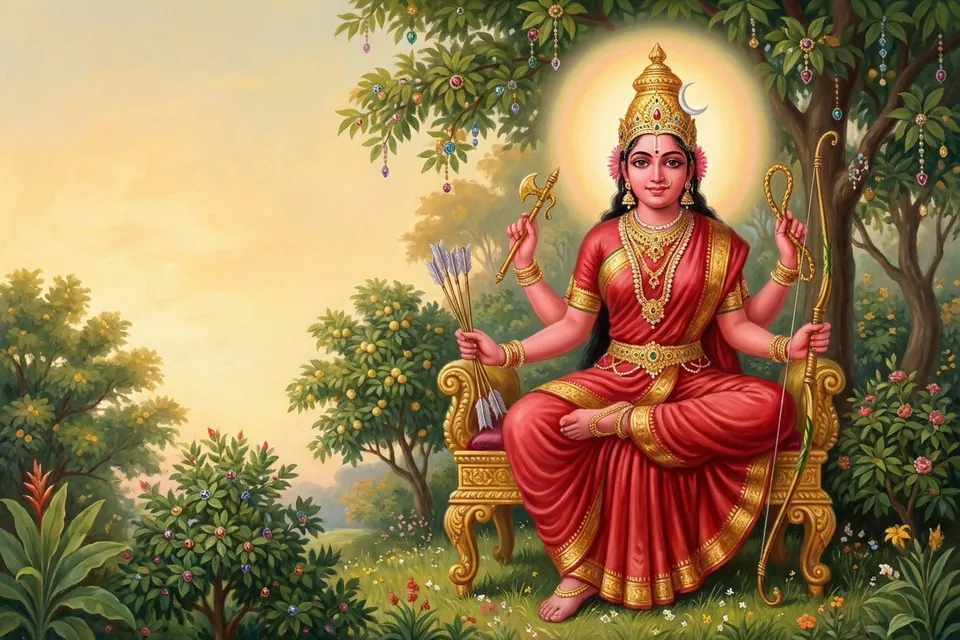
Lalita Sahasranama is a Sanskrit stotra of one thousand names of Maa Durga as Sri Lalita Tripura Sundari, from the Brahmanda Purana.
Recited on: Navratri, Friday puja, Purnima, Lalita Panchami, Sri Chakra puja, Kumkum archana, Daily puja
- Shloka 1
सिन्धूरारुण विग्रहां त्रिणयनां माणिक्य मौलिस्फुर-त्तारानायक शेखरां स्मितमुखी मापीन वक्षोरुहाम् । पाणिभ्यामलिपूर्ण रत्न चषकं रक्तोत्पलं बिभ्रतीं सौम्यां रत्नघटस्थ रक्त चरणां ध्यायेत्परामम्बिकाम् ॥
Sindhuraruna vigraham trinayanam manikya maulisphura-ttaranayaka shekharam smitamukhi mapina vakshoruham, panibhyamalipurna ratna chashakam raktotpalam bibhratim saumyam ratnaghatastha rakta charanam dhyayetparamambikam.
Meditate on the supreme Mother Ambika, red like sindoor, with three eyes and a ruby crown on which the moon shines. She smiles, her bosom is full, and in her hands she holds a jewelled cup filled with honey and a red lotus. She is gentle, and her red feet rest on a jewelled pot.
- Shloka 2
अरुणां करुणातरङ्गिताक्षीं धृतपाशाङ्कुशपुष्पबाणचापाम् । अणिमादिभिरावृतां मयूखैरहमित्येव विभावये भवानीम् ॥
Arunam karunatarangitakshim dhritapashankushapushpabanachapam, animadibhiravritam mayukhairahamityeva vibhavaye bhavanim.
I meditate on Bhavani as my very own Self. She is rosy red, her eyes ripple with waves of compassion, and she holds the noose, the goad, the flower arrows and the bow. She is surrounded by rays that are the powers such as Anima.
- Shloka 3
ध्यायेत्पद्मासनस्थां विकसितवदनां पद्मपत्रायताक्षीं हेमाभां पीतवस्त्रां करकलितलसद्धेमपद्मां वराङ्गीम् । सर्वालङ्कारयुक्तां सततमभयदां भक्तनम्रां भवानीं श्रीविद्यां शान्तमूर्तिं सकलसुरनुतां सर्वसम्पत्प्रदात्रीम् ॥
Dhyayetpadmasanastham vikasitavadanam padmapatrayatakshim hemabham pitavastram karakalitalasaddhemapadmam varangim, sarvalankarayuktam satatamabhayadam bhaktanamram bhavanim shrividyam shantamurtim sakalasuranutam sarvasampatpradatrim.
One should meditate on Bhavani, seated on a lotus, her face blooming, her eyes long like lotus petals, golden in colour and dressed in yellow, holding a shining golden lotus. She is graceful, wears every ornament, always grants fearlessness, and bends lovingly toward her devotees. She is Shri Vidya, peaceful in form, praised by all the devas, and giver of all wealth.
- Shloka 4
सकुङ्कुमविलेपनामलिकचुम्बिकस्तूरिकां समन्दहसितेक्षणां सशरचापपाशाङ्कुशाम् । अशेषजनमोहिनीमरुणमाल्यभूषाम्बरां जपाकुसुमभासुरां जपविधौ स्मरेदम्बिकाम् ॥
Sakunkumavilepanamalikachumbikasturikam samandahasitekshanam sasharachapapashankusham, asheshajanamohinimarunamalyabhushambaram japakusumabhasuram japavidhau smaredambikam.
During japa, one should remember Ambika. She is anointed with kumkum, with a musk mark on her forehead. Her eyes hold a gentle smile, and she bears arrows, bow, noose and goad. She enchants all beings, wears red garlands, ornaments and garments, and glows like the red hibiscus flower.
- Shloka 5
श्री माता, श्री महाराज्ञी, श्रीमत्-सिंहासनेश्वरी । चिदग्नि कुण्डसम्भूता, देवकार्यसमुद्यता ॥ 1 ॥
Shri mata, shri maharagyi, shrimat-sinhasaneshvari, chidagni kundasambhuta, devakaryasamudyata.
She is the auspicious Mother, the great Queen, ruler of the glorious lion throne. She arose from the fire altar of pure consciousness and is ready to fulfil the work of the devas.
- Shloka 6
उद्यद्भानु सहस्राभा, चतुर्बाहु समन्विता । रागस्वरूप पाशाढ्या, क्रोधाकाराङ्कुशोज्ज्वला ॥ 2 ॥
Udyadbhanu sahasrabha, chaturbahu samanvita, ragasvarupa pashadhya, krodhakarankushojjvala.
She shines like a thousand rising suns and has four arms. She holds a noose that is desire itself and a bright goad that is the form of anger.
- Shloka 7
मनोरूपेक्षुकोदण्डा, पञ्चतन्मात्र सायका । निजारुण प्रभापूर मज्जद्-ब्रह्माण्डमण्डला ॥ 3 ॥
Manorupekshukodanda, panchatanmatra sayaka, nijaruna prabhapura majjad-brahmandamandala.
Her sugarcane bow is the mind and her arrows are the five subtle elements. The flood of her red radiance bathes the whole universe.
- Shloka 8
चम्पकाशोक पुन्नाग सौगन्धिक लसत्कचा । कुरुविन्द मणिश्रेणी कनत्कोटीर मण्डिता ॥ 4 ॥
Champakashoka punnaga saugandhika lasatkacha, kuruvinda manishreni kanatkotira mandita.
Her hair glows with champaka, ashoka, punnaga and saugandhika flowers. Her crown sparkles with rows of kuruvinda rubies.
- Shloka 9
अष्टमी चन्द्र विभ्राज दलिकस्थल शोभिता । मुखचन्द्र कलङ्काभ मृगनाभि विशेषका ॥ 5 ॥
Ashtami chandra vibhraja dalikasthala shobhita, mukhachandra kalankabha mriganabhi visheshaka.
Her forehead shines like the half moon of the eighth lunar day. The musk tilak on her moon-like face looks like the mark on the moon.
- Shloka 10
वदनस्मर माङ्गल्य गृहतोरण चिल्लिका । वक्त्रलक्ष्मी परीवाह चलन्मीनाभ लोचना ॥ 6 ॥
Vadanasmara mangalya grihatorana chillika, vaktralakshmi parivaha chalanminabha lochana.
Her eyebrows are like arches over the gate of Kama's auspicious home, which is her face. Her eyes move like fish in the stream of beauty flowing from her face.
- Shloka 11
नवचम्पक पुष्पाभ नासादण्ड विराजिता । ताराकान्ति तिरस्कारि नासाभरण भासुरा ॥ 7 ॥
Navachampaka pushpabha nasadanda virajita, tarakanti tiraskari nasabharana bhasura.
Her nose is lovely like a fresh champaka bud. Her nose ornament shines brighter than the stars.
- Shloka 12
कदम्ब मञ्जरीक्लुप्त कर्णपूर मनोहरा । ताटङ्क युगलीभूत तपनोडुप मण्डला ॥ 8 ॥
Kadamba manjariklupta karnapura manohara, tatanka yugalibhuta tapanodupa mandala.
She is charming with ear ornaments made of kadamba flower clusters. The sun and the moon are her pair of earrings.
- Shloka 13
पद्मराग शिलादर्श परिभावि कपोलभूः । नवविद्रुम बिम्बश्रीः न्यक्कारि रदनच्छदा ॥ 9 ॥
Padmaraga shiladarsha paribhavi kapolabhuh, navavidruma bimbashrih nyakkari radanachchhada.
Her cheeks outshine mirrors of ruby. Her lips surpass fresh coral and the bimba fruit in beauty.
- Shloka 14
शुद्ध विद्याङ्कुराकार द्विजपङ्क्ति द्वयोज्ज्वला । कर्पूरवीटि कामोद समाकर्षद्दिगन्तरा ॥ 10 ॥
Shuddha vidyankurakara dvijapankti dvayojjvala, karpuraviti kamoda samakarshaddigantara.
Her two rows of teeth shine like sprouts of pure knowledge. The fragrance of the camphor betel she chews draws in all directions.
- Shloka 15
निजसल्लाप माधुर्य विनिर्भर्-त्सित कच्छपी । मन्दस्मित प्रभापूर मज्जत्-कामेश मानसा ॥ 11 ॥
Nijasallapa madhurya vinirbhar-tsita kachchhapi, mandasmita prabhapura majjat-kamesha manasa.
The sweetness of her speech surpasses the sound of the kacchapi veena. The mind of Kamesha, Bhagwan Shiva, is immersed in the light of her gentle smile.
- Shloka 16
अनाकलित सादृश्य चुबुक श्री विराजिता । कामेशबद्ध माङ्गल्य सूत्रशोभित कन्थरा ॥ 12 ॥
Anakalita sadrishya chubuka shri virajita, kameshabaddha mangalya sutrashobhita kanthara.
Her chin has a beauty beyond any comparison. Her neck is adorned with the mangalsutra tied by Kamesha.
- Shloka 17
कनकाङ्गद केयूर कमनीय भुजान्विता । रत्नग्रैवेय चिन्ताक लोलमुक्ता फलान्विता ॥ 13 ॥
Kanakangada keyura kamaniya bhujanvita, ratnagraiveya chintaka lolamukta phalanvita.
Her lovely arms wear golden armlets. She wears a jewelled necklace with a swaying pearl pendant.
- Shloka 18
कामेश्वर प्रेमरत्न मणि प्रतिपणस्तनी । नाभ्यालवाल रोमालि लताफल कुचद्वयी ॥ 14 ॥
Kameshvara premaratna mani pratipanastani, nabhyalavala romali lataphala kuchadvayi.
Her bosom is what she gives in return for Kameshvara's precious jewel of love. Her breasts are like fruits on the fine line of hair rising from her navel like a vine from its basin.
- Shloka 19
लक्ष्यरोमलता धारता समुन्नेय मध्यमा । स्तनभार दलन्-मध्य पट्टबन्ध वलित्रया ॥ 15 ॥
Lakshyaromalata dharata samunneya madhyama, stanabhara dalan-madhya pattabandha valitraya.
Her waist is so slender that it can only be guessed from that fine line of hair. Three folds at her waist look like a band supporting it.
- Shloka 20
अरुणारुण कौसुम्भ वस्त्र भास्वत्-कटीतटी । रत्नकिङ्किणि कारम्य रशनादाम भूषिता ॥ 16 ॥
Arunaruna kausumbha vastra bhasvat-katitati, ratnakinkini karamya rashanadama bhushita.
Her hips shine in a cloth of deep red safflower colour. She is adorned with a girdle of jewelled little bells.
- Shloka 21
कामेश ज्ञात सौभाग्य मार्दवोरु द्वयान्विता । माणिक्य मकुटाकार जानुद्वय विराजिता ॥ 17 ॥
Kamesha gyata saubhagya mardavoru dvayanvita, manikya makutakara janudvaya virajita.
The soft beauty of her thighs is known only to Kamesha. Her knees shine like crowns of ruby.
- Shloka 22
इन्द्रगोप परिक्षिप्त स्मर तूणाभ जङ्घिका । गूढगुल्भा कूर्मपृष्ठ जयिष्णु प्रपदान्विता ॥ 18 ॥
Indragopa parikshipta smara tunabha janghika, gudhagulbha kurmaprishtha jayishnu prapadanvita.
Her calves look like Kama's quivers, ringed with red indragopa insects. Her ankles are rounded and hidden, and the arches of her feet surpass a tortoise's back in grace.
- Shloka 23
नखदीधिति संछन्न नमज्जन तमोगुणा । पदद्वय प्रभाजाल पराकृत सरोरुहा ॥ 19 ॥
Nakhadidhiti sanchhanna namajjana tamoguna, padadvaya prabhajala parakrita saroruha.
The light of her toenails removes the darkness of those who bow to her. The radiance of her two feet outshines lotuses.
- Shloka 24
शिञ्जान मणिमञ्जीर मण्डित श्री पदाम्बुजा । मराली मन्दगमना, महालावण्य शेवधिः ॥ 20 ॥
Shinjana manimanjira mandita shri padambuja, marali mandagamana, mahalavanya shevadhih.
Her lotus feet are adorned with tinkling jewelled anklets. She walks slowly like a swan and is a treasure of great beauty.
- Shloka 25
सर्वारुणाऽनवद्याङ्गी सर्वाभरण भूषिता । शिवकामेश्वराङ्कस्था, शिवा, स्वाधीन वल्लभा ॥ 21 ॥
Sarvarunanavadyangi sarvabharana bhushita, shivakameshvarankastha, shiva, svadhina vallabha.
She is red all over, flawless in every limb and adorned with every ornament. She sits on the lap of Shiva Kameshvara; she is Shiva, the auspicious one, and her beloved is devoted to her.
- Shloka 26
सुमेरु मध्यशृङ्गस्था, श्रीमन्नगर नायिका । चिन्तामणि गृहान्तस्था, पञ्चब्रह्मासनस्थिता ॥ 22 ॥
Sumeru madhyashringastha, shrimannagara nayika, chintamani grihantastha, panchabrahmasanasthita.
She dwells on the middle peak of Mount Sumeru and is the queen of the glorious city. She lives in a palace of chintamani gems and sits on a throne formed by the five Brahmas.
- Shloka 27
महापद्माटवी संस्था, कदम्ब वनवासिनी । सुधासागर मध्यस्था, कामाक्षी कामदायिनी ॥ 23 ॥
Mahapadmatavi sanstha, kadamba vanavasini, sudhasagara madhyastha, kamakshi kamadayini.
She lives in a great forest of lotuses and in a kadamba grove, in the middle of an ocean of nectar. She is Kamakshi, and she grants wishes.
- Shloka 28
देवर्षि गणसङ्घात स्तूयमानात्म वैभवा । भण्डासुर वधोद्युक्त शक्तिसेना समन्विता ॥ 24 ॥
Devarshi ganasanghata stuyamanatma vaibhava, bhandasura vadhodyukta shaktisena samanvita.
Hosts of devas and rishis praise her glory. She is accompanied by an army of shaktis ready to slay Bhandasura.
- Shloka 29
सम्पत्करी समारूढ सिन्धुर व्रजसेविता । अश्वारूढाधिष्ठिताश्व कोटिकोटि भिरावृता ॥ 25 ॥
Sampatkari samarudha sindhura vrajasevita, ashvarudhadhishthitashva kotikoti bhiravrita.
She is served by herds of elephants led by the shakti Sampatkari. She is surrounded by countless horses led by the shakti Ashvarudha.
- Shloka 30
चक्रराज रथारूढ सर्वायुध परिष्कृता । गेयचक्र रथारूढ मन्त्रिणी परिसेविता ॥ 26 ॥
Chakraraja ratharudha sarvayudha parishkrita, geyachakra ratharudha mantrini parisevita.
She rides the chariot Chakraraja, equipped with every weapon. Mantrini, riding the chariot Geyachakra, attends on her.
- Shloka 31
किरिचक्र रथारूढ दण्डनाथा पुरस्कृता । ज्वालामालिनि काक्षिप्त वह्निप्राकार मध्यगा ॥ 27 ॥
Kirichakra ratharudha dandanatha puraskrita, jvalamalini kakshipta vahniprakara madhyaga.
Dandanatha, riding the chariot Kirichakra, goes before her in honour. She stands within the wall of fire raised by Jvalamalini.
- Shloka 32
भण्डसैन्य वधोद्युक्त शक्ति विक्रमहर्षिता । नित्या पराक्रमाटोप निरीक्षण समुत्सुका ॥ 28 ॥
Bhandasainya vadhodyukta shakti vikramaharshita, nitya parakramatopa nirikshana samutsuka.
She rejoices at the valour of the shaktis who strike Bhanda's army. She is eager to watch the might of the Nitya goddesses.
- Shloka 33
भण्डपुत्र वधोद्युक्त बालाविक्रम नन्दिता । मन्त्रिण्यम्बा विरचित विषङ्ग वधतोषिता ॥ 29 ॥
Bhandaputra vadhodyukta balavikrama nandita, mantrinyamba virachita vishanga vadhatoshita.
She is delighted by the valour of Bala in slaying the sons of Bhanda. She is pleased when Mantrini Amba slays Vishanga.
- Shloka 34
विशुक्र प्राणहरण वाराही वीर्यनन्दिता । कामेश्वर मुखालोक कल्पित श्री गणेश्वरा ॥ 30 ॥
Vishukra pranaharana varahi viryanandita, kameshvara mukhaloka kalpita shri ganeshvara.
She is pleased by Varahi's might in ending Vishukra's life. By a glance at Kameshvara's face she brings forth Sri Ganesha.
- Shloka 35
महागणेश निर्भिन्न विघ्नयन्त्र प्रहर्षिता । भण्डासुरेन्द्र निर्मुक्त शस्त्र प्रत्यस्त्र वर्षिणी ॥ 31 ॥
Mahaganesha nirbhinna vighnayantra praharshita, bhandasurendra nirmukta shastra pratyastra varshini.
She rejoices when Mahaganesha shatters the yantra of obstacles. She answers every weapon Bhandasura sends with a shower of counter weapons.
- Shloka 36
कराङ्गुलि नखोत्पन्न नारायण दशाकृतिः । महापाशुपतास्त्राग्नि निर्दग्धासुर सैनिका ॥ 32 ॥
Karanguli nakhotpanna narayana dashakritih, mahapashupatastragni nirdagdhasura sainika.
From the nails of her fingers arose the ten forms of Narayana. With the fire of the Mahapashupata weapon she burns the asura soldiers.
- Shloka 37
कामेश्वरास्त्र निर्दग्ध सभण्डासुर शून्यका । ब्रह्मोपेन्द्र महेन्द्रादि देवसंस्तुत वैभवा ॥ 33 ॥
Kameshvarastra nirdagdha sabhandasura shunyaka, brahmopendra mahendradi devasanstuta vaibhava.
With the Kameshvara weapon she burns Bhandasura along with his city Shunyaka. Brahma, Vishnu, Indra and the other devas praise her glory.
- Shloka 38
हरनेत्राग्नि सन्दग्ध काम सञ्जीवनौषधिः । श्रीमद्वाग्भव कूटैक स्वरूप मुखपङ्कजा ॥ 34 ॥
Haranetragni sandagdha kama sanjivanaushadhih, shrimadvagbhava kutaika svarupa mukhapankaja.
She is the life-giving herb that revived Kama after he was burnt by the fire of Bhagwan Shiva's eye. Her lotus face is the Vagbhava section of her sacred mantra.
- Shloka 39
कण्ठाधः कटिपर्यन्त मध्यकूट स्वरूपिणी । शक्तिकूटैकतापन्न कट्यथोभाग धारिणी ॥ 35 ॥
Kanthadhah katiparyanta madhyakuta svarupini, shaktikutaikatapanna katyathobhaga dharini.
From her neck to her waist she is the middle section of the mantra. Below her waist she is the Shakti section.
- Shloka 40
मूलमन्त्रात्मिका, मूलकूट त्रय कलेबरा । कुलामृतैक रसिका, कुलसङ्केत पालिनी ॥ 36 ॥
Mulamantratmika, mulakuta traya kalebara, kulamritaika rasika, kulasanketa palini.
She is the root mantra itself, and her body is its three sections. She delights in the nectar of the Kula path and guards its hidden teachings.
- Shloka 41
कुलाङ्गना, कुलान्तःस्था, कौलिनी, कुलयोगिनी । अकुला, समयान्तःस्था, समयाचार तत्परा ॥ 37 ॥
Kulangana, kulantahstha, kaulini, kulayogini, akula, samayantahstha, samayachara tatpara.
She is the noble lady of the Kula, dwelling within it, Kaulini and Kulayogini. She is also beyond the Kula, dwells within the Samaya path and is devoted to its practice.
- Shloka 42
मूलाधारैक निलया, ब्रह्मग्रन्थि विभेदिनी । मणिपूरान्तरुदिता, विष्णुग्रन्थि विभेदिनी ॥ 38 ॥
Muladharaika nilaya, brahmagranthi vibhedini, manipurantarudita, vishnugranthi vibhedini.
Her dwelling is the Muladhara, and she pierces the knot of Brahma. She rises at the Manipura and pierces the knot of Vishnu.
- Shloka 43
आज्ञा चक्रान्तरालस्था, रुद्रग्रन्थि विभेदिनी । सहस्राराम्बुजा रूढा, सुधासाराभि वर्षिणी ॥ 39 ॥
Aagya chakrantaralastha, rudragranthi vibhedini, sahasrarambuja rudha, sudhasarabhi varshini.
She dwells within the Ajna chakra and pierces the knot of Rudra. She rises to the thousand-petalled lotus and showers streams of nectar.
- Shloka 44
तटिल्लता समरुचिः, षट्-चक्रोपरि संस्थिता । महाशक्तिः, कुण्डलिनी, बिसतन्तु तनीयसी ॥ 40 ॥
Tatillata samaruchih, shat-chakropari sansthita, mahashaktih, kundalini, bisatantu taniyasi.
Her radiance is like a flash of lightning, and she dwells above the six chakras. She is Mahashakti, the Kundalini, slender and delicate like a fibre of the lotus stalk.
- Shloka 45
भवानी, भावनागम्या, भवारण्य कुठारिका । भद्रप्रिया, भद्रमूर्तिर्भक्तसौभाग्य दायिनी ॥ 41 ॥
Bhavani, bhavanagamya, bhavaranya kutharika, bhadrapriya, bhadramurtirbhaktasaubhagya dayini.
She is Bhavani, reached through inner contemplation, an axe that clears the forest of worldly life. She loves what is good, is goodness in form and gives good fortune to her devotees.
- Shloka 46
भक्तिप्रिया, भक्तिगम्या, भक्तिवश्या, भयापहा । शाम्भवी, शारदाराध्या, शर्वाणी, शर्मदायिनी ॥ 42 ॥
Bhaktipriya, bhaktigamya, bhaktivashya, bhayapaha, shambhavi, sharadaradhya, sharvani, sharmadayini.
She loves devotion, is reached through devotion, is won over by devotion and removes fear. She is Shambhavi, worshipped by Sharada, Sharvani, and the giver of peace and happiness.
- Shloka 47
शाङ्करी, श्रीकरी, साध्वी, शरच्चन्द्रनिभानना । शातोदरी, शान्तिमती, निराधारा, निरञ्जना ॥ 43 ॥
Shankari, shrikari, sadhvi, sharachchandranibhanana, shatodari, shantimati, niradhara, niranjana.
She is Shankari, the giver of prosperity, the virtuous one, with a face like the autumn moon. She is slender-waisted, peaceful, needs no support and is free of all stain.
- Shloka 48
निर्लेपा, निर्मला, नित्या, निराकारा, निराकुला । निर्गुणा, निष्कला, शान्ता, निष्कामा, निरुपप्लवा ॥ 44 ॥
Nirlepa, nirmala, nitya, nirakara, nirakula, nirguna, nishkala, shanta, nishkama, nirupaplava.
She is untouched, pure, eternal, formless and untroubled. She is beyond the gunas, without parts, calm, free of desire and beyond all disturbance.
- Shloka 49
नित्यमुक्ता, निर्विकारा, निष्प्रपञ्चा, निराश्रया । नित्यशुद्धा, नित्यबुद्धा, निरवद्या, निरन्तरा ॥ 45 ॥
Nityamukta, nirvikara, nishprapancha, nirashraya, nityashuddha, nityabuddha, niravadya, nirantara.
She is ever free, unchanging, beyond the visible world and dependent on nothing. She is ever pure, ever awake, faultless and present everywhere without break.
- Shloka 50
निष्कारणा, निष्कलङ्का, निरुपाधिर्निरीश्वरा । नीरागा, रागमथनी, निर्मदा, मदनाशिनी ॥ 46 ॥
Nishkarana, nishkalanka, nirupadhirnirishvara, niraga, ragamathani, nirmada, madanashini.
She has no cause, no blemish, no limiting conditions and no one above her. She is free of attachment and removes it, free of pride and destroys it.
- Shloka 51
निश्चिन्ता, निरहङ्कारा, निर्मोहा, मोहनाशिनी । निर्ममा, ममताहन्त्री, निष्पापा, पापनाशिनी ॥ 47 ॥
Nishchinta, nirahankara, nirmoha, mohanashini, nirmama, mamatahantri, nishpapa, papanashini.
She is free of worry, ego and delusion, and she ends delusion. She has no sense of 'mine' and removes it in others; she is sinless and destroys sin.
- Shloka 52
निष्क्रोधा, क्रोधशमनी, निर्लोभा, लोभनाशिनी । निःसंशया, संशयघ्नी, निर्भवा, भवनाशिनी ॥ 48 ॥
Nishkrodha, krodhashamani, nirlobha, lobhanashini, nihsanshaya, sanshayaghni, nirbhava, bhavanashini.
She is free of anger and calms it, free of greed and removes it. She is free of doubt and ends it, beyond birth and ends the cycle of worldly existence.
- Shloka 53
निर्विकल्पा, निराबाधा, निर्भेदा, भेदनाशिनी । निर्नाशा, मृत्युमथनी, निष्क्रिया, निष्परिग्रहा ॥ 49 ॥
Nirvikalpa, nirabadha, nirbheda, bhedanashini, nirnasha, mrityumathani, nishkriya, nishparigraha.
She is beyond mental wavering, unobstructed and without division, and she removes the sense of separation. She is imperishable, overcomes death, is beyond action and owns nothing.
- Shloka 54
निस्तुला, नीलचिकुरा, निरपाया, निरत्यया । दुर्लभा, दुर्गमा, दुर्गा, दुःखहन्त्री, सुखप्रदा ॥ 50 ॥
Nistula, nilachikura, nirapaya, niratyaya, durlabha, durgama, durga, duhkhahantri, sukhaprada.
She is beyond compare, with dark hair, free of decay and beyond all limits. She is hard to attain and hard to reach; she is Durga, who ends sorrow and gives happiness.
- Shloka 55
दुष्टदूरा, दुराचार शमनी, दोषवर्जिता । सर्वज्ञा, सान्द्रकरुणा, समानाधिकवर्जिता ॥ 51 ॥
Dushtadura, durachara shamani, doshavarjita, sarvagya, sandrakaruna, samanadhikavarjita.
She stays far from the wicked, calms wrong conduct and is free of every fault. She knows all, her compassion is deep, and none is equal to or greater than her.
- Shloka 56
सर्वशक्तिमयी, सर्वमङ्गला, सद्गतिप्रदा । सर्वेश्वरी, सर्वमयी, सर्वमन्त्र स्वरूपिणी ॥ 52 ॥
Sarvashaktimayi, sarvamangala, sadgatiprada, sarveshvari, sarvamayi, sarvamantra svarupini.
She holds all powers, is all auspiciousness and gives the good path. She is ruler of all, present in all and the form of every mantra.
- Shloka 57
सर्वयन्त्रात्मिका, सर्वतन्त्ररूपा, मनोन्मनी । माहेश्वरी, महादेवी, महालक्ष्मीर्मृडप्रिया ॥ 53 ॥
Sarvayantratmika, sarvatantrarupa, manonmani, maheshvari, mahadevi, mahalakshmirmridapriya.
She is the soul of every yantra and the form of every tantra, and she is Manonmani, beyond the mind. She is Maheshvari, Mahadevi, Mahalakshmi and the beloved of Mrida, Bhagwan Shiva.
- Shloka 58
महारूपा, महापूज्या, महापातक नाशिनी । महामाया, महासत्त्वा, महाशक्तिर्महारतिः ॥ 54 ॥
Maharupa, mahapujya, mahapataka nashini, mahamaya, mahasattva, mahashaktirmaharatih.
Her form is vast and she is worthy of the highest worship; she removes even the gravest sins. She is Mahamaya, great in purity, the great Shakti and great delight.
- Shloka 59
महाभोगा, महैश्वर्या, महावीर्या, महाबला । महाबुद्धिर्महासिद्धिर्महायोगेश्वरेश्वरी ॥ 55 ॥
Mahabhoga, mahaishvarya, mahavirya, mahabala, mahabuddhirmahasiddhirmahayogeshvareshvari.
Great is her enjoyment, sovereignty, valour and strength. She is great wisdom and great attainment, the ruler over the greatest masters of yoga.
- Shloka 60
महातन्त्रा, महामन्त्रा, महायन्त्रा, महासना । महायाग क्रमाराध्या, महाभैरव पूजिता ॥ 56 ॥
Mahatantra, mahamantra, mahayantra, mahasana, mahayaga kramaradhya, mahabhairava pujita.
She is the great tantra, mantra, yantra and seat of worship. She is worshipped through the great sacrificial rite and is worshipped by Mahabhairava.
- Shloka 61
महेश्वर महाकल्प महाताण्डव साक्षिणी । महाकामेश महिषी, महात्रिपुर सुन्दरी ॥ 57 ॥
Maheshvara mahakalpa mahatandava sakshini, mahakamesha mahishi, mahatripura sundari.
She witnesses Maheshvara's great tandava dance at the end of the great age. She is the queen of Mahakamesha, the great Tripura Sundari.
- Shloka 62
चतुःषष्ट्युपचाराढ्या, चतुष्षष्टि कलामयी । महा चतुष्षष्टि कोटि योगिनी गणसेविता ॥ 58 ॥
Chatuhshashtyupacharadhya, chatushshashti kalamayi, maha chatushshashti koti yogini ganasevita.
She is honoured with the sixty-four offerings of worship and embodies the sixty-four arts. She is served by sixty-four crore hosts of yoginis.
- Shloka 63
मनुविद्या, चन्द्रविद्या, चन्द्रमण्डलमध्यगा । चारुरूपा, चारुहासा, चारुचन्द्र कलाधरा ॥ 59 ॥
Manuvidya, chandravidya, chandramandalamadhyaga, charurupa, charuhasa, charuchandra kaladhara.
She is Manuvidya and Chandravidya and dwells in the centre of the moon's orb. Her form is lovely, her smile is lovely, and she wears a lovely crescent moon.
- Shloka 64
चराचर जगन्नाथा, चक्रराज निकेतना । पार्वती, पद्मनयना, पद्मराग समप्रभा ॥ 60 ॥
Charachara jagannatha, chakraraja niketana, parvati, padmanayana, padmaraga samaprabha.
She rules all moving and unmoving things, and the Sri Chakra is her home. She is Parvati, lotus-eyed, glowing like a ruby.
- Shloka 65
पञ्चप्रेतासनासीना, पञ्चब्रह्म स्वरूपिणी । चिन्मयी, परमानन्दा, विज्ञान घनरूपिणी ॥ 61 ॥
Panchapretasanasina, panchabrahma svarupini, chinmayi, paramananda, vigyana ghanarupini.
She sits on a seat formed by five still forms and is herself the five Brahmas. She is pure consciousness, supreme bliss and wisdom in its fullest form.
- Shloka 66
ध्यानध्यातृ ध्येयरूपा, धर्माधर्म विवर्जिता । विश्वरूपा, जागरिणी, स्वपन्ती, तैजसात्मिका ॥ 62 ॥
Dhyanadhyatri dhyeyarupa, dharmadharma vivarjita, vishvarupa, jagarini, svapanti, taijasatmika.
She is meditation, the one who meditates and the one meditated upon, beyond dharma and adharma. She is the cosmic form in the waking state, the one who wakes, the one who dreams and the luminous dream self.
- Shloka 67
सुप्ता, प्राज्ञात्मिका, तुर्या, सर्वावस्था विवर्जिता । सृष्टिकर्त्री, ब्रह्मरूपा, गोप्त्री, गोविन्दरूपिणी ॥ 63 ॥
Supta, pragyatmika, turya, sarvavastha vivarjita, srishtikartri, brahmarupa, goptri, govindarupini.
She is deep sleep and its knowing self, the fourth state, and beyond all states. She creates as Brahma and protects as Govinda.
- Shloka 68
संहारिणी, रुद्ररूपा, तिरोधानकरीश्वरी । सदाशिवानुग्रहदा, पञ्चकृत्य परायणा ॥ 64 ॥
Sanharini, rudrarupa, tirodhanakarishvari, sadashivanugrahada, panchakritya parayana.
She dissolves as Rudra and is the Ishvari who veils all things. As Sadashiva she grants grace, and she is devoted to the five divine acts.
- Shloka 69
भानुमण्डल मध्यस्था, भैरवी, भगमालिनी । पद्मासना, भगवती, पद्मनाभ सहोदरी ॥ 65 ॥
Bhanumandala madhyastha, bhairavi, bhagamalini, padmasana, bhagavati, padmanabha sahodari.
She dwells in the centre of the sun's orb; she is Bhairavi and Bhagamalini. She is seated on a lotus, she is Bhagavati, and she is the sister of Padmanabha, Bhagwan Vishnu.
- Shloka 70
उन्मेष निमिषोत्पन्न विपन्न भुवनावलिः । सहस्रशीर्षवदना, सहस्राक्षी, सहस्रपात् ॥ 66 ॥
Unmesha nimishotpanna vipanna bhuvanavalih, sahasrashirshavadana, sahasrakshi, sahasrapat.
Worlds arise and dissolve as she opens and closes her eyes. She has a thousand heads and faces, a thousand eyes and a thousand feet.
- Shloka 71
आब्रह्म कीटजननी, वर्णाश्रम विधायिनी । निजाज्ञारूपनिगमा, पुण्यापुण्य फलप्रदा ॥ 67 ॥
Aabrahma kitajanani, varnashrama vidhayini, nijagyarupanigama, punyapunya phalaprada.
She is mother of all, from Brahma down to the smallest insect, and she set the order of varna and ashrama. The Vedas are her own command, and she gives the fruits of good and bad deeds.
- Shloka 72
श्रुति सीमन्त सिन्धूरीकृत पादाब्जधूलिका । सकलागम सन्दोह शुक्तिसम्पुट मौक्तिका ॥ 68 ॥
Shruti simanta sindhurikrita padabjadhulika, sakalagama sandoha shuktisamputa mauktika.
The dust of her lotus feet is the sindoor in the hair parting of the Vedas. She is the pearl held within the shell formed by all the Agamas.
- Shloka 73
पुरुषार्थप्रदा, पूर्णा, भोगिनी, भुवनेश्वरी । अम्बिकाऽनादि निधना, हरिब्रह्मेन्द्र सेविता ॥ 69 ॥
Purusharthaprada, purna, bhogini, bhuvaneshvari, ambikanadi nidhana, haribrahmendra sevita.
She grants the four aims of life; she is whole, the enjoyer and ruler of the worlds. She is Ambika, without beginning or end, served by Hari, Brahma and Indra.
- Shloka 74
नारायणी, नादरूपा, नामरूप विवर्जिता । ह्रीङ्कारी, ह्रीमती, हृद्या, हेयोपादेय वर्जिता ॥ 70 ॥
Narayani, nadarupa, namarupa vivarjita, hrinkari, hrimati, hridya, heyopadeya varjita.
She is Narayani, the form of sacred sound, beyond name and form. She is Hrinkari and Hrimati, dear to the heart, beyond what is to be rejected or accepted.
- Shloka 75
राजराजार्चिता, राज्ञी, रम्या, राजीवलोचना । रञ्जनी, रमणी, रस्या, रणत्किङ्किणि मेखला ॥ 71 ॥
Rajarajarchita, ragyi, ramya, rajivalochana, ranjani, ramani, rasya, ranatkinkini mekhala.
She is worshipped by the king of kings, she is the queen, lovely and lotus-eyed. She delights all, is charming and full of sweetness, and wears a girdle of tinkling bells.
- Shloka 76
रमा, राकेन्दुवदना, रतिरूपा, रतिप्रिया । रक्षाकरी, राक्षसघ्नी, रामा, रमणलम्पटा ॥ 72 ॥
Rama, rakenduvadana, ratirupa, ratipriya, rakshakari, rakshasaghni, rama, ramanalampata.
She is Rama, with a face like the full moon, the form of Rati and fond of Rati. She protects, destroys the rakshasas, is the delightful one and delights in her beloved.
- Shloka 77
काम्या, कामकलारूपा, कदम्ब कुसुमप्रिया । कल्याणी, जगतीकन्दा, करुणारस सागरा ॥ 73 ॥
Kamya, kamakalarupa, kadamba kusumapriya, kalyani, jagatikanda, karunarasa sagara.
She is longed for by all and is the form of Kamakala, fond of kadamba flowers. She is Kalyani, the root of the world and an ocean of compassion.
- Shloka 78
कलावती, कलालापा, कान्ता, कादम्बरीप्रिया । वरदा, वामनयना, वारुणीमदविह्वला ॥ 74 ॥
Kalavati, kalalapa, kanta, kadambaripriya, varada, vamanayana, varunimadavihvala.
She is full of the arts, sweet in speech, beloved and fond of kadambari nectar. She grants boons, has beautiful eyes and is absorbed in divine rapture.
- Shloka 79
विश्वाधिका, वेदवेद्या, विन्ध्याचल निवासिनी । विधात्री, वेदजननी, विष्णुमाया, विलासिनी ॥ 75 ॥
Vishvadhika, vedavedya, vindhyachala nivasini, vidhatri, vedajanani, vishnumaya, vilasini.
She is beyond the universe and is known through the Vedas; she dwells on the Vindhya mountain. She upholds all, is the mother of the Vedas, Vishnumaya and the playful one.
- Shloka 80
क्षेत्रस्वरूपा, क्षेत्रेशी, क्षेत्र क्षेत्रज्ञ पालिनी । क्षयवृद्धि विनिर्मुक्ता, क्षेत्रपाल समर्चिता ॥ 76 ॥
Kshetrasvarupa, kshetreshi, kshetra kshetragya palini, kshayavriddhi vinirmukta, kshetrapala samarchita.
She is the field, which is the body, and its ruler, and she protects both the field and its knower. She is free of decline and growth and is worshipped by Kshetrapala.
- Shloka 81
विजया, विमला, वन्द्या, वन्दारु जनवत्सला । वाग्वादिनी, वामकेशी, वह्निमण्डल वासिनी ॥ 77 ॥
Vijaya, vimala, vandya, vandaru janavatsala, vagvadini, vamakeshi, vahnimandala vasini.
She is Vijaya and Vimala, worthy of worship and loving to those who bow to her. She is the goddess of speech, Vamakeshi, dwelling in the orb of fire.
- Shloka 82
भक्तिमत्-कल्पलतिका, पशुपाश विमोचनी । संहृताशेष पाषण्डा, सदाचार प्रवर्तिका ॥ 78 ॥
Bhaktimat-kalpalatika, pashupasha vimochani, sanhritashesha pashanda, sadachara pravartika.
She is a wish-fulfilling vine for her devotees and frees beings from their bonds. She removes all false paths and sets good conduct in motion.
- Shloka 83
तापत्रयाग्नि सन्तप्त समाह्लादन चन्द्रिका । तरुणी, तापसाराध्या, तनुमध्या, तमोऽपहा ॥ 79 ॥
Tapatrayagni santapta samahladana chandrika, taruni, tapasaradhya, tanumadhya, tamopaha.
She is cool moonlight for those scorched by the three kinds of suffering. She is youthful, worshipped by ascetics, slender-waisted and removes darkness.
- Shloka 84
चितिस्तत्पदलक्ष्यार्था, चिदेक रसरूपिणी । स्वात्मानन्दलवीभूत ब्रह्माद्यानन्द सन्ततिः ॥ 80 ॥
Chitistatpadalakshyartha, chideka rasarupini, svatmanandalavibhuta brahmadyananda santatih.
She is consciousness, the meaning pointed to by the word 'Tat', and the single essence of awareness. The bliss of Brahma and others is only a small portion of her own bliss.
- Shloka 85
परा, प्रत्यक्चिती रूपा, पश्यन्ती, परदेवता । मध्यमा, वैखरीरूपा, भक्तमानस हंसिका ॥ 81 ॥
Para, pratyakchiti rupa, pashyanti, paradevata, madhyama, vaikharirupa, bhaktamanasa hansika.
She is Para, the inner consciousness, Pashyanti, and the supreme deity. She is Madhyama and Vaikhari, the stages of speech, and a swan in the minds of her devotees.
- Shloka 86
कामेश्वर प्राणनाडी, कृतज्ञा, कामपूजिता । शृङ्गार रससम्पूर्णा, जया, जालन्धरस्थिता ॥ 82 ॥
Kameshvara prananadi, kritagya, kamapujita, shringara rasasampurna, jaya, jalandharasthita.
She is the very life breath of Kameshvara, knows all that is done and is worshipped by Kama. She is full of the mood of love, she is Jaya, and she dwells at Jalandhara.
- Shloka 87
ओड्याण पीठनिलया, बिन्दुमण्डल वासिनी । रहोयाग क्रमाराध्या, रहस्तर्पण तर्पिता ॥ 83 ॥
Odyana pithanilaya, bindumandala vasini, rahoyaga kramaradhya, rahastarpana tarpita.
She dwells at the Odyana pitha and in the bindu at the centre. She is worshipped through inner worship and pleased by inner offerings.
- Shloka 88
सद्यः प्रसादिनी, विश्वसाक्षिणी, साक्षिवर्जिता । षडङ्गदेवता युक्ता, षाड्गुण्य परिपूरिता ॥ 84 ॥
Sadyah prasadini, vishvasakshini, sakshivarjita, shadangadevata yukta, shadgunya paripurita.
She grants grace at once; she is witness to the universe, yet nothing witnesses her. She is attended by the six limb deities and is full of the six divine qualities.
- Shloka 89
नित्यक्लिन्ना, निरुपमा, निर्वाण सुखदायिनी । नित्या, षोडशिकारूपा, श्रीकण्ठार्ध शरीरिणी ॥ 85 ॥
Nityaklinna, nirupama, nirvana sukhadayini, nitya, shodashikarupa, shrikanthardha sharirini.
Her compassion is ever flowing; she is beyond compare and gives the joy of liberation. She is Nitya, the form of Shodashi, and half the body of Shrikantha, Bhagwan Shiva.
- Shloka 90
प्रभावती, प्रभारूपा, प्रसिद्धा, परमेश्वरी । मूलप्रकृति रव्यक्ता, व्यक्ताऽव्यक्त स्वरूपिणी ॥ 86 ॥
Prabhavati, prabharupa, prasiddha, parameshvari, mulaprakriti ravyakta, vyaktavyakta svarupini.
She is radiant and radiance itself, renowned, the supreme Ishvari. She is the root of nature, unmanifest, and both manifest and unmanifest.
- Shloka 91
व्यापिनी, विविधाकारा, विद्याऽविद्या स्वरूपिणी । महाकामेश नयना, कुमुदाह्लाद कौमुदी ॥ 87 ॥
Vyapini, vividhakara, vidyavidya svarupini, mahakamesha nayana, kumudahlada kaumudi.
She pervades all, takes many forms and is both knowledge and ignorance. She is the moonlight that delights the lily-like eyes of Mahakamesha.
- Shloka 92
भक्तहार्द तमोभेद भानुमद्-भानुसन्ततिः । शिवदूती, शिवाराध्या, शिवमूर्ति, श्शिवङ्करी ॥ 88 ॥
Bhaktaharda tamobheda bhanumad-bhanusantatih, shivaduti, shivaradhya, shivamurti, shshivankari.
She is the stream of sunrays that breaks the darkness in her devotees' hearts. She sent Shiva as her messenger, is worshipped by Shiva, is Shiva's own form and brings what is auspicious.
- Shloka 93
शिवप्रिया, शिवपरा, शिष्टेष्टा, शिष्टपूजिता । अप्रमेया, स्वप्रकाशा, मनोवाचाम गोचरा ॥ 89 ॥
Shivapriya, shivapara, shishteshta, shishtapujita, aprameya, svaprakasha, manovachama gochara.
She is dear to Shiva and wholly devoted to Shiva; the virtuous love and worship her. She is beyond measure, shines by her own light and is beyond the reach of mind and speech.
- Shloka 94
चिच्छक्ति, श्चेतनारूपा, जडशक्ति, र्जडात्मिका । गायत्री, व्याहृति, स्सन्ध्या, द्विजबृन्द निषेविता ॥ 90 ॥
Chichchhakti, shchetanarupa, jadashakti, rjadatmika, gayatri, vyahriti, ssandhya, dvijabrinda nishevita.
She is the power of consciousness and awareness itself, and also the power and form of inert matter. She is Gayatri, the Vyahritis and Sandhya, served by the twice-born.
- Shloka 95
तत्त्वासना, तत्त्वमयी, पञ्चकोशान्तरस्थिता । निस्सीममहिमा, नित्ययौवना, मदशालिनी ॥ 91 ॥
Tattvasana, tattvamayi, panchakoshantarasthita, nissimamahima, nityayauvana, madashalini.
The tattvas are her seat and she is made of them; she dwells within the five sheaths. Her glory is boundless, she is ever youthful and radiant in divine joy.
- Shloka 96
मदघूर्णित रक्ताक्षी, मदपाटल गण्डभूः । चन्दन द्रवदिग्धाङ्गी, चाम्पेय कुसुम प्रिया ॥ 92 ॥
Madaghurnita raktakshi, madapatala gandabhuh, chandana dravadigdhangi, champeya kusuma priya.
Her reddish eyes roll in divine rapture and her cheeks are flushed with it. Her body is anointed with sandal paste, and she loves champaka flowers.
- Shloka 97
कुशला, कोमलाकारा, कुरुकुल्ला, कुलेश्वरी । कुलकुण्डालया, कौल मार्गतत्पर सेविता ॥ 93 ॥
Kushala, komalakara, kurukulla, kuleshvari, kulakundalaya, kaula margatatpara sevita.
She is skilful and gentle in form; she is Kurukulla and Kuleshvari. She dwells in the Kula kunda and is served by those devoted to the Kaula path.
- Shloka 98
कुमार गणनाथाम्बा, तुष्टिः, पुष्टि, र्मति, र्धृतिः । शान्तिः, स्वस्तिमती, कान्ति, र्नन्दिनी, विघ्ननाशिनी ॥ 94 ॥
Kumara gananathamba, tushtih, pushti, rmati, rdhritih, shantih, svastimati, kanti, rnandini, vighnanashini.
She is the mother of Kumara and Ganesha; she is contentment, nourishment, understanding and steadiness. She is peace, well-being, radiance and joy, and she removes obstacles.
- Shloka 99
तेजोवती, त्रिनयना, लोलाक्षी कामरूपिणी । मालिनी, हंसिनी, माता, मलयाचल वासिनी ॥ 95 ॥
Tejovati, trinayana, lolakshi kamarupini, malini, hansini, mata, malayachala vasini.
She is radiant and three-eyed, with playful eyes, taking any form she wishes. She is Malini and Hamsini, the Mother, dwelling on the Malaya mountain.
- Shloka 100
सुमुखी, नलिनी, सुभ्रूः, शोभना, सुरनायिका । कालकण्ठी, कान्तिमती, क्षोभिणी, सूक्ष्मरूपिणी ॥ 96 ॥
Sumukhi, nalini, subhruh, shobhana, suranayika, kalakanthi, kantimati, kshobhini, sukshmarupini.
She has a lovely face and lovely brows; she is Nalini, beautiful, and leader of the devas. She is Kalakanthi, full of lustre, the one who stirs all things and is subtle in form.
- Shloka 101
वज्रेश्वरी, वामदेवी, वयोऽवस्था विवर्जिता । सिद्धेश्वरी, सिद्धविद्या, सिद्धमाता, यशस्विनी ॥ 97 ॥
Vajreshvari, vamadevi, vayovastha vivarjita, siddheshvari, siddhavidya, siddhamata, yashasvini.
She is Vajreshvari and Vamadevi, beyond all stages of age. She is Siddheshvari, Siddhavidya, mother of the siddhas and full of glory.
- Shloka 102
विशुद्धि चक्रनिलया, रक्तवर्णा, त्रिलोचना । खट्वाङ्गादि प्रहरणा, वदनैक समन्विता ॥ 98 ॥
Vishuddhi chakranilaya, raktavarna, trilochana, khatvangadi praharana, vadanaika samanvita.
She dwells in the Vishuddhi chakra, red in colour and three-eyed. She holds the khatvanga and other weapons and has one face.
- Shloka 103
पायसान्नप्रिया, त्वक्स्था, पशुलोक भयङ्करी । अमृतादि महाशक्ति संवृता, डाकिनीश्वरी ॥ 99 ॥
Payasannapriya, tvakstha, pashuloka bhayankari, amritadi mahashakti sanvrita, dakinishvari.
She loves payasam and abides in the skin; she stands in awe-inspiring majesty before those bound by ignorance. She is surrounded by Amrita and other great shaktis and is Dakinishvari.
- Shloka 104
अनाहताब्ज निलया, श्यामाभा, वदनद्वया । दंष्ट्रोज्ज्वलाऽक्षमालाधिधरा, रुधिर संस्थिता ॥ 100 ॥
Anahatabja nilaya, shyamabha, vadanadvaya, danshtrojjvalakshamaladhidhara, rudhira sansthita.
She dwells in the Anahata lotus, dark in hue, with two faces. Her teeth shine, she holds a rosary, and she abides in the blood.
- Shloka 105
कालरात्र्यादि शक्त्योघवृता, स्निग्धौदनप्रिया । महावीरेन्द्र वरदा, राकिण्यम्बा स्वरूपिणी ॥ 101 ॥
Kalaratryadi shaktyoghavrita, snigdhaudanapriya, mahavirendra varada, rakinyamba svarupini.
She is surrounded by Kalaratri and other shaktis and loves rice cooked with ghee. She grants boons to great heroes and is the form of Rakini Amba.
- Shloka 106
मणिपूराब्ज निलया, वदनत्रय संयुता । वज्राधिकायुधोपेता, डामर्यादिभि रावृता ॥ 102 ॥
Manipurabja nilaya, vadanatraya sanyuta, vajradhikayudhopeta, damaryadibhi ravrita.
She dwells in the Manipura lotus and has three faces. She holds the vajra and other weapons and is surrounded by Damari and other shaktis.
- Shloka 107
रक्तवर्णा, मांसनिष्ठा, गुडान्न प्रीतमानसा । समस्त भक्तसुखदा, लाकिन्यम्बा स्वरूपिणी ॥ 103 ॥
Raktavarna, mansanishtha, gudanna pritamanasa, samasta bhaktasukhada, lakinyamba svarupini.
She is red in colour and abides in the flesh; she is pleased by rice cooked with jaggery. She gives happiness to all devotees and is the form of Lakini Amba.
- Shloka 108
स्वाधिष्ठानाम्बु जगता, चतुर्वक्त्र मनोहरा । शूलाद्यायुध सम्पन्ना, पीतवर्णाऽतिगर्विता ॥ 104 ॥
Svadhishthanambu jagata, chaturvaktra manohara, shuladyayudha sampanna, pitavarnatigarvita.
She dwells in the Svadhishthana lotus, lovely with four faces. She holds the trident and other weapons, is yellow in colour and full of majesty.
- Shloka 109
मेदोनिष्ठा, मधुप्रीता, बन्दिन्यादि समन्विता । दध्यन्नासक्त हृदया, काकिनी रूपधारिणी ॥ 105 ॥
Medonishtha, madhuprita, bandinyadi samanvita, dadhyannasakta hridaya, kakini rupadharini.
She abides in the fat tissue and loves honey; Bandini and other shaktis are with her. Her heart is fond of curd rice, and she takes the form of Kakini.
- Shloka 110
मूला धाराम्बुजारूढा, पञ्चवक्त्राऽस्थिसंस्थिता । अङ्कुशादि प्रहरणा, वरदादि निषेविता ॥ 106 ॥
Mula dharambujarudha, panchavaktrasthisansthita, ankushadi praharana, varadadi nishevita.
She rises on the Muladhara lotus, has five faces and abides in the bones. She holds the goad and other weapons and is served by Varada and other shaktis.
- Shloka 111
मुद्गौदनासक्त चित्ता, साकिन्यम्बास्वरूपिणी । आज्ञा चक्राब्जनिलया, शुक्लवर्णा, षडानना ॥ 107 ॥
Mudgaudanasakta chitta, sakinyambasvarupini, Aagya chakrabjanilaya, shuklavarna, shadanana.
Her mind delights in rice cooked with mung dal, and she is the form of Sakini Amba. She also dwells in the Ajna lotus, white in colour and six-faced.
- Shloka 112
मज्जासंस्था, हंसवती मुख्यशक्ति समन्विता । हरिद्रान्नैक रसिका, हाकिनी रूपधारिणी ॥ 108 ॥
Majjasanstha, hansavati mukhyashakti samanvita, haridrannaika rasika, hakini rupadharini.
She abides in the marrow and is joined by Hamsavati and other chief shaktis. She loves turmeric rice and takes the form of Hakini.
- Shloka 113
सहस्रदल पद्मस्था, सर्ववर्णोप शोभिता । सर्वायुधधरा, शुक्ल संस्थिता, सर्वतोमुखी ॥ 109 ॥
Sahasradala padmastha, sarvavarnopa shobhita, sarvayudhadhara, shukla sansthita, sarvatomukhi.
She dwells in the thousand-petalled lotus and shines with every colour. She holds all weapons, abides in the vital essence and faces every direction.
- Shloka 114
सर्वौदन प्रीतचित्ता, याकिन्यम्बा स्वरूपिणी । स्वाहा, स्वधा, मति, र्मेधा, श्रुतिः, स्मृति, रनुत्तमा ॥ 110 ॥
Sarvaudana pritachitta, yakinyamba svarupini, svaha, svadha, mati, rmedha, shrutih, smriti, ranuttama.
She is pleased with every kind of food and is the form of Yakini Amba. She is Svaha and Svadha, understanding and wisdom, Shruti and Smriti, and the highest of all.
- Shloka 115
पुण्यकीर्तिः, पुण्यलभ्या, पुण्यश्रवण कीर्तना । पुलोमजार्चिता, बन्धमोचनी, बन्धुरालका ॥ 111 ॥
Punyakirtih, punyalabhya, punyashravana kirtana, pulomajarchita, bandhamochani, bandhuralaka.
Her fame is sacred, she is reached through good deeds, and hearing and singing of her is itself sacred. She is worshipped by Pulomaja, frees from bondage and has lovely curling hair.
- Shloka 116
विमर्शरूपिणी, विद्या, वियदादि जगत्प्रसूः । सर्वव्याधि प्रशमनी, सर्वमृत्यु निवारिणी ॥ 112 ॥
Vimarsharupini, vidya, viyadadi jagatprasuh, sarvavyadhi prashamani, sarvamrityu nivarini.
She is Vimarsha, the power of self-awareness, and she is Vidya, sacred knowledge itself. She gives birth to the whole universe, beginning with space. She calms every illness and wards off every form of death.
- Shloka 117
अग्रगण्याऽचिन्त्यरूपा, कलिकल्मष नाशिनी । कात्यायिनी, कालहन्त्री, कमलाक्ष निषेविता ॥ 113 ॥
Agraganyachintyarupa, kalikalmasha nashini, katyayini, kalahantri, kamalaksha nishevita.
She is foremost of all, her form beyond thought, and she removes the impurities of the Kali age. She is Katyayani, who ends time itself, served by the lotus-eyed Bhagwan Vishnu.
- Shloka 118
ताम्बूल पूरित मुखी, दाडिमी कुसुमप्रभा । मृगाक्षी, मोहिनी, मुख्या, मृडानी, मित्ररूपिणी ॥ 114 ॥
Tambula purita mukhi, dadimi kusumaprabha, mrigakshi, mohini, mukhya, mridani, mitrarupini.
Her mouth is filled with betel, and she glows like a pomegranate flower. She is doe-eyed, enchanting and foremost; she is Mridani and has the form of a friend.
- Shloka 119
नित्यतृप्ता, भक्तनिधि, र्नियन्त्री, निखिलेश्वरी । मैत्र्यादि वासनालभ्या, महाप्रलय साक्षिणी ॥ 115 ॥
Nityatripta, bhaktanidhi, rniyantri, nikhileshvari, maitryadi vasanalabhya, mahapralaya sakshini.
She is ever content and a treasure for her devotees, the guide and ruler of all. She is reached through qualities like friendliness and compassion, and she witnesses the great dissolution.
- Shloka 120
पराशक्तिः, परानिष्ठा, प्रज्ञानघन रूपिणी । माध्वीपानालसा, मत्ता, मातृका वर्ण रूपिणी ॥ 116 ॥
Parashaktih, paranishtha, pragyanaghana rupini, madhvipanalasa, matta, matrika varna rupini.
She is the supreme power and the supreme goal, whose form is dense, pure consciousness. She is languid from drinking sweet madhvi and joyfully absorbed in bliss. Her form is the letters of the alphabet.
- Shloka 121
महाकैलास निलया, मृणाल मृदु दोर्लता । महनीया, दयामूर्ति, र्महासाम्राज्य शालिनी ॥ 117 ॥
Mahakailasa nilaya, mrinala mridu dorlata, mahaniya, dayamurti, rmahasamrajya shalini.
She dwells in the great Kailasa, and her arms are soft as lotus stalks. She is worthy of adoration, compassion in form, and she rules the great empire of the universe.
- Shloka 122
आत्मविद्या, महाविद्या, श्रीविद्या, कामसेविता । श्रीषोडशाक्षरी विद्या, त्रिकूटा, कामकोटिका ॥ 118 ॥
Aatmavidya, mahavidya, shrividya, kamasevita, shrishodashakshari vidya, trikuta, kamakotika.
She is the knowledge of the Self, the great Vidya and Shri Vidya, worshipped by Kamadeva. She is the sacred sixteen-syllable mantra, the three-part mantra, and the one who dwells in Kamakoti.
- Shloka 123
कटाक्षकिङ्करीभूत कमलाकोटि सेविता । शिरःस्थिता, चन्द्रनिभा, फालस्थेन्द्र धनुःप्रभा ॥ 119 ॥
Katakshakinkaribhuta kamalakoti sevita, shirahsthita, chandranibha, phalasthendra dhanuhprabha.
She is served by countless Lakshmis who become her servants at a mere glance from her. She dwells at the crown of the head, bright like the moon, and at the forehead she shines like a rainbow.
- Shloka 124
हृदयस्था, रविप्रख्या, त्रिकोणान्तर दीपिका । दाक्षायणी, दैत्यहन्त्री, दक्षयज्ञ विनाशिनी ॥ 120 ॥
Hridayastha, raviprakhya, trikonantara dipika, dakshayani, daityahantri, dakshayagya vinashini.
She dwells in the heart, bright as the sun, a lamp glowing within the triangle. She is Dakshayani, slayer of demons, and the one who ended Daksha's sacrifice.
- Shloka 125
दरान्दोलित दीर्घाक्षी, दरहासोज्ज्वलन्मुखी । गुरुमूर्ति, र्गुणनिधि, र्गोमाता, गुहजन्मभूः ॥ 121 ॥
Darandolita dirghakshi, darahasojjvalanmukhi, gurumurti, rgunanidhi, rgomata, guhajanmabhuh.
Her long eyes move gently, and her face shines with a soft smile. She is the Guru in form, a treasure of virtues, the mother of cows, and the mother of Guha (Kartikeya).
- Shloka 126
देवेशी, दण्डनीतिस्था, दहराकाश रूपिणी । प्रतिपन्मुख्य राकान्त तिथिमण्डल पूजिता ॥ 122 ॥
Deveshi, dandanitistha, daharakasha rupini, pratipanmukhya rakanta tithimandala pujita.
She is the ruler of the devas, abiding in just governance, and her form is the subtle space within the heart. She is worshipped in the circle of tithis from Pratipada to Purnima.
- Shloka 127
कलात्मिका, कलानाथा, काव्यालाप विनोदिनी । सचामर रमावाणी सव्यदक्षिण सेविता ॥ 123 ॥
Kalatmika, kalanatha, kavyalapa vinodini, sachamara ramavani savyadakshina sevita.
She is made of all the arts and is their ruler, and she delights in poetic conversation. Lakshmi and Saraswati serve her on the left and right, waving chamaras.
- Shloka 128
आदिशक्ति, रमेयाऽऽत्मा, परमा, पावनाकृतिः । अनेककोटि ब्रह्माण्ड जननी, दिव्यविग्रहा ॥ 124 ॥
Aadishakti, rameyatma, parama, pavanakritih, anekakoti brahmanda janani, divyavigraha.
She is the primal power, the immeasurable Self, the highest, pure in form. She is the mother of countless crores of universes and has a divine body.
- Shloka 129
क्लीङ्कारी, केवला, गुह्या, कैवल्य पददायिनी । त्रिपुरा, त्रिजगद्वन्द्या, त्रिमूर्ति, स्त्रिदशेश्वरी ॥ 125 ॥
Klinkari, kevala, guhya, kaivalya padadayini, tripura, trijagadvandya, trimurti, stridasheshvari.
She is the form of the syllable Klim, the one alone, the hidden one, and the giver of final liberation. She is Tripura, worshipped by the three worlds, the Trimurti, and the ruler of the devas.
- Shloka 130
त्र्यक्षरी, दिव्यगन्धाढ्या, सिन्धूर तिलकाञ्चिता । उमा, शैलेन्द्रतनया, गौरी, गन्धर्व सेविता ॥ 126 ॥
Tryakshari, divyagandhadhya, sindhura tilakanchita, uma, shailendratanaya, gauri, gandharva sevita.
She is the three-syllabled mantra, rich with divine fragrance, and adorned with a sindoor tilak. She is Uma, daughter of the king of mountains, Gauri, and is served by the Gandharvas.
- Shloka 131
विश्वगर्भा, स्वर्णगर्भा, वरदा, वागधीश्वरी । ध्यानगम्या, ऽपरिच्छेद्या, ज्ञानदा, ज्ञानविग्रहा ॥ 127 ॥
Vishvagarbha, svarnagarbha, varada, vagadhishvari, dhyanagamya, parichchhedya, gyanada, gyanavigraha.
She holds the universe within her, she is the golden womb, the giver of boons and the ruler of speech. She is reached through meditation, has no limits, gives knowledge, and is knowledge in form.
- Shloka 132
सर्ववेदान्त संवेद्या, सत्यानन्द स्वरूपिणी । लोपामुद्रार्चिता, लीलाक्लुप्त ब्रह्माण्डमण्डला ॥ 128 ॥
Sarvavedanta sanvedya, satyananda svarupini, lopamudrarchita, lilaklupta brahmandamandala.
She is known through all of Vedanta, and her nature is truth and bliss. Lopamudra worships her, and she has created the whole sphere of the universe as play.
- Shloka 133
अदृश्या, दृश्यरहिता, विज्ञात्री, वेद्यवर्जिता । योगिनी, योगदा, योग्या, योगानन्दा, युगन्धरा ॥ 129 ॥
Adrishya, drishyarahita, vigyatri, vedyavarjita, yogini, yogada, yogya, yogananda, yugandhara.
She is unseen and beyond all that is seen, the knower who is never an object of knowing. She is the Yogini, the giver of yoga, the one to be reached by yoga, the bliss of yoga, and the upholder of the ages.
- Shloka 134
इच्छाशक्ति ज्ञानशक्ति क्रियाशक्ति स्वरूपिणी । सर्वाधारा, सुप्रतिष्ठा, सदसद्-रूपधारिणी ॥ 130 ॥
Ichchhashakti gyanashakti kriyashakti svarupini, sarvadhara, supratishtha, sadasad-rupadharini.
Her nature is the power of will, the power of knowledge and the power of action. She is the support of all, firmly established, and holds the forms of both what is and what is not.
- Shloka 135
अष्टमूर्ति, रजाजैत्री, लोकयात्रा विधायिनी । एकाकिनी, भूमरूपा, निर्द्वैता, द्वैतवर्जिता ॥ 131 ॥
Ashtamurti, rajajaitri, lokayatra vidhayini, ekakini, bhumarupa, nirdvaita, dvaitavarjita.
She has eight forms, she overcomes ignorance, and she sets the course of the worlds. She is alone, the infinite fullness, non-dual and free from all duality.
- Shloka 136
अन्नदा, वसुदा, वृद्धा, ब्रह्मात्मैक्य स्वरूपिणी । बृहती, ब्राह्मणी, ब्राह्मी, ब्रह्मानन्दा, बलिप्रिया ॥ 132 ॥
Annada, vasuda, vriddha, brahmatmaikya svarupini, brihati, brahmani, brahmi, brahmananda, balipriya.
She gives food and wealth, she is the ancient one, and her nature is the oneness of Brahman and the Self. She is vast, she is Brahmani and Brahmi, the bliss of Brahman, and she is fond of offerings.
- Shloka 137
भाषारूपा, बृहत्सेना, भावाभाव विवर्जिता । सुखाराध्या, शुभकरी, शोभना सुलभागतिः ॥ 133 ॥
Bhasharupa, brihatsena, bhavabhava vivarjita, sukharadhya, shubhakari, shobhana sulabhagatih.
Her form is language itself, and she has a great army. She is beyond being and non-being. She is easily worshipped, does good, is radiant, and is easy to reach.
- Shloka 138
राजराजेश्वरी, राज्यदायिनी, राज्यवल्लभा । राजत्कृपा, राजपीठ निवेशित निजाश्रिता ॥ 134 ॥
Rajarajeshvari, rajyadayini, rajyavallabha, rajatkripa, rajapitha niveshita nijashrita.
She is Rajarajeshvari, the queen of kings, who gives kingdoms and loves her realm. Her grace shines, and she seats those who take refuge in her on royal thrones.
- Shloka 139
राज्यलक्ष्मीः, कोशनाथा, चतुरङ्ग बलेश्वरी । साम्राज्यदायिनी, सत्यसन्धा, सागरमेखला ॥ 135 ॥
Rajyalakshmih, koshanatha, chaturanga baleshvari, samrajyadayini, satyasandha, sagaramekhala.
She is the prosperity of the kingdom, mistress of the treasury, and ruler of the fourfold army. She grants empires, is always true to her word, and is the earth girdled by the ocean.
- Shloka 140
दीक्षिता, दैत्यशमनी, सर्वलोक वशङ्करी । सर्वार्थदात्री, सावित्री, सच्चिदानन्द रूपिणी ॥ 136 ॥
Dikshita, daityashamani, sarvaloka vashankari, sarvarthadatri, savitri, sachchidananda rupini.
She is the initiated one and the giver of initiation, she subdues the demons, and she draws all worlds under her sway. She gives every aim of life, she is Savitri, and her form is existence, consciousness and bliss.
- Shloka 141
देशकालापरिच्छिन्ना, सर्वगा, सर्वमोहिनी । सरस्वती, शास्त्रमयी, गुहाम्बा, गुह्यरूपिणी ॥ 137 ॥
Deshakalaparichchhinna, sarvaga, sarvamohini, sarasvati, shastramayi, guhamba, guhyarupini.
She is not limited by place or time, she is everywhere, and she enchants all. She is Saraswati, made of the scriptures, mother of Guha, and hidden in form.
- Shloka 142
सर्वोपाधि विनिर्मुक्ता, सदाशिव पतिव्रता । सम्प्रदायेश्वरी, साध्वी, गुरुमण्डल रूपिणी ॥ 138 ॥
Sarvopadhi vinirmukta, sadashiva pativrata, sampradayeshvari, sadhvi, gurumandala rupini.
She is free from every limiting condition and is the devoted wife of Sadashiva. She rules over the sacred traditions, is virtuous, and her form is the whole circle of Gurus.
- Shloka 143
कुलोत्तीर्णा, भगाराध्या, माया, मधुमती, मही । गणाम्बा, गुह्यकाराध्या, कोमलाङ्गी, गुरुप्रिया ॥ 139 ॥
Kulottirna, bhagaradhya, maya, madhumati, mahi, ganamba, guhyakaradhya, komalangi, gurupriya.
She is beyond the Kula, worshipped in the orb of the sun, she is Maya, Madhumati, and the earth. She is the mother of the Ganas, worshipped by the Guhyakas, soft-limbed, and dear to the Guru.
- Shloka 144
स्वतन्त्रा, सर्वतन्त्रेशी, दक्षिणामूर्ति रूपिणी । सनकादि समाराध्या, शिवज्ञान प्रदायिनी ॥ 140 ॥
Svatantra, sarvatantreshi, dakshinamurti rupini, sanakadi samaradhya, shivagyana pradayini.
She is independent and the ruler of all Tantras, and she takes the form of Dakshinamurti. Sanaka and the other sages worship her, and she grants the knowledge of Shiva.
- Shloka 145
चित्कलाऽऽनन्दकलिका, प्रेमरूपा, प्रियङ्करी । नामपारायण प्रीता, नन्दिविद्या, नटेश्वरी ॥ 141 ॥
Chitkalanandakalika, premarupa, priyankari, namaparayana prita, nandividya, nateshvari.
She is a spark of consciousness and a bud of bliss, love in form, and she does what is dear to her devotees. She is pleased by the recitation of her names, she is Nandividya, and she is the queen of dance.
- Shloka 146
मिथ्या जगदधिष्ठाना, मुक्तिदा, मुक्तिरूपिणी । लास्यप्रिया, लयकरी, लज्जा, रम्भादिवन्दिता ॥ 142 ॥
Mithya jagadadhishthana, muktida, muktirupini, lasyapriya, layakari, lajja, rambhadivandita.
She is the ground on which this passing world appears. She gives liberation and is liberation itself. She loves the graceful Lasya dance, brings all things to rest in herself, is modesty, and is honoured by Rambha and other apsaras.
- Shloka 147
भवदाव सुधावृष्टिः, पापारण्य दवानला । दौर्भाग्यतूल वातूला, जराध्वान्त रविप्रभा ॥ 143 ॥
Bhavadava sudhavrishtih, paparanya davanala, daurbhagyatula vatula, jaradhvanta raviprabha.
She is a rain of nectar on the forest fire of worldly life, and a fire that burns the forest of sins. She is a strong wind that scatters misfortune like cotton, and sunlight that removes the darkness of old age.
- Shloka 148
भाग्याब्धिचन्द्रिका, भक्तचित्तकेकि घनाघना । रोगपर्वत दम्भोलि, र्मृत्युदारु कुठारिका ॥ 144 ॥
Bhagyabdhichandrika, bhaktachittakeki ghanaghana, rogaparvata dambholi, rmrityudaru kutharika.
She is moonlight that makes the ocean of good fortune swell, and a rain cloud that makes the peacock of the devotee's heart dance. She is the thunderbolt that breaks the mountain of disease and the axe that cuts the tree of death.
- Shloka 149
महेश्वरी, महाकाली, महाग्रासा, महाऽशना । अपर्णा, चण्डिका, चण्डमुण्डासुर निषूदिनी ॥ 145 ॥
Maheshvari, mahakali, mahagrasa, mahashana, aparna, chandika, chandamundasura nishudini.
She is Maheshvari and Mahakali, the great devourer who takes all into herself at the end. She is Aparna and Chandika, the slayer of the asuras Chanda and Munda.
- Shloka 150
क्षराक्षरात्मिका, सर्वलोकेशी, विश्वधारिणी । त्रिवर्गदात्री, सुभगा, त्र्यम्बका, त्रिगुणात्मिका ॥ 146 ॥
Ksharaksharatmika, sarvalokeshi, vishvadharini, trivargadatri, subhaga, tryambaka, trigunatmika.
She is both the perishable and the imperishable, ruler of all worlds and upholder of the universe. She grants dharma, wealth and fulfilment, she is gracious, three-eyed, and made of the three gunas.
- Shloka 151
स्वर्गापवर्गदा, शुद्धा, जपापुष्प निभाकृतिः । ओजोवती, द्युतिधरा, यज्ञरूपा, प्रियव्रता ॥ 147 ॥
Svargapavargada, shuddha, japapushpa nibhakritih, ojovati, dyutidhara, yagyarupa, priyavrata.
She grants heaven and liberation, she is pure, and her form glows like the red hibiscus. She is full of vigour, radiant, the very form of yajna, and fond of sacred vows.
- Shloka 152
दुराराध्या, दुराधर्षा, पाटली कुसुमप्रिया । महती, मेरुनिलया, मन्दार कुसुमप्रिया ॥ 148 ॥
Duraradhya, duradharsha, patali kusumapriya, mahati, merunilaya, mandara kusumapriya.
She is hard to worship without discipline and cannot be overpowered. She loves patali flowers, is great, dwells on Mount Meru, and loves mandara flowers.
- Shloka 153
वीराराध्या, विराड्रूपा, विरजा, विश्वतोमुखी । प्रत्यग्रूपा, पराकाशा, प्राणदा, प्राणरूपिणी ॥ 149 ॥
Viraradhya, viradrupa, viraja, vishvatomukhi, pratyagrupa, parakasha, pranada, pranarupini.
The brave worship her, the cosmic body is her form, and she is stainless, facing every direction. She is the inner Self, the supreme space, giver of life breath, and life breath itself.
- Shloka 154
मार्ताण्ड भैरवाराध्या, मन्त्रिणी न्यस्तराज्यधूः । त्रिपुरेशी, जयत्सेना, निस्त्रैगुण्या, परापरा ॥ 150 ॥
Martanda bhairavaradhya, mantrini nyastarajyadhuh, tripureshi, jayatsena, nistraigunya, parapara.
Martanda Bhairava worships her, and she has entrusted the burden of rule to her minister, Mantrini. She is Tripureshi, whose army is ever victorious, beyond the three gunas, both the highest and the near.
- Shloka 155
सत्यज्ञानानन्दरूपा, सामरस्य परायणा । कपर्दिनी, कलामाला, कामधुक्, कामरूपिणी ॥ 151 ॥
Satyagyananandarupa, samarasya parayana, kapardini, kalamala, kamadhuk, kamarupini.
Her form is truth, knowledge and bliss, and she is devoted to the perfect union of Shiva and Shakti. She is Kapardini, a garland of all arts, the wish-fulfilling cow, and takes any form she wills.
- Shloka 156
कलानिधिः, काव्यकला, रसज्ञा, रसशेवधिः । पुष्टा, पुरातना, पूज्या, पुष्करा, पुष्करेक्षणा ॥ 152 ॥
Kalanidhih, kavyakala, rasagya, rasashevadhih, pushta, puratana, pujya, pushkara, pushkarekshana.
She is a treasury of the arts and the art of poetry, she knows every rasa and is its storehouse. She is full and nourished, ancient, worthy of worship, she is Pushkara, and her eyes are like lotuses.
- Shloka 157
परञ्ज्योतिः, परन्धाम, परमाणुः, परात्परा । पाशहस्ता, पाशहन्त्री, परमन्त्र विभेदिनी ॥ 153 ॥
Paranjyotih, parandhama, paramanuh, paratpara, pashahasta, pashahantri, paramantra vibhedini.
She is the supreme light, the supreme abode, the subtlest atom, higher than the highest. She holds the noose, cuts every bond, and breaks the force of hostile mantras.
- Shloka 158
मूर्ता, ऽमूर्ता, ऽनित्यतृप्ता, मुनिमानस हंसिका । सत्यव्रता, सत्यरूपा, सर्वान्तर्यामिनी, सती ॥ 154 ॥
Murta, murta, nityatripta, munimanasa hansika, satyavrata, satyarupa, sarvantaryamini, sati.
She has form and is also formless, she is content even with simple, passing offerings, and she is a swan in the minds of sages. She is true to her vows, truth in form, the inner guide of all, and Sati.
- Shloka 159
ब्रह्माणी, ब्रह्मजननी, बहुरूपा, बुधार्चिता । प्रसवित्री, प्रचण्डाऽऽज्ञा, प्रतिष्ठा, प्रकटाकृतिः ॥ 155 ॥
Brahmani, brahmajanani, bahurupa, budharchita, prasavitri, prachandagya, pratishtha, prakatakritih.
She is Brahmani and the mother of Brahma, she has many forms and is worshipped by the wise. She gives birth to all, her command is mighty, she is the foundation of all, and her form is manifest.
- Shloka 160
प्राणेश्वरी, प्राणदात्री, पञ्चाशत्-पीठरूपिणी । विशृङ्खला, विविक्तस्था, वीरमाता, वियत्प्रसूः ॥ 156 ॥
Praneshvari, pranadatri, panchashat-pitharupini, vishrinkhala, viviktastha, viramata, viyatprasuh.
She is the ruler and giver of life breath, and her form is the fifty sacred seats. She is unbound, dwells in solitude, is the mother of heroes, and gives birth to space.
- Shloka 161
मुकुन्दा, मुक्ति निलया, मूलविग्रह रूपिणी । भावज्ञा, भवरोगघ्नी, भवचक्र प्रवर्तिनी ॥ 157 ॥
Mukunda, mukti nilaya, mulavigraha rupini, bhavagya, bhavarogaghni, bhavachakra pravartini.
She is Mukunda, the home of liberation, and the root form of all. She knows every feeling, removes the illness of worldly existence, and turns the wheel of birth and death.
- Shloka 162
छन्दस्सारा, शास्त्रसारा, मन्त्रसारा, तलोदरी । उदारकीर्ति, रुद्दामवैभवा, वर्णरूपिणी ॥ 158 ॥
Chhandassara, shastrasara, mantrasara, talodari, udarakirti, ruddamavaibhava, varnarupini.
She is the essence of the Vedic meters, the scriptures and the mantras, and she is slender-waisted. Her fame is wide, her glory boundless, and her form is the letters.
- Shloka 163
जन्ममृत्यु जरातप्त जन विश्रान्ति दायिनी । सर्वोपनिष दुद्-घुष्टा, शान्त्यतीत कलात्मिका ॥ 159 ॥
Janmamrityu jaratapta jana vishranti dayini, sarvopanisha dud-ghushta, shantyatita kalatmika.
She gives rest to those scorched by birth, death and old age. All the Upanishads proclaim her, and she is the state beyond even peace.
- Shloka 164
गम्भीरा, गगनान्तःस्था, गर्विता, गानलोलुपा । कल्पना रहिता, काष्ठा, ऽकान्ता, कान्तार्ध विग्रहा ॥ 160 ॥
Gambhira, gaganantahstha, garvita, ganalolupa, kalpana rahita, kashtha, kanta, kantardha vigraha.
She is deep, dwells within the sky, is majestic, and loves music. She is free from imagination, the farthest limit, beyond all sorrow, and half of her beloved's body.
- Shloka 165
कार्यकारण निर्मुक्ता, कामकेलि तरङ्गिता । कनत्-कनकताटङ्का, लीलाविग्रह धारिणी ॥ 161 ॥
Karyakarana nirmukta, kamakeli tarangita, kanat-kanakatatanka, lilavigraha dharini.
She is free from cause and effect, and waves of joyful play with Kameshvara rise in her. She wears shining golden earrings and takes on forms for her divine play.
- Shloka 166
अजा, क्षयविनिर्मुक्ता, मुग्धा, क्षिप्रप्रसादिनी । अन्तर्मुख समाराध्या, बहिर्मुख सुदुर्लभा ॥ 162 ॥
Aja, kshayavinirmukta, mugdha, kshipraprasadini, antarmukha samaradhya, bahirmukha sudurlabha.
She is unborn and free from decay, charming in her innocence, and quickly pleased. Those who turn inward worship her well, while she is very hard to find for those who look only outward.
- Shloka 167
त्रयी, त्रिवर्ग निलया, त्रिस्था, त्रिपुरमालिनी । निरामया, निरालम्बा, स्वात्मारामा, सुधासृतिः ॥ 163 ॥
Trayi, trivarga nilaya, tristha, tripuramalini, niramaya, niralamba, svatmarama, sudhasritih.
She is the three Vedas, the home of the three aims of life, present in all three states, and wears the garland of Tripura. She is free of illness, needs no support, delights in her own Self, and is a stream of nectar.
- Shloka 168
संसारपङ्क निर्मग्न समुद्धरण पण्डिता । यज्ञप्रिया, यज्ञकर्त्री, यजमान स्वरूपिणी ॥ 164 ॥
Sansarapanka nirmagna samuddharana pandita, yagyapriya, yagyakartri, yajamana svarupini.
She is skilled at lifting out those who are sunk in the mire of worldly life. She loves yajna, performs yajna, and is the one who offers the yajna.
- Shloka 169
धर्माधारा, धनाध्यक्षा, धनधान्य विवर्धिनी । विप्रप्रिया, विप्ररूपा, विश्वभ्रमण कारिणी ॥ 165 ॥
Dharmadhara, dhanadhyaksha, dhanadhanya vivardhini, viprapriya, viprarupa, vishvabhramana karini.
She is the support of dharma, ruler of wealth, and the one who increases wealth and grain. She loves the learned, takes the form of the learned, and keeps the universe in motion.
- Shloka 170
विश्वग्रासा, विद्रुमाभा, वैष्णवी, विष्णुरूपिणी । अयोनि, र्योनिनिलया, कूटस्था, कुलरूपिणी ॥ 166 ॥
Vishvagrasa, vidrumabha, vaishnavi, vishnurupini, ayoni, ryoninilaya, kutastha, kularupini.
She draws the whole universe into herself, she glows like coral, and she is Vaishnavi, in the form of Bhagwan Vishnu. She has no origin yet is the source of all, she is unchanging, and the Kula is her form.
- Shloka 171
वीरगोष्ठीप्रिया, वीरा, नैष्कर्म्या, नादरूपिणी । विज्ञान कलना, कल्या, विदग्धा, बैन्दवासना ॥ 167 ॥
Viragoshthipriya, vira, naishkarmya, nadarupini, vigyana kalana, kalya, vidagdha, baindavasana.
She loves the gathering of the brave and is brave herself, beyond all action, and her form is sacred sound. She is the realization of knowledge, capable, skilled, and seated in the Bindu.
- Shloka 172
तत्त्वाधिका, तत्त्वमयी, तत्त्वमर्थ स्वरूपिणी । सामगानप्रिया, सौम्या, सदाशिव कुटुम्बिनी ॥ 168 ॥
Tattvadhika, tattvamayi, tattvamartha svarupini, samaganapriya, saumya, sadashiva kutumbini.
She is beyond the tattvas and also made of them, and she is the meaning of 'That' and 'you'. She loves the chanting of the Sama Veda, is gentle, and is the consort of Sadashiva.
- Shloka 173
सव्यापसव्य मार्गस्था, सर्वापद्विनिवारिणी । स्वस्था, स्वभावमधुरा, धीरा, धीर समर्चिता ॥ 169 ॥
Savyapasavya margastha, sarvapadvinivarini, svastha, svabhavamadhura, dhira, dhira samarchita.
She abides in both the right and the left paths of worship and removes all troubles. She rests in herself, is sweet by nature, steady, and worshipped by the steadfast.
- Shloka 174
चैतन्यार्घ्य समाराध्या, चैतन्य कुसुमप्रिया । सदोदिता, सदातुष्टा, तरुणादित्य पाटला ॥ 170 ॥
Chaitanyarghya samaradhya, chaitanya kusumapriya, sadodita, sadatushta, tarunaditya patala.
She is worshipped with the offering of one's own awareness and loves the flower of consciousness. She is ever risen, ever content, and rosy like the rising sun.
- Shloka 175
दक्षिणा, दक्षिणाराध्या, दरस्मेर मुखाम्बुजा । कौलिनी केवला, ऽनर्घ्य कैवल्य पददायिनी ॥ 171 ॥
Dakshina, dakshinaradhya, darasmera mukhambuja, kaulini kevala, narghya kaivalya padadayini.
She is Dakshina, worshipped by the wise, and her lotus face carries a gentle smile. She is Kaulini, the one alone, and the giver of priceless final liberation.
- Shloka 176
स्तोत्रप्रिया, स्तुतिमती, श्रुतिसंस्तुत वैभवा । मनस्विनी, मानवती, महेशी, मङ्गलाकृतिः ॥ 172 ॥
Stotrapriya, stutimati, shrutisanstuta vaibhava, manasvini, manavati, maheshi, mangalakritih.
She loves hymns, is worthy of praise, and her glory is sung by the Vedas. She is wise in mind, dignified, the great queen, and auspicious in form.
- Shloka 177
विश्वमाता, जगद्धात्री, विशालाक्षी, विरागिणी । प्रगल्भा, परमोदारा, परामोदा, मनोमयी ॥ 173 ॥
Vishvamata, jagaddhatri, vishalakshi, viragini, pragalbha, paramodara, paramoda, manomayi.
She is the mother of the universe and its sustainer, wide-eyed, and free from attachment. She is bold, supremely generous, supreme joy, and present in the mind.
- Shloka 178
व्योमकेशी, विमानस्था, वज्रिणी, वामकेश्वरी । पञ्चयज्ञप्रिया, पञ्चप्रेत मञ्चाधिशायिनी ॥ 174 ॥
Vyomakeshi, vimanastha, vajrini, vamakeshvari, panchayagyapriya, panchapreta manchadhishayini.
The sky is her hair, she rides a celestial vehicle, holds the thunderbolt, and is Vamakeshvari. She loves the five daily yajnas and reclines on a couch formed of five deities lying still.
- Shloka 179
पञ्चमी, पञ्चभूतेशी, पञ्च सङ्ख्योपचारिणी । शाश्वती, शाश्वतैश्वर्या, शर्मदा, शम्भुमोहिनी ॥ 175 ॥
Panchami, panchabhuteshi, pancha sankhyopacharini, shashvati, shashvataishvarya, sharmada, shambhumohini.
She is Panchami, ruler of the five elements, and worshipped with five offerings. She is eternal, her sovereignty is eternal, she gives joy, and she enchants Bhagwan Shiva.
- Shloka 180
धरा, धरसुता, धन्या, धर्मिणी, धर्मवर्धिनी । लोकातीता, गुणातीता, सर्वातीता, शमात्मिका ॥ 176 ॥
Dhara, dharasuta, dhanya, dharmini, dharmavardhini, lokatita, gunatita, sarvatita, shamatmika.
She is the earth and the daughter of the mountain, blessed, righteous, and the one who strengthens dharma. She is beyond the worlds, beyond the gunas, beyond everything, and peace itself.
- Shloka 181
बन्धूक कुसुमप्रख्या, बाला, लीलाविनोदिनी । सुमङ्गली, सुखकरी, सुवेषाढ्या, सुवासिनी ॥ 177 ॥
Bandhuka kusumaprakhya, bala, lilavinodini, sumangali, sukhakari, suveshadhya, suvasini.
She glows like the bandhuka flower, she is Bala the young girl, and she delights in play. She is most auspicious, gives happiness, is beautifully dressed, and is a blessed married woman.
- Shloka 182
सुवासिन्यर्चनप्रीता, ऽऽशोभना, शुद्ध मानसा । बिन्दु तर्पण सन्तुष्टा, पूर्वजा, त्रिपुराम्बिका ॥ 178 ॥
Suvasinyarchanaprita, shobhana, shuddha manasa, bindu tarpana santushta, purvaja, tripurambika.
She is pleased when married women are honoured in worship, she is radiant, and her mind is pure. She is pleased by offerings into the Bindu, she is the first-born, and the mother Tripurambika.
- Shloka 183
दशमुद्रा समाराध्या, त्रिपुराश्री वशङ्करी । ज्ञानमुद्रा, ज्ञानगम्या, ज्ञानज्ञेय स्वरूपिणी ॥ 179 ॥
Dashamudra samaradhya, tripurashri vashankari, gyanamudra, gyanagamya, gyanagyeya svarupini.
She is worshipped with the ten mudras and holds Tripurashri under her sway. She is the mudra of knowledge, reached through knowledge, and both knowledge and the known.
- Shloka 184
योनिमुद्रा, त्रिखण्डेशी, त्रिगुणाम्बा, त्रिकोणगा । अनघाऽद्भुत चारित्रा, वाञ्छितार्थ प्रदायिनी ॥ 180 ॥
Yonimudra, trikhandeshi, trigunamba, trikonaga, anaghadbhuta charitra, vanchhitartha pradayini.
She is the Yoni mudra, ruler of the three sections, mother of the three gunas, and dwells in the triangle. She is sinless, her deeds are wondrous, and she grants what is wished for.
- Shloka 185
अभ्यासातिशयज्ञाता, षडध्वातीत रूपिणी । अव्याज करुणामूर्ति, रज्ञानध्वान्त दीपिका ॥ 181 ॥
Abhyasatishayagyata, shadadhvatita rupini, avyaja karunamurti, ragyanadhvanta dipika.
She is known through deep and steady practice, and her form is beyond the six paths. She is compassion that needs no reason, and a lamp that lights up the darkness of ignorance.
- Shloka 186
आबालगोप विदिता, सर्वानुल्लङ्घ्य शासना । श्रीचक्रराजनिलया, श्रीमत्त्रिपुरसुन्दरी ॥ 182 ॥
Aabalagopa vidita, sarvanullanghya shasana, shrichakrarajanilaya, shrimattripurasundari.
She is known to all, even to children and cowherds, and no one can go against her command. She dwells in the Shri Chakra, the king of chakras, and she is the glorious Tripura Sundari.
- Shloka 187
श्रीशिवा, शिवशक्त्यैक्य रूपिणी, ललिताम्बिका । एवं श्रीललितादेव्या नाम्नां साहस्रकं जगुः ॥ 183 ॥
Shrishiva, shivashaktyaikya rupini, lalitambika, evam shrilalitadevya namnam sahasrakam jaguh.
She is Shri Shiva, the form in which Shiva and Shakti are one, and she is Lalitambika. In this way the thousand names of Shri Lalita Devi were sung.