Stotra · Hanuman ji
Hanuman Kavacham
हनुमत्कवचम्
Hanuman Kavacham is a Sanskrit protective hymn that asks Hanuman ji to guard every direction and every part of the body, one by one.
Recited on: Tuesday, Saturday, Hanuman Jayanti, Daily morning prayer
- 1
ओं अस्य श्री हनुमत्कवच स्तोत्रमहामन्त्रस्य श्री रामचन्द्र ऋषिः श्री हनुमान् परमात्मा देवता अनुष्टुप् छन्दः मारुतात्मजेति बीजं अञ्जनीसूनुरिति शक्तिः लक्ष्मणप्राणदातेति कीलकं रामदूतायेत्यस्त्रं हनुमान् देवता इति कवचं पिङ्गाक्षोऽमितविक्रम इति मन्त्रः श्रीरामचन्द्र प्रेरणया रामचन्द्रप्रीत्यर्थं मम सकलकामनासिद्ध्यर्थं जपे विनियोगः ।
Om asya shri hanumatkavacha stotramahamantrasya shri ramachandra rishih shri hanuman paramatma devata anushtup chhandah marutatmajeti bijam anjanisunuriti shaktih lakshmanapranadateti kilakam ramadutayetyastram hanuman devata iti kavacham pingakshomitavikrama iti mantrah shriramachandra preranaya ramachandraprityartham mama sakalakamanasiddhyartham jape viniyogah
Om. This is the viniyoga (statement of use) for the great mantra of the Hanuman Kavacham: its seer is Shri Ramachandra, its deity is Shri Hanuman as the Supreme Self, and its metre is Anushtup. Its seed is 'son of the wind', its power is 'son of Anjani', its key is 'giver of life to Lakshmana', its weapon is 'messenger of Rama', its armour is 'Hanuman the deity', and its mantra is 'tawny-eyed one of boundless valour'. Inspired by Shri Ramachandra, I apply it in japa to please him and for the fulfilment of all my wishes.
Word by word
- 2
ओं ह्रां अञ्जनीसुताय अङ्गुष्ठाभ्यां नमः । ओं ह्रीं रुद्रमूर्तये तर्जनीभ्यां नमः । ओं ह्रूं रामदूताय मध्यमाभ्यां नमः । ओं ह्रैं वायुपुत्राय अनामिकाभ्यां नमः । ओं ह्रौं अग्निगर्भाय कनिष्ठिकाभ्यां नमः । ओं ह्रः ब्रह्मास्त्रनिवारणाय करतलकरपृष्ठाभ्यां नमः ॥
Om hram anjanisutaya angushthabhyam namah, om hrim rudramurtaye tarjanibhyam namah, om hrum ramadutaya madhyamabhyam namah, om hraim vayuputraya anamikabhyam namah, om hraum agnigarbhaya kanishthikabhyam namah, om hrah brahmastranivaranaya karatalakaraprishthabhyam namah.
This is the kara nyasa, where the mantra is placed on the fingers. Salutations to the son of Anjani on the thumbs, to the form of Rudra on the index fingers, to Rama's messenger on the middle fingers, to the son of Vayu on the ring fingers, to the one who holds fire within on the little fingers, and to the one who turned back the Brahmastra on the palms and backs of the hands.
Word by word
- 3
ओं ह्रां अञ्जनीसुताय हृदयाय नमः । ओं ह्रीं रुद्रमूर्तये शिरसे स्वाहा । ओं ह्रूं रामदूताय शिखायै वषट् । ओं ह्रैं वायुपुत्राय कवचाय हुम् । ओं ह्रौं अग्निगर्भाय नेत्रत्रयाय वौषट् । ओं ह्रः ब्रह्मास्त्रनिवारणाय अस्त्राय फट् । भूर्भुवःसुवरोमिति दिग्बन्धः ॥
Om hram anjanisutaya hridayaya namah, om hrim rudramurtaye shirase svaha, om hrum ramadutaya shikhayai vashat, om hraim vayuputraya kavachaya hum, om hraum agnigarbhaya netratrayaya vaushat, om hrah brahmastranivaranaya astraya phat, bhurbhuvahsuvaromiti digbandhah.
This is the anga nyasa, where the same names are placed on the heart, head, crown tuft, the body as armour, the three eyes and as a weapon, each with its sacred call. With 'Bhur Bhuvah Suvah Om' the directions are sealed.
Word by word
- Shloka 1
ध्यायेद्बालदिवाकरद्युतिनिभं देवारिदर्पापहं देवेन्द्रप्रमुखं प्रशस्तयशसं देदीप्यमानं रुचा । सुग्रीवादिसमस्तवानरयुतं सुव्यक्ततत्त्वप्रियं संरक्तारुणलोचनं पवनजं पीताम्बरालङ्कृतम् ॥ १ ॥
Dhyayedbaladivakaradyutinibham devaridarpapaham devendrapramukham prashastayashasam dedipyamanam rucha, sugrivadisamastavanarayutam suvyaktatattvapriyam sanraktarunalochanam pavanajam pitambaralankritam.
One should meditate on the son of the wind. He glows like the morning sun, humbles the pride of the gods' enemies, and is honoured by Indra and the other gods. His fame is praised and he blazes with light. He is surrounded by Sugriva and all the vanaras, loves clear truth, has deep red eyes and is dressed in yellow garments.
Word by word
- Shloka 2
उद्यन्मार्तण्डकोटिप्रकटरुचियुतं चारुवीरासनस्थं मौञ्जीयज्ञोपवीताभरणरुचिशिखं शोभितं कुण्डलाङ्गम् । भक्तानामिष्टदं तं प्रणतमुनिजनं वेदनादप्रमोदं ध्यायेद्देवं विधेयं प्लवगकुलपतिं गोष्पदीभूतवार्धिम् ॥ २ ॥
Udyanmartandakotiprakataruchiyutam charuvirasanastham maunjiyagyopavitabharanaruchishikham shobhitam kundalangam, bhaktanamishtadam tam pranatamunijanam vedanadapramodam dhyayeddevam vidheyam plavagakulapatim goshpadibhutavardhim.
One should meditate on that divine one, shining like countless rising suns, seated gracefully in the hero's posture. He wears a munja-grass girdle and sacred thread, has a radiant tuft of hair and earrings. He grants devotees their wishes, sages bow to him, he delights in the sound of the Vedas, he serves Shri Rama faithfully, he leads the vanara clan, and for him the ocean became as small as a cow's hoofprint.
Word by word
- Shloka 3
वज्राङ्गं पिङ्गकेशाढ्यं स्वर्णकुण्डलमण्डितम् । निगूढमुपसङ्गम्य पारावारपराक्रमम् ॥ ३ ॥
Vajrangam pingakeshadhyam svarnakundalamanditam, nigudhamupasangamya paravaraparakramam.
Approaching him quietly within, one meditates on him whose body is strong as a thunderbolt, whose hair is tawny, who is adorned with golden earrings, and whose valour carried him across the ocean.
Word by word
- Shloka 4
स्फटिकाभं स्वर्णकान्तिं द्विभुजं च कृताञ्जलिम् । कुण्डलद्वयसंशोभिमुखाम्भोजं हरिं भजे ॥ ४ ॥
Sphatikabham svarnakantim dvibhujam cha kritanjalim, kundaladvayasanshobhimukhambhojam harim bhaje.
I worship Hari, the great vanara, clear as crystal yet glowing like gold, with two arms and palms joined in reverence, his lotus face made lovely by a pair of earrings.
Word by word
- Shloka 5
सव्यहस्ते गदायुक्तं वामहस्ते कमण्डलुम् । उद्यद्दक्षिणदोर्दण्डं हनूमन्तं विचिन्तयेत् ॥ ५ ॥
Savyahaste gadayuktam vamahaste kamandalum, udyaddakshinadordandam hanumantam vichintayet.
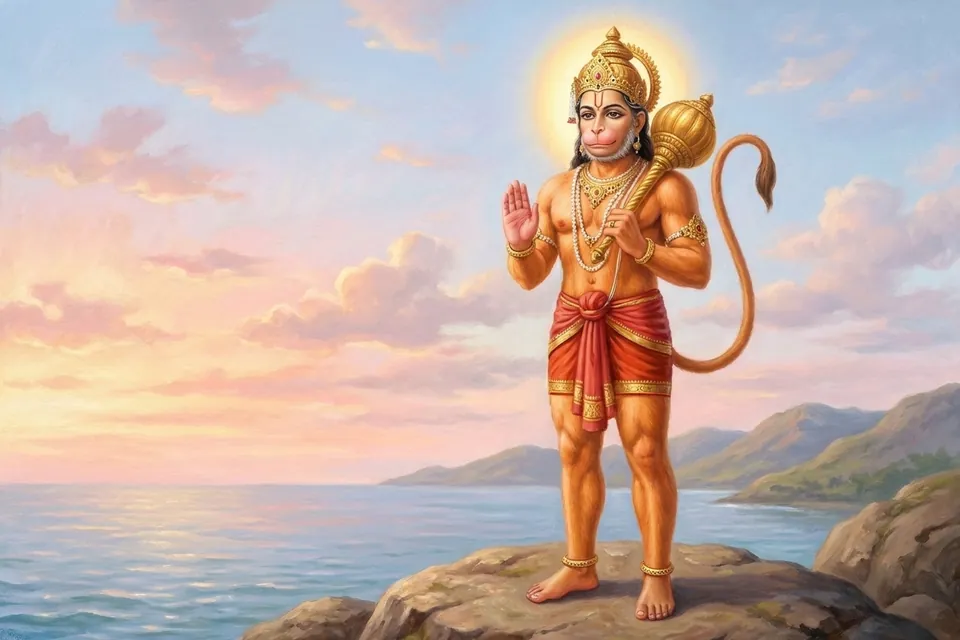
One should contemplate Hanuman ji holding a mace in the right hand and a water pot in the left, with his mighty right arm raised.
Word by word
- 9
ओं नमो हनुमते शोभिताननाय यशोलङ्कृताय अञ्जनीगर्भसम्भूताय रामलक्ष्मणानन्दकाय कपिसैन्यप्रकाशनाय पर्वतोत्पाटनाय सुग्रीवसाह्यकरणाय परोच्चाटनाय कुमारब्रह्मचर्याय गम्भीरशब्दोदयाय ओं ह्रीं सर्वदुष्टग्रहनिवारणाय स्वाहा ॥
Om namo hanumate shobhitananaya yasholankritaya anjanigarbhasambhutaya ramalakshmananandakaya kapisainyaprakashanaya parvatotpatanaya sugrivasahyakaranaya parochchatanaya kumarabrahmacharyaya gambhirashabdodayaya om hrim sarvadushtagrahanivaranaya svaha.
Om, salutations to Hanuman ji of radiant face, adorned with fame, born of Anjana, who brings joy to Rama and Lakshmana, who brightens the vanara army, uproots mountains and helps Sugriva. He drives away opponents, is a youthful brahmachari and has a deep resounding voice. Om hreem, svaha to the one who removes all troubling planetary influences.
Word by word
- 10
ओं नमो हनुमते एहि एहि एहि सर्वग्रहभूतानां शाकिनी डाकिनीनां विषमदुष्टानां सर्वेषामाकर्षयाकर्षय मर्दय मर्दय छेदय छेदय मर्त्यान् मारय मारय शोषय शोषय प्रज्वल प्रज्वल भूतमण्डल पिशाचमण्डल निरसनाय भूतज्वर प्रेतज्वर चातुर्थिकज्वर ब्रह्मराक्षस पिशाचच्छेदनाक्रिया विष्णुज्वर महेशज्वरान् छिन्धि छिन्धि भिन्धि भिन्धि अक्षिशूले शिरोऽभ्यन्तरे कुक्षिशूले गुल्मशूले पित्तशूले ब्रह्मराक्षसकुलप्रबल नागकुलविनिर्विषझटिति झटिति ओं ह्रीं फट् घेघे स्वाहा ।
Om namo hanumate ehi ehi ehi sarvagrahabhutanam shakini dakininam vishamadushtanam sarveshamakarshayakarshaya mardaya mardaya chhedaya chhedaya martyan maraya maraya shoshaya shoshaya prajvala prajvala bhutamandala pishachamandala nirasanaya bhutajvara pretajvara chaturthikajvara brahmarakshasa pishachachchhedanakriya vishnujvara maheshajvaran chhindhi chhindhi bhindhi bhindhi akshishule shirobhyantare kukshishule gulmashule pittashule brahmarakshasakulaprabala nagakulavinirvishajhatiti jhatiti om hrim phat gheghe svaha
Om, salutations to Hanuman ji: come, come, come. The mantra calls on him to draw in, subdue and cut away all harmful grahas, spirits and unsettling forces, and to burn brightly against them. It asks him to remove fevers of every kind, along with pain in the eyes and head, abdominal pain and bile pain, and to free one quickly from poison. It closes with the sacred syllables Om hreem phat ghe ghe svaha.
Word by word
- 11
ओं नमो हनुमते पवनपुत्र वैश्वानरमुख पापदृष्टि षोढादृष्टि हनुमते का आज्ञा फुरे स्वाहा । स्वगृहे द्वारे पट्टके तिष्ठ तिष्ठेति तत्र रोगभयं राजकुलभयं नास्ति तस्योच्चारणमात्रेण सर्वे ज्वरा नश्यन्ति ओं ह्रां ह्रीं ह्रूं घेघे स्वाहा ।
Om namo hanumate pavanaputra vaishvanaramukha papadrishti shodhadrishti hanumate ka Aagya phure svaha, svagrihe dvare pattake tishtha tishtheti tatra rogabhayam rajakulabhayam nasti tasyochcharanamatrena sarve jvara nashyanti om hram hrim hrum gheghe svaha
Om, salutations to Hanuman ji, son of the wind, whose face shines like fire, who removes the evil eye: by Hanuman's command may this take effect, svaha. It asks him to stay at the door and on the threshold of one's home. The text says that where this is done there is no trouble from illness or from rulers, and that by merely uttering it all fevers fade. Om hraam hreem hroom ghe ghe svaha.
Word by word
- Shloka 6
हनूमान् पूर्वतः पातु दक्षिणे पवनात्मजः । पातु प्रतीच्यां रक्षोघ्नः पातु सागरपारगः ॥ १ ॥
Hanuman purvatah patu dakshine pavanatmajah, patu pratichyam rakshoghnah patu sagaraparagah.
May Hanuman ji protect me from the east, and the son of the wind from the south. May the slayer of rakshasas protect me in the west, and may the one who crossed the ocean protect me.
Word by word
- Shloka 7
उदीच्यामूर्ध्वगः पातु केसरीप्रियनन्दनः । अधस्तु विष्णुभक्तश्च पातु मध्यं तु पावनिः ॥ २ ॥
Udichyamurdhvagah patu kesaripriyanandanah, adhastu vishnubhaktashcha patu madhyam tu pavanih.
May the one who soars upward protect me in the north, along with Kesari's beloved son. May the devotee of Vishnu protect me below, and the son of Pavana protect my middle.
Word by word
- Shloka 8
लङ्काविदाहकः पातु सर्वापद्भ्यो निरन्तरम् । सुग्रीवसचिवः पातु मस्तकं वायुनन्दनः ॥ ३ ॥
Lankavidahakah patu sarvapadbhyo nirantaram, sugrivasachivah patu mastakam vayunandanah.
May the one who set Lanka ablaze protect me from all troubles at all times. May Sugriva's minister, the son of Vayu, protect my head.
Word by word
- Shloka 9
भालं पातु महावीरो भ्रुवोर्मध्ये निरन्तरम् । नेत्रे छायापहारी च पावनः प्लवगेश्वरः ॥ ४ ॥
Bhalam patu mahaviro bhruvormadhye nirantaram, netre chhayapahari cha pavanah plavageshvarah.
May the great hero always protect my forehead and the space between my brows. May the one who overcame the shadow-seizer, the pure lord of the vanaras, protect my eyes.
Word by word
- Shloka 10
कपोले कर्णमूले च पातु श्रीरामकिङ्करः । नासाग्रमञ्जनीसूनुः पातु वक्त्रं हरीश्वरः ॥ ५ ॥
Kapole karnamule cha patu shriramakinkarah, nasagramanjanisunuh patu vaktram harishvarah.
May the servant of Shri Rama protect my cheeks and the roots of my ears. May Anjani's son protect the tip of my nose, and the lord of the vanaras protect my mouth.
Word by word
- Shloka 11
वाचं रुद्रप्रियः पातु जिह्वां पिङ्गललोचनः । पातु देवः फाल्गुनेष्टश्चुबुकं दैत्यदर्पहा ॥ ६ ॥
Vacham rudrapriyah patu jihvam pingalalochanah, patu devah phalguneshtashchubukam daityadarpaha.
May the beloved of Rudra protect my speech and the tawny-eyed one my tongue. May the divine one dear to Arjuna, who humbles the pride of the daityas, protect my chin.
Word by word
- Shloka 12
पातु कण्ठं च दैत्यारिः स्कन्धौ पातु सुरार्चितः । भुजौ पातु महातेजाः करौ च चरणायुधः ॥ ७ ॥
Patu kantham cha daityarih skandhau patu surarchitah, bhujau patu mahatejah karau cha charanayudhah.
May the foe of the daityas protect my throat, and the one worshipped by the gods my shoulders. May the greatly radiant one protect my arms, and the one whose feet are his weapons protect my hands.
Word by word
- Shloka 13
नखान्नखायुधः पातु कुक्षौ पातु कपीश्वरः । वक्षो मुद्रापहारी च पातु पार्श्वे भुजायुधः ॥ ८ ॥
Nakhannakhayudhah patu kukshau patu kapishvarah, vaksho mudrapahari cha patu parshve bhujayudhah.
May the one whose nails are weapons protect my nails, and the lord of the vanaras my belly. May the one who carried Rama's ring protect my chest, and the one whose arms are weapons protect my sides.
Word by word
- Shloka 14
लङ्काविभञ्जनः पातु पृष्ठदेशे निरन्तरम् । नाभिं च रामदूतस्तु कटिं पात्वनिलात्मजः ॥ ९ ॥
Lankavibhanjanah patu prishthadeshe nirantaram, nabhim cha ramadutastu katim patvanilatmajah.
May the breaker of Lanka always protect my back. May Rama's messenger protect my navel, and the son of the wind protect my waist.
Word by word
- Shloka 15
गुह्यं पातु महाप्राज्ञो लिङ्गं पातु शिवप्रियः । ऊरू च जानुनी पातु लङ्काप्रासादभञ्जनः ॥ १० ॥
Guhyam patu mahapragyo lingam patu shivapriyah, uru cha januni patu lankaprasadabhanjanah.
May the greatly wise one and the one dear to Shiva protect my private parts. May the one who broke Lanka's palaces protect my thighs and knees.
Word by word
- Shloka 16
जङ्घे पातु कपिश्रेष्ठो गुल्फौ पातु महाबलः । अचलोद्धारकः पातु पादौ भास्करसन्निभः ॥ ११ ॥
Janghe patu kapishreshtho gulphau patu mahabalah, achaloddharakah patu padau bhaskarasannibhah.
May the best of vanaras protect my shins, and the mighty one my ankles. May the one who lifted the mountain, shining like the sun, protect my feet.
Word by word
- Shloka 17
अङ्गान्यमितसत्त्वाढ्यः पातु पादाङ्गुलीस्तथा । सर्वाङ्गानि महाशूरः पातु रोमाणि चात्मवित् ॥ १२ ॥
Anganyamitasattvadhyah patu padangulistatha, sarvangani mahashurah patu romani chatmavit.
May the one rich in boundless strength protect my limbs and my toes. May the great hero protect my whole body, and the knower of the Self protect every hair on it.
Word by word
- Shloka 18
हनुमत्कवचं यस्तु पठेद्विद्वान्विचक्षणः । स एव पुरुषश्रेष्ठो भुक्तिं मुक्तिं च विन्दति ॥ १३ ॥
Hanumatkavacham yastu pathedvidvanvichakshanah, sa eva purushashreshtho bhuktim muktim cha vindati.
The text says that the learned, discerning person who reads the Hanuman Kavacham is truly the best among people and attains both worldly fulfilment and liberation.
Word by word
- Shloka 19
त्रिकालमेककालं वा पठेन्मासत्रयं नरः । सर्वान् रिपून् क्षणाज्जित्वा स पुमान् श्रियमाप्नुयात् ॥ १४ ॥
Trikalamekakalam va pathenmasatrayam narah, sarvan ripun kshanajjitva sa puman shriyamapnuyat.
The text says that one who reads it three times a day, or once a day, for three months, quickly overcomes all opponents and gains prosperity.
Word by word
- Shloka 20
मध्यरात्रे जले स्थित्वा सप्तवारं पठेद्यदि । क्षयापस्मारकुष्टादितापत्रयनिवारणः ॥ १५ ॥
Madhyaratre jale sthitva saptavaram pathedyadi, kshayapasmarakushtaditapatrayanivaranah.
The text says that if one stands in water at midnight and reads it seven times, it removes ailments such as wasting illness, epilepsy and skin disease, and the three kinds of suffering.
Word by word
- Shloka 21
अश्वत्थमूलेऽर्कवारे स्थित्वा पठति यः पुमान् । अचलां श्रियमाप्नोति सङ्ग्रामे विजयं तथा ॥ १६ ॥
Ashvatthamulerkavare sthitva pathati yah puman, achalam shriyamapnoti sangrame vijayam tatha.
The text says that one who reads it seated at the root of a peepal tree on a Sunday gains lasting prosperity and victory in battle.
Word by word
- Shloka 22
बुद्धिर्बलं यशो धैर्यं निर्भयत्वमरोगता । सुदार्ढ्यं वाक्स्फुरत्वं च हनुमत्स्मरणाद्भवेत् ॥ १७ ॥
Buddhirbalam yasho dhairyam nirbhayatvamarogata, sudardhyam vaksphuratvam cha hanumatsmaranadbhavet.
The text says that by remembering Hanuman ji one gains intelligence, strength, fame, courage, fearlessness, good health, steadiness and clear speech.
Word by word
- Shloka 23
मारणं वैरिणां सद्यः शरणं सर्वसम्पदाम् । शोकस्य हरणे दक्षं वन्दे तं रणदारुणम् ॥ १८ ॥
Maranam vairinam sadyah sharanam sarvasampadam, shokasya harane daksham vande tam ranadarunam.
I bow to him who swiftly overcomes enemies, who is the refuge of all wealth, who is skilled in removing sorrow, and who is mighty in battle.
Word by word
- Shloka 24
लिखित्वा पूजयेद्यस्तु सर्वत्र विजयी भवेत् । यः करे धारयेन्नित्यं स पुमाञ्छ्रियमाप्नुयात् ॥ १९ ॥
Likhitva pujayedyastu sarvatra vijayi bhavet, yah kare dharayennityam sa pumanchhriyamapnuyat.
The text says that one who writes out this kavacha and worships it is victorious everywhere, and one who always wears it on the hand gains prosperity.
Word by word
- Shloka 25
स्थित्वा तु बन्धने यस्तु जपं कारयति द्विजैः । तत्क्षणान्मुक्तिमाप्नोति निगडात्तु तथैव च ॥ २० ॥
Sthitva tu bandhane yastu japam karayati dvijaih, tatkshananmuktimapnoti nigadattu tathaiva cha.
The text says that one held in confinement who has this japa done by Brahmins is freed at once, and released from shackles in the same way.
Word by word
- Shloka 26
य इदं प्रातरुत्थाय पठेच्च कवचं सदा । आयुरारोग्यसन्तानैस्तस्य स्तव्यः स्तवो भवेत् ॥ २१ ॥
Ya idam pratarutthaya pathechcha kavacham sada, Aayurarogyasantanaistasya stavyah stavo bhavet.
The text says that one who rises early and always reads this kavacha is blessed with long life, good health and children, and becomes worthy of praise.
Word by word
- Shloka 27
इदं पूर्वं पठित्वा तु रामस्य कवचं ततः । पठनीयं नरैर्भक्त्या नैकमेव पठेत्कदा ॥ २२ ॥
Idam purvam pathitva tu ramasya kavacham tatah, pathaniyam narairbhaktya naikameva pathetkada.
The text advises that people first read this kavacha and then the kavacha of Shri Rama, with devotion, and never read just one of them alone.
Word by word
- Shloka 28
हनुमत्कवचं चात्र श्रीरामकवचं विना । ये पठन्ति नराश्चात्र पठनं तद्वृथा भवेत् ॥ २३ ॥
Hanumatkavacham chatra shriramakavacham vina, ye pathanti narashchatra pathanam tadvritha bhavet.
The text says that when people read the Hanuman Kavacham without the Shri Rama Kavacham, that reading does not bear its full fruit.
Word by word
- Shloka 29
तस्मात्सर्वैः पठनीयं सर्वदा कवचद्वयम् । रामस्य वायुपुत्रस्य सद्भक्तैश्च विशेषतः ॥ २४ ॥
Tasmatsarvaih pathaniyam sarvada kavachadvayam, ramasya vayuputrasya sadbhaktaishcha visheshatah.
Therefore, the text says, everyone, and true devotees most of all, should always read both kavachas, of Shri Rama and of the son of the wind.
Word by word