
Yama Dwitiya katha: Yama and Yamuna, as the Bhavishya Purana tells it
Tirth editorial · 16 Feb 2026 · 8 min read
The Yama Dwitiya katha is the story of one meal. On Kartika Shukla Dwitiya, the second day of the bright fortnight of Kartika, Yamuna fed her brother Yama in her own home, and the Bhavishya Purana says that is how the tithi came to be known in the world as Yama Dwitiya. Families keep the day as Bhai Dooj, when the brother eats at his sister’s house and gives her gifts.
P. V. Kane gives that passage in his chapter on Diwali, and Gita Press’s Vrat Parichay prints the five prayers said on the day.
Bhai Dooj (Yama Dwitiya) in 2026: Wednesday, 11 November. Dwitiya tithi: 1:59 PM on 10 November to 3:52 PM on 11 November. Afternoon (aparahna) window in New Delhi: 1:09 PM to 3:19 PM.
Checked on 25 Oct 2026. Timings for your city in the Tirth Spiritual Calendar
What does the Bhavishya Purana say about Yama and Yamuna?
Yama and Yamuna are brother and sister, both children of Surya. The prayers read on this day call Yama the son of the Sun and Yamuna’s elder brother, and they call Yamuna the daughter of the Sun and Yama’s sister.
Kane prints the Bhavishya Purana passage in his History of Dharmasastra. Yamuna fed Yama in her own house on the second day of the bright half of Kartika. That meal is why the world knows the tithi as Yama Dwitiya.
No midday meal at home on this day, the passage says. The brother should eat what his sister serves him with her own hands, out of affection, and the text holds that this adds to his welfare. His sisters are to be honoured with gold ornaments and clothes, a welcome and a meal. For a man without a sister, the same passage names an uncle’s or aunt’s daughter, or a friend’s sister.
Kane adds a longer procedure from a digest called the Vrataraja. There the brother recites ten names of Yama before he leaves for his sister’s house. She, for her part, worships images of Yama and of eight immortals (Markandeya, Bali etc.) for his long life.
The popular telling is longer. Yamuna invites Yama many times before he comes. On the way to her house he frees beings from naraka (hell). She asks for a boon: that brothers who visit their sisters on this day lose the fear of untimely death. Their mother is Chhaya in some tellings and Sanjna in others. Not one of these details appears in Kane’s Bhavishya passage, and Gita Press’s Vrat Parichay does not have them either.
How is the popular story different from the printed one?
On one point the two agree. Yama eats at Yamuna’s home on Kartika Shukla Dwitiya, and the table sets the rest side by side.
| Detail | Bhavishya Purana (as Kane quotes it) and Vrat Parichay | Popular telling |
|---|---|---|
| The meal | Yamuna feeds Yama in her own house | The same, as the climax of the story |
| Invitations | Not mentioned | Yamuna invites him many times before he comes |
| On the way | Not mentioned | Yama frees beings from naraka |
| The boon | No boon; the text gives the rule for the day | Brothers who visit their sisters lose the fear of untimely death |
| Their mother | Not named; the prayers call both children of the Sun | Chhaya, or Sanjna |
A family raised on the longer version can read both. I would name the source of the short one, then read the longer one as the popular telling, with Chhaya or Sanjna, whichever name the family uses for their mother.
Where do the names Yama Dwitiya and Bhaiya Dooj come from?
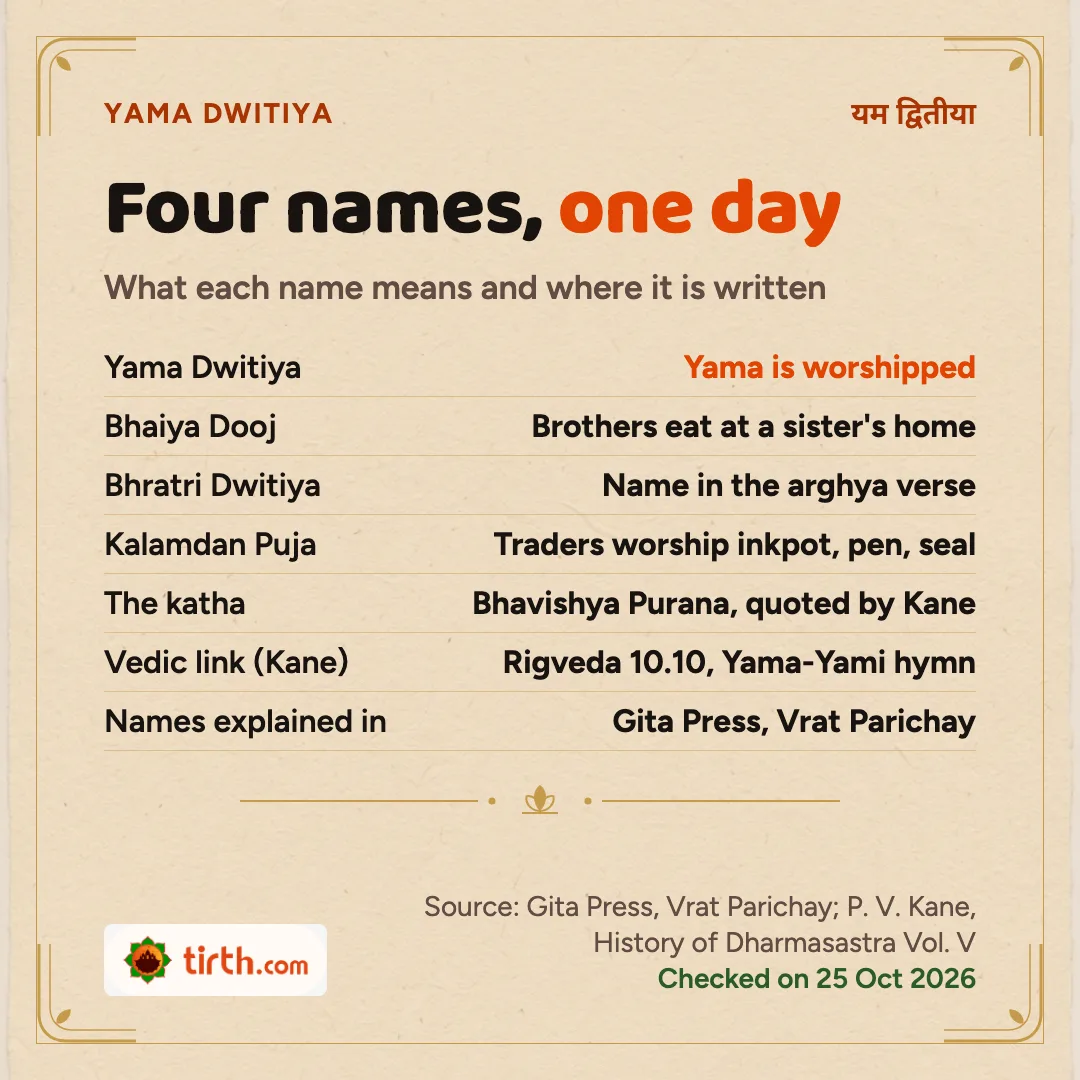
Vrat Parichay explains both names. It is Pandit Hanuman Sharma’s handbook of vrats, published by Gita Press. Yama is worshipped on it, hence Yama Dwitiya, and brothers eat at their sister’s home that day, hence Bhaiya Dooj. Kane uses a third name, Bhratri Dwitiya (the brother’s second day), which you will meet again in the arghya verse further down.
Kane links the day to the Yama-Yami hymn of the Rigveda (10.10). In his own time, he writes, the main observance was the brother visiting his sister and eating at her house, a lamp waved before him, and presents from him to her. Then there is a fourth name, used by traders. According to Vrat Parichay, people in trade do puja to their inkpot, pen and seal on this day, and from that comes the name Kalamdan Puja.
Which prayers does Vrat Parichay print for Yama Dwitiya?
The full vidhi, step by step, is in our Bhai Dooj guide.
Kane records that a lamp is waved before the brother, and the words for an aarti are in our Bhai Dooj aarti post. The Bhavishya passage itself builds the day around food from a sister’s hands.
Hemadri prefers the Dwitiya that covers midday. The Smarta view takes the fifth of the eight parts of the day. By the word of the Skanda Purana the Dwitiya covering the afternoon (aparahna) is better, and Vrat Parichay calls that the right rule; the date and afternoon window in the card above follow it.
Prayer to Yama:
धर्मराज नमस्तुभ्यं नमस्ते यमुनाग्रज। पाहि मां किंकरैः सार्धं सूर्यपुत्र नमोऽस्तु ते॥
Dharmaraja namastubhyam namaste Yamunagraja, pahi mam kinkaraih sardham Suryaputra namo’stu te.
Meaning: Salutation to Dharmaraja, elder brother of Yamuna; son of the Sun, protect me along with your attendants.
Prayer to Yamuna:
यमस्वसर्नमस्तेऽस्तु यमुने लोकपूजिते। वरदा भव मे नित्यं सूर्यपुत्रि नमोऽस्तु ते॥
Yamasvasar namaste’stu Yamune lokapujite, varada bhava me nityam Suryaputri namo’stu te.
Meaning: Salutation to Yamuna, Yama’s sister, honoured by the world; daughter of the Sun, always grant me boons.
Then the arghya, offered to Yama:
एह्येहि मार्तण्डज पाशहस्त यमान्तकालोकधरामरेश। भ्रातृद्वितीयाकृतदेवपूजां गृहाण चार्घ्यं भगवन्नमोऽस्तु ते।
Ehyehi Martandaja pashahasta Yamantakalokadharamaresha, bhratridvitiyakritadevapujam grihana charghyam bhagavan namo’stu te.
Meaning: Come, come, son of the Sun, noose in hand; accept the worship done on Bhratri Dwitiya and this arghya.
Prayer to Chitragupta:
मसिभाजनसंयुक्तं ध्यायेत्तं च महाबलम्। लेखनीपट्टिकाहस्तं चित्रगुप्तं नमाम्यहम्॥
Masibhajanasamyuktam dhyayettam cha mahabalam, lekhanipattikahastam Chitraguptam namamyaham.
Plain meaning (our own rendering, as Vrat Parichay prints this verse without a translation): I bow to Chitragupta, the mighty one, to be pictured with his inkpot, holding pen and writing tablet.
And this is what the sister says while she serves him:
भ्रातस्तवानुजाताहं भुङ्क्ष्व भक्तमिमं शुभम्। प्रीतये यमराजस्य यमुनाया विशेषतः॥
Bhratastavanujataham bhunkshva bhaktamimam shubham, pritaye Yamarajasya Yamunaya visheshatah.
Meaning: Brother, I was born after you; eat this auspicious food, for the pleasure of Yamaraja and above all of Yamuna.
An older sister changes the words, saying she was born before him. If a man has no sister of his own, Vrat Parichay says he should eat at the home of his paternal uncle’s daughter, his maternal uncle’s daughter or a friend’s sister.
What about the Yamuna bath and Vishram Ghat?
According to Vrat Parichay, when the sister cooks and the brother eats on the Yamuna bank on Yama Dwitiya, his life is increased and her saubhagya protected. In Kane’s account, people living on or near the Yamuna bathe in it on this day, and a mela gathers on the river.
ETV Bharat reported from Mathura in 2025 that brothers and sisters there bathed in the Yamuna together on Yama Dwitiya, holding hands, and then visited the temple of Dharmaraj and Yamuna at Vishram Ghat. Devotees told the reporter the joint bath is believed to keep Yama’s wrath away.
Frequently asked questions
Which Purana tells the Yama Dwitiya katha?
It comes from the Bhavishya Purana. P. V. Kane quotes that passage, and in it Yamuna feeds Yama at her house on Kartika Shukla Dwitiya, so the day is named after the meal. It says nothing of repeated invitations or a boon against untimely death, which belong to the popular tellings.
Why is it called Yama Dwitiya?
Because Yama is worshipped on it, according to Gita Press’s Vrat Parichay. Bhaiya Dooj, in the same book, is named for brothers eating at their sister’s home that day.
What does the sister say while feeding her brother?
She says “भ्रातस्तवानुजाताहं भुङ्क्ष्व भक्तमिमं शुभम्। प्रीतये यमराजस्य यमुनाया विशेषतः॥” (Bhratastavanujataham bhunkshva bhaktamimam shubham, pritaye Yamarajasya Yamunaya visheshatah), meaning: Brother, I was born after you; eat this auspicious food, for the pleasure of Yamaraja and above all of Yamuna. If she is older than him, she says she was born before him.
What if a man has no sister?
Any of three homes will do, says Vrat Parichay. His paternal uncle’s daughter, his maternal uncle’s daughter, or a friend’s sister. The Bhavishya passage in Kane agrees.
Is Chitragupta worshipped on Yama Dwitiya?
Yes. In Vrat Parichay he comes right after Yama, ahead of the Yamadutas and Yamuna, with a prayer of his own. Traders also worship their inkpot, pen and seal on this day, which is why it is called Kalamdan Puja as well.
Why do people bathe in the Yamuna on this day?
Vrat Parichay praises a meal that the sister cooks and the brother eats on the Yamuna bank that day, and says it adds to his life and protects her saubhagya. Kane records that people near the river bathe in it, and that a mela is held on the river. In the katha, Yamuna is Yama’s sister.
Continue on Tirth
- Bhai Dooj in the Tirth Spiritual Calendar, for the date and timings in your city.