
Vishnu Mantras: 5 Verses With Meaning and Source
Tirth editorial · 10 Jan 2026 · 7 min read

Om Namo Bhagavate Vasudevaya, the twelve-syllable Vishnu mantra, has a precise home in scripture. It is the first line of Bhagavata Purana 4.8.54, where Narada gives it to Dhruva. Five Vishnu mantras follow with their words and sources, and if you are starting out, begin with that twelve-syllable mantra or the shorter Om Namo Narayanaya.
The other four are the Bhagavata prayer Krishnaya Vasudevaya Haraye Paramatmane, the Vishnu Gayatri, the Shantakaram meditation verse and a short Dhanvantari mantra. Each one is given in transliteration, with what it says and where it comes from, so you can see which texts stand on a named verse and which are known only from how families recite them.
Which Vishnu mantra should a beginner chant first?
| Mantra | What it is | Where it comes from |
|---|---|---|
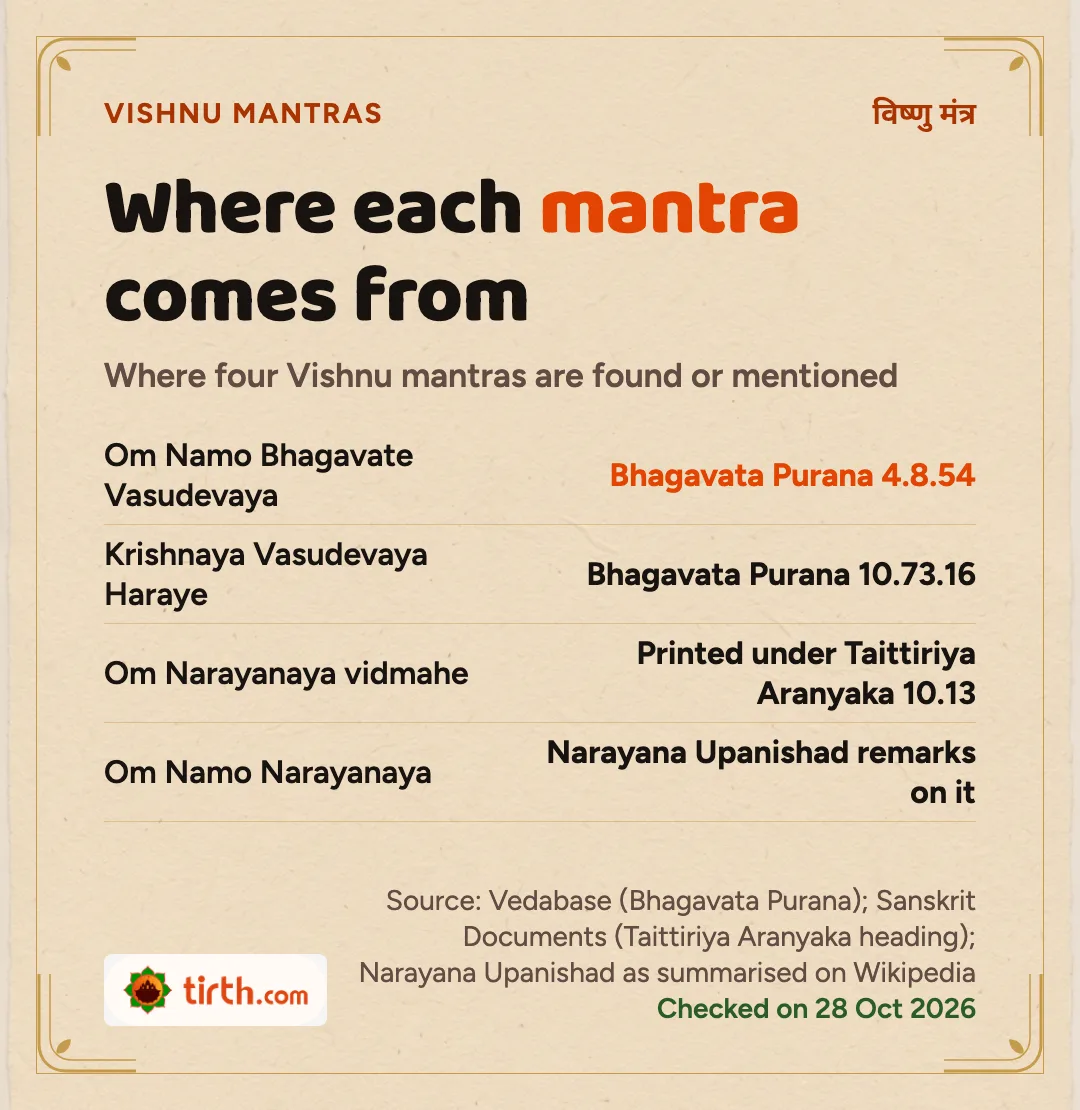
| Om Namo Bhagavate Vasudevaya | The twelve-syllable (dvadashakshara) mantra | Bhagavata Purana 4.8.54 |
| Krishnaya Vasudevaya Haraye Paramatmane | A two-line prayer of salutation to Krishna and Hari | Bhagavata Purana 10.73.16 |
| Om Narayanaya vidmahe | The Vishnu Gayatri | Taittiriya Aranyaka, prapathaka 10, anuvaka 13 (as headed on Sanskrit Documents) |
| Shantakaram Bhujagashayanam | A dhyana (meditation) verse on Vishnu | Traditional dhyana verse; no verified text source |
| Om namo bhagavate vasudevaya dhanvantaraye | A short Dhanvantari mantra | As chanted; no original text named |
Start with Om Namo Bhagavate Vasudevaya, because it is short, its source is a named verse anyone can look up, and its opening words come back inside the Dhanvantari mantra later on this page.
Om Namo Narayanaya is the eight-syllable (ashtakshara) mantra, and the Narayana Upanishad remarks on it. If even twelve syllables feel like a lot for an elderly parent, the eight are just as much a mantra of Bhagwan Vishnu, and our Narayan mantra guide covers it on its own.
Om Namo Bhagavate Vasudevaya meaning, word by word
Om Namo Bhagavate Vasudevaya
Counted out, it has twelve syllables. Which is why it is called the dvadashakshara, the twelve-syllable mantra, in the purport to Bhagavata 4.8.54, the verse in which Narada instructs Dhruva. In English it means “Om, homage to Bhagavan Vasudeva”, commonly rendered as “I bow to Lord Vasudeva”.
| Word | Meaning |
|---|---|
| Om | The sacred syllable |
| namah (namo) | Homage |
| bhagavate | To the Lord |
| vasudevaya | To Vasudeva |
It is commonly called the Vishnu mool mantra.
Krishnaya Vasudevaya Haraye Paramatmane: the Bhagavata 10.73.16 prayer
Krishnaya Vasudevaya Haraye Paramatmane
Pranata-klesha-nashaya Govindaya namo namah
This couplet is Srimad Bhagavatam 10.73.16, the last verse of the prayer the freed kings offer in the chapter where Krishna blesses them, so it is spoken to him, not by him. It is a prayer of salutation to Krishna and Hari, and it opens without Om, since Om is not part of the verse.
| Word | Meaning |
|---|---|
| krishnaya | To Krishna |
| vasudevaya | To the son of Vasudeva |
| haraye | To Hari |
| parama-atmane | To the Supersoul |
| pranata-klesha-nashaya | To the destroyer of the distress of those who have surrendered |
| govindaya | To Govinda |
| namah namah | Repeated obeisances |
The verse bows to Krishna, son of Vasudeva, to Hari, the Supreme Soul, and to Govinda, the one who destroys the distress of those who bow to him, and it says these salutations twice over. It does not say that remembering him makes every trouble fade. The word pranata (one who has bowed down, surrendered) is the hinge of the second line. If Krishna is the form you pray to most, our page of Krishna mantras with meaning sits alongside this one.
What does the Vishnu Gayatri, Narayanaya vidmahe, actually say?
Om Narayanaya vidmahe Vasudevaya dhimahi, tanno Vishnuh prachodayat
As it is commonly rendered, we know Narayana, we meditate on Vasudeva, may Vishnu inspire and guide us. Three names, one Lord. The line moves from knowing him to meditating on him to asking for his guidance.
The text itself is printed on Sanskrit Documents under the heading Taittiriya Aranyaka, prapathaka 10, anuvaka 13, and it is also cited from the Mahanarayana Upanishad (the numbering here follows that page’s heading, and a printed edition is the place to confirm it).
Shantakaram Bhujagashayanam meaning, line by line
Shantaakaaram Bhujagashayanam Padmanabham Suresham,
Vishwaadharam Gaganasadrisham Meghavarnam Shubhaangam,
Lakshmikantam Kamalanayanam Yogibhirdhyanagamyam,
Vande Vishnum Bhavabhayaharam Sarvalokaikanatham
This is a dhyana verse. It gives you a picture to hold in mind before worship. No verified text source has been found for it, so this page does not name one. The line meanings below follow the renderings on Shlokam and on Green Message, and the two agree line by line.
| Line | What it describes |
|---|---|
| Shantaakaaram Bhujagashayanam Padmanabham Suresham | The peaceful form, reclining on the serpent, the lotus rising from his navel (Padmanabha), lord of the gods |
| Vishwaadharam Gaganasadrisham Meghavarnam Shubhaangam | Support of the universe, like the sky, the colour of a rain cloud, with auspicious limbs |
| Lakshmikantam Kamalanayanam Yogibhirdhyanagamyam | Beloved of Lakshmi, lotus-eyed, reached by yogis through meditation |
| Vande Vishnum Bhavabhayaharam Sarvalokaikanatham | I bow to Vishnu, remover of the fear of worldly existence, sole lord of all worlds |
Two details are easy to miss. Gaganasadrisham, “like the sky”, and Lakshmikantam, “beloved of Lakshmi”, are both there in the Sanskrit. So is the exact fear the last line names, bhava-bhaya, the fear of worldly existence, which Vishnu is praised for removing in the words Vande Vishnum Bhavabhayaharam.
Dhanvantari mantra, and which version to trust
om namo bhagavate vasudevaya dhanvantaraye amrita-kalasha-hastaya sarvamaya-vinashanaya trailokyanathaya shri mahavishnave namah
This is the short form, as printed by Shlokam, which names no scripture for it. A much longer version also circulates (Mahasudarshanaya, Aushadhachakra Narayanaya and so on), joined to the short one as if they were a single text, and no source has been found for that long form at all. We would rather give you the short version with an honest note than a long one with an invented pedigree.
Dhanvantari himself does have a scripture. In the Bhagavata, at 8.8.31, a wondrous male figure rises from the churning of the ocean, 8.8.32 describes his appearance, and at 8.8.33 he is carrying a pitcher brimming with nectar, which is the amrita-kalasha of the mantra’s own words. Verse 8.8.34 names him Dhanvantari, born of a portion of a portion of Vishnu, expert in Ayurveda and entitled to a share of the sacrifices.
Notice how the mantra opens. Om namo bhagavate vasudevaya, the same twelve syllables Narada taught Dhruva, before it names Dhanvantari and ends by bowing to Shri Mahavishnu. People chant it as a prayer to Dhanvantari, and it is a prayer, never a promise of recovery or a stand-in for a doctor (the Bhagavata calls him an expert in Ayurveda, and says nothing about the mantra healing anyone). For the full text and its other forms, see our Dhanvantari mantra page.
More for Vishnu puja at home: the Vishnu aarti, the Shree Vishnu Chalisa, the Tulsi mantra and the aarti of Ekadashi Mata.
Frequently asked questions
Which is the most powerful Vishnu mantra?
No text we found ranks them, so no honest page can. The one with a named verse you can read for yourself is Om Namo Bhagavate Vasudevaya, Bhagavata 4.8.54.
What is the Vishnu mool mantra?
Om Namo Bhagavate Vasudevaya is commonly called the Vishnu mool mantra. The name is popular usage. The mantra itself is the first line of Bhagavata Purana 4.8.54, where Narada instructs Dhruva.
What is the meaning of Om Namo Bhagavate Vasudevaya?
Om, homage to Bhagavan Vasudeva. Word by word, namah is homage, bhagavate is “to the Lord” and vasudevaya is “to Vasudeva”, which is why most English versions render the whole line as “I bow to Lord Vasudeva”.
What is the Vishnu Gayatri mantra?
It is Om Narayanaya vidmahe Vasudevaya dhimahi, tanno Vishnuh prachodayat. It means we know Narayana, we meditate on Vasudeva, may Vishnu inspire and guide us, and it is printed under Taittiriya Aranyaka 10.13.
What does Shantakaram Bhujagashayanam mean?
It is a meditation verse picturing Vishnu at peace, reclining on the serpent, with a lotus from his navel, cloud-coloured and lotus-eyed. It ends by bowing to Vishnu, remover of the fear of worldly existence and sole lord of all worlds.
Which Vishnu mantra is good for beginners or daily japa?
Om Namo Bhagavate Vasudevaya, the twelve-syllable mantra, or Om Namo Narayanaya, the eight-syllable one. Both are short enough to learn quickly, and the first has a verse you can read for yourself in the Bhagavata.