
Om Jai Jagdish Hare aarti: Vishnu aarti lyrics with meaning
Tirth editorial · 8 Jan 2026 · 7 min read

Jagdish is “lord of the world”. Platts’ dictionary gives it as an epithet of Vishnu. Bhakti Bharat says “Om Jai Jagdish Hare” is dedicated to Vishnu, yet it is sung at almost any puja or festival. We print it here word for word from the Aarti-Sangrah of Gita Press, Gorakhpur.
Roman letters and a plain meaning follow each line, and the author, as The Tribune has it, was Pandit Shardha Ram Phillauri, a name you will meet again further down.
Bhakti Bharat makes a point worth knowing before you start. The aarti is addressed to Bhagwan Vishnu, yet it gets sung at almost any puja or festival.
Om Jai Jagdish Hare aarti lyrics in Hindi and English
Seven verses and a refrain, printed under the title “Bhagwan Jagdishwar”.
Look closely at the book and every verse carries a pair of small cues: “Prabhu” after its first line and “Om” after its second, telling the singers to go back into the refrain (if you are leading it at home for the first time, learn that refrain by heart before anything else, since it comes round after every single verse).
ॐ जय जगदीश हरे, प्रभु! जय जगदीश हरे।
भक्तजनोंके संकट छिनमें दूर करे॥
Om jai Jagdish hare, Prabhu! jai Jagdish hare.
Bhaktajanon ke sankat chhin mein door kare.
जो ध्यावै फल पावै, दुख विनसै मनका।
सुख-सम्पति घर आवै, कष्ट मिटै तनका॥
Jo dhyavai phal pavai, dukh vinsai man ka.
Sukh-sampati ghar aavai, kasht mitai tan ka.
मात-पिता तुम मेरे, शरण गहूँ किसकी।
तुम बिन और न दूजा, आस करूँ जिसकी॥
Maat-pita tum mere, sharan gahun kiski.
Tum bin aur na dooja, aas karun jiski.
तुम पूरन परमात्मा, तुम अन्तर्यामी।
पारब्रह्म परमेश्वर, तुम सबके स्वामी॥
Tum pooran Paramatma, tum antaryami.
Parbrahm Parameshwar, tum sabke swami.
तुम करुणाके सागर तुम पालन-कर्ता।
मैं मूरख खल कामी, कृपा करो भर्ता॥
Tum karuna ke sagar, tum palan-karta.
Main moorakh khal kami, kripa karo bharta.
तुम हो एक अगोचर, सबके प्राणपती।
किस बिधि मिलूँ दयामय! मैं तुमको कुमती॥
Tum ho ek agochar, sabke pranapati.
Kis bidhi milun dayamay! main tumko kumati.
दीनबन्धु दुखहर्ता तुम ठाकुर मेरे।
अपने हाथ उठाओ, द्वार पड़ा तेरे॥
Deenbandhu dukhharta, tum thakur mere.
Apne haath uthao, dwar pada tere.
विषय-विकार मिटाओ, पाप हरो देवा।
श्रद्धा-भक्ति बढ़ाओ, संतनकी सेवा॥
Vishay-vikar mitao, paap haro deva.
Shraddha-bhakti badhao, santan ki seva.
We checked each of these lines against the scanned page itself, item 8 on page 12. Bhakti Bharat’s version closes with the refrain sung once more.
What does Om Jai Jagdish Hare mean, line by line?
Hari is itself a name of Vishnu. So the refrain greets him twice in one breath, once as lord of the world and once by name. Our meanings in the table are plain English of our own, with the harder words checked in Platts.
| Line | Plain meaning (Tirth’s rendering) |
|---|---|
| Om jai Jagdish hare, Prabhu! jai Jagdish hare. Bhaktajanon ke sankat chhin mein door kare. | Glory to you, Hari, lord of the world, O Lord. You take away the troubles of your devotees in a moment. |
| Jo dhyavai phal pavai, dukh vinsai man ka. Sukh-sampati ghar aavai, kasht mitai tan ka. | Whoever meditates on you gains the fruit, and the mind’s sorrow falls away. Happiness and plenty come into the home, and the body’s pain ends. |
| Maat-pita tum mere, sharan gahun kiski. Tum bin aur na dooja, aas karun jiski. | You are my mother and father; whose shelter would I take? Without you there is no other in whom I could place my hope. |
| Tum pooran Paramatma, tum antaryami. Parbrahm Parameshwar, tum sabke swami. | You are the complete Supreme Self, the one who dwells within. Supreme Spirit, Supreme Lord, you are the master of all. |
| Tum karuna ke sagar, tum palan-karta. Main moorakh khal kami, kripa karo bharta. | You are an ocean of compassion, you are the sustainer. I am foolish, base and full of desire; be merciful, protector. |
| Tum ho ek agochar, sabke pranapati. Kis bidhi milun dayamay! main tumko kumati. | You are the one beyond the senses, the lord of every life. By what means, merciful one, can a foolish mind like mine reach you? |
| Deenbandhu dukhharta, tum thakur mere. Apne haath uthao, dwar pada tere. | Friend of the humble, remover of sorrow, you are my lord. Raise your hand; I lie at your door. |
| Vishay-vikar mitao, paap haro deva. Shraddha-bhakti badhao, santan ki seva. | Wipe away the pull of the senses and the mind’s disorders, and take away sin, O Lord. Make faith, devotion and service of the saints grow. |
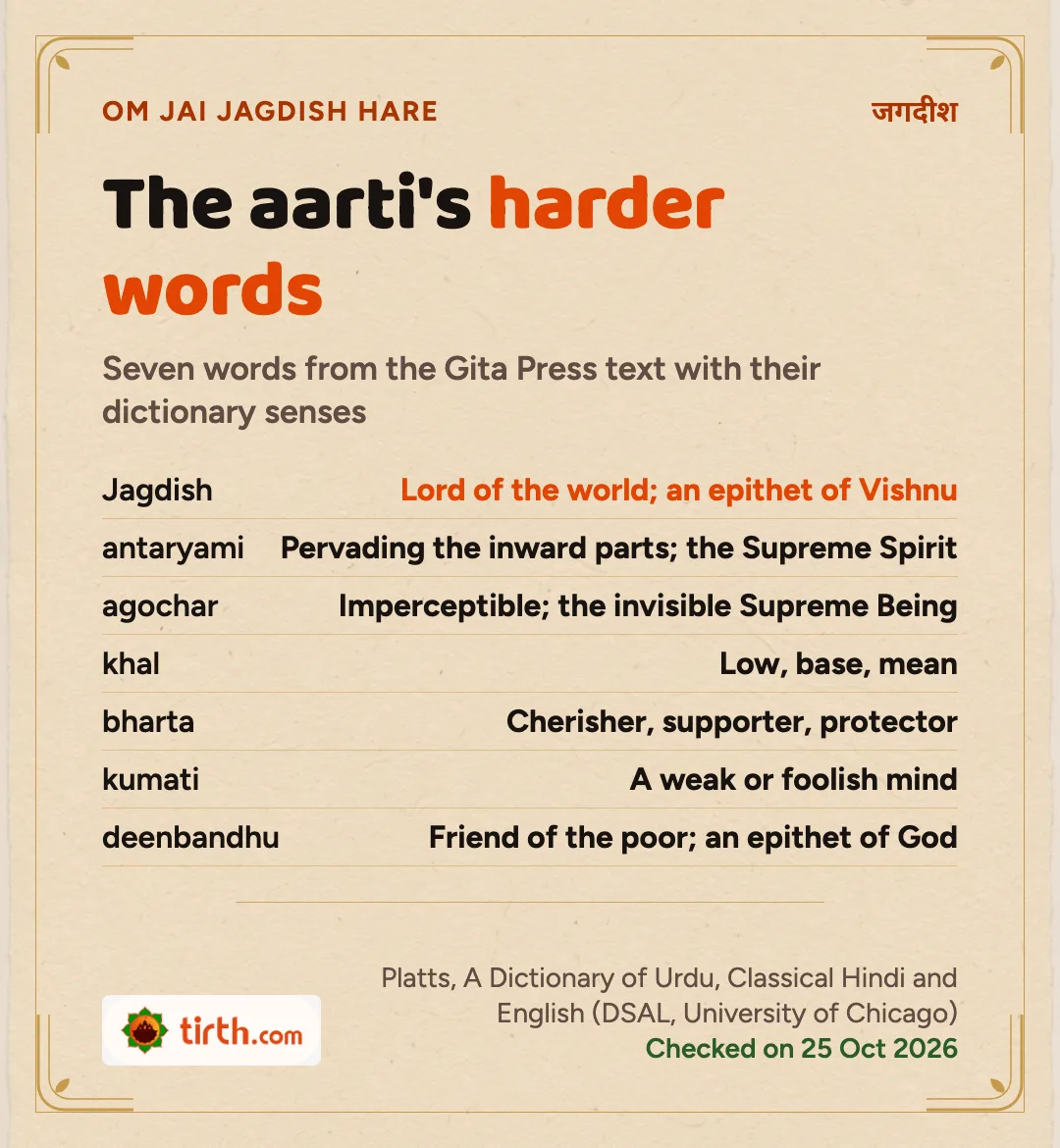
A handful of words carry most of the theology. Antaryami, read literally in Platts, is the one “pervading the inward parts”, a name for the Supreme Spirit. Agochar means imperceptible, and used as a noun it is the invisible Supreme Being.
Then kumati. A weak or foolish mind, and the singer pins it on himself in the very line where he calls the Lord agochar.
The fourth verse is harder on the singer still. Khal is low or base, kami is full of desire, and only after owning both does he ask for mercy, addressing the Lord as bharta (cherisher, protector).
Why do some versions say Swami and others Prabhu?
Over the years the sung aarti drifted a little from the printed one. Put Bhakti Bharat’s sung text next to Gita Press and the differences show up quickly:
- Gita Press says “Prabhu”; the sung text says “Swami”.
- The refrain gains a line, “Das janon ke sankat”, right after the devotees’ troubles.
- Gita Press keeps “chhin mein”; singers say “kshan mein” (in a moment).
- “Main moorakh khal kami” turns into “Main moorakh phalkami, main sevak tum swami”.
- The sixth verse picks up “Swami rakshak tum mere” and “Apne sharan lagao”, and half lines get sung twice.
Both keep the same seven verses in the same order. Which is why we would not ask anyone to change what they sing at home. If your family has always said “Swami”, carry on with “Swami”; the printed words sit on this page so you can see where yours came from.
Does the aarti end with “Kahat Shivanand Swami”?
Neither Gita Press nor Bhakti Bharat ends it that way. The Shivanand Swami line belongs one page later in the same book: “Bhanat Shivanand Swami” is the signature line of “Jai Shiv Omkara”, item 9, which ends on page 13.
So that verse is not here.
Who wrote Om Jai Jagdish Hare?
Pandit Shardha Ram Phillauri, says The Tribune, describing the aarti as a hymn sung in Hindu households across the country. Born in Phillaur in 1837, he died in Lahore on 24 June 1881.
Some pages print an exact year. We looked for a reliable source that gives one and did not find it, so the year is left out here rather than guessed.
For more of Vishnu in song and chant there is the Vishnu Chalisa, Vishnu mantras, the Narayan mantra and the Satyanarayan aarti. And if you would like a Vishnu puja done for the family, our pujas on Tirth page lists them.
Frequently asked questions
Is Om Jai Jagdish Hare the Vishnu aarti?
Yes. Both Jagdish (lord of the world) and Hari name Vishnu, and Bhakti Bharat calls the aarti his, though it turns up at pujas for other deities as well.
Who wrote Om Jai Jagdish Hare?
The Tribune names Pandit Shardha Ram Phillauri, who lived from 1837 to 1881.
How many verses does Om Jai Jagdish Hare have?
Seven, plus a refrain that Gita Press marks for singing after each one.
What does “main moorakh khal kami” mean?
“I am foolish, base and full of desire.” Once that is said, the singer asks the Lord as protector to be merciful.
Is “Kahat Shivanand Swami” part of this aarti?
Gita Press does not print it here. In that book the Shivanand line belongs to “Jai Shiv Omkara”, the very next aarti.