
Teej Festival: Hariyali, Kajari and Hartalika Explained
Tirth editorial · 11 Feb 2026 · 9 min read
Tritiya, the third day of a lunar fortnight, is the day every Teej falls on, and the Teej festival comes round three times in the monsoon months of Shravana and Bhadrapada. Women keep it for Goddess Parvati and Lord Shiva, remembering the long penance by which Parvati won Shiva as her husband.
The three days are Hariyali Teej, Kajari Teej and Hartalika Teej, in that order across the rains. Each has its own songs and its own way of fasting. Swings go up, hands are covered in mehndi, and in many homes a married daughter receives a parcel of clothes, bangles and sweets from her mother’s house.
Teej in 2027 (New Delhi):
Hariyali Teej: Wednesday, 4 August. Shravana Shukla Tritiya: 8:19 AM on 4 August to 5:08 AM on 5 August. Tritiya is not running at sunrise on either day, so some almanacs keep 5 August, while Tirth keeps 4 August because the tithi runs through the rest of that day and its evening.
Kajari Teej: Friday, 20 August. Bhadrapada Krishna Tritiya: 5:15 PM on 19 August to 6:52 PM on 20 August.
Hartalika Teej: Friday, 3 September. Bhadrapada Shukla Tritiya: 4:49 PM on 2 September to 2:18 PM on 3 September.
Checked on 28 Oct 2026. Timings for your city in the Tirth Spiritual Calendar
Dates and timings are calculated for New Delhi using the traditional North Indian panchang. Timings change from city to city, sometimes by more than an hour for moonrise; see the Tirth Spiritual Calendar for your location.
Hariyali, Kajari or Hartalika: which Teej is which?
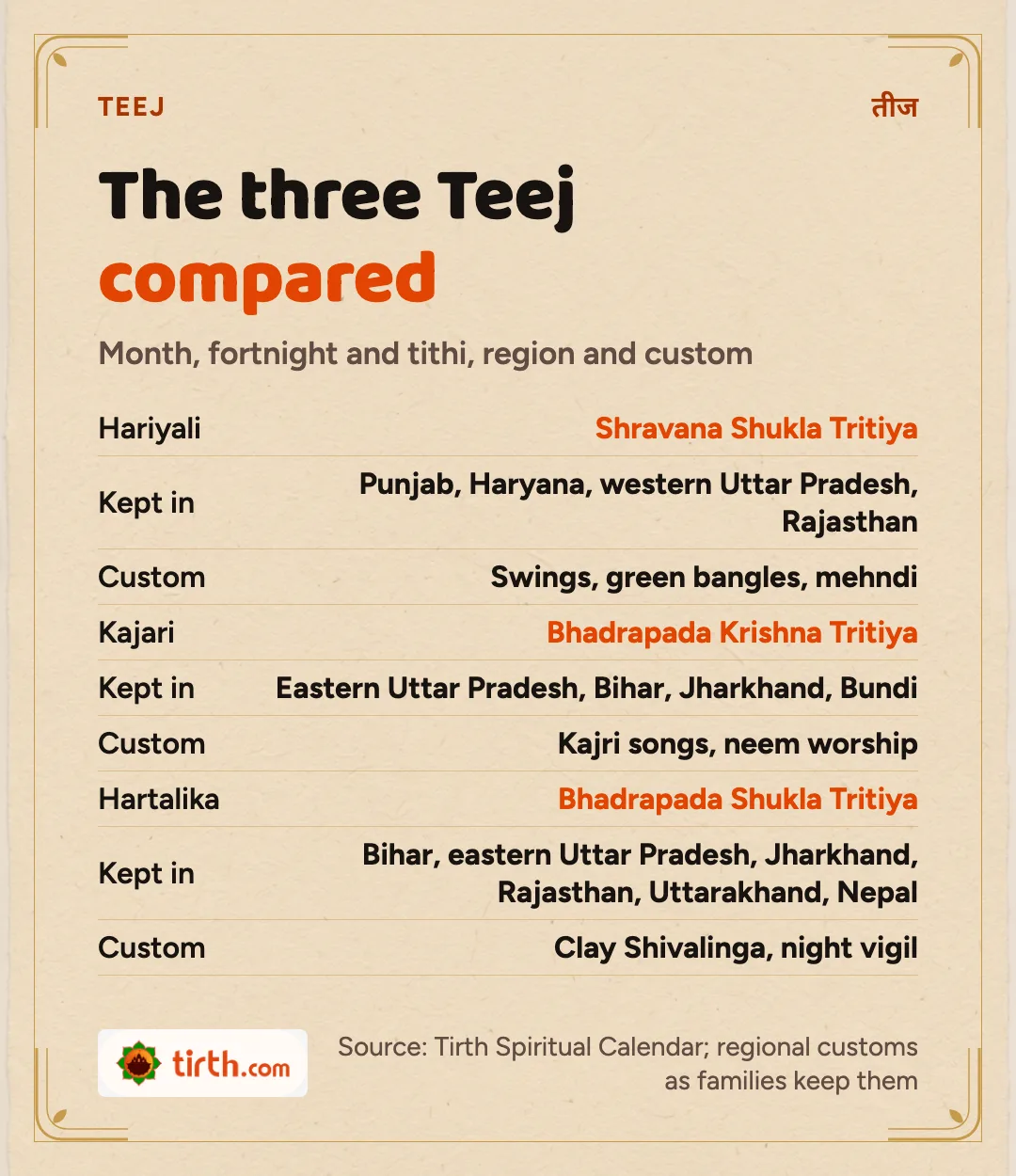
All three fall on a Tritiya. The fortnight is what tells them apart.
Kajari is the one that trips people up, because calendars give its month two different names. Calendars that count a month from one full moon to the next (Purnimanta) put Kajari in Bhadrapada, while calendars that count from new moon to new moon (Amanta) put that very fortnight in Shravana. So one website says Bhadrapada, the next says Shravana, and both mean the same day.
| Hariyali Teej | Kajari Teej | Hartalika Teej | |
|---|---|---|---|
| Tithi (Purnimanta month) | Shravana Shukla Tritiya | Bhadrapada Krishna Tritiya | Bhadrapada Shukla Tritiya |
| Same tithi in Amanta reckoning | Shravana Shukla Tritiya | Shravana Krishna Tritiya | Bhadrapada Shukla Tritiya |
| Other names | Haryali Teej; Teeyan in Punjab | Kajli Teej, Badi Teej | Haritalika Teej |
| The fast, as many families keep it | Lightest of the three; fruit allowed in many households | A fast broken with sattu in the Bhojpuri belt | Strictest; nirjala (no water), with a night vigil |
| Kept mainly in | Punjab, Haryana, western Uttar Pradesh, Rajasthan | Eastern Uttar Pradesh, Bihar, Jharkhand, Bundi | Bihar, eastern Uttar Pradesh, Jharkhand, Rajasthan, Uttarakhand, Nepal |
| Custom it is known for | Swings, green bangles, mehndi, sindhara gifts | Kajri songs, worship of the neem tree | Clay Shivalinga, puja of Shiva and Parvati through the night |
Read the fast row as a picture of what is common. Your own family’s custom may be stricter or gentler than anything in that column, and it is the one to follow.
Why is Teej celebrated? Parvati’s tapas for Shiva
The Shiva Purana tells Parvati’s story in the Rudra Samhita, in the part called the Parvati Khanda: Parvati performs severe tapas (austerities) to win Shiva, and the gods plead with him to marry her.
Chapter 22 of that khanda, in J. L. Shastri’s 1950 English translation, gives the penance in detail. Parvati goes to the holy place Shringitirtha, which takes the name Gauri-Shikhara. In summer she sits ringed by fire, in the rains on bare rock, in winter in water. For a year she lives on fruit, for the next on leaves, and then she gives up even leaves, which is why the gods call her Aparna, the one without a leaf. A woman who fasts on Teej is remembering that resolve.
Hartalika Teej carries a second story, from the vrat katha. The name is usually split into harit (carried off) and alika (a woman friend). The Hartalika katha tells that Parvati’s father wished to marry her to Vishnu, so a friend took her away into a forest, where Parvati kept up her penance for Shiva and worshipped a Shivalinga she had shaped from sand or clay. The whole Hartalika Teej katha is told on its own page, step by step.
How is Hariyali Teej kept at home?
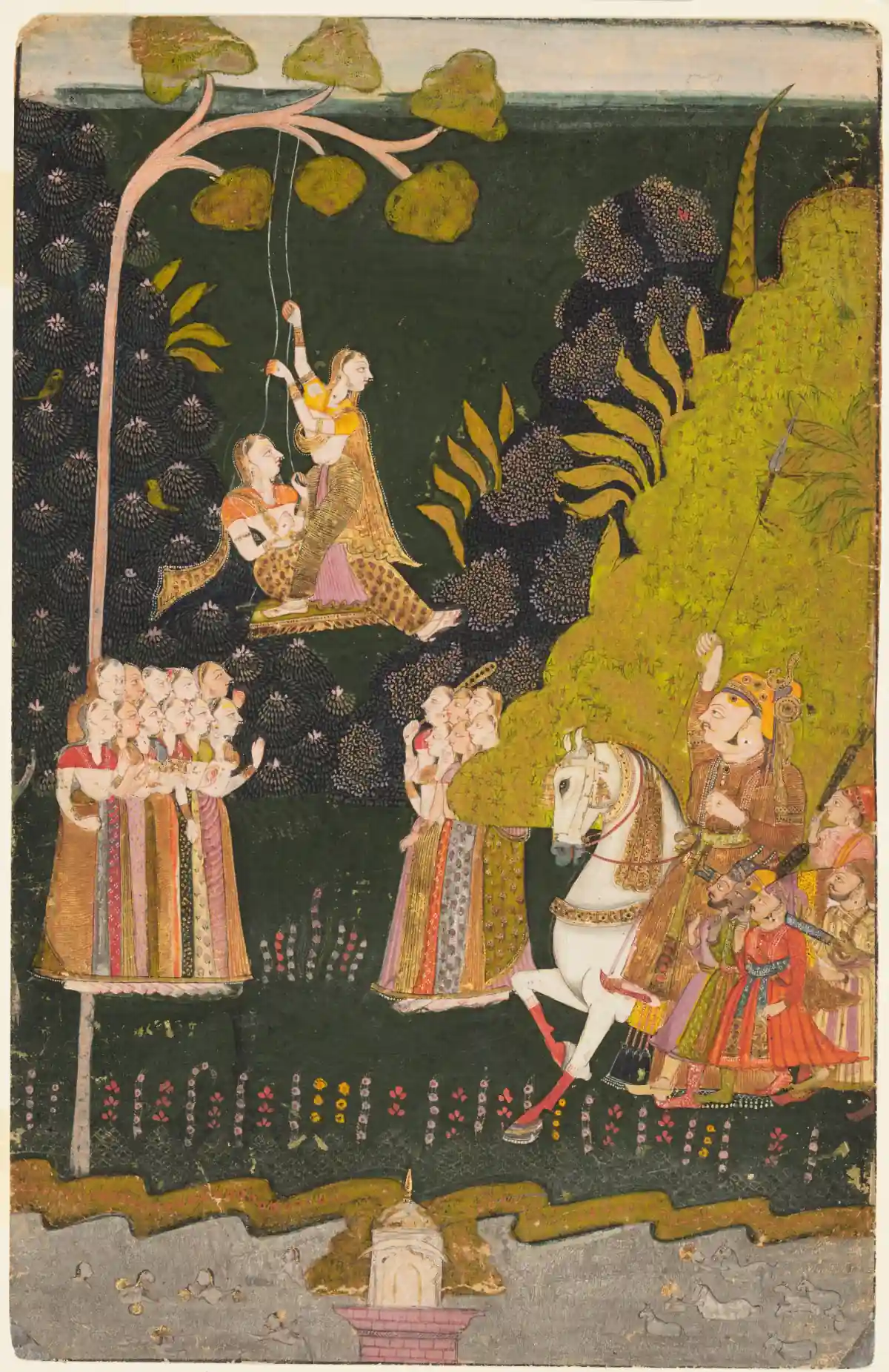
In Rajasthan the day before it is called Sinjara, and that is the day for mehndi. Swings (jhula) are hung from trees or set up in the courtyard, and women dress in green clothes and green bangles and sing the Teej folk songs together.
A mother or the family sends a married daughter a parcel for Teej called sindhara, with clothes, bangles, sweets and ghevar in it. Where she can, the daughter goes home to her parents for the day, and in Rajasthan a brother may put up the swing for his sister. Many women wear the laharia, a sari printed in multicoloured stripes.
Haryana keeps the puja in the morning. A square (chowk) is decorated at the place of worship, an image or picture of Parvati is set there, and the baya, the plate of food the mother has sent, is placed before her on a thali. Evenings go to folk songs and dancing.
On fasting, Hariyali is the lightest of the three as families keep them.
In many households fruit is allowed and the fast is flexible. Others keep it more strictly. Ask the eldest woman in your family how your house has always done it (her answer counts for more than anything printed online, this page included).
If you like to close the puja with an aarti, the words of the Parvati aarti are on Tirth with their meaning.
Some families also want a Shiva puja done by a pandit around Teej, for the household, and Tirth lists pujas you can book with a pandit.
Kajari and Hartalika Teej: neem, sattu and the night vigil
Kajari Teej (Kajli Teej, or Badi Teej) belongs mainly to the Bhojpuri belt of eastern Uttar Pradesh, Bihar and Jharkhand. Two things mark it out. The kajri songs, folk songs of the rains, and the worship of the neem tree. In the Bhojpuri belt the Kajari fast is broken with sattu (roasted gram flour).
Hartalika Teej is the strictest of the three.
Many women keep it as a nirjala vrat, a fast without water, that begins in the evening and runs on through a night vigil, with the puja of Shiva and Parvati before a Shivalinga of clay, as Parvati made hers in the forest. Hartalika is kept mainly in Bihar, eastern Uttar Pradesh, Jharkhand, Rajasthan, Uttarakhand and Nepal. Customs differ from house to house and region to region, and a woman who is pregnant, unwell or elderly is usually told by her own elders what is right for her.
The Hartalika puja, step by step
Drik Panchang sets out the order from the Vratraj. Bathe early. Take the sankalp, the stated resolve, to keep the vrat for Uma and Maheshwara. Make images of Shiva and Parvati from sand. Worship Ganesha first, then Shiva and Parvati with the sixteen offerings (shodashopachara), with a separate puja of Parvati’s form limb by limb, and have the Hartalika katha read aloud. Morning is good for the puja, and pradosh, the hour around dusk, is also considered good. Swami Harshananda’s Concise Encyclopedia of Hinduism describes the vrat as a worship of Uma with Shiva.
Sinjara in Jaipur, Teeyan in Punjab: how regions keep Teej
In Jaipur an image of Teej Mata is carried out of Tripolia Gate at the City Palace in a royal-style procession, with decorated elephants and camels, horses, folk dancers and musicians, and the Government of India’s Incredible India portal lists the Jaipur Teej Festival among the state’s events. The Ministry of Tourism’s Utsav listing, posted by Rajasthan’s Department of Tourism, fills in the route: the procession runs on both days of the festival, from Tripolia Gate through Tripolia Bazaar and Chhoti Chaupar, and ends at Talkatora. On the same listing the department sets out henna and ghewar for visitors.
In Punjab the monsoon festival is Teeyan, and it lasts about thirteen days, from the Tritiya of the bright half of Sawan to the full moon. Gidda, the women’s dance, and the swings carry it.
Haryana and western Uttar Pradesh keep Hariyali Teej too. In Nepal, Teej (spelt Tij there) is a three-day festival of women that includes a fast of about a day, visits to Shiva temples such as Pashupatinath, and songs that comment on women’s lives.
Other vrats and festivals of the year have their own pages on Tirth, among them the Mangala Gauri vrat katha, the Jaya Parvati vrat katha, the Vat Savitri guide, the Karwa Chauth guide and the Raksha Bandhan guide.
Frequently asked questions
What is the difference between Hariyali, Kajari and Hartalika Teej?
They are three separate days, each a Tritiya. Hariyali falls in the bright half of Shravana, Kajari in the dark half of Bhadrapada (Shravana in the Amanta calendar), and Hartalika in the bright half of Bhadrapada. Hariyali has the lightest fast, Kajari is known for neem worship and sattu, and Hartalika for a waterless fast and a night vigil.
Why is Teej celebrated?
Teej remembers Parvati’s devotion to Shiva. The Shiva Purana, in chapter 22 of the Parvati Khanda of the Rudra Samhita, tells how she won him through severe tapas, living on fruit, then leaves, then nothing at all.
Why do women wear green on Teej?
The first Teej falls in Shravana, in the rains, and green clothes and green bangles are part of how it is kept, along with mehndi and swings.
Is water allowed during the Teej fast?
It depends on which Teej and on your family. Hartalika is the one many women keep as a nirjala fast, without water, while Hariyali is usually lighter and many households allow fruit on it. Each family follows its own custom, with the elders deciding what is right for anyone whose health is a worry.
Which Teej is the most important?
That depends on where your family comes from. Hariyali Teej is mainly kept in Punjab, Haryana, western Uttar Pradesh and Rajasthan, Kajari in the Bhojpuri belt of eastern Uttar Pradesh, Bihar and Jharkhand, and Hartalika in Bihar, eastern Uttar Pradesh, Jharkhand, Rajasthan, Uttarakhand and Nepal.
What is the story of Hartalika Teej?
The Hartalika katha tells that a friend carried Parvati off to a forest so that she would not be married to Vishnu, as her father wished. There she kept her penance for Shiva and worshipped a Shivalinga of sand or clay. The name joins harit (carried off) and alika (a woman friend).
Continue on Tirth
- Festival dates, Tirth Spiritual Calendar: tithi and day for Hariyali, Kajari and Hartalika Teej, New Delhi.