
Surya Dev Aarti: Jai Kashyap-Nandan Lyrics in Hindi and Roman with Meaning
Tirth editorial · 8 Jan 2026 · 8 min read
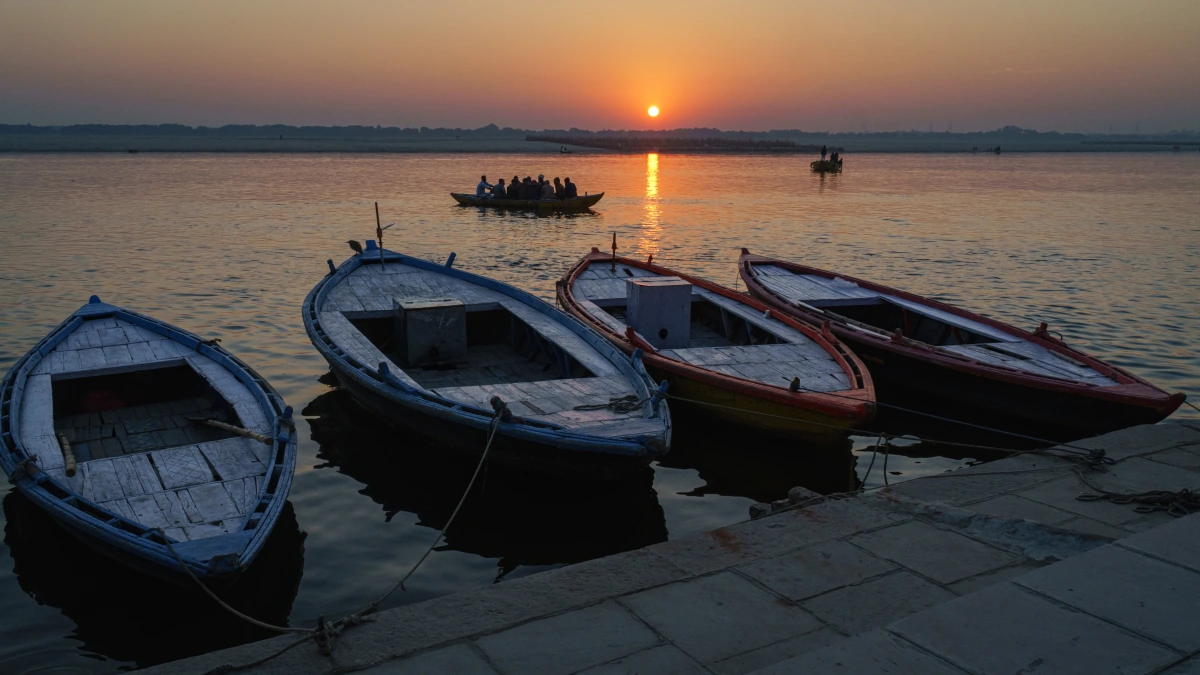
In the first line of this aarti the singer turns to Lord Surya and calls him by his parents, Kashyap-Nandan for the sage Kashyap and Aditi-Nandan for Aditi, the mother of the gods. This is the Surya Dev aarti that Gita Press prints in its Shri Aarti Sangrah as item 79, under the heading “Bhagwan Surya”, and it has one refrain and six couplets, all given below in Devanagari and in Roman letters with what each couplet says.
Nobody is named as its author.
Gita Press prints it without one, as do Drik Panchang and BhaktiBharat, so this page names none. The older version of this page also wrote the refrain out twice between every couplet. The book does it differently. It prints the refrain once, as the tek, and closes each couplet with a single word, “Jai”, to send the singer back to it.
Jai Kashyap-Nandan aarti lyrics in Hindi and Roman
The Devanagari is copied from Shri Aarti Sangrah (Gita Press, Gorakhpur), where the first couplet is on page 51 and the aarti runs on to page 52. Sing the refrain first, then go back to it after each couplet.
जय कश्यप-नन्दन, ॐ जय अदिति-नन्दन।
त्रिभुवन-तिमिर-निकन्दन भक्त-हृदय-चन्दन॥
Jai Kashyap-Nandan, Om Jai Aditi-Nandan.
Tribhuvan-Timir-Nikandan Bhakt-Hriday-Chandan.
सप्त-अश्वरथ राजित एक चक्रधारी।
दुखहारी, सुखकारी, मानस-मल-हारी॥
Sapt-Ashwarath Rajit Ek Chakradhaari.
Dukhhaari, Sukhkaari, Maanas-Mal-Haari.
(Jai)
सुर-मुनि-भूसुर-वंदित, विमल विभवशाली।
अघ-दल-दलन दिवाकर दिव्य किरण माली॥
Sur-Muni-Bhoosur-Vandit, Vimal Vibhavshaali.
Agh-Dal-Dalan Divakar Divya Kiran Maali.
(Jai)
सकल-सुकर्म-प्रसविता सविता शुभकारी।
विश्व-विलोचन मोचन भव-बंधन भारी॥
Sakal-Sukarm-Prasvita Savita Shubhkaari.
Vishv-Vilochan Mochan Bhav-Bandhan Bhaari.
(Jai)
कमल-समूह-विकासक, नाशक त्रय तापा।
सेवत सहज हरत अति मनसिज-संतापा॥
Kamal-Samuh-Vikaasak, Naashak Traya Taapa.
Sevat Sahaj Harat Ati Manasij-Santaapa.
(Jai)
नेत्र-व्याधि-हर सुरवर भू-पीड़ा-हारी।
वृष्टि-विमोचन संतत परहित-व्रतधारी॥
Netra-Vyaadhi-Har Survar Bhu-Peeda-Haari.
Vrishti-Vimochan Santat Parhit-Vratdhaari.
(Jai)
सूर्यदेव करुणाकर अब करुणा कीजै।
हर अज्ञान-मोह सब तत्त्वज्ञान दीजै॥
Suryadev Karunakar Ab Karuna Keejai.
Har Agyaan-Moh Sab Tatvagyaan Deejai.
(Jai)
Copies do not all open the same way. BhaktiBharat starts with Om, adds “prabhu” and drops the hyphens (“Om jai Kashyap nandan, prabhu jai Aditi nandan”), while Drik Panchang opens as Gita Press does, with a single “Jai Kashyap-Nandan”. The wording above stays with the Gita Press page. One small thing about the last word of the closing couplet (dijai in one scan of the book, dije in another), which is a spelling, not a different line.
If you are the one leading it for the family, we would sing the refrain once at the start and again at every Jai, exactly as the book sets it out. That is our advice, not a rule. The book prints the refrain once, and a shorter page is easier to sing from.
Just before the aarti, Gita Press prints a short Sanskrit Shri Surya-vandana as item 78, opening “namo namaste ‘stu sada vibhavaso”. It is a separate prayer. Not a verse of this aarti. For more to recite to Surya, see the Surya mantra and the Surya Dev Chalisa.
What the six couplets of Jai Kashyap-Nandan say
Read in order, the couplets go from the seven-horse chariot to the praise of gods and sages, then to what Surya does for the world, and the sixth is a prayer. The refrain names him the son of Kashyap and of Aditi and the one who ends the timir, the darkness, of the tribhuvan. Its last word calls him chandan, which Platts explains as sandalwood, and as the unctuous preparation of sandalwood held in high estimation as a perfume.
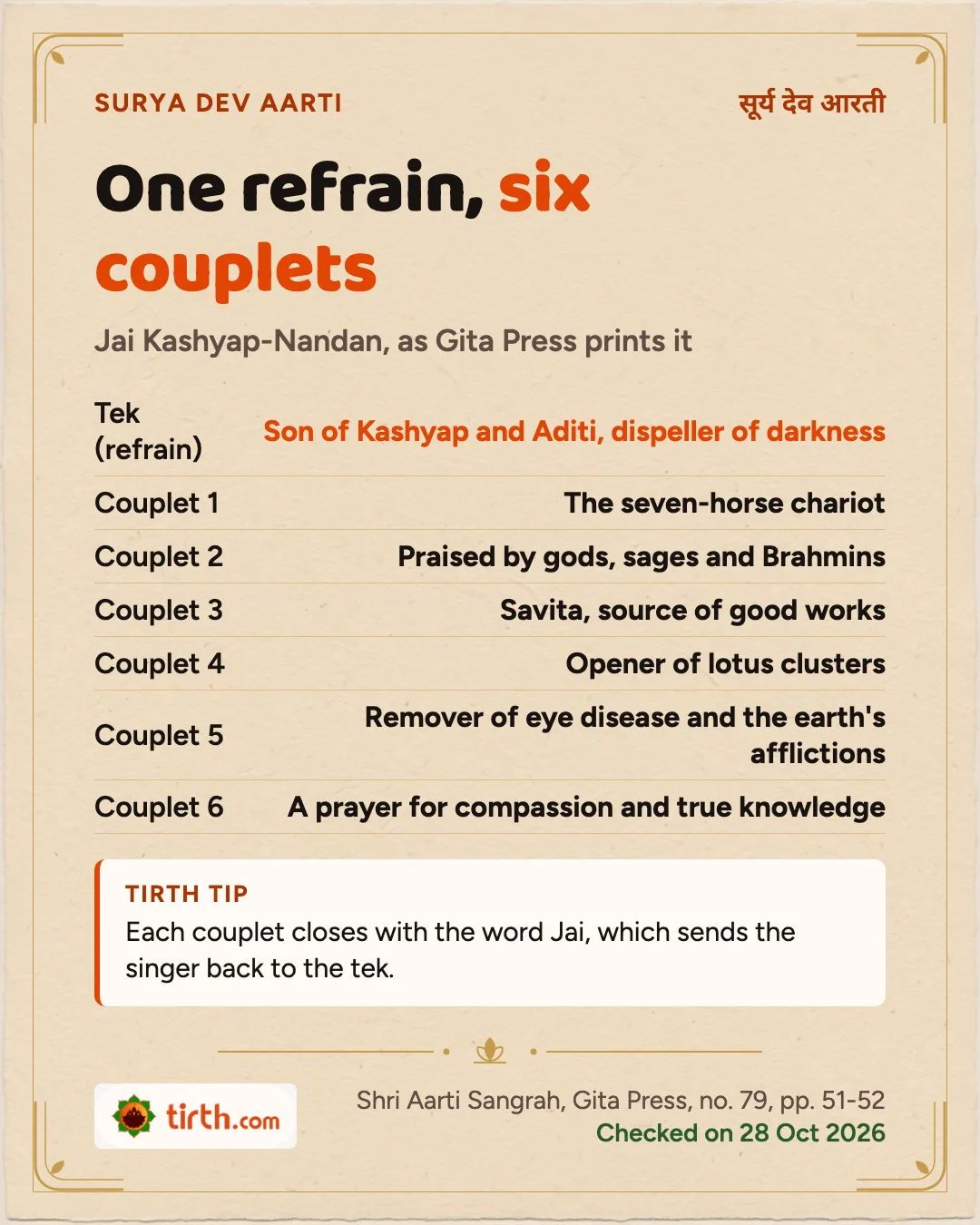
The first couplet puts him on his chariot of seven horses. He is ek chakradhari, the one who bears (dhari) a single (ek) chakra, and three names follow. Dukh is suffering and hari a remover, so dukhhari is the remover of suffering, and sukhkari is the one who makes happiness. The third, maanas-mal-hari, takes something away from the maanas, the mind, and this page leaves mal unglossed.
Gods, sages and Brahmins, sur, muni and bhoosur, all praise him in the next one (Platts gives bhoosur as an epithet of a Brahman), and vandit is the word for that. Its second line has him put an end to agh, which Platts gives as sin or guilt and also as suffering.
His Gayatri name comes third.
He is Savita, which Platts notes is the name by which the sun is invoked in the Gayatri, and the source of sakal sukarm, all good works. The second line calls him mochan, the one who releases, from bhav-bandhan, bandhan being a bond, a tie or a knot.
Then the lotus clusters, which he opens. In the same line he is nashak, the destroyer, of tray tapa, and tap in Platts is heat or fever and also affliction and sorrow. The second line says that sevat, serving him, easily takes away (harat) what its last compound names, manasij-santapa, a word left without a gloss here.
The fifth couplet is the one that mentions sickness, so here it is as it stands. Netra-vyaadhi-har calls him the remover of eye disease, bhu-peeda-haari the remover of the earth’s afflictions, and vrishti is rain, the rain he releases. The couplet praises Surya and promises nothing to the singer.
The last couplet stops describing and asks. Suryadev, karunakar, show karuna (compassion) now, take away ignorance and moh, attachment, and give tattvagyan, true knowledge. That prayer is the end of the aarti.
Kashyap, Savita, vrishti and the other words in Platts
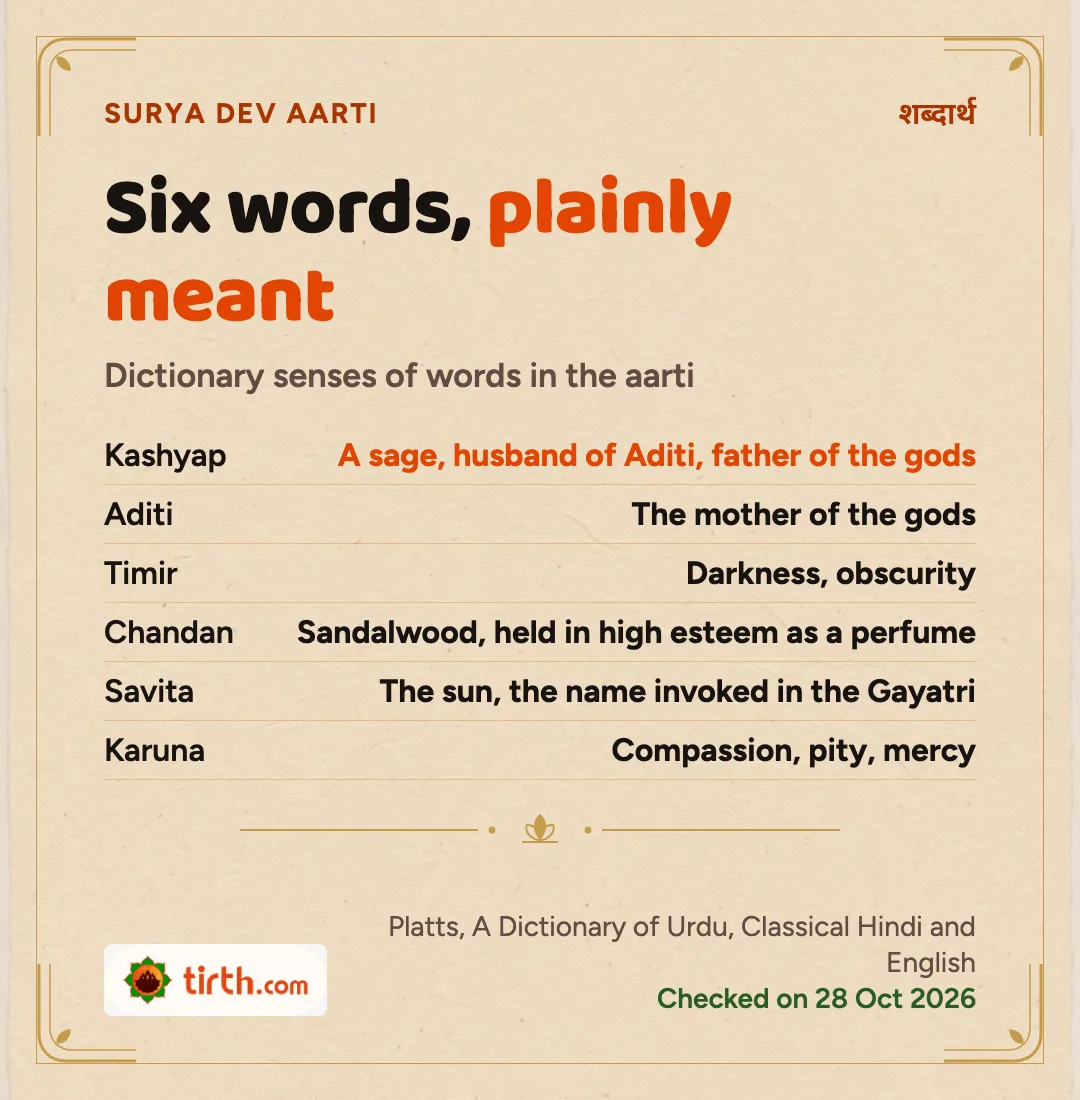
Every meaning in this table is from one dictionary, Platts’ A Dictionary of Urdu, Classical Hindi, and English, in the University of Chicago’s online edition, with its page number. A word without a Platts entry here is simply not in the table.
| Word in the aarti | Where | Platts gives | Platts page |
|---|---|---|---|
| कश्यप (Kashyap) | Refrain | name of a deified sage, son of Marici, husband of Diti and Aditi, father of the immortals (gods and demons) | 838 |
| अदिति (Aditi) | Refrain | the mother of the gods | 32 |
| नन्दन (nandan) | Refrain | delighting, gladdening; a son, “the rejoicer” of his father | 1155 |
| अदिति-नन्दन (Aditi-nandan) | Refrain | a son of Aditi; an epithet of any male deity | 32 |
| तिमिर (timir) | Refrain | darkness, obscurity; timir-nashak, dispeller of darkness | 337 |
| चन्दन (chandan) | Refrain | the sandal tree; sandalwood, sandal; the unctuous preparation of sandalwood (held in high estimation as a perfume) | 444 |
| एक (ek) | 1 | one, single, sole | 114 |
| धारी (dhari) | 1, 5 | bearing, holding, carrying, wearing, possessing (last member of a compound) | 538 |
| दुख (dukh) | 1 | pain, affliction, suffering, distress, sorrow | 521 |
| सुख (sukh) | 1 | happiness, pleasure, joy; comfort, ease | 666 |
| हारी (hari) | 1, 5 | taking away, removing, destroying; a remover | 1216 |
| कारी (kari) | 1, 3 | last member of a compound: doing, making | 800 |
| मानस (maanas) | 1 | of the mind; mind, seat of reason and feeling; heart, soul | 985 |
| भूसुर (bhoosur) | 2 | epithet of a Brahman | 196 |
| वन्दित (vandit) | 2 | praised, extolled, adored, celebrated | 1202 |
| अघ (agh) | 2 | sin, guilt, crime, wickedness; suffering | 72 |
| सकल (sakal) | 3 | all, entire, the whole | 664 |
| सविता (Savita) | 3 | the sun; the name by which the deity is invoked in the Gayatri | 693 |
| मोचन (mochan) | 3 | releasing, setting free, liberating; deliverance | 1087 |
| बन्धन (bandhan) | 3 | fastening, binding, tying; tie, knot; bond, confinement | 170 |
| नाशक (nashak) | 4 | removing, destroying; a destroyer, remover, dispeller | 1115 |
| ताप (tap) | 4 | warmth, heat, burning; fever; affliction, pain, sorrow, distress | 303 |
| सेवत (sevat) | 4 | under sevan: serving, service, devotion to | 715 |
| हरत (harat) | 4 | under harna: to take away, remove, destroy | 1226 |
| व्याधि (vyaadhi) | 5 | pain, sickness | 1206 |
| पीड़ा (peeda) | 5 | pain, suffering, anguish; sorrow, affliction; disease | 299 |
| वृष्टि (vrishti) | 5 | rain; a shower | 1188 |
| व्रत (vrat) | 5 | rite, observance, practice; a religious act or obligation | 1186 |
| करुणा (karuna) | 6 | compassion, pity, mercy, tenderness | 828 |
| ज्ञान (gyan) | 6 | knowing, knowledge, understanding; knowledge of a religious kind | 941 |
| सूर्य (Surya) | 6 | the sun | 698 |
Two entries need a word. Sevat and harat are verb forms, so Platts lists them under sevan and harna, and the table says so.
Why does the aarti call Surya the son of Aditi?
Because the refrain greets him through both his parents. Platts describes Kashyap as a deified sage, the son of Marici and the husband of Diti and Aditi, and father of the immortals, gods and demons both, while Aditi is the mother of the gods, so Kashyap-Nandan and Aditi-Nandan are the father’s son and the mother’s son, said one after the other.
Nandan carries a little more than “son”. Platts gives it as delighting, gladdening, and a son as “the rejoicer” of his father.
Platts also notes that Aditi-nandan can be an epithet of any male deity.
Is Om Jai Surya Bhagwan the same aarti?
No. “Om Jai Surya Bhagwan” is a different aarti, and a search of the Gita Press Shri Aarti Sangrah text for सूर्य भगवान, रविदेव and रविवार finds no match, so it is not in that book.
This page keeps to the printed one.
The Aarti Collection holds aartis to the other grahas too, such as the Chandra Dev aarti, the Shani aarti and the Brihaspati Dev aarti. For a priest to do a puja for you, see Tirth puja booking.
Frequently asked questions
Which aarti is for Surya Dev?
Gita Press prints Jai Kashyap-Nandan as the aarti of Bhagwan Surya, item 79 of its Shri Aarti Sangrah, on pages 51 to 52. It has a refrain and six couplets.
What does “Jai Kashyap Nandan” mean?
It hails Surya as the son of Kashyap. Platts gives Kashyap as a deified sage, the husband of Diti and Aditi, and nandan as a son, “the rejoicer” of his father.
Is “Om Jai Surya Bhagwan” the same aarti?
No, it is a different aarti. It does not appear in the Gita Press Shri Aarti Sangrah, and this page does not print it.
Who wrote the Surya Dev aarti?
None of the copies checked names an author: Gita Press, Drik Panchang and BhaktiBharat all print it without a name.
What does “ek chakradhari” mean?
Platts gives ek as one or single and dhari as bearing or holding, so the words describe Surya, on his seven-horse chariot, as the bearer of a single chakra.
What does the last couplet ask for?
It asks Suryadev, the compassionate one, for karuna, to take away ignorance and attachment, and to give tattvagyan, true knowledge.