
Surya mantra: text, meaning and how to chant at sunrise
Tirth editorial · 10 Jan 2026 · 9 min read

Om Ghrini Suryaya Namah. Ask for the Surya mantra and these four words are usually what you hear, a short salutation to Surya, the Sun, said at sunrise while facing him. Sunday is his weekday. Behind it stands an older text. The Surya Upanishad has an eight-syllable mantra, Om Ghrinih Surya Adityah, and the four-word form grew out of it later as a devotional one.
Six other Surya texts are in everyday use too. They run from a verse of the Rigveda to the Aditya Hridayam, the hymn the sage Agastya taught Shri Ram. Every text on this page carries its source, and no meaning goes further than a dictionary or a printed edition allows. Mantras for the other deities are gathered in the Tirth mantra collection.
Which Surya mantras are there, and where is each one from?
| Mantra | Opening words | Where it comes from |
|---|---|---|
| Surya moola mantra | Om Ghrini Suryaya Namah | Short devotional form of the Surya Upanishad mantra; listed by Drik Panchang as the Surya Moola Mantra |
| Eight-syllable mantra | Om Ghrinih Surya Adityah | Surya Upanishad (Atharvaveda) |
| Surya beej mantra | Om Hram Hreem Hraum Sah Suryaya Namah | Recited in Navagraha japa; no scripture source traced |
| Surya Gayatri | Om Adityaya vidmahe prabhakaraya dhimahi | Recited widely; the Surya Upanishad has a close form with sahasrakiranaya |
| Aditya Hridayam, verse 4 | Adityahridayam punyam sarvashatruvinashanam | Valmiki Ramayana, Yuddha Kanda, sarga 105 |
| Surya pranam | Japakusuma sankasham kashyapeyam mahadyutim | Navagraha Stotra, verse 1, attributed to Vyasa |
| Rigveda Surya verse | Chitram devanam udagad anikam | Rigveda 1.115.1, seer Kutsa Angirasa |
Kutsa Angirasa is its seer and Surya its deity, though Mitra, Varuna and Agni all get named before the verse comes round to him.
चित्रं देवानामुदगादनीकं चक्षुर्मित्रस्य वरुणस्याग्नेः । आप्रा द्यावापृथिवी अन्तरिक्षं सूर्य आत्मा जगतस्तस्थुषश्च ॥
Citraṁ devānām udagād anīkaṁ cakṣur mitrasya varuṇasyāgneḥ, āprā dyāvāpṛthivī antarikṣaṁ sūrya ātmā jagatas tasthuṣaś ca.
Ralph T.H. Griffith, The Hymns of the Rigveda (1896), translates it: “The brilliant presence of the Gods hath risen, the eye of Mitra, Varuna and Agni. The soul of all that moveth not or moveth, the Sun hath filled the air and earth and heaven.”
Om Ghrini Suryaya Namah, one word at a time
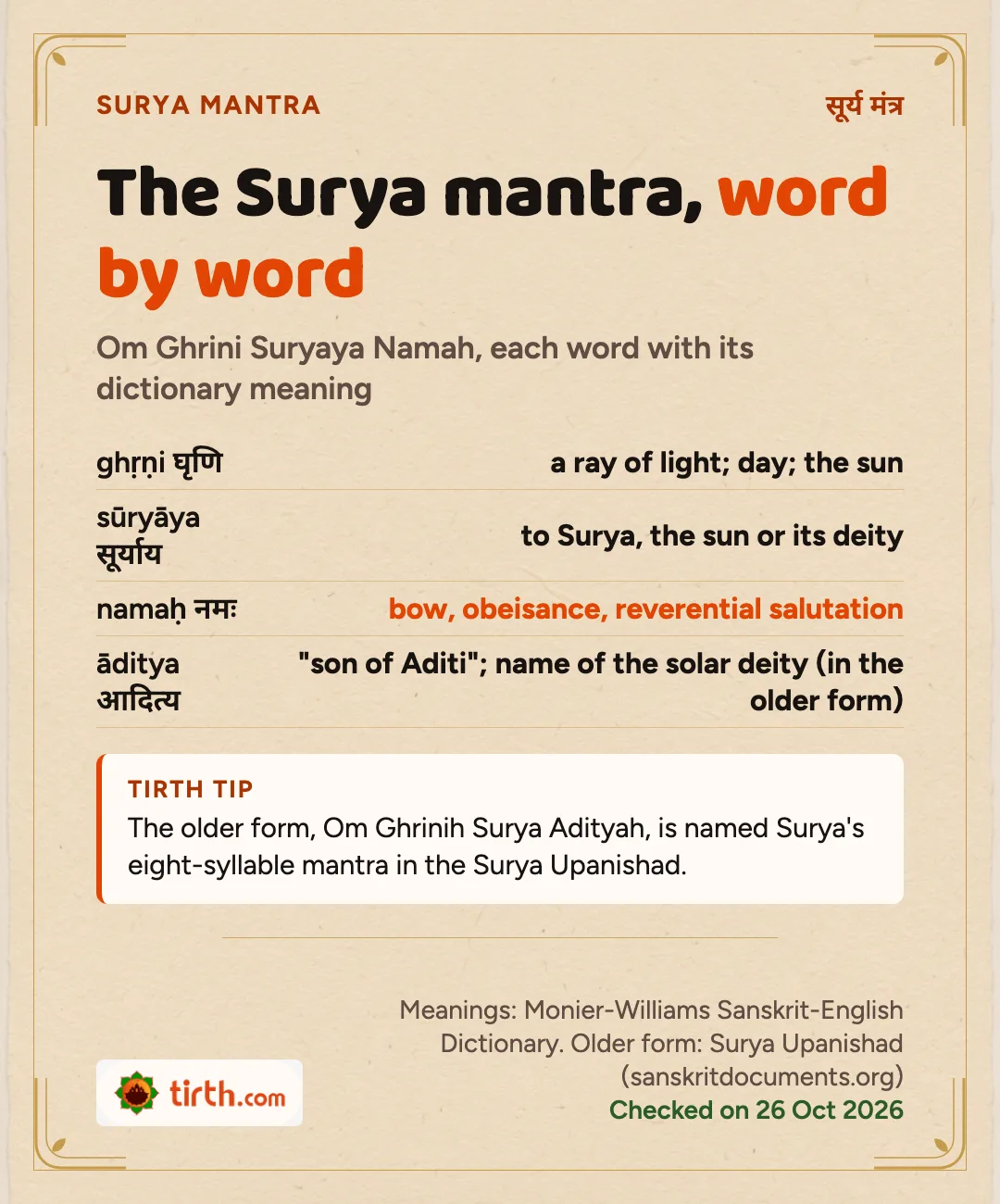
Put simply, the mantra bows to Surya as a ray of light. Leave Om aside and each word has a plain dictionary sense, which Monier-Williams gives like this.
| Word | Meaning (Monier-Williams) |
|---|---|
| ghṛṇi | a ray of light; day; the sun |
| sūrya | the sun or its deity |
| namaḥ (namas) | bow, obeisance, reverential salutation |
| āditya | “son of Aditi”; name of the solar deity |
That last word, āditya, is not in the short form at all. It comes from the older one. In the Surya Upanishad (a short text of the Atharvaveda) the syllables of Om Ghrinih Surya Adityah are counted out one by one, and the whole is named Surya’s eight-syllable mantra.
ओमित्येकाक्षरं ब्रह्म । घृणिरिति द्वे अक्षरे । सूर्य इत्यक्षरद्वयम् । आदित्य इति त्रीण्यक्षराणि । एतस्यैव सूर्यस्याष्टाक्षरो मनुः ।
Om ity ekākṣaraṁ brahma. Ghṛṇir iti dve akṣare. Sūrya ity akṣaradvayam. Āditya iti trīṇy akṣarāṇi. Etasyaiva sūryasyāṣṭākṣaro manuḥ.
Om is the one-syllable Brahman. Ghrinih is two syllables, Surya is two syllables, Aditya is three syllables. This is the eight-syllable mantra of this very Surya.
Learn just one, and we would make it this one. It is four words long, its root is in the Surya Upanishad, and every word is in the dictionary.
The Upanishad also makes a claim of its own. Chant facing the Sun, it says, and you are freed from the fear of great disease (सूर्याभिमुखो जप्त्वा महाव्याधिभयात्प्रमुच्यते). It wants the recitation at dawn and again at midday. We quote all of that as the text puts it. None of it is medical advice, and anyone who is ill still needs a doctor.
The Sun’s seed mantra, and the Surya Gayatri
In Navagraha japa, the recitation for the nine planets, this is the seed (beej) mantra used for the Sun. Its name in the Drik Panchang list is Surya Beeja Mantra. We could not trace it to a printed scripture, though, so it appears here only in the form people commonly recite.
ॐ ह्रां ह्रीं ह्रौं सः सूर्याय नमः
Oṁ hrāṁ hrīṁ hrauṁ saḥ sūryāya namaḥ
The seed syllables hrāṁ, hrīṁ and hrauṁ are not translated. Sūryāya namaḥ is the salutation to Surya.
The other eight grahas have theirs on the Navagraha mantras page.
Three lines, in the Gayatri pattern, make up the Surya Gayatri. Its widely recited form, the one Drik Panchang lists, has prabhakaraya in the middle line, while the Surya Upanishad gives a close form of its own that drops the Om and puts sahasrakiranaya (“the thousand-rayed”) where prabhakaraya stands.
आदित्याय विद्महे सहस्रकिरणाय धीमहि । तन्नः सूर्यः प्रचोदयात् ।
Ādityāya vidmahe sahasrakiraṇāya dhīmahi, tan naḥ sūryaḥ pracodayāt.
ॐ आदित्याय विद्महे प्रभाकराय धीमहि । तन्नः सूर्यः प्रचोदयात् ॥
Oṁ ādityāya vidmahe prabhākarāya dhīmahi, tan naḥ sūryaḥ pracodayāt.
Āditya and Sūrya are the two names of the Sun in it, the first meaning “son of Aditi”.
Aditya Hridayam: the hymn Agastya gave Shri Ram before the last battle
The setting is the battlefield of the Valmiki Ramayana, Yuddha Kanda, just before the final fight with Ravana, when the sage Agastya comes to Shri Ram and teaches him this hymn to the Sun. Verses 2 and 3 are Agastya talking. The hymn proper starts at verse 4.
In Monier-Williams, hridaya is the heart, or the core and essence of anything. The name, then, is the heart of Aditya.
Sarga numbers are a small nuisance here (they change with the edition you hold). Valmikiramayan.net gives the sarga as 105, while other editions number it differently and some print 107. A book that says 107 has the same hymn.
आदित्यहृदयं पुण्यं सर्वशत्रुविनाशनम् । जयावहं जपेन्नित्यमक्षय्यं परमं शिवम् ॥
Āditya-hṛdayaṁ puṇyaṁ sarva-śatru-vināśanam, jayāvahaṁ japen nityam akṣayyaṁ paramaṁ śivam.
Look closely at japen nityam, which the edition glosses as “is to be muttered” for japet and “at all times” for nityam. Some versions online read japa nityam instead; the edition reads japen nityam.
| Word | Meaning (valmikiramayan.net gloss) |
|---|---|
| puṇyam | is holy |
| sarva-śatru-vināśanam | which can destroy all the adversaries |
| jayāvaham | which can bestow victory |
| japet | is to be muttered |
| nityam | at all times |
| akṣayyam | giving undecaying prosperity |
| paramam śivam | supremely auspicious |
Verse 5 turns round and praises the hymn. Blessing of all blessings, destroyer of all sins, allayer of anxiety and grief, prolonger of life. That is how Agastya describes it, and those are the Ramayana’s words about its own hymn, so read them as what the text says and never as a result somebody can promise you. If you would like a priest to recite it for your family, the Aditya Hridayam puja in Ayodhya has a Tirth purohit recite the stotra eleven times in your name.
The Japakusuma bow, and the 12 names said in Surya Namaskar
Japakusuma opens the Navagraha Stotra, whose authorship is traditionally given to Vyasa. As its verse 1, Japakusuma is the Surya verse, the bow to the Sun.
जपाकुसुमसंकाशं काश्यपेयं महाद्युतिम् । तमोऽरिं सर्वपापघ्नं प्रणतोऽस्मि दिवाकरम् ॥
Japākusuma-saṅkāśaṁ kāśyapeyaṁ mahādyutim, tamo’riṁ sarva-pāpaghnaṁ praṇato’smi divākaram.
| Word | Meaning (Monier-Williams) |
|---|---|
| japā | the China rose (hibiscus) |
| kāśyapeya | a patronymic (descendant of Kaśyapa) of the twelve Ādityas; of the sun |
| dyuti (in mahādyutim) | splendour, brightness, lustre |
| tamas (in tamo’rim) | darkness |
| pāpa (in sarva-pāpaghnam) | bad, evil; sin |
| praṇata (in praṇato’smi) | bowed, saluted reverentially |
| divākara | “day-maker”, the sun |
Surya Namaskar comes with a set of its own. Twelve names of the Sun, each name said between Om and Namah, as in Om Mitraya Namah, Om Ravaye Namah etc. The order matters here.
| Order | Name | Meaning (Monier-Williams, where given) |
|---|---|---|
| 1 | Mitra | friend; name of an Āditya; the sun |
| 2 | Ravi | the sun or the sun-god; also Sunday |
| 3 | Surya | the sun or its deity |
| 4 | Bhanu | brightness, light, a ray; the sun |
| 5 | Khaga | moving in the air; a bird; the sun |
| 6 | Pushan | |
| 7 | Hiranyagarbha | |
| 8 | Marichi | |
| 9 | Aditya | “son of Aditi”; name of the solar deity |
| 10 | Savitr | |
| 11 | Arka | |
| 12 | Bhaskara |
Pushan, Hiranyagarbha, Marichi, Savitr, Arka and Bhaskara are glossed here only as names of Surya in the sequence.
In some yoga schools a seed syllable goes in front of each name. Those pairings vary from source to source, and we could not check a single one against a printed page, so they are left out (we would rather give none than give one wrong).
When and how do you say the Surya mantra?
Only two instructions come from the Surya Upanishad itself. Face the Sun. Recite at dawn or at midday. Sunday is Surya’s weekday, and the Sanskrit ravi even means Sunday, as in ravidina.
The texts quoted on this page give a time and a direction, and no count.
If your family already keeps a fixed number of rounds on the mala, stay with it, and if it does not, ask your family priest before you choose one. For the Chhath mantras, see our Chhath Puja mantras page. If you close with an aarti, the Surya Dev Aarti has the full words.
Ratha Saptami, the Saptami of the bright half of Magha, is the day traditionally kept as Surya Dev‘s birthday.
Ratha Saptami in 2027: Saturday, 13 February. Saptami tithi: 2:58 AM, 13 February to 2:06 AM, 14 February. Sunrise in New Delhi: 7:01 AM.
Checked on 26 Oct 2026. Ratha Saptami timings for your city in the Tirth Spiritual Calendar
Also on Tirth, the Surya Dev Chalisa and a post on Makar Sankranti.
Frequently asked questions
Which is the most powerful Surya mantra?
No text puts them in a ranking. The form most often recited is Om Ghrini Suryaya Namah (Drik Panchang lists it as the Surya Moola Mantra), and its source, the eight-syllable mantra of the Surya Upanishad, is the clearest of any of them. Want a story behind your mantra? Then it is the Aditya Hridayam, which Agastya taught Shri Ram in the Valmiki Ramayana.
What is the Surya mantra in English?
In English letters you write it Om Ghrini Suryaya Namah. Its words make a reverential salutation (namah) to Surya, the Sun, as ghrini, a ray of light.
What does Om Ghrini Suryaya Namah mean?
Ghrini, says Monier-Williams, is a ray of light, day or the sun. Surya is the sun or its deity, and namah a bow or reverential salutation. So the line bows to the Sun as light. The longer form it comes from is Om Ghrinih Surya Adityah, in the Surya Upanishad.
How many times should the Surya mantra be chanted?
No number is given. The Surya Upanishad names a time, dawn and midday, and a direction, facing the Sun, so go by your family’s custom or ask your family priest.
What is the best time to chant the Surya mantra?
Dawn and midday are the two times the Surya Upanishad gives, and it wants the one reciting to face the Sun.
Can the Surya mantra be chanted only on Sunday?
No. Sunday (Ravivar) is Surya’s weekday, but the Surya Upanishad speaks only of dawn and midday and names no weekday at all. Say it every morning if you like.