
Tulsi Chalisa: full Hindi text, English letters and line by line meaning
Tirth editorial · 3 Jan 2026 · 14 min read
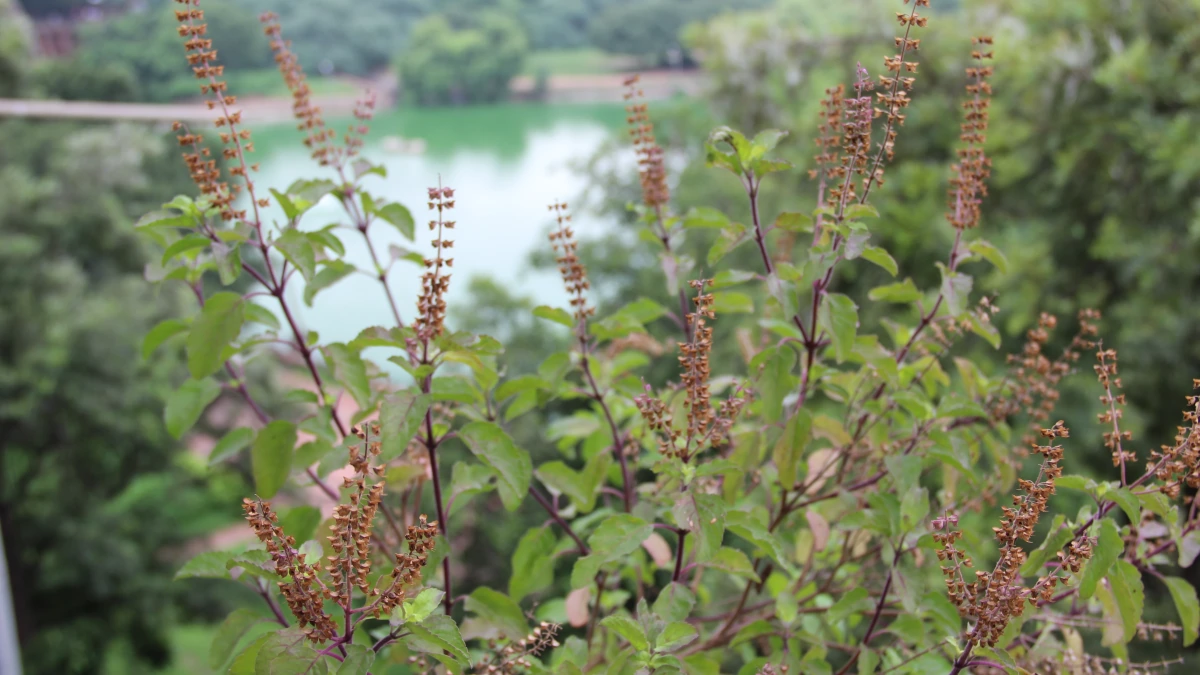
The Tulsi Chalisa, read in Tulsi puja, is a Hindi prayer to Tulsi Mata that begins “Namo namo Tulsi Maharani”, with an opening doha, 38 chaupais and a closing doha. The chalisa itself praises daily worship and singles out one month by name, Kartik, the month in which Tulasi Vivah falls.
The words on this page are the “Shri Tulsi Chalisa” printed on pages 226 to 229 of 51 Chalisa Sangrah Artiyon Sahit (Randhir Prakashan, Haridwar, 2004), read from the scan of that book on the Internet Archive. The book names no author, and no other source we checked names one. The day of Tulasi Vivah moves from year to year, so the Tulasi Vivah date and timings for your city are kept on the Tirth Spiritual Calendar.
Tulsi Chalisa lyrics in Hindi
Read it aloud the first few times. The two halves of every chaupai rhyme, all but one, so the ear catches a dropped or swapped word before the eye does (गाया, gaaya, and पाया, paaya, in chaupai 17, for one).
श्री तुलसी महारानी, करूँ विनय सिरनाय। जो मम हो संकट विकट, दीजै मात नशाय॥
नमो नमो तुलसी महारानी, महिमा अमित न जाय बखानी।
दियो विष्णु तुमको सनमाना, जग में छायो सुयश महाना।
विष्णुप्रिया जय जयति भवानि, तिहूं लोक की हो सुखखानी।
भगवत पूजा कर जो कोई, बिना तुम्हारे सफल न होई।
जिन घर तव नहिं होय निवासा, उस पर करहिं विष्णु नहिं बासा।
करे सदा जो तव नित सुमिरन, तेहिके काज होय सब पूरन।
कातिक मास महात्म तुम्हारा, ताको जानत सब संसारा।
तव पूजन जो करैं कुंवारी, पावै सुन्दर वर सुकुमारी।
कर जो पूजा नितप्रति नारी, सुख सम्पत्ति से होय सुखारी।
वृद्धा नारी करै जो पूजन, मिले भक्ति होवै पुलकित मन।
श्रद्धा से पूजै जो कोई, भवनिधि से तर जावै सोई।
कथा भागवत यज्ञ करावै, तुम बिन नहीं सफलता पावै।
छायो तब प्रताप जगभारी, ध्यावत तुमहिं सकल चितधारी।
तुम्हीं मात यंत्रन तंत्रन में, सकल काज सिधि होवै क्षण में।
औषधि रूप आप हो माता, सब जग में तव यश विख्याता।
देव रिषी मुनि औ तपधारी, करत सदा तव जय जयकारी।
वेद पुरानन तव यश गाया, महिमा अगम पार नहिं पाया।
नमो नमो जै जै सुखकारनि, नमो नमो जै दुखनिवारनि।
नमो नमो सुखसम्पति देनी, नमो नमो अघ काटन छेनी।
नमो नमो भक्तन दुःख हरनी, नमो नमो दुष्टन मद छेनी।
नमो नमो भव पार उतारनि, नमो नमो परलोक सुधारनि।
नमो नमो निज भक्त उबारनि, नमो नमो जनकाज संवारनि।
नमो नमो जय कुमति नशावनि, नमो नमो सब सुख उपजावनि।
जयति जयति जय तुलसीमाई, ध्याऊँ तुमको शीश नवाई।
निजजन जानि मोहि अपनाओ, बिगड़े कारज आप बनाओ।
करूँ विनय मैं मात तुम्हारी, पूरण आशा करहु हमारी।
शरण चरण कर जोरि मनाऊँ, निशदिन तेरे ही गुण गाऊँ।
करहु मात यह अब मोपर दाया, निर्मल होय सकल ममकाया।
मांगू मात यह बर दीजै, सकल मनोरथ पूर्ण कीजै।
जानूं नहिं कुछ नेम अचारा, छमहु मात अपराध हमारा।
बारह मास करै जो पूजा, ता सम जग में और न दूजा।
प्रथमहि गंगाजल मंगवावे, फिर सुन्दर स्नान करावे।
चन्दन अक्षत पुष्प चढ़ावे, धूप दीप नैवेद्य लगावे।
करे आचमन गंगा जल से, ध्यान करे हृदय निर्मल से।
पाठ करे फिर चालीसा की, अस्तुति करे मात तुलसा की।
यह विधि पूजा करे हमेशा, ताके तन नहिं रहै क्लेशा।
करै मास कार्तिक का साधन, सोवे नित पवित्र सिध हुई जाहीं।
है यह कथा महा सुखदाई, पढ़ै सुने सो भव तर जाई।
यह श्री तुलसी चालीसा पाठ करे जो कोय। गोविन्द सो फल पावही जो मन इच्छा होय॥
Six words where copies drift from the printed book
The earlier version of this page carried six small copying slips, and all six also appear on two other pages we checked, srimandir.com and hindunidhi.com. Each one differs from the 2004 printing, and two of them, दया (daya) and तुलसी (Tulsi), also break the rhyme. That is why the text above follows the book word for word.
| Where | As printed (2004) | On srimandir.com and hindunidhi.com |
|---|---|---|
| Chaupai 1 | न जाय बखानी (na jaay) | न जाए बखानी (na jaaye) |
| Chaupai 9 | नितप्रति नारी (nitprati, every day) | नितप्रीति नारी (nit preeti) |
| Chaupai 16 | मुनि औ तपधारी (au) | मुनि और तपधारी (aur) |
| Chaupai 19 | सुखसम्पति देनी (sukhsampati) | सुखसम्पत्ति देनी (sukhsampatti) |
| Chaupai 28 | मोपर दाया (daaya, rhymes with ममकाया, mamkaya) | मोपर दया (daya) |
| Chaupai 35 | मात तुलसा की (Tulsa, rhymes with चालीसा की, chalisa ki) | मात तुलसी की (Tulsi) |
One line has been left exactly as it is. Chaupai 37, “करै मास कार्तिक का साधन, सोवे नित पवित्र सिध हुई जाहीं” (karai maas Kartik ka sadhan, sove nit pavitra sidh hui jaahin), does not rhyme and its second half is hard to make sense of. We would rather print it as the book does than smooth it into a line nobody ever printed, because every source we checked carries it unchanged. If your family’s book reads differently in other places, it may be another edition, or another text going by the same name.
In chaupai 17 the last word is clipped at the edge of the scan. The strokes that show begin like पाया (paaya), and the word rhymes with गाया (gaaya), so that is what we print; the other copies we checked read the same.
Tulsi Chalisa in English letters, with the meaning of each line
Not everyone in the family reads Devanagari with ease.
The table below gives each line in Roman letters beside a plain English meaning, so a grandchild who reads Hindi slowly can follow along while someone else leads the reading at the plant. Long vowels are doubled only where the sound needs it (maat, deejai, paavai). Nothing else is marked.
The meanings are Tirth’s own, kept close to the Hindi, and for the harder words we leaned on Platts’ dictionary. Agh is sin. A chheni is a chisel, so “agh kaatan chheni” in chaupai 19 becomes the chisel that cuts away sin, and since bhav is worldly existence and nidhi can mean an ocean, bhavnidhi in chaupai 11 is the ocean of worldly existence that the faithful worshipper crosses.
| Line | In English letters | Plain meaning (Tirth’s rendering) |
|---|---|---|
| Opening doha | Shri Tulsi Maharani, karun vinay sirnaay. Jo mam ho sankat vikat, deejai maat nashaay. | O Shri Tulsi Maharani, I make my plea to you with my head bowed. Whatever grave trouble is mine, Mother, destroy it. |
| Chaupai 1 | Namo namo Tulsi Maharani, mahima amit na jaay bakhani. | Salutations, salutations to Tulsi Maharani. Your greatness is boundless and cannot be told in full. |
| Chaupai 2 | Diyo Vishnu tumko sanmana, jag mein chhayo suyash mahana. | Vishnu gave you honour, and your great fame has spread across the world. |
| Chaupai 3 | Vishnupriya jay jayati Bhavani, tihun lok ki ho sukhkhani. | Victory to you, Vishnupriya (beloved of Vishnu), Bhavani. You are the source of happiness for the three worlds. |
| Chaupai 4 | Bhagvat puja kar jo koi, bina tumhare saphal na hoi. | Whoever worships Bhagwan, that worship does not succeed without you. |
| Chaupai 5 | Jin ghar tav nahin hoy nivasa, us par karahin Vishnu nahin basa. | In a home where you do not dwell, Vishnu does not make his dwelling either. |
| Chaupai 6 | Kare sada jo tav nit sumiran, tehike kaaj hoy sab puran. | Whoever remembers you always, every day, has all their work brought to completion. |
| Chaupai 7 | Katik maas mahatm tumhara, taako jaanat sab sansara. | Your greatness in the month of Kartik is known to the whole world. |
| Chaupai 8 | Tav pujan jo karain kunvari, paavai sundar var sukumari. | An unmarried girl who worships you, tender as she is, gains a fine husband. |
| Chaupai 9 | Kar jo puja nitprati nari, sukh sampatti se hoy sukhari. | A woman who worships you every day is made happy with comfort and wealth. |
| Chaupai 10 | Vriddha nari karai jo pujan, mile bhakti hovai pulkit man. | An elderly woman who worships you gains devotion, and her mind thrills with joy. |
| Chaupai 11 | Shraddha se pujai jo koi, bhavnidhi se tar jaavai soi. | Whoever worships you with faith crosses the ocean of worldly existence. |
| Chaupai 12 | Katha Bhagvat yagya karavai, tum bin nahin saphalta paavai. | Whoever has a katha, a Bhagavat reading or a yagya performed finds no success without you. |
| Chaupai 13 | Chhayo tab pratap jagbhari, dhyavat tumahin sakal chitdhari. | Your glory has spread over the whole world, and everyone who holds you in mind meditates on you. |
| Chaupai 14 | Tumhin maat yantran tantran mein, sakal kaaj sidhi hovai kshan mein. | You, Mother, are within yantras and tantras; through you every task is accomplished in a moment. |
| Chaupai 15 | Aushadhi roop aap ho mata, sab jag mein tav yash vikhyata. | You, Mother, are in the form of medicine, and your fame is known through all the world. |
| Chaupai 16 | Dev rishi muni au tapdhari, karat sada tav jay jaykari. | Gods, rishis, munis and ascetics always sing your praise. |
| Chaupai 17 | Ved puranan tav yash gaya, mahima agam paar nahin paya. | The Vedas and Puranas have sung your fame; your greatness is beyond reach and none has found its end. |
| Chaupai 18 | Namo namo jai jai sukhkarani, namo namo jai dukhnivarani. | Salutations and victory to you who bring happiness; salutations and victory to you who remove sorrow. |
| Chaupai 19 | Namo namo sukhsampati deni, namo namo agh kaatan chheni. | Salutations to you who give happiness and wealth; salutations to you, the chisel that cuts away sin. |
| Chaupai 20 | Namo namo bhaktan dukh harani, namo namo dushtan mad chheni. | Salutations to you who take away the sorrow of devotees; salutations to you who pierce the pride of the wicked. |
| Chaupai 21 | Namo namo bhav paar utarani, namo namo parlok sudharani. | Salutations to you who carry us across worldly existence; salutations to you who set right the world beyond. |
| Chaupai 22 | Namo namo nij bhakt ubarani, namo namo jankaaj sanvarani. | Salutations to you who rescue your own devotees; salutations to you who put people’s work in order. |
| Chaupai 23 | Namo namo jay kumati nashavani, namo namo sab sukh upjavani. | Salutations and victory to you who destroy bad thinking; salutations to you who bring forth every happiness. |
| Chaupai 24 | Jayati jayati jay Tulsimai, dhyaun tumko sheesh navai. | Victory, victory to Mother Tulsi. I meditate on you with my head bowed. |
| Chaupai 25 | Nijjan jaani mohi apnao, bigde karaj aap banao. | Know me as your own and take me in; set right, yourself, the work that has gone wrong. |
| Chaupai 26 | Karun vinay main maat tumhari, puran aasha karahu hamari. | I make my plea to you, Mother: fulfil our hopes. |
| Chaupai 27 | Sharan charan kar jori manaun, nishdin tere hi gun gaaun. | Taking refuge at your feet, with joined hands I pray, and day and night I sing your qualities alone. |
| Chaupai 28 | Karahu maat yah ab mopar daaya, nirmal hoy sakal mamkaya. | Mother, be kind to me now, so that my whole body becomes pure. |
| Chaupai 29 | Mangun maat yah bar deejai, sakal manorath purn keejai. | I ask you, Mother, give me this boon: fulfil every wish. |
| Chaupai 30 | Jaanun nahin kuchh nem achara, chhamahu maat apradh hamara. | I know nothing of rules and observances; forgive our faults, Mother. |
| Chaupai 31 | Barah maas karai jo puja, ta sam jag mein aur na dooja. | Whoever worships you through all twelve months has no equal in the world. |
| Chaupai 32 | Prathamahi Gangajal mangvave, phir sundar snaan karave. | First have Ganga water brought, then give a fine bath. |
| Chaupai 33 | Chandan akshat pushp chadhave, dhoop deep naivedya lagave. | Offer sandal paste, akshat and flowers, then incense, lamp and naivedya. |
| Chaupai 34 | Kare aachman Ganga jal se, dhyan kare hriday nirmal se. | Do achaman with Ganga water (sip a little water from the palm to purify yourself), then meditate with a clean heart. |
| Chaupai 35 | Paath kare phir chalisa ki, astuti kare maat Tulsa ki. | Then read the chalisa, and sing the praise of Mother Tulsa. |
| Chaupai 36 | Yah vidhi puja kare hamesha, taake tan nahin rahai klesha. | Whoever worships this way always, no suffering stays in their body. |
| Chaupai 37 | Karai maas Kartik ka sadhan, sove nit pavitra sidh hui jaahin. | Whoever keeps the sadhana of the month of Kartik; the second half is printed this way in every source we checked, and its sense is unclear, so we leave it unrendered. |
| Chaupai 38 | Hai yah katha maha sukhdai, padhai sune so bhav tar jaai. | This katha gives great happiness; whoever reads or hears it crosses over worldly existence. |
| Closing doha | Yah Shri Tulsi Chalisa paath kare jo koy. Govind so phal paavahi jo man ichchha hoy. | Whoever reads this Shri Tulsi Chalisa receives from Govind the fruit the heart desires. |
Sukumari, in chaupai 8, describes the girl herself and comes from sukumar, which Platts gives as youthful, tender or elegant. Chaupai 37 stays half rendered.
How the chalisa itself lays out Tulsi puja
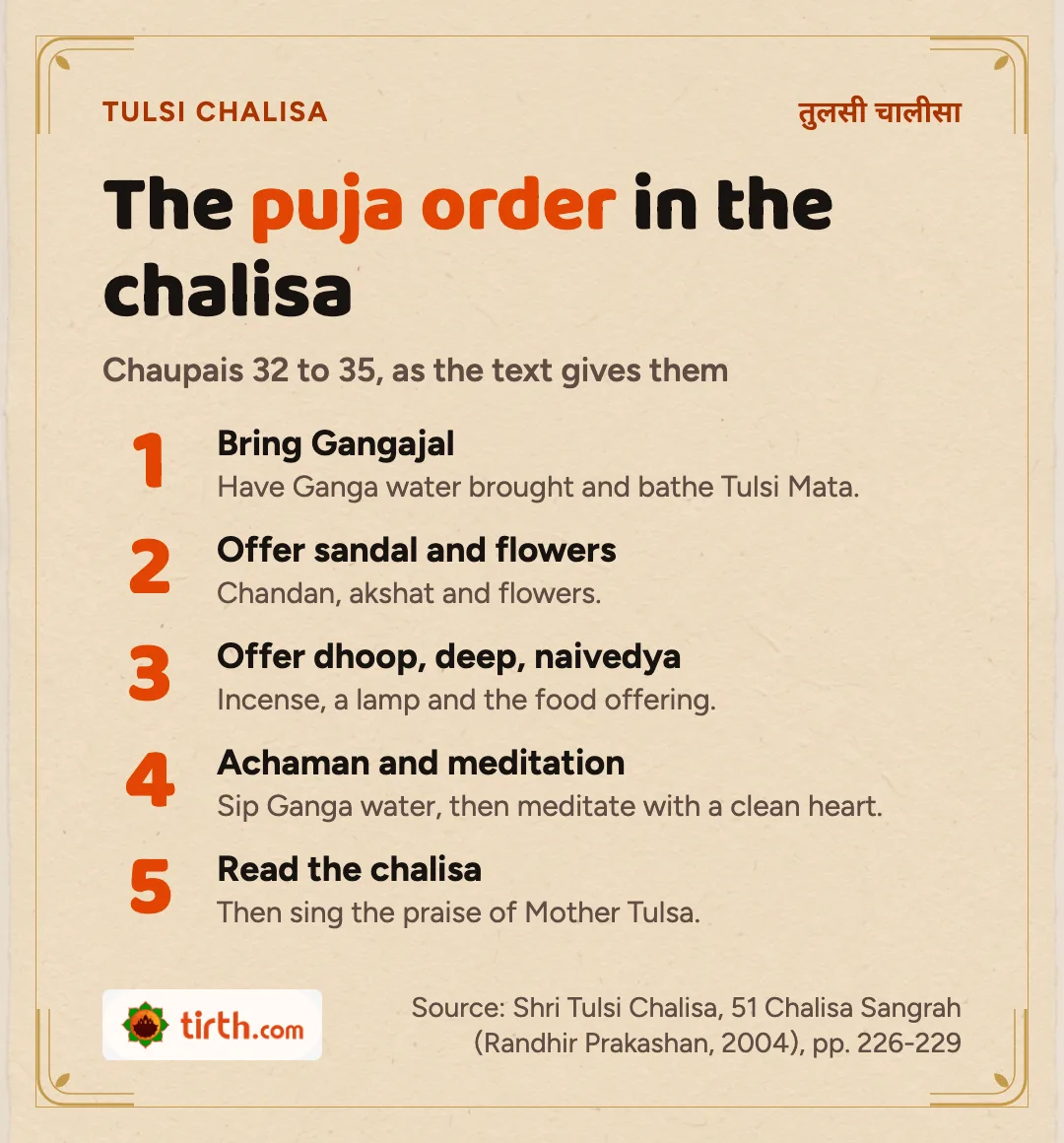
Chaupais 32 to 35 are a small puja vidhi tucked inside the prayer itself, so no separate book is needed. The chalisa says to go in this order:
- Have Gangajal (Ganga water) brought.
- Give Tulsi Mata a fine bath (sundar snaan).
- Offer chandan (sandal paste), akshat and flowers.
- Offer dhoop, deep and naivedya: incense, a lamp and the food offering.
- Do achaman with Ganga water, which Platts describes as sipping a little water from the palm to purify yourself before a religious ceremony.
- Meditate with a clean heart.
- Read the chalisa, then sing the praise of Mother Tulsa.
The printed text (pages 226 to 229) sets no hour of the day and no number of readings, and it asks for no fast either; we have added none.
If you also want a short mantra to say at the plant, our Tulsi mantra page has them, and for anyone who counts a mantra on beads, Tirth Shop has a natural Tulsi mala.
What the chalisa says it gives
The phalashruti, the lines that name the reward, is spread through the text instead of being kept for the end. In chaupai 8 the chalisa says an unmarried girl who worships Tulsi gains a fine husband. By chaupai 9 the woman who worships every day is made happy with comfort and wealth, and by chaupai 10 the elderly woman who worships gains devotion. Chaupai 31 says nobody in the world equals the one who worships through all twelve months. The closing doha says whoever reads the chalisa receives from Govind the fruit the heart desires.
These are the chalisa’s own words about itself. Tirth reports them; it does not promise them. Chaupai 15 calls Tulsi a medicine in form (aushadhi roop), which is praise in a prayer, not advice to treat an illness with the plant.
Chaupai 5 puts it the other way round: a home where Tulsi does not dwell, it says, is a home where Vishnu does not dwell either.
Reading it through Kartik and on Tulasi Vivah
Kartik is the only month the chalisa names, and it names it twice. Chaupai 7 says Tulsi’s greatness in Kartik (कातिक, Kaatik, in the printed spelling) is known to the whole world, and chaupai 37 speaks of keeping the sadhana of the month. Tulasi Vivah falls in Kartik too. Its day moves each year and can sit close to sunrise, so the city you are in matters; see the Tulasi Vivah timings for your city.
If you are choosing between reading it once on Tulasi Vivah and reading it through the month, the text points to the second, and asks for more than that: chaupai 6 praises remembrance every day, and chaupai 31 for worship across all twelve months. For the stories told through Kartik, read our Kartika Mahatmya katha.
For Vishnu himself, whose Bhagwan Vishnu page sits beside this one, there is the Vishnu Chalisa and the Vishnu aarti, and for Lakshmi the Mahalakshmi Chalisa. Other chalisas are gathered in our chalisa collection.
Frequently asked questions
Who wrote the Tulsi Chalisa?
No author is named. The 2004 Randhir Prakashan printing gives the text without one, and none of the other sources we checked names one, so this page credits nobody.
How many verses are in the Tulsi Chalisa?
There are 38 chaupais, with a doha before them and another after. Each chaupai is a rhyming couplet, apart from chaupai 37, which does not rhyme as printed.
When should the Tulsi Chalisa be read?
The chalisa praises daily remembrance (chaupai 6) and places its own reading inside a short puja, after the offerings, achaman and meditation (chaupais 32 to 35). It names no particular hour.
Should it be read daily or only on Tulasi Vivah?
The text leans towards daily. It praises the woman who worships every day (chaupai 9) and worship through all twelve months (chaupai 31), and it singles out Kartik, the month of Tulasi Vivah.
What does the Tulsi Chalisa say about Kartik?
Chaupai 7 says Tulsi’s greatness in Kartik is known to the whole world, and chaupai 37 speaks of keeping the Kartik sadhana. The second half of chaupai 37 is unclear as printed, so we have left it unrendered.
How do you do Tulsi puja with the Tulsi Chalisa?
Follow the order the chalisa gives in chaupais 32 to 35: Ganga water, a bath for Tulsi Mata, sandal paste, akshat and flowers, incense, lamp and naivedya, achaman, meditation, and then the reading itself.
Continue on Tirth
- Tulasi Vivah timings by city, Tirth Spiritual Calendar