
Shri Ram Chalisa in Hindi and English, with the meaning of each couplet
Tirth editorial · 3 Jan 2026 · 16 min read

The Ram Chalisa is a short devotional hymn to Shri Ram, and its own closing lines name the man who sang it, Haridas. Below is the full text in Devanagari and Roman letters with a plain-English meaning for every couplet, and its closing doha asks for seven days of reading with a settled mind.
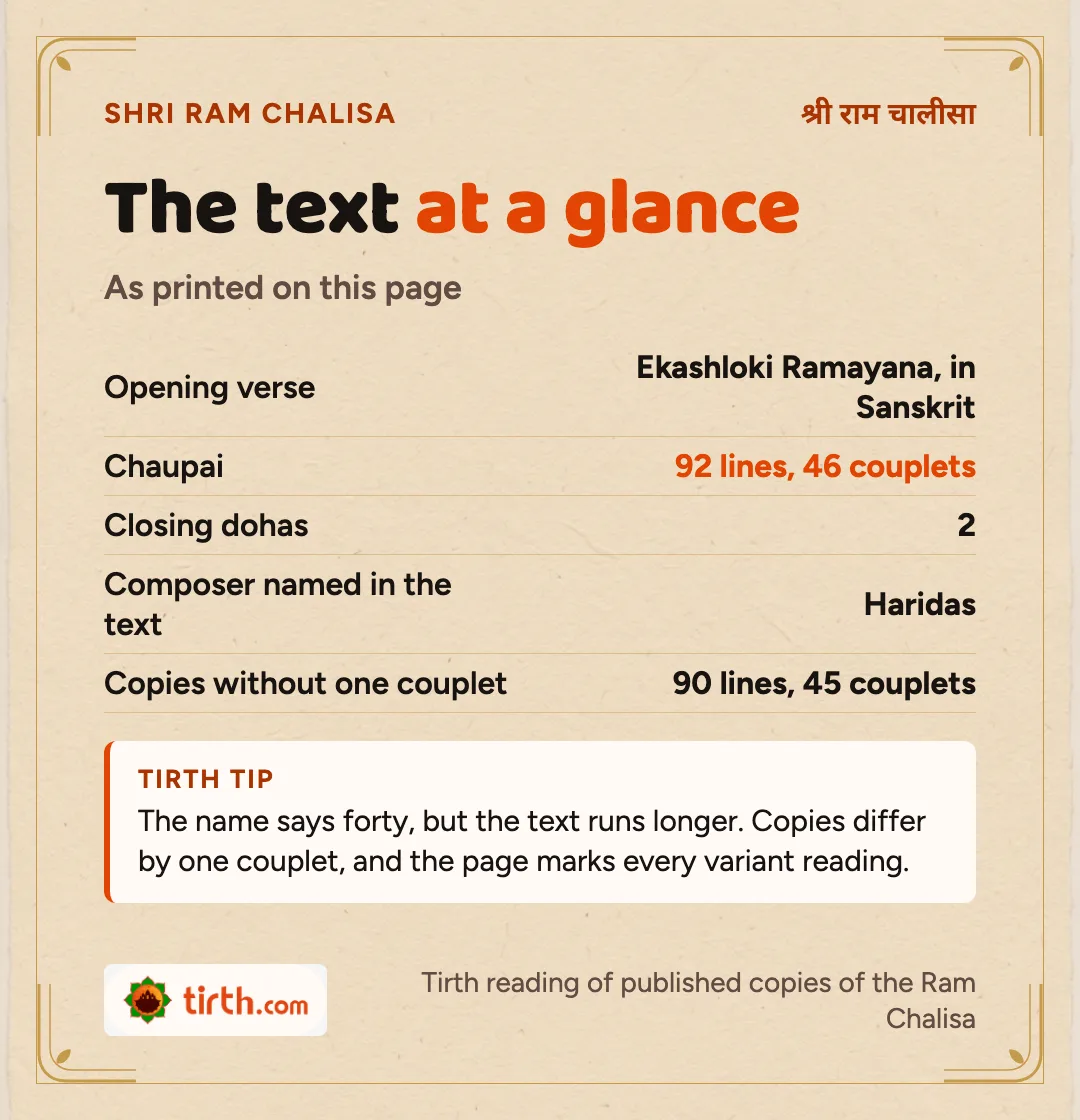
Count the chaupai from “Shri Raghubir bhakt hitkari” down to “So Baikunth Dham ko paavai” and the version on this page comes to 92 lines, or 46 couplets, while the printing that leaves out one couplet runs two lines shorter. Neither is forty verses. Hanuman ji turns up in the fourth couplet as Ram’s messenger (his own hymn is the Hanuman Chalisa), and the brothers Bharat, Lakhan and Shatrughan each get a couplet of their own further down.
Adau Ram tapovanadi, the Sanskrit verse printed before the chalisa
The verse at the top is a Sanskrit shloka known as the Ekashloki Ramayana, the whole Ramayana fitted into four lines.
Read it slowly and the story goes past in order. Shri Ram goes to the forest, the golden deer is killed, Sita ji is carried off and Jatayu dies, then Ram meets Sugriva, Vali falls, the sea is crossed and Lanka burns, and only at the very end are Ravan and Kumbhakarna killed.
The copy that ran on this page earlier had three slips in it, “hatvaah mrigaa” for “hatvaa mrigam”, “Baali nirdalan” for “Vaali nigrahanam” and “Pashchaadraavanam” run together. Several popular sites print the very same slips. We have not. The verse below follows the standard reading published by Shlokam and Vedanta Today.
| Sanskrit and Roman | Meaning (Tirth’s rendering) |
|---|---|
| आदौ राम तपोवनादि गमनं हत्वा मृगं कांचनं। वैदेही हरणं जटायु मरणं सुग्रीव संभाषणम्॥ वाली निग्रहणं समुद्र तरणं लंकापुरी दाहनं। पश्चात् रावण कुंभकर्ण हननं एतद्धि रामायणम्॥ Aadau Ram tapovanaadi gamanam hatvaa mrigam kaanchanam। Vaidehi haranam Jatayu maranam Sugreev sambhaashanam॥ Vaali nigrahanam samudra taranam Lankaapuri daahanam। Pashchaat Ravan Kumbhakarna hananam etaddhi Ramayanam॥ | First Ram goes to the forest hermitages and kills the golden deer. Vaidehi is carried off, Jatayu dies and Ram speaks with Sugriva. Vali is brought down, the sea is crossed and Lanka burns. After that Ravan and Kumbhakarna are killed. This is the Ramayana. |
If your family sings the Ramayana itself at home, the Aarti of Shri Ramayana ji belongs beside this verse.
Shri Raghubir bhakt hitkari, the Ram Chalisa in Hindi and English with meaning
The 46 couplets below are the text as commonly printed and recited, in the same wording this page has always carried. Two spellings in the Devanagari are set right, a broken conjunct in brahm in the 32nd couplet and the word swaroopa, which the 32nd and 36th couplets both carry. Nothing else in the lines has been touched, even where other copies read differently. Those places are listed further down.
The meanings are Tirth’s plain reading of each line, and copies of the text differ in places. On a phone, turn it sideways if the table feels cramped.
| No. | Hindi and Roman | Meaning (Tirth’s rendering) |
|---|---|---|
| 1 | श्री रघुबीर भक्त हितकारी। सुनि लीजै प्रभु अरज हमारी॥ Shri Raghubeer bhakt hitkaari, Suni lijai Prabhu arj hamaari॥ | Shri Raghubir, friend and well-wisher of your devotees, Lord, please hear our plea. |
| 2 | निशि दिन ध्यान धरै जो कोई। ता सम भक्त और नहीं होई॥ Nishi din dhyan dharai jo koi, Ta sam bhakt aur nahin hoi॥ | Whoever keeps you in mind night and day, there is no devotee to equal that person. |
| 3 | ध्यान धरें शिवजी मन मांही। ब्रह्मा, इन्द्र पार नहीं पाहीं॥ Dhyan dharein Shivji man maahin, Brahma, Indra paar nahin paahin॥ | Shiv ji meditates on you within his heart, and even Brahma and Indra cannot find the end of you. |
| 4 | दूत तुम्हार वीर हनुमाना। जासु प्रभाव तिहुं पुर जाना॥ Doot tumhar Veer Hanumana, Jaasu prabhav tihu pur jaana॥ | Your messenger is the brave Hanuman, whose might is known in all three worlds. |
| 5 | जय, जय, जय रघुनाथ कृपाला। सदा करो संतन प्रतिपाला॥ Jai, Jai, Jai Raghunath Kripala, Sada karo santan pratipala॥ | Victory to the merciful Raghunath, who always looks after the saints. |
| 6 | तुव भुजदण्ड प्रचण्ड कृपाला। रावण मारि सुरन प्रतिपाला॥ Tuv bhujdand prachand Kripala, Ravan maari suran pratipala॥ | Merciful one, with your mighty arms you killed Ravan and kept the gods safe. |
| 7 | तुम अनाथ के नाथ गोसाईं। दीनन के हो सदा सहाई॥ Tum anath ke nath Gosain, Deenan ke ho sada sahaayi॥ | Master, you are the protector of those who have no one, and always the helper of the poor. |
| 8 | ब्रह्मादिक तव पार न पावैं। सदा ईश तुम्हरो यश गावैं॥ Brahmadik tav paar na paavai, Sada Ish tumharo yash gaavai॥ | Brahma and the others cannot reach your end, and Ish always sings your praise. |
| 9 | चारिउ भेद भरत हैं साखी। तुम भक्तन की लज्जा राखी॥ Charihu bhed Bharat hain saakhi, Tum bhaktan ki lajja raakhi॥ | The four (ved in other copies) and Bharat are witness that you kept the honour of those devoted to you. |
| 10 | गुण गावत शारद मन माहीं। सुरपति ताको पार न पाहिं॥ Gun gaavat Sharad man maahin, Surpati taako paar na paahin॥ | Sharada sings your virtues in her heart, and Indra, king of the gods, cannot reach their end. |
| 11 | नाम तुम्हार लेत जो कोई। ता सम धन्य और नहीं होई॥ Naam tumhar let jo koi, Ta sam dhanya aur nahin hoi॥ | Whoever takes your name, no one is as blessed as that person. |
| 12 | राम नाम है अपरम्पारा। चारिहु वेदन जाहि पुकारा॥ Ram naam hai aparmpara, Charihu vedan jahi pukaara॥ | The name Ram has no limit. It is the name all four Vedas call out. |
| 13 | गणपति नाम तुम्हारो लीन्हो। तिनको प्रथम पूज्य तुम कीन्हो॥ Ganpati naam tumharo leenho, Tinko pratham poojya tum keenho॥ | Ganpati took your name, and you made him the one worshipped first. |
| 14 | शेष रटत नित नाम तुम्हारा। महि को भार शीश पर धारा॥ Shesh ratat nit naam tumhara, Mahi ko bhaar sheesh par dhaara॥ | Shesh repeats your name every day and carries the weight of the earth on his head. |
| 15 | फूल समान रहत सो भारा। पावत कोऊ न तुम्हरो पारा॥ Phool samaan rahat so bhaara, Paavat kou na tumharo paara॥ | That weight sits on him as light as a flower. No one finds the end of your greatness. |
| 16 | भरत नाम तुम्हरो उर धारो। तासों कबहूं न रण में हारो॥ Bharat naam tumharo ur dhaaro, Taaso kabahun na ran me haaro॥ | Bharat held your name in his heart, and so he never lost in battle. |
| 17 | नाम शत्रुहन हृदय प्रकाशा। सुमिरत होत शत्रु कर नाशा॥ Naam Shatrughan hriday prakaasha, Sumirat hot shatru kar naasha॥ | Your name shines in Shatrughan’s heart, and remembering it, he brings his enemies to an end. |
| 18 | लखन तुम्हारे आज्ञाकारी। सदा करत सन्तन रखवारी॥ Lakhan tumhare aagyaakaari, Sada karat santan rakhvaari॥ | Lakhan does as you bid and always stands guard over the saints. |
| 19 | ताते रण जीते नहिं कोई। युद्ध जुरे यमहूं किन होई॥ Taate ran jeete nahin koi, Yuddh jure yamhun kin hoi॥ | So no one can beat him in battle, even if Yama himself joins the fight. |
| 20 | महालक्ष्मी धर अवतारा। सब विधि करत पाप को छारा॥ Mahalakshmi dhar avataara, Sab vidhi karat paap ko chaara॥ | Mahalakshmi took birth on earth, and in every way she turns sin to ash. |
| 21 | सीता राम पुनीता गायो। भुवनेश्वरी प्रभाव दिखायो॥ Sita Ram punita gaayo, Bhuvaneshwari prabhav dikhayo॥ | Sita and Ram, the pure, are sung, and Bhuvaneshwari’s power is shown. |
| 22 | घट सों प्रकट भई सो आई। जाको देखत चन्द्र लजाई॥ Ghat son prakat bhai so aayi, Jako dekh chandra lajaayi॥ | She came forth from a ghat, and on seeing her the moon is shy. |
| 23 | जो तुम्हरे नित पांव पलोटत। नवो निद्धि चरणन में लोटत॥ Jo tumhare nit paav palotat, Navo niddhi charanan me lotat॥ | The text says the nine treasures lie at the feet of the one who serves your feet each day. |
| 24 | सिद्धि अठारह मंगलकारी। सो तुम पर जावै बलिहारी॥ Siddhi atharah mangalkaari, So tum par jaavai balihaari॥ | The eighteen siddhis that bring good all give themselves up to you. |
| 25 | औरहु जो अनेक प्रभुताई। सो सीतापति तुमहिं बनाई॥ Aurahu jo anek prabhutayi, So Sitapati tumhin banaayi॥ | Every other kind of greatness there is, you made it, lord of Sita. |
| 26 | इच्छा ते कोटिन संसारा। रचत न लागत पल की बारा॥ Ichha te kotin sansara, Rachat na laagat pal ki baara॥ | By your wish alone millions of worlds are made, and it takes you less than a moment. |
| 27 | जो तुम्हरे चरणन चित लावै। ताकी मुक्ति अवसि हो जावै॥ Jo tumhare charanan chit laavai, Taki mukti avasi ho jaavai॥ | Whoever sets the mind on your feet, the text says, is surely set free. |
| 28 | सुनहु राम तुम तात हमारे। तुमहिं भरत कुल पूज्य प्रचारे॥ Sunahu Ram tum taat hamaare, Tumhin Bharat kul poojya prachaare॥ | Hear us, Ram, you are our father. You are made known as the one the Bharat kul worships. |
| 29 | तुमहिं देव कुल देव हमारे। तुम गुरु देव प्राण के प्यारे॥ Tumhin Dev kul Dev hamaare, Tum Guru Dev praan ke pyaare॥ | You are our god and our family god, our guru, dearer to us than life. |
| 30 | जो कुछ हो सो तुमहिं राजा। जय जय जय प्रभु राखो लाजा॥ Jo kuchh ho so tumhin raja, Jai Jai Jai Prabhu raakho laaja॥ | Whatever there is, you are its king. Victory to you, Lord, keep our honour. |
| 31 | राम आत्मा पोषण हारे। जय जय जय दशरथ के प्यारे॥ Ram aatma poshan haare, Jai Jai Jai Dashrath ke pyaare॥ | Ram, who nourishes the soul. Victory to the beloved son of Dashrath. |
| 32 | जय जय जय प्रभु ज्योति स्वरूपा। नर्गुण ब्रह्म अखण्ड अनूपा॥ Jai Jai Jai Prabhu jyoti swaroopa, Nirgun Brahm akhand anoopa॥ | Victory to the Lord whose form is light, the Brahman without qualities, whole and beyond compare. |
| 33 | सत्य सत्य जय सत्यव्रत स्वामी। सत्य सनातन अन्तर्यामी॥ Satya Satya Jai Satyavrat Swami, Satya Sanatan antaryaami॥ | Truth, truth, victory to the master sworn to truth, the eternal truth who lives within everyone. |
| 34 | सत्य भजन तुम्हरो जो गावै। सो निश्चय चारों फल पावै॥ Satya bhajan tumharo jo gaavai, So nischay charon phal paavai॥ | Whoever sings your praise in truth, says the text, gains the four fruits. |
| 35 | सत्य शपथ गौरीपति कीन्हीं। तुमने भक्तिहिं सब सिधि दीन्हीं॥ Satya shapath Gauripati keenhi, Tumne bhaktih sab siddhi deenhi॥ | Gauri’s lord swore it true that you have given every siddhi to devotion. |
| 36 | ज्ञान हृदय दो ज्ञान स्वरूपा। नमो नमो जय जगपति भूपा॥ Gyaan hriday do gyaan swaroopa, Namo Namo Jai Jagpati Bhoopa॥ | You whose form is knowledge, put knowledge in our hearts. We bow to you, king and lord of the world. |
| 37 | धन्य धन्य तुम धन्य प्रतापा। नाम तुम्हार हरत संतापा॥ Dhanya Dhanya tum dhanya prataapa, Naam tumhar harat santaapa॥ | Blessed, blessed is your glory. Your name, it says, takes suffering away. |
| 38 | सत्य शुद्ध देवन मुख गाया। बजी दुन्दुभी शंख बजाया॥ Satya shuddh devan mukh gaaya, Baji dundubhi shankh bajaaya॥ | The gods sang of you as true and pure, the drums sounded and the conches were blown. |
| 39 | सत्य सत्य तुम सत्य सनातन। तुम ही हो हमरे तनमन धन॥ Satya Satya tum Satya Sanatan, Tum hi ho hamare tanman dhan॥ | You are truth, the eternal truth. You are our body, our mind and our wealth. |
| 40 | याको पाठ करे जो कोई। ज्ञान प्रकट ताके उर होई॥ Yaako paath kare jo koi, Gyaan prakat taake ur hoi॥ | Whoever recites this, the text says, knowledge dawns in that person’s heart. |
| 41 | आवागमन मिटै तिहि केरा। सत्य वचन माने शिव मेरा॥ Aavaagaman mitai tihi kera, Satya vachan maane Shiv mera॥ | Their coming and going in birth and death ends, the text says. The second line reads Shiv here and shir in other copies. |
| 42 | और आस मन में जो होई। मनवांछित फल पावे सोई॥ Aur aas man me jo hoi, Manvanchit phal paave soyi॥ | And whatever other hope is in the mind, the text says, that person receives the fruit wished for. |
| 43 | तीनहुं काल ध्यान जो ल्यावै। तुलसी दल अरु फूल चढ़ावै॥ Teenhun kaal dhyan jo lyaavai, Tulsi dal aru phool chadhaavai॥ | Whoever meditates at the three times of day and offers Tulsi leaves and flowers, |
| 44 | साग पत्र सो भोग लगावै। सो नर सकल सिद्धता पावै॥ Saag patra so bhog lagaavai, So nar sakal siddhata paavai॥ | and offers plain leafy greens as bhog, that person, the text says, gains every accomplishment. |
| 45 | अन्त समय रघुबर पुर जाई। जहां जन्म हरि भक्त कहाई॥ Ant samay Raghubar pur jaayi, Jahan janm Hari bhakt kahaayi॥ | At the end that person goes to Raghubar’s city, and wherever born again is called a devotee of Hari. |
| 46 | श्री हरिदास कहै अरु गावै। सो बैकुण्ठ धाम को पावै॥ Shri Haridas kahai aru gaavai, So Baikunth Dhaam ko paavai॥ | Shri Haridas says it and sings it. Such a person reaches Baikunth Dham. |
The seven-day doha, and who Haridas was
Two dohas close the text, and the first brings back the name from the last chaupai line, “Shri Haridas kahai aru gaavai”.
| No. | Hindi and Roman | Meaning (Tirth’s rendering) |
|---|---|---|
| 1 | सात दिवस जो नेम कर, पाठ करे चित लाय। हरिदास हरि कृपा से, अवसि भक्ति को पाय॥ Saat divas jo nem kar, paath kare chit laay। Haridas Hari kripa se, avasi bhakti ko paay॥ | Whoever keeps the rule for seven days and reads with the mind settled, says Haridas, surely gains devotion by Hari’s grace. |
| 2 | राम चालीसा जो पढ़े, राम चरण चित लाय। जो इच्छा मन में करै, सकल सिद्ध हो जाय॥ Ram Chalisa jo padhe, Ram charan chit laay। Jo ichha man me karai, sakal siddh ho jaay॥ | Whoever reads the Ram Chalisa with the mind on Ram’s feet, whatever that person wishes for is fulfilled, the doha says. |
The seven days are the doha’s own count, and the only count of days the text gives.
As for Haridas, the text names him twice.
Beyond that it says nothing about him, and none of the sources checked for this page tell us any more about who he was, where he lived or when he sang. The chalisa itself signs off as Haridas, and none of the sources checked credits anyone else.
Suni or sun, bhed or ved, and other lines where copies of the Ram Chalisa differ
Two versions of the Ram Chalisa go round in print and online. This page follows neither exactly. Or rather, it follows a mix that matches the Sri Mandir and Bhakt Vatsal texts word for word.
The biggest difference is a whole couplet. Webdunia, Dharmsaar and Sanatana Journey leave out “Jai jai jai Raghunath kripala, sada karo santan pratipala”, and they move the block that begins “Sunahu Ram tum taat hamaare” to sit after “sab vidhi deenhi”. Pavitra Granth, Reviving Cultures and Indif keep the couplet, just after “Brahma Indra paar nahin paahin”, as this page does. A few Roman-letter printings, Indif among them, also open with an extra doha, “Jaani Gauri anukool”, which most copies leave out.
The smaller differences are a letter or a word each.
| This page reads | Some other copies read |
|---|---|
| Suni lijai | Sun lijai |
| Gosain | Gunsai |
| Charihu bhed Bharat hain saakhi | Charihu ved Bharat hain saakhi |
| Paavat kou na tumharo paara | Paav na kou tumharo paara |
| Devanagari नर्गुण (Roman: Nirgun Brahm) | निर्गुण (Pavitra Granth, Astroyogi) |
| Naam Shatrughan | Naam Shakshuhan (a misprint in some copies) |
| Jo tumhare nit paav palotat | So tumre nit paav palotat |
| Satya vachan maane Shiv mera | Satya vachan maane shir mera |
| Tuv bhujdand prachand kripala | Tab bhuj dand prachand kripala |
| Tumne bhaktih sab siddhi deenhi | Tumne bhaktih sab vidhi deenhi |
We print “Charihu bhed” because that is the wording this page has long carried, but we think “ved” is the right reading. The four Vedas bearing witness makes sense of the line, and “bhed” looks like a slip made in copying.
If you already read from a family book, keep its wording. None of these differences changes whom the prayer is addressed to or what it asks for.
What Haridas asks of Shri Ram across the 46 couplets
The chalisa opens as a plea. “Suni lijai Prabhu arj hamaari”, Lord, hear our request, and then it spends a good stretch showing who is being asked.
Shiv ji meditates on Ram, Brahma and Indra cannot find his end, Sharada sings of him, Ganpati is worshipped first because he took Ram’s name, and Shesh, who repeats that name every day, carries the earth as lightly as a flower. Then the family comes in. Bharat, Shatrughan and Lakhan each draw their strength from Ram’s name, and couplets 20 to 22 speak of Mahalakshmi taking birth, of Sita and Ram, and of one so lovely that the moon is shy before her.
Couplets 31 and 32 are where the text makes its largest claim. In two lines Ram is the beloved son of Dashrath and the nirgun Brahman (the Absolute without qualities), whole and beyond compare. Our piece on Maryada Purushottam Ram takes up another of his titles.
After that the word satya, truth, comes back again and again. Then the text turns to the reader, and the last dozen couplets say what reading it brings, from knowledge in the heart to an end of rebirth.
Tirth gives these as the text’s own words. The name itself sits at the centre of all this (“Ram naam hai aparmpara”, the name Ram has no limit), and the Ram mantra page goes into the name as a mantra.
Reading the Ram Chalisa at home, by its own instructions
The text sets out its own small vidhi. Couplet 43 speaks of meditating at the three times of day, teenhun kaal, and offering Tulsi leaves and flowers, and couplet 44 asks for nothing grander than plain leafy greens as bhog.
So the setting it asks for is small, a Tulsi leaf or two, a few flowers and a little saag.
The closing doha adds the frame of seven days, read each day with the mind settled. If you are starting out, take that seven-day rule as your plan, because it is the only count the text itself gives, and it names no weekday at all. If your father can no longer read small Devanagari, read the Roman column aloud to him, a couplet at a time, and let him say it after you.
The Ram aarti and the Ram Siya Ram aarti are both on Tirth. So is the Vishnu Chalisa.
Rama Navami has its own page on the Spiritual Calendar. To book a puja for your family, see Tirth Puja Seva, or read about the city itself on the Ayodhya destination page.
Frequently asked questions
Who wrote the Ram Chalisa?
The text names its singer-composer as Haridas, in the last chaupai line and again in the closing doha. Nothing more about him is known. None of the sources checked for this page credits anyone else.
How many verses are in the Ram Chalisa?
The chaupai on this page runs to 92 lines, which is 46 couplets, between the opening Sanskrit verse and the two closing dohas. Copies that leave out the “Jai jai jai Raghunath kripala” couplet run two lines shorter. So it is not a literal set of forty verses, whatever the name suggests.
What does the Ram Chalisa say about the benefits of reading it?
Its last couplets say that knowledge dawns in the reader’s heart and the round of birth and death ends, and the dohas speak of devotion after seven days and of wishes fulfilled. These are the text’s own words about itself. Tirth passes them on as the chalisa says them and does not promise them.
When should the Ram Chalisa be read?
The text names no weekday. It speaks of keeping Ram in mind night and day, of the three times of day, and of a rule kept for seven days, so any day suits it.
What is the difference between the Ram Chalisa and the Hanuman Chalisa?
The Ram Chalisa is addressed to Shri Ram and signed by Haridas. Hanuman ji appears in it once, in the fourth couplet, as Ram’s messenger, whereas the Hanuman Chalisa is addressed to Hanuman ji himself.
Can I read the Ram Chalisa without a puja?
Yes. The chalisa asks for a settled mind, and in one couplet for Tulsi leaves, flowers and plain greens as an offering. Nothing in it calls for a priest or a full puja.