
Chamunda Chalisa in Hindi and Roman, with the Devi Mahatmya story behind it
Tirth editorial · 3 Jan 2026 · 12 min read
The Chamunda Chalisa is a Hindi prayer to a goddess named for two demons she killed. In the Devi Mahatmya, Kali brings the heads of Chanda and Munda to Chandika, and at chapter 7, verse 27, Chandika tells her that for bringing them she will be known in the world as Maa Chamunda. The chalisa retells that fight, and the wider war against Shumbha and Nishumbha, in 40 paired lines set between dohas.
Nobody’s name is attached to it. The chalisa circulates in devotional use, copied from one website to the next with small changes of spelling, and we could not trace it to a printed edition. It was not found in the three printed Hindi chalisa collections we searched, one of them published in Hardwar in 2004, though the scan of the third could only be partly read.
So the verses below are left exactly as this page has always given them.
What this page says about the story rests on firmer ground, the Devi Mahatmya of the Markandeya Purana as Gita Press prints it in the Shri Durga Saptashati, a book anyone can open and check.
Chamunda Chalisa lyrics in Hindi and Roman, from Neelvaran to Sharanagat
Each verse is given twice, in Devanagari and in English letters, and numbered so the story section further down can point to it. Two opening dohas (a doha is a two-line verse) come first, then the 40 chaupais or paired lines, then the closing doha.
| Verse | Hindi | In English letters |
|---|---|---|
| Doha 1 | नीलवरण माँ कालिका रहती सदा प्रचंड। दस हाथो मई ससत्रा धार देती दुष्ट को दंड॥ | Neelvaran Maa Kalika, rehti sada prachand. Das hathon mai sashtra dhar, deti dusht ko dand. |
| Doha 2 | मधु केटभ संहार कर करी धर्म की जीत। मेरी भी पीड़ा हरो हो जो कर्म पुनीत॥ | MadhuKaitabh sanhar kar, kari dharm ki jeet. Meri bhi peeda haro, ho jo karm puneet. |
| 1 | नमस्कार चामुंडा माता। तीनो लोक मई मई विख्याता॥ | Namaskar Chamunda Mata, Teeno lok mai mai vikhyata. |
| 2 | हिमाल्या मई पवितरा धाम है । महाशक्ति तुमको प्रणाम है॥ | Himalaya mai pavitra dham hai, Mahashakti tumko pranam hai. |
| 3 | मार्कंडिए ऋषि ने धीयया । कैसे प्रगती भेद बताया॥ | Markandeya rishi ne dhyaya, Kaise pragati bhed bataya. |
| 4 | सूभ निसुभ दो डेतिए बलसाली । तीनो लोक जो कर दिए खाली॥ | ShumbhNishumbh do daitya balsali, Teeno lok jo kar diye khaali. |
| 5 | वायु अग्नि याँ कुबेर संग । सूर्या चंद्रा वरुण हुए तंग॥ | Vayu, Agni ya Kuber sang, Surya, Chandra, Varun huye tang. |
| 6 | अपमानित चर्नो मई आए । गिरिराज हिमआलये को लाए॥ | Apmanit charno mai aaye, Giriraj Himalaya ko laaye. |
| 7 | भद्रारॉंद्र्रा निट्टया धीयया । चेतन शक्ति करके बुलाया॥ | BhadraRaudra Nitya dhyaya, Chetan shakti karke bulaya. |
| 8 | क्रोधित होकर काली आई । जिसने अपनी लीला दिखाई॥ | Krodhit hokar Kali aayi, Jisne apni leela dikhayi. |
| 9 | चंदड़ मूंदड़ ओर सुंभ पतए । कामुक वेरी लड़ने आए॥ | ChandMund aur Shumbh pate, Kamuk vairee ladne aaye. |
| 10 | पहले सुग्गृीव दूत को मारा । भगा चंदड़ भी मारा मारा॥ | Pehle Sugreev doot ko maara, Bhaga Chand bhi maara maara. |
| 11 | अरबो सैनिक लेकर आया । द्रहूँ लॉकंगन क्रोध दिखाया॥ | Arbo sainik lekar aaya, Dharun lokanghan krodh dikhaya. |
| 12 | जैसे ही दुस्त ललकारा । हा उ सबद्ड गुंजा के मार॥ | Jaise hi dust lalkara, “Hau” sabad gunja ke maara. |
| 13 | सेना ने मचाई भगदड़ । फादा सिंग ने आया जो बाद॥ | Sena ne machayi bhagdar, Fada Singh ne aaya jo baad. |
| 14 | हत्टिया करने चंदड़मूंदड़ आए । मदिरा पीकेर के घुर्रई॥ | Hatya karne ChandMund aaye, Madira peekar ke ghoor aaye. |
| 15 | चतुरंगी सेना संग लाए । उचे उचे सीविएर गिराई॥ | Chaturangi sena sang laaye, Uche uche seeviyar giraye. |
| 16 | तुमने क्रोधित रूप निकाला । प्रगती डाल गले मूंद माला॥ | Tumne krodhit roop nikala, Pragati daal gale Mund mala. |
| 17 | चर्म की सॅडी चीते वाली । हड्डी ढ़ाचा था बलसाली॥ | Charm ki sadi cheetey wali, Haddi dacha tha balsali. |
| 18 | विकराल मुखी आँखे दिखलाई । जिसे देख सृष्टि घबराई॥ | Vikraal mukhi aankhein dikhayi, Jise dekh srishti ghabrayi. |
| 19 | चंदड़ मूंदड़ ने चकरा चलाया । ले तलवार हू साबद गूंजाया॥ | ChandMund ne chakra chalaya, Le talwar “Hu” sabad gunjaya. |
| 20 | पपियो का कर दिया निस्तरा । चंदड़ मूंदड़ दोनो को मार॥ | Papio ka kar diya nistara, ChandMund dono ko maara. |
| 21 | हाथ मई मस्तक ले मुस्काई । पापी सेना फिर घबराई॥ | Hath mai mastak le muskayi, Paapi sena phir ghabrayi. |
| 22 | सरस्वती मा तुम्हे पुकारा । पड़ा चामुंडा नाम तिहर॥ | Saraswati Maa tumhe pukara, Pada Chamunda naam tihara. |
| 23 | चंदड़ मूंदड़ की मिरतट्यु सुनकर । कालक मौर्या आए रात पर॥ | ChandMund ki mrityu sunkar, KaalkMaurya aaye raaj par. |
| 24 | अरब खराब युध के पाठ पर । झोक दिए सब चामुंडा पर॥ | Arab kharab yudh ke path par, Jhok diye sab Chamunda par. |
| 25 | उगर्र चंडिका प्रगती आकर । गीडदीयो की वाडी भरकर॥ | Ugra Chandika pragati aakar, Gidiyon ki vaadi bhar kar. |
| 26 | काली ख़टवांग घुसो से मारा । ब्रह्माड्ड ने फेकि जल धारा॥ | Kaali khatvaang ghuson se maara, Brahmand ne feki jal dhaara. |
| 27 | माहेश्वरी ने त्रिशूल चलाया । मा वेश्दवी कक्करा घुमाया॥ | Maheshwari ne trishul chalaya, Maa Vaishnavi kakra ghumaya. |
| 28 | कार्तिके के शक्ति आई । नार्सिंघई दित्तियो पे छाई॥ | Kartikeya ki shakti aayi, Narsinghayi daityon pe chhayi. |
| 29 | चुन चुन सिंग सभी को खाया । हर दानव घायल घबराया॥ | Chun chun Singh sabhi ko khaya, Har danav ghaayal ghabraya. |
| 30 | रक्टतबीज माया फेलाई । शक्ति उसने नई दिखाई॥ | Raktabeej maya felayi, Shakti usne nai dikhayi. |
| 31 | रक्त्त गिरा जब धरती ऊपर । नया डेतिए प्रगता था वही पर॥ | Rakt gira jab dharti upar, Naya daitya pragata tha wahi par. |
| 32 | चाँदी मा अब शूल घुमाया । मारा उसको लहू चूसाया॥ | Chandi Maa ab shool ghumaya, Maara usko lahoo choosaya. |
| 33 | सूभ निसुभ अब डोडे आए । सततर सेना भरकर लाए॥ | ShumbhNishumbh ab dode aaye, Sattar sena bhar kar laaye. |
| 34 | वज्रपात संग सूल चलाया । सभी देवता कुछ घबराई॥ | Vajrapaat sang shool chalaya, Sabhi devta kuch ghabraye. |
| 35 | ललकारा फिर घुसा मारा । ले त्रिशूल किया निस्तरा॥ | Lalkara phir ghuso maara, Le trishul kiya nistara. |
| 36 | सुभ निसुभ धरती पर सोए । डेतिए सभी देखकर रोए॥ | ShumbhNishumbh dharti par soye, Daitya sabhi dekhkar roye. |
| 37 | कहमुंडा मा धृम बचाया । अपना शुभ मंदिर बनवाया॥ | Kaumunda Maa dharm bachaya, Apna shubh mandir banvaya. |
| 38 | सभी देवता आके मानते । हनुमत भेराव चवर दुलते॥ | Sabhi devta aake maante, Hanumat, Bhairav chavar dulte. |
| 39 | आसवीं चेट नवराततरे अओ । धवजा नारियल भेंट चाड़ौ॥ | Aaswin chet navratre aao, Dhvaja nariyal bhet chadhau. |
| 40 | वांडर नदी सनन करऔ । चामुंडा मा तुमको पियौ॥ | Wandar nadi snan karao, Chamunda Maa tumko piyau. |
| Closing doha | शरणागत को शक्ति दो हे जग की आधार। ‘ओम’ ये नैया डोलती कर दो भाव से पार॥ | Sharanagat ko shakti do, He jag ki aadhaar. ‘Om’ ye naiyaa dolti, kar do bhaav se paar. |
A word of warning about the Hindi column. It carries the slips of machine transliteration, such as “mai mai” where the line means “mein”, “Himalya” and “Dhiyaya”, and a garbled word in line 11 where a cleaner copy online reads “Dhumra lochan”. That same copy reads line 39 as “Ashtami Chaitra Navratre”.
Which is why, when the two columns disagree, the English-letter column is the one to follow, since it sits closer to the corrected reading.
Which Devi Mahatmya battles does the Chamunda Chalisa retell?
All of them, more or less in order. Line 3 even names the rishi Markandeya. Madhu and Kaitabh, recalled in the second doha, belong to chapter 1 of the Devi Mahatmya, but every other demon in the chalisa, along with every form of the goddess it calls on (Kali, Chandika, Maheshwari, Vaishnavi, Narasimhi and the shakti of Kartikeya), also appears in chapters 5 to 10. The wording is the chalisa’s own.
The two opening dohas praise a goddess who “deti dusht ko dand”, who punishes the wicked. They recall Madhu and Kaitabh, then turn to the reader’s own prayer.
The war is set up in lines 4 to 7. Shumbha and Nishumbha have emptied the three worlds, and the gods of line 5 (Vayu, Agni, Kuber, Surya etc.) are left tang, troubled. Line 6 names the Himalaya.
Kali appears in line 8.
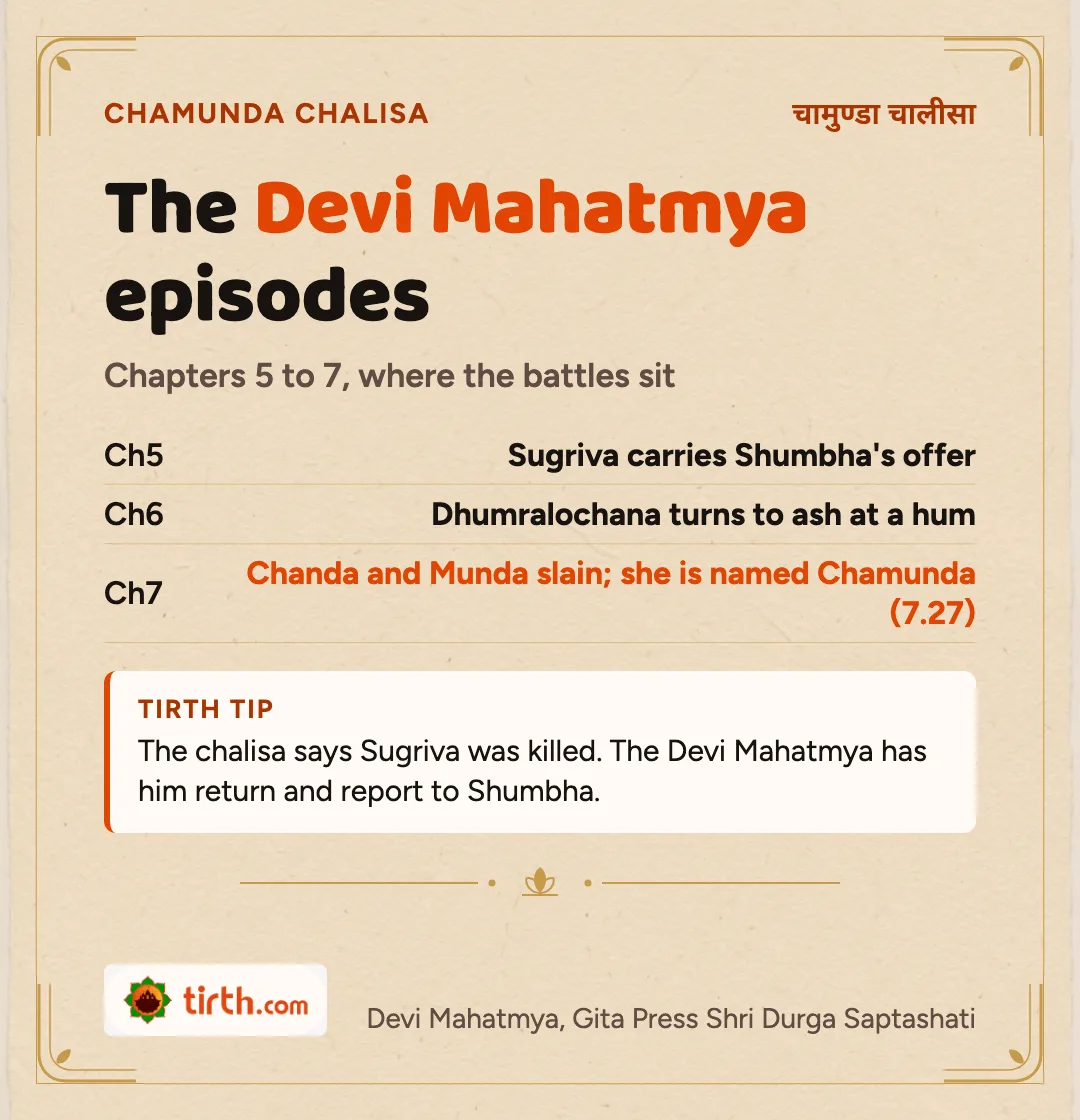
Here the chalisa and the Purana part ways, at line 10. The chalisa says the messenger Sugriva was killed first. In chapter 5 of the Devi Mahatmya, Shumbha sends Sugriva to the goddess with his proposal and Sugriva hears her reply. At the start of chapter 6 he goes back to Shumbha and reports it in full. Neither chapter says he was killed. A hymn is free to tell a story in its own way, but for who did what to whom, the Devi Mahatmya is the text to trust.
Next comes Dhumralochana in lines 11 to 13, though the Hindi column mangles his name. A demon arrives with an army and shouts his lalkar (challenge), and in line 12 a sound, “Hau”, rings out against him. In chapter 6, verse 13, Ambika turns Dhumralochana to ash with her hunkara alone, the sound “hum”, and the chalisa’s line echoes that moment.
Then Chanda and Munda. Lines 14 to 22 give them the most room of any episode in the chalisa, with the mund mala (garland of heads) in line 16, a talwar (sword) in line 19, and in line 21 the mastak, the severed head, carried in hand. This follows chapter 7 closely, where Kali beheads Chanda with a sword, strikes Munda down in turn and carries both heads to Chandika with a loud laugh, offering them as great animals for the sacrifice of battle (7.20 to 7.24). If the fierce Kali of these lines is the form you know best, the Kali Chalisa praises her in her own right.
The name Chamunda arrives in line 22, with Saraswati’s call.
After that, through lines 23 to 32, the battle widens. Ugra Chandika appears in line 25, line 27 names Maheshwari and Vaishnavi, and the shakti of Kartikeya and Narasimhi follow in line 28. Lines 30 to 32 are Raktabija, the demon of chapter 8.
Shumbha and Nishumbha themselves fall in lines 33 to 36. Chapter 7 had already looked ahead to this, because Kali hands over the two heads and tells Chandika that she will herself kill Shumbha and Nishumbha (7.24). The last four lines turn from battle to worship, and line 38 names Hanumat and Bhairav.
Why is she called Chamunda, and is she the same as Kali?
Chapter 7 of the Devi Mahatmya is titled Chanda-Munda-vadha, the slaying of Chanda and Munda, and near its end, at verse 27, Chandika speaks to Kali. Because you have come bringing Chanda and Munda, she says, you will be known in the world as Chamunda. The line in the Gita Press text reads “chamundeti tato loke khyata devi bhavishyasi”. A Hindi edition of the Durga Saptashati from Rajeshwari Prakashan in Delhi gives the same sense at the close of the chapter.
So yes, in the Devi Mahatmya Chamunda is Kali, and Chamunda is the name she earns for bringing back those two demons.
Fourteen hard words in the Chamunda Chalisa, from dand to dhvaja
Meanings here are from Platts’ A Dictionary of Urdu, Classical Hindi, and English, with the word spelt as the chalisa spells it and the dictionary’s headword after it where the two differ.
| Word in the chalisa | Verse | Meaning (Platts) |
|---|---|---|
| dand | Doha 1 | Stick, rod, mace, and also punishment, penalty, chastisement. “Deti dusht ko dand” is she punishes the wicked. |
| daitya | 4, 31, 36 | “Son of Diti”, a being hostile to the gods, a demon. |
| tang | 5 | Troubled, vexed, distressed. |
| leela (lila) | 8 | Play, sport, exploit, wonder. “Apni leela dikhayi” is she showed her own divine play. |
| lalkara (lalkar) | 12, 35 | Shout of defiance, challenge, call. |
| mala | 16 | Garland, string of beads, necklace, rosary. Mund mala is the garland of heads. |
| ghabrayi (ghabrana) | 18, 21, 29, 34 | To be alarmed, scared, dismayed. |
| talwar | 19 | Sword. |
| mastak | 21 | The head, skull, forehead. “Hath mai mastak” is the severed head carried in her hand. |
| dhvaja | 39 | Flag, banner, standard. |
| nariyal | 39 | Coconut. |
| bhet (bhent) | 39 | Present, offering. |
| shakti | 2, 7, 28, 30, closing doha | Power, energy, the active power of a deity personified. |
| aadhaar (adhar) | Closing doha | Support, prop, stay. “Jag ki aadhaar” is support of the world. |
A few words, khatvang and vajrapat among them, are left out because we could not check their meaning in the dictionary.
When is the Chamunda Chalisa recited, and what does it ask for?
The chalisa names one time itself. Line 39 calls the reader to come at Navratri with a dhvaja and a nariyal as bhet, a flag and a coconut as the offering, and line 40 adds a bath in a river that no source we read could identify, so we will not guess at it. Beyond that, the text sets no rule of day, hour or count.
What it asks for is in its closing doha, “Sharanagat ko shakti do”, a plea for shakti.
If you are reading it for the first time, read the story section above prior to reading the verses aloud, because a line like “Hath mai mastak le muskayi” carries very little until you know whose head it is (in the Gita Press Durga Saptashati chapter 7 closes on page 83, and it is worth reading once alongside). For a puja to the goddess done by a priest on your family’s behalf, you can book a puja with Tirth.
For more prayers to the goddess, whose best-known form has her own Maa Durga page, there is the Durga Chalisa, a Maa Kali mantra and a set of Durga mantras, and for travel to the goddess’s seats, the Shakti Peeth yatra guide.
Frequently asked questions
Who wrote the Chamunda Chalisa?
No author is recorded. The chalisa names no poet in its lines, and it circulates in devotional use and online without a printed edition we could trace.
What is a chalisa?
The word comes from chalis, forty. This one has 40 chaupais, or paired lines, between two opening dohas and one closing doha, a doha being a two-line verse.
Is Chamunda the same as Kali?
In the Devi Mahatmya, yes. At chapter 7, verse 27, Chandika tells Kali that because she has brought Chanda and Munda, she will be known in the world as Chamunda.
Who were Chanda and Munda?
Two demons of the Devi Mahatmya whose death gives chapter 7 its title, Chanda-Munda-vadha. Kali beheads Chanda with a sword, strikes Munda down and carries both heads to Chandika (7.20 to 7.24).
Does the chalisa follow the Devi Mahatmya exactly?
In outline, yes, but it departs in three places. It says the messenger Sugriva was killed, where in chapters 5 and 6 of the Devi Mahatmya he delivers Shumbha’s proposal, hears the goddess’s reply and goes back to Shumbha. In line 14 Chanda and Munda arrive drunk on liquor, which chapter 7 does not say. And in line 22 Saraswati calls on the goddess and the name Chamunda comes with that call, where at 7.27 Chandika gives Kali the name.
Can the Chamunda Chalisa be read outside Navratri?
The text names Navratri in line 39 and sets no other rule. Reading it on other days is a matter of your family’s practice, and nothing in the chalisa forbids it.