
Vishnu Chalisa: Lyrics in Hindi and English with Meaning
Tirth editorial · 6 Jan 2026 · 16 min read
The Vishnu Chalisa is a Hindi prayer to Bhagwan Vishnu of one doha and 40 chaupais. Its full text follows, line for line from a 2004 Haridwar booklet, with every line spelled in English letters and given a plain meaning.
Neither that booklet nor the three web copies checked against it names the poet.
Text and word meanings checked on 28 October 2026 against 51 Chalisa Sangrah Artiyon Sahit (Randhir Prakashan, Haridwar, 2004), pages 38 to 41.
Vishnu Chalisa lyrics in Hindi, as the Haridwar booklet prints them
In 51 Chalisa Sangrah Artiyon Sahit the Shri Vishnu Chalisa runs from page 38 to page 41, under the headings Doha and Chaupai, and the Vishnu aarti begins on the same page the chalisa ends. A scan of the whole booklet is on the Internet Archive, and all four pages were read against it letter by letter. Three of those copies, on Bhagvadbhakti, Aaj Tak and Bhakt Vatsal, differ from the print in spelling and in two readings that change the sense, at chaupais 30 and 32. Those differences are kept out of the text and set side by side further down.
One doha, then forty chaupais. The print has no doha at the close, though two websites add a second (more on that below).
॥ दोहा ॥
विष्णु सुनिए विनय सेवक की चितलाय।
कीरत कुछ वर्णन करूँ दीजै ज्ञान बताय॥
॥ चौपाई ॥
नमो विष्णु भगवान् खरारी, कष्ट नशावन अखिल बिहारी ।
प्रबल जगत में शक्ति तुम्हारी, त्रिभुवन फैल रही उजियारी।
सुन्दर रूप मनोहर सूरत, सरल स्वभाव मोहनी मूरत।
तन पर पीताम्बर अति सोहत, बैजन्ती माला मन मोहत।
शंख चक्र कर गदा बिराजे, देखत दैत्य असुर दल भाजे।
सत्य धर्म मद लोभ न गाजे, काम क्रोध मद लोभ न छाजे।
सन्तभक्त सज्जन मनरंजन, दनुज असुर दुष्टन दल गंजन।
सुख उपजाय कष्ट सब भंजन, दोष मिटाय करत जन सज्जन।
पाप काट भव सिन्धु उतारण, कष्ट नाशकर भक्त उबारण।
करत अनेक रूप प्रभु धारण, केवल आप भक्ति के कारण।
धरणि धेनु बन तुमहिं पुकारा, तब तुम रूप राम का धारा।
भार उतार असुर दल मारा, रावण आदिक को संहारा।
आप वाराह रूप बनाया, हिरण्याक्ष को मार गिराया।
धर मतस्य तन सिन्धु बनाया, चौदह रतनन को निकलाया।
अमिलख असुरन द्वन्द मचाया, रूप मोहनी आप दिखाया।
देवन को अमृत पान कराया, असुरन को छबि से बहलाया।
कूर्म रूप धर सिन्धु मझाया, मन्द्राचल गिरि तुरत उठाया।
शंकर का तुम फन्द छुड़ाया, भस्मासुर को रूप दिखाया।
वेदन को जब असुर डुबाया, कर प्रबन्ध उन्हें ढुँढवाया।
मोहित बनकर खलहि नचाया, उसही कर से भस्म कराया।
असुर जलंधर अति बलदाई, शंकर से उन कीन्ह लड़ाई।
हार पार शिव सकल बनाई, कीन सती से छल खल जाई।
सुमिरन कीन तुम्हें शिवरानी, बतलाई सब विपत कहानी।
तब तुम बने मुनीश्वर ज्ञानी, वृन्दा की सब सुरति भुलानी।
देखत तीन दनुज शैतानी, वृन्दा आय तुम्हें लपटानी।
हो स्पर्श धर्म क्षति मानी, हना असुर उर शिव शैतानी।
तुमने धुरू प्रहलाद उबारे, हिरणाकुश आदिक खल मारे।
गणिका और अजामिल तारे, बहुत भक्त भव सिन्धु उतारे।
हरहु सकल संताप हमारे, कृपा करहु हरि सिरजन हारे।
देखहुँ मैं नित दरश तुम्हारे, दीन बन्धु भक्तन हितकारे।
चहत आपका सेवक दर्शन, करहु दया अपनी मधुसूदन।
जानूं नहीं योग्य जप पूजन, होय यज्ञ स्तुति अनुमोदन।
शीलदया सन्तोष सुलक्षण, विदित नहीं व्रतबोध विलक्षण।
करहुँ आपका किस विधि पूजन, कुमति विलोक होत दुख भीषण।
करहुँ प्रणाम कौन विधिसुमिरण, कौन भांति मैं करहु समर्पण।
सुर मुनि करत सदा सिवकाई, हर्षित रहत परम गति पाई।
दीन दुखिन पर सदा सहाई, निज जन जान लेव अपनाई।
पाप दोष संताप नशाओ, भव बन्धन से मुक्त कराओ।
सुत सम्पति दे सुख उपजाओ, निज चरनन का दास बनाओ।
निगम सदा ये विनय सुनावै, पढ़ै सुनै सो जन सुख पावै।
Vishnu Chalisa in English letters, with the meaning of each line
The middle column spells each line in English letters following the print’s own spellings, so धुरू in chaupai 27 stays Dhuru and is not changed to Dhruv. The last column is Tirth’s own plain rendering of the line, written for reading along. It is not a published translation, and where a line is hard in every copy (chaupais 22 and 26, mostly) it says so instead of guessing.
(If you are reading for a parent whose eyes tire with Devanagari, the English letters will carry you through the first weeks. Learn the Hindi in the end, since the spellings are where one copy differs from the next.)
| Line | In English letters | Plain meaning (Tirth’s rendering) |
|---|---|---|
| Doha | Vishnu suniye vinay sevak ki chitlay. | Vishnu, please hear this prayer of your servant. |
| Doha | Keerat kuchh varnan karoon deejai gyan batay. | Let me tell a little of your fame. Grant me the knowledge to say it. |
| 1 | Namo Vishnu Bhagwan kharari, kasht nashavan akhil bihari. | I bow to Lord Vishnu, Kharari (kept as printed, with no sourced meaning). You end suffering and play through all that exists. |
| 2 | Prabal jagat mein shakti tumhari, tribhuvan phail rahi ujiyari. | Your power in the world is mighty, and your light spreads through the three worlds. |
| 3 | Sundar roop manohar soorat, saral svabhav mohani moorat. | Your form is beautiful and heart-winning, your nature gentle, and your figure charms all who see it. |
| 4 | Tan par peetambar ati sohat, baijanti mala man mohat. | Yellow cloth shines on your body, and the baijanti garland charms the mind. |
| 5 | Shankh chakra kar gada biraje, dekhat daitya asur dal bhaje. | Conch, discus and mace rest in your hands. The demon hosts flee at the sight of you. |
| 6 | Satya dharm mad lobh na gaje, kaam krodh mad lobh na chhaje. | Pride and greed cannot boast before truth and dharma. Desire, anger, pride and greed find no place. |
| 7 | Santbhakt sajjan manranjan, danuj asur dushtan dal ganjan. | You delight saints, devotees and good people, and you break the ranks of demons and the wicked. |
| 8 | Sukh upjay kasht sab bhanjan, dosh mitay karat jan sajjan. | You bring happiness, break all suffering, and remove faults so that people become good. |
| 9 | Paap kaat bhav sindhu utaran, kasht naashkar bhakt ubaran. | You cut away sin and carry people across the ocean of worldly life. You end pain and lift up those devoted to you. |
| 10 | Karat anek roop prabhu dharan, keval aap bhakti ke karan. | You take many forms, Lord, only for the sake of devotion. |
| 11 | Dharani dhenu ban tumahin pukara, tab tum roop Ram ka dhara. | When the Earth, taking the form of a cow, called out to you, you took the form of Shri Ram. |
| 12 | Bhaar utaar asur dal mara, Ravan aadik ko sanhara. | You lifted the earth’s burden, struck down the demon host, and destroyed Ravana and others. |
| 13 | Aap Varah roop banaya, Hiranyaksh ko maar giraya. | You took the Varaha (boar) form and struck down Hiranyaksha. |
| 14 | Dhar matasya tan sindhu banaya, chaudah ratanan ko nikalaya. | In the fish form you made the sea give up the fourteen jewels. |
| 15 | Amilakh asuran dvand machaya, roop mohani aap dikhaya. | A quarrel broke out among the demons, and you showed the form of Mohini. |
| 16 | Devan ko amrit paan karaya, asuran ko chhabi se bahlaya. | You made the gods drink the nectar and beguiled the demons with your charm. |
| 17 | Koorm roop dhar sindhu majhaya, Mandrachal giri turat uthaya. | In the tortoise form you stood in the sea and quickly lifted Mount Mandara. |
| 18 | Shankar ka tum phand chhudaya, Bhasmasur ko roop dikhaya. | You freed Shankar from a snare and showed your form to Bhasmasur. |
| 19 | Vedan ko jab asur dubaya, kar prabandh unhen dhundhvaya. | When a demon sank the Vedas, you arranged for them to be searched out and recovered. |
| 20 | Mohit bankar khalahi nachaya, usahi kar se bhasm karaya. | As the chalisa tells it, you took a charming form, made the wicked one dance, and had him burned to ash by his own hand. |
| 21 | Asur Jalandhar ati baldai, Shankar se un keenh ladai. | The very mighty demon Jalandhar went to war against Shankar. |
| 22 | Haar paar Shiv sakal banai, keen Sati se chhal khal jai. | A hard pair of lines in print and on the web. The plain sense is that the wicked one then played a trick on Sati. |
| 23 | Sumiran keen tumhen Shivrani, batlai sab vipat kahani. | Shivrani (Parvati) remembered you and told you the whole story of the trouble. |
| 24 | Tab tum bane munishvar gyani, Vrinda ki sab surati bhulani. | Then, in the chalisa’s telling, you became a wise sage, and Vrinda forgot everything. |
| 25 | Dekhat teen danuj shaitani, Vrinda aay tumhen laptani. | Seeing the mischief of the demon, Vrinda came and clung to you. |
| 26 | Ho sparsh dharm kshati mani, hana asur ur Shiv shaitani. | Another hard pair. It seems to speak of her dharma broken by the touch, and of the demon being struck. |
| 27 | Tumne Dhuru Prahlad ubare, Hiranakush aadik khal mare. | You rescued Dhruva and Prahlad, and struck down Hiranyakashipu and other wicked ones. |
| 28 | Ganika aur Ajamil tare, bahut bhakt bhav sindhu utare. | You saved Ganika and Ajamil, and carried many devotees across the ocean of worldly life. |
| 29 | Harahu sakal santap hamare, kripa karahu Hari sirjan hare. | Remove all our sorrows. Be kind to us, Hari, the creator. |
| 30 | Dekhahun main nit daras tumhare, deen bandhu bhaktan hitkare. | May I see you every day, friend of the poor, well-wisher of devotees. (The print reads nit, daily. Many web copies read nij, your own.) |
| 31 | Chahat aapka sevak darshan, karahu daya apni Madhusudan. | Your servant longs to see you. Show mercy, Madhusudan. |
| 32 | Jaanoon nahin yogya jap poojan, hoy yagya stuti anumodan. | I do not know the fit way of worship or chanting, nor how a yajna, a praise or an offering should be done. |
| 33 | Sheeldaya santosh sulakshan, vidit nahin vratbodh vilakshan. | I lack good conduct, kindness, contentment and good qualities, and I do not know the rare knowledge of vows. |
| 34 | Karahun aapka kis vidhi poojan, kumati vilok hot dukh bheeshan. | How should I worship you? When I see my own poor understanding, I am deeply troubled. |
| 35 | Karahun pranam kaun vidhi sumiran, kaun bhanti main karahu samarpan. | How do I bow to you, how do I remember you, and in what way do I surrender myself? |
| 36 | Sur muni karat sada sivkai, harshit rahat param gati pai. | Gods and sages always serve you. They stay glad and reach the highest state. |
| 37 | Deen dukhin par sada sahai, nij jan jaan lev apnai. | You are always the helper of the poor and afflicted. Knowing them as your own, you take them in. |
| 38 | Paap dosh santap nashao, bhav bandhan se mukt karao. | Destroy sin, fault and pain, and free me from the bonds of worldly life. |
| 39 | Sut sampati de sukh upjao, nij charanan ka daas banao. | The poet asks for children, wealth and happiness, and to be made a servant at your feet. |
| 40 | Nigam sada ye vinay sunavai, padhai sunai so jan sukh pavai. | The poet says that whoever reads or hears this prayer gets happiness. |
Harder words in the Vishnu Chalisa, from Platts’ dictionary
The word meanings below come from one book only, John T. Platts’ A Dictionary of Urdu, Classical Hindi and English, read on the University of Chicago’s Digital South Asia Library. Where Platts lists a verb rather than the form in the chalisa, the table says which verb.
| Word | Hindi | Chaupai | Platts gives |
|---|---|---|---|
| varnan | वर्णन | Doha | description |
| akhil | अखिल | 1 | all, whole, entire, complete |
| bihari | बिहारी | 1 | sportive, and a name of Krishna |
| prabal | प्रबल | 2 | mighty, very powerful |
| mohani | मोहनी | 3, 15 | an enchantress, a charmer, fascination |
| gada | गदा | 5 | a mace, a club |
| daitya | दैत्य | 5 | a son of Diti, a being hostile to the gods |
| asur | असुर | 5, 21 | evil spirit, demon |
| bhaje | भाजे | 5 | from the verb bhagna, to run off, flee |
| gaje | गाजे | 6 | from the verb gajna, to sound, roar, thunder |
| bhanjan | भंजन | 8 | breaking, destroying |
| bhav | भव | 9, 28, 38 | being, existence, the world |
| sindhu | सिन्धु | 9, 14, 17, 28 | sea, ocean |
| ubaran, ubare | उबारण | 9, 27 | from the verb ubarna, to release, deliver, set at liberty |
| dharani | धरणि | 11 | the earth |
| dhenu | धेनु | 11 | a milch cow, and also the earth |
| varah | वाराह | 13 | a boar |
| koorm | कूर्म | 17 | a tortoise, a turtle |
| phand | फन्द | 18 | a noose, net, snare, trap |
| Bhasmasur | भस्मासुर | 18 | a demon with the power to reduce to ashes anyone on whose head he placed his hand |
| chhal | छल | 22 | fraud, deceit, trick, disguise |
| munishvar | मुनीश्वर | 24 | under muni, a saint-sage, a seer, a holy man |
| laptani | लपटानी | 25 | from the verb lipatna, to cling, to twine round |
| ganika | गणिका | 28 | a courtesan, a dancing-girl |
| tare | तारे | 28 | from the verb tarna, to enable to cross, to deliver, save |
| santap | संताप | 29, 38 | affliction, pain, anguish, distress |
| anumodan | अनुमोदन | 32 | pleasure, delight |
| vilakshan | विलक्षण | 33 | having distinguishing qualities, extraordinary |
| kumati | कुमति | 34 | a weak mind, folly, perversity |
| samarpan | समर्पण | 35 | handing over, entrusting, surrendering |
| sivkai | सिवकाई | 36 | under sevakai, service |
| apnai | अपनाई | 37 | from the verb apnana, to make one’s own |
| nigam | निगम | 40 | Holy Writ, scripture, the Veda |
Some words are missing on purpose. Kharari, chitlay, keerat, peetambar, baijanti, amilakh, Madhusudan and a few more either have no entry in Platts or have one in a different sense, so they get no dictionary meaning here. They get only the line meaning above, which is our reading and labelled as such.
Varaha, Mohini, Vrinda: which text tells each story in the chalisa
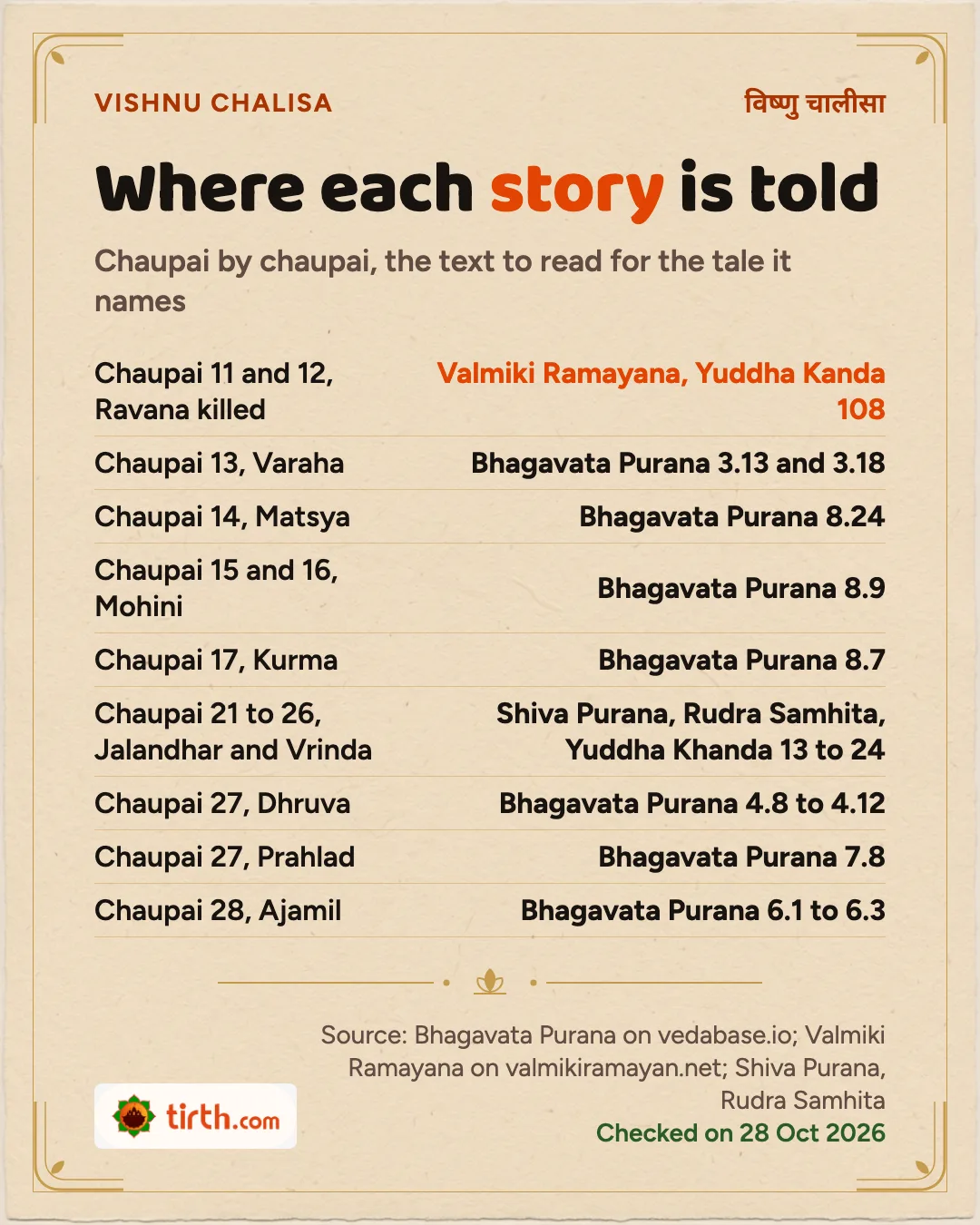
From chaupai 10 the chalisa turns to the forms Vishnu takes, a line or two to each story, and it moves fast. Most of them can be traced to a chapter of the Bhagavata Purana, the Shiva Purana or the Valmiki Ramayana.
| Chaupai | What the chalisa tells | Where to read it |
|---|---|---|
| 11 and 12 | The Earth, as a cow, calls out, and Vishnu takes the form of Shri Ram. Ravana and the demon host are killed. | Ravana’s death: Valmiki Ramayana, Yuddha Kanda, sarga 108 in the valmikiramayan.net text. The Earth calling as a cow is the chalisa’s own telling here |
| 13 | As Varaha, the boar, he strikes down Hiranyaksha. | Bhagavata Purana 3.13 (Varaha appears) and 3.18 (the battle) |
| 14 | The fish form, and fourteen jewels drawn out of the sea. | Bhagavata Purana 8.24 for Matsya, and 8.6 to 8.8 for the churning of the milk ocean |
| 15 and 16 | As Mohini, he has the gods drink the nectar. | Bhagavata Purana 8.9 |
| 17 | As Kurma, the tortoise, he lifts Mount Mandara (the chalisa’s Mandrachal). | Bhagavata Purana 8.7, texts 8 to 10 |
| 18 and 20 | He frees Lord Shiva from Bhasmasur. | The chalisa’s own telling. The Bhagavata has a close parallel, the rescue of Lord Shiva from the demon Vrikasura, in 10.88 |
| 21 to 26 | Jalandhar fights Lord Shiva and plays a trick on Sati. Vishnu comes to Vrinda as a sage, and the demon is struck down. | The Jalandhara and Vrinda story is told in the Shiva Purana, Rudra Samhita, Yuddha Khanda (chapters 13 to 24), where Vishnu goes to Vrinda in the form of Jalandhara. The sage and the trick on Sati are the chalisa’s own telling here |
| 27 | He rescues Dhruva and Prahlad, and Hiranyakashipu is killed. | Bhagavata Purana 4.8 to 4.12 for Dhruva, and 7.8 for Narasimha and Hiranyakashipu |
| 28 | Ganika and Ajamil are carried across. | Bhagavata Purana 6.1 to 6.3 for Ajamil. Ganika is not named there |
Read the Bhagavata beside it and you see how much the chalisa folds together. Chaupai 14 puts the fish form and the fourteen jewels of the sea in one breath, where the Purana gives Matsya a chapter of his own (8.24) and the churning another three, 8.6 to 8.8. The forms this chalisa names also have their own pages on Tirth: Varaha, Kurma and Narasimha.
Bhasmasur, named in chaupais 18 and 20, is harder to place. The Bhagavata has a close parallel in the rescue of Lord Shiva from a demon called Vrikasura, but the Bhasmasur telling itself has not been traced to a text that could be checked, and Ganika in chaupai 28 has not either, so neither gets a chapter number in the table.
Nit daras or nij daras? Two readings of the Vishnu Chalisa
Most of the differences between copies are spellings. Two change the sense.
In chaupai 30 the Randhir booklet prints nit daras, to see you daily, where Bhagvadbhakti, Aaj Tak and Bhakt Vatsal all print nij daras, your own sight. In chaupai 32 the booklet’s jap poojan (chanting and worship) becomes jab poojan (when worship) on Bhagvadbhakti and Aaj Tak.
| Chaupai | Printed booklet | Web copies |
|---|---|---|
| 13 | हिरण्याक्ष | हरण्याक्ष (Bhagvadbhakti, Aaj Tak) |
| 14 | मतस्य | मत्स्य (all three) |
| 27 | धुरू | ध्रुव (Bhagvadbhakti, Aaj Tak) |
| 30 | नित दरश | निज दरश (all three) |
| 32 | जप पूजन | जब पूजन (Bhagvadbhakti, Aaj Tak) |
| 36 | सिवकाई | सेवकाई (Bhagvadbhakti, Aaj Tak) |
The text above keeps the booklet’s nit and jap.
Both readings of chaupai 30 still ask for darshan, so a family that has always said nij daras is saying the same prayer with a slightly different wish in it.
Bhagvadbhakti and Aaj Tak also close with a second doha that the booklet and Bhakt Vatsal do not have.
भक्त हृदय में वास करें, पूर्ण कीजिये काज।
शंख चक्र और गदा पद्म, हे विष्णु महाराज॥
Because the booklet does not print it, the text above stops at chaupai 40, as the print does.
When to read the Vishnu Chalisa, and what its last chaupais ask
The chalisa names no day for itself. Not Thursday, not Ekadashi either. The only rhythm in the text is the wish in chaupai 30 to see him daily, and even that rests on the printed nit. If you keep Ekadashi fasts, the vrat calendar lists the days.
From chaupai 29 the stories stop and the poet speaks for himself. He asks Hari to remove all santap, asks to see him, and in chaupais 32 to 35 admits he does not know the fit way to do japa, puja, a yajna or even a pranam. If you are new and worried about getting it wrong, that is worth knowing prior to your first reading. The hymn has the same worry, in four lines.
Chaupai 39 asks for children, wealth and happiness, and the last line, padhai sunai so jan sukh pavai, says that whoever reads or hears it gets happiness. That claim is the poet’s, made of his own hymn. It is left in his words, and Tirth adds no promise to it.
In the Randhir booklet the Vishnu aarti starts straight after chaupai 40, so the book itself points you on to it.
Other prayers to him on Tirth are the Vishnu mantras, the Satyanarayan aarti, the Narayan mantra and, for Hanuman ji, the Hanuman Chalisa. The Vishnu Sahasranama path has a puja page of its own.
Frequently asked questions
Who wrote the Vishnu Chalisa?
The poet is not named in the Randhir booklet or in the three web copies checked against it (Bhagvadbhakti, Aaj Tak and Bhakt Vatsal). The last chaupai has the word nigam, which Platts gives as Holy Writ, the Veda, but no source says whether it is also the poet’s signature.
How many chaupais are in the Vishnu Chalisa?
Forty, under one opening doha. The printed booklet has no closing doha, and the second doha found on two websites is not part of it.
What does “Namo Vishnu Bhagwan Kharari” mean?
It is the first chaupai. In plain words, I bow to Lord Vishnu, who ends suffering and plays through all that exists. Platts glosses akhil (all, whole, entire) and bihari (sportive, and a name of Krishna). Kharari has no dictionary entry that fits, so it is kept as printed.
Which avatars does the Vishnu Chalisa name?
Shri Ram, Varaha the boar, the fish form, Mohini and Kurma the tortoise, in chaupais 11 to 17. Later it has him come to Vrinda as a sage, and it recalls Dhruva, Prahlad and Ajamil.
Can the Vishnu Chalisa be read daily?
The text names no special day for itself. In the printed reading, chaupai 30 asks to see him daily (nit). Web copies read nij there, which drops the word daily, though nothing in them limits the day either.
What is the doha at the start of the Vishnu Chalisa?
Two lines. They ask Vishnu to hear his servant’s prayer and to grant the knowledge to tell a little of his fame. Platts gives varnan as description. Chitlay and keerat are left as printed.