
Aarti Kunj Bihari Ki: lyrics in Hindi with meaning
Tirth editorial · 8 Jan 2026 · 7 min read
“Aarti Kunj Bihari Ki, Shri Giridhar Krishna Murari ki” is the aarti families sing to Lord Krishna as the one who plays among the groves. Shubh Panchang calls it his best-known aarti. It is sung in daily puja and on Janmashtami.
The name explains itself once you have two words of it, because Platts’ dictionary gives kunj as an arbour or grove and bihari as sportive, and it lists Bihari as a name of Krishna as well.
Aarti Kunj Bihari Ki lyrics in Hindi and Roman letters
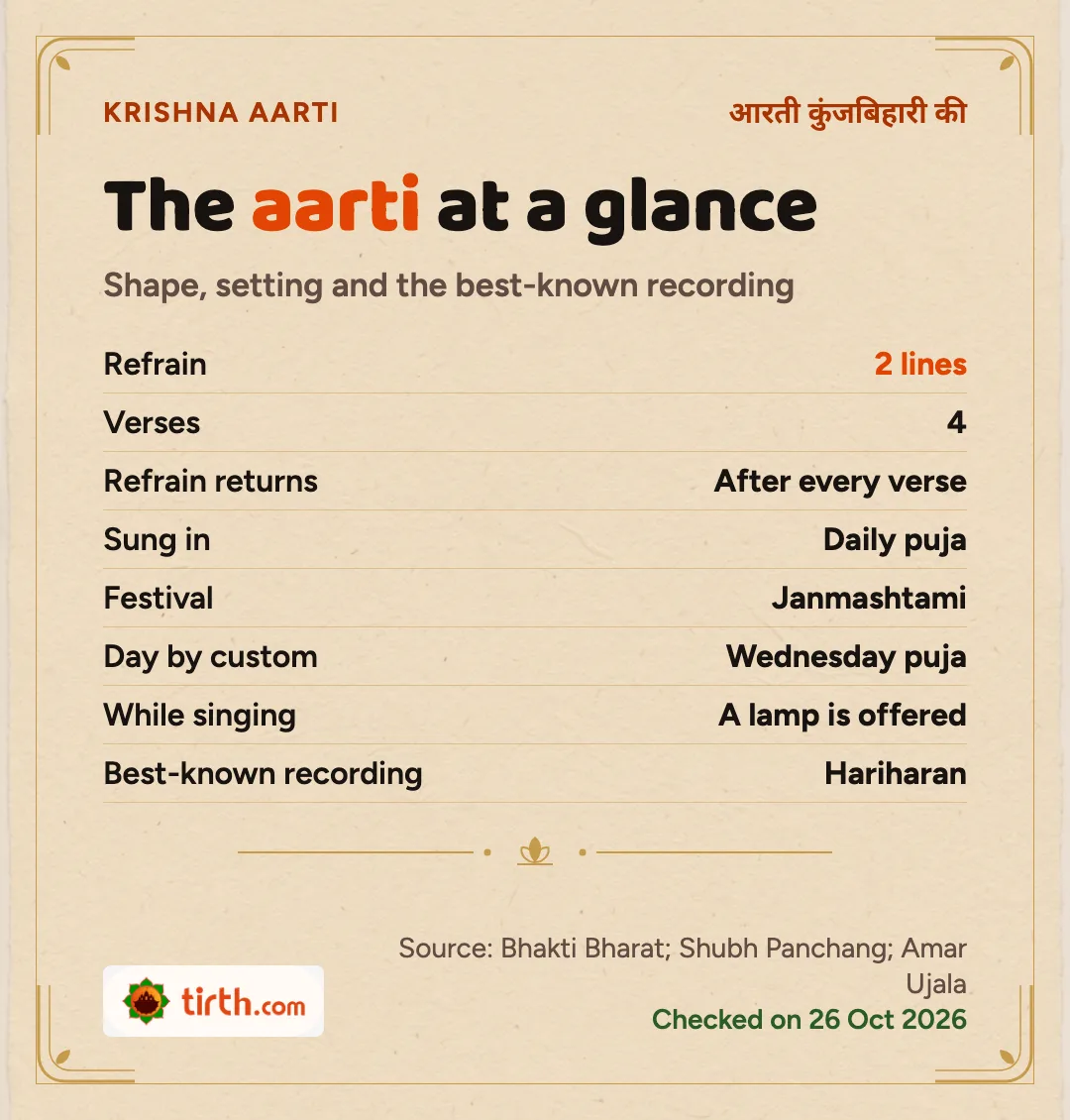
The aarti is a two-line refrain and four verses, and the refrain comes back after every verse.
आरती कुंजबिहारी की, श्री गिरिधर कृष्ण मुरारी की॥
Aarti Kunj Bihari ki, Shri Giridhar Krishna Murari ki.
गले में बैजंती माला, बजावै मुरली मधुर बाला।
श्रवण में कुण्डल झलकाला, नंद के आनंद नंदलाला।
गगन सम अंग कांति काली, राधिका चमक रही आली।
लतन में ठाढ़े बनमाली, भ्रमर सी अलक, कस्तूरी तिलक, चंद्र सी झलक,
ललित छवि श्यामा प्यारी की, श्री गिरिधर कृष्ण मुरारी की॥
Gale mein baijanti mala, bajavai murli madhur bala.
Shravan mein kundal jhalkala, Nand ke anand Nandlala.
Gagan sam ang kanti kali, Radhika chamak rahi aali.
Latan mein thadhe Banmali, bhramar si alak, kasturi tilak, chandra si jhalak,
lalit chhavi Shyama pyari ki, Shri Giridhar Krishna Murari ki.
कनकमय मोर मुकुट बिलसै, देवता दरसन को तरसैं।
गगन सों सुमन रासि बरसै।
बजे मुरचंग, मधुर मिरदंग, ग्वालिन संग,
अतुल रति गोप कुमारी की, श्री गिरिधर कृष्ण मुरारी की॥
Kanakmay mor mukut bilasai, devta darsan ko tarsain.
Gagan son suman rasi barsai.
Baje murchang, madhur mirdang, gwalin sang,
atul rati gop kumari ki, Shri Giridhar Krishna Murari ki.
जहां ते प्रकट भई गंगा, सकल मन हारिणि श्री गंगा।
स्मरन ते होत मोह भंगा,
बसी शिव सीस, जटा के बीच, हरै अघ कीच,
चरन छवि श्री बनवारी की, श्री गिरिधर कृष्ण मुरारी की॥
Jahan te prakat bhai Ganga, sakal man harini Shri Ganga.
Smaran te hot moh bhanga,
basi Shiv sees, jata ke beech, harai agh keech,
charan chhavi Shri Banwari ki, Shri Giridhar Krishna Murari ki.
चमकती उज्ज्वल तट रेनू, बज रही वृंदावन बेनू।
चहुं दिसि गोपि ग्वाल धेनू,
हंसत मृदु मंद, चांदनी चंद, कटत भव फंद,
टेर सुन दीन दुखारी की, श्री गिरिधर कृष्ण मुरारी की॥
Chamakti ujjwal tat renu, baj rahi Vrindavan benu.
Chahun disi gopi gwal dhenu,
hansat mridu mand, chandni chand, katat bhav phand,
ter sun deen dukhari ki, Shri Giridhar Krishna Murari ki.
This is the text Bhakti Bharat, Amar Ujala and Shubh Panchang print, and the three agree word for word apart from a few spellings (bajavai or bajave, harai or hare). Drik Panchang differs in two places. In the Ganga verse it reads “kalush kali harini” where the others have “sakal man harini”, and its last verse ends on “deen bhikhari” in place of “deen dukhari”. Drik Panchang prints those two readings; the other three copies do not.
What each verse of the Kunj Bihari aarti says
The meanings below are Tirth’s own plain English. The words that need a dictionary go back to senses in Platts’ dictionary of Urdu, Classical Hindi and English, and where a phrase can be read two ways, or we could not source a word, we say so rather than choose for you.
| Part | Plain meaning (Tirth’s rendering) |
|---|---|
| Refrain | The aarti of Kunj Bihari, the one who plays in the groves, of Shri Giridhar, Krishna, Murari. |
| Verse 1 | A vaijayanti garland at his neck, he plays the sweet flute. Earrings glitter in his ears, Nanda’s joy, Nandlala. His body has the dark lustre of the sky, and Radhika shines, O friend. The garland-wearer stands among the creepers, curls like black bees, a musk tilak, a radiance like the moon, the graceful beauty of “Shyama pyari”. |
| Verse 2 | A golden peacock crown shines with delight, and the gods long for a sight of him. Heaps of flowers rain from the sky. The jew’s harp sounds, the sweet drum plays, with the cowherdesses, and the unmatched love of the young gopi girls. |
| Verse 3 | The Ganga, who appeared from there, Shri Ganga, “sakal man harini”, whose remembrance breaks delusion, who lives on Shiva’s head among his matted locks and takes away the mire of sin: such is the beauty of Shri Banwari’s feet. |
| Verse 4 | The bright sand of the riverbank shines, the flute plays in Vrindavan, gopis, cowherds and cows on every side. He smiles soft and slow, the moon in its light, and the noose of worldly existence is cut. He hears the cry of the poor and the suffering. |
Three names in the refrain carry the whole aarti. Giridhar joins giri, a mountain, to dhar, holding, so it means the one who holds up the mountain. Murari is “enemy of Mura”, and Platts explains Mura as a demon slain by Krishna. Kunj Bihari is the one at play in the groves. Verse 4 even names the place, since the flute it hears is playing in Vrindavan.
We leave two phrases as they are sung. “Shyama pyari” stays because the copies we checked do not say whom it names. “Sakal man harini” stays because the printed readings differ there and we found no sense of harini to rely on. The table keeps both in quotes.
Murchang, mirdang and banmali: the words people ask about
Verse 2 names two instruments. The murchang is a jew’s harp in Platts, and the mirdang is the mridang, a drum broader in the middle than at the ends, which Platts also calls the pakhawaj. They play with the gwalin, the cowherdesses.
Banmali and Banwari are one person under two names. Platts gives banmali as the one who wears the ban-mal, the chaplet worn by Krishna, and banwari as the same word. The vaijayanti mala of verse 1 is a different garland again (Platts calls it the necklace of Vishnu).
The rest come quickly once you know them, with alak a curl of hair, kasturi musk, renu the dust or sand of the bank, benu the flute (venu) and dhenu a milch cow.
Why does a Krishna aarti sing about the Ganga?
Verse 3 surprises people. It sings of the Ganga appearing “from there”, living on Shiva’s head among his matted locks and taking away the mire of sin, and only in its last line does it say whose feet it means, Shri Banwari’s.
The feet are where the river comes from.
The Bhagavata Purana tells the story behind that line. In 5.17.1 the water that became the Ganga first washed the Lord’s feet, when Vamana pierced the covering of the universe with the nail of his big toe, and so it entered the universe. The aarti does not quote this verse. It sings the same picture, though. More on the river herself is on our Maa Ganga page.
When do families sing Aarti Kunj Bihari Ki?
Shubh Panchang says it is sung in daily puja and on Janmashtami, and it links Krishna’s aarti by custom with Wednesday puja. A lamp is offered while it is sung. On Janmashtami, Amar Ujala’s advice is to sing it after the puja. For the festival itself, our Janmashtami guide covers the day, and the Tirth Spiritual Calendar gives the festival dates for your city.
If you are leading it at home for the first time, learn the refrain before anything else. It comes back after every verse.
That way the room can join in from the first minute, even if you are the only one who knows the verses. For the tune, Bhakti Bharat notes that the rendition by the singer Hariharan is the best known.
Other prayers to Krishna and Radha on Tirth include the Krishna mantra, the Govardhan Maharaj aarti and the Radha Chalisa, and there is the story of the Radha Damodar temple in Vrindavan too. If you would like a pandit to perform a puja for your family, see the pujas Tirth arranges.
Frequently asked questions
What does Kunj Bihari mean?
Kunj is an arbour or grove, and bihari means sportive, so Kunj Bihari is the one at play in the groves. Platts also lists Bihari as a name of Krishna.
Who sang the famous Aarti Kunj Bihari Ki?
The aarti is traditional and has no named author in the copies we checked. Bhakti Bharat says the version sung by Hariharan is the best known.
When is Aarti Kunj Bihari Ki sung?
In daily puja and on Janmashtami, according to Shubh Panchang, which also links Krishna’s aarti with Wednesday puja. Amar Ujala advises singing it after the Janmashtami puja.
What is murchang in the aarti?
A jew’s harp, according to Platts’ dictionary.
Why is the Ganga in a Krishna aarti?
Because verse 3 says she appeared from his feet and lives in Shiva’s matted locks. The Bhagavata Purana (5.17.1) tells the same picture, with the water that became the Ganga first washing the Lord’s feet.