
Shiva Mantras: Om Namah Shivaya, Mahamrityunjaya and Shiva Gayatri
Tirth editorial · 10 Jan 2026 · 6 min read
Om Namah Shivaya, the Mahamrityunjaya mantra and the Shiva Gayatri are the three Shiva mantras given here, each with its Devanagari text, a transliteration and the Vedic book it is found in, plus a word-by-word meaning for the Mahamrityunjaya. In that one the person praying speaks to Tryambaka, the three-eyed one, and asks to come away from death the way a cucumber comes away from its stem.
All three speak to Lord Shiva, though not always by that name. Tryambaka is a title of Rudra, and Rudra is identified with Shiva.
Namah Shivaya has five syllables, Om Namah Shivaya has six
ॐ नमः शिवाय
om namaḥ śivāya
Count it on your fingers. Na, maḥ, śi, vā, ya. Five.
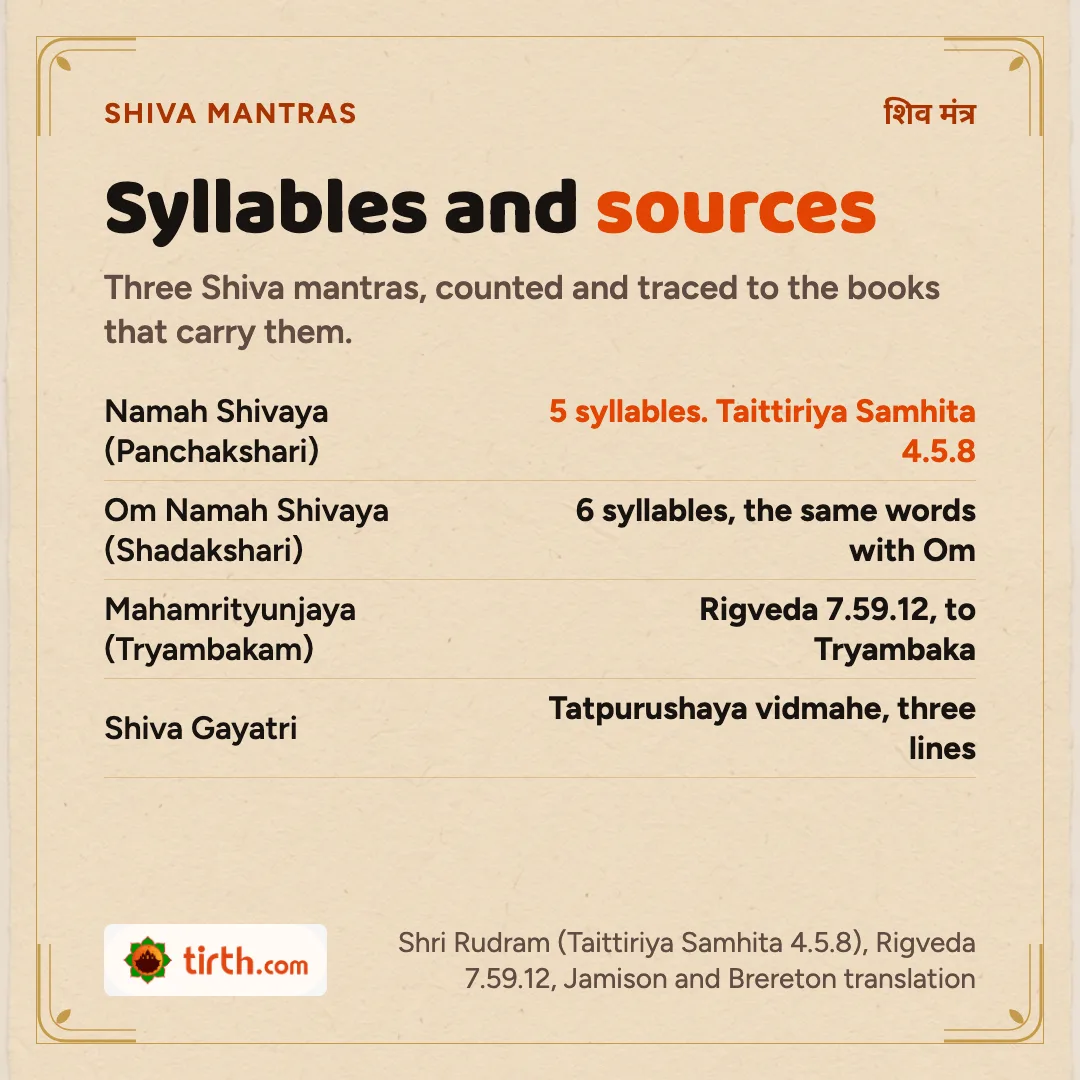
Namah Shivaya without the Om is the Panchakshari, the five-syllable mantra, and it occurs in Shri Rudram, in the Namakam portion of the Taittiriya Samhita at 4.5.8 (the eighth anuvaka, or section, of the Namakam). Put Om in front of it and the count becomes six, so Om Namah Shivaya is the Shadakshari. If you have seen Om Namah Shivaya called the five-syllable mantra somewhere, the count was made without the Om.
There is no word-by-word meaning for this mantra here. We would rather leave the line empty than print a gloss that has not been checked against a printed Sanskrit dictionary, and a meaning made up for something this short is very easy to repeat and very hard to take back.
Tryambakam yajamahe from Rigveda 7.59.12, word by word
ॐ त्र्यम्बकम् यजामहे सुगन्धिम् पुष्टिवर्धनम् ।
उर्वारुकमिव बन्धनान् मृत्योर्मुक्षीय मामृतात् ॥
tryambakaṃ yajāmahe sugandhiṃ puṣṭivardhanam |
urvārukam iva bandhanān mṛtyor mukṣīya māmṛtāt
This is Rigveda 7.59.12, the Mahamrityunjaya or Tryambakam mantra, addressed to Tryambaka. The same verse turns up again in the Yajurveda, at Taittiriya Samhita 1.8.6.i and at Vajasaneyi Samhita (Madhyandina) 3.60.
The Devanagari opens with Om and the transliterated verse does not (do not be thrown if your book prints one and not the other).
Watch the last word. Māmṛtāt is two words run together, mā amṛtāt, and the way you split it decides what the whole second line asks for. Written as one solid word in English letters, as it often is, the split disappears.
| Devanagari | Transliteration | Meaning |
|---|---|---|
| त्र्यम्बकम् | tryambakam | the three-eyed one, a name of Rudra (Shiva) |
| यजामहे | yajāmahe | we worship, we revere |
| सुगन्धिम् | sugandhim | fragrant, sweet-smelling |
| पुष्टिवर्धनम् | puṣṭivardhanam | the one who nourishes and increases well-being |
| उर्वारुकम् इव | urvārukam iva | like a gourd or cucumber |
| बन्धनान् | bandhanān | from the stem, from the bond |
| मृत्योः मुक्षीय | mṛtyor mukṣīya | may I be freed from death |
| मा अमृतात् | mā amṛtāt | not from the immortal (the Jamison and Brereton reading) |
Put together, the first line is worship.
Jamison and Brereton, in their English Rigveda, have the worshippers sacrificing to Tryambaka, the fragrant one, the increaser of prosperity.
The second line is the request. A ripe cucumber parts from its stem on the vine, and the one praying asks to be freed from death in the same way, but in their reading not from the immortal. Other translators take the last words the opposite way round and read them as a plea for immortality. There is also a reading that splits urvāruka differently and finds a word for disease in it, though the cucumber is the image Jamison and Brereton keep and the one followed here.
Pages about this mantra often add that it keeps the body healthy or protects from danger and untimely death. The verse itself asks for release from death and says nothing about health. None of the sources cited here makes those promises either, so this page leaves them out. There is a separate page on the Mahamrityunjaya mantra in full for readers who want to stay with this one verse longer.
Tatpurushaya vidmahe, the Shiva Gayatri, and the books that carry it
ॐ तत्पुरुषाय विद्महे ।
महादेवाय धीमहि ।
तन्नो रुद्रः प्रचोदयात् ॥
om tatpuruṣāya vidmahe |
mahādevāya dhīmahi |
tanno rudraḥ pracodayāt ||
This is the Shiva Gayatri, also called the Rudra Gayatri. For the Gayatri mantra itself, see the Gayatri mantra.
Where does it come from? Gayatri verses of this kind are found in the Mahanarayana Upanishad, which is Taittiriya Aranyaka 10.1.5 to 7. No single verse has been confirmed for this exact Shiva wording. So if a page gives you one verse number for the Shiva Gayatri as its sole origin, read it with some caution.
No word-by-word meaning here either, for the same reason as Om Namah Shivaya.
The common text, with Om at the start and tanno rudraḥ pracodayāt at the close, is the one printed above, and it matches the form found in the sources listed at the end. For other prayers to Shiva under his Vedic name, see the Rudra mantra.
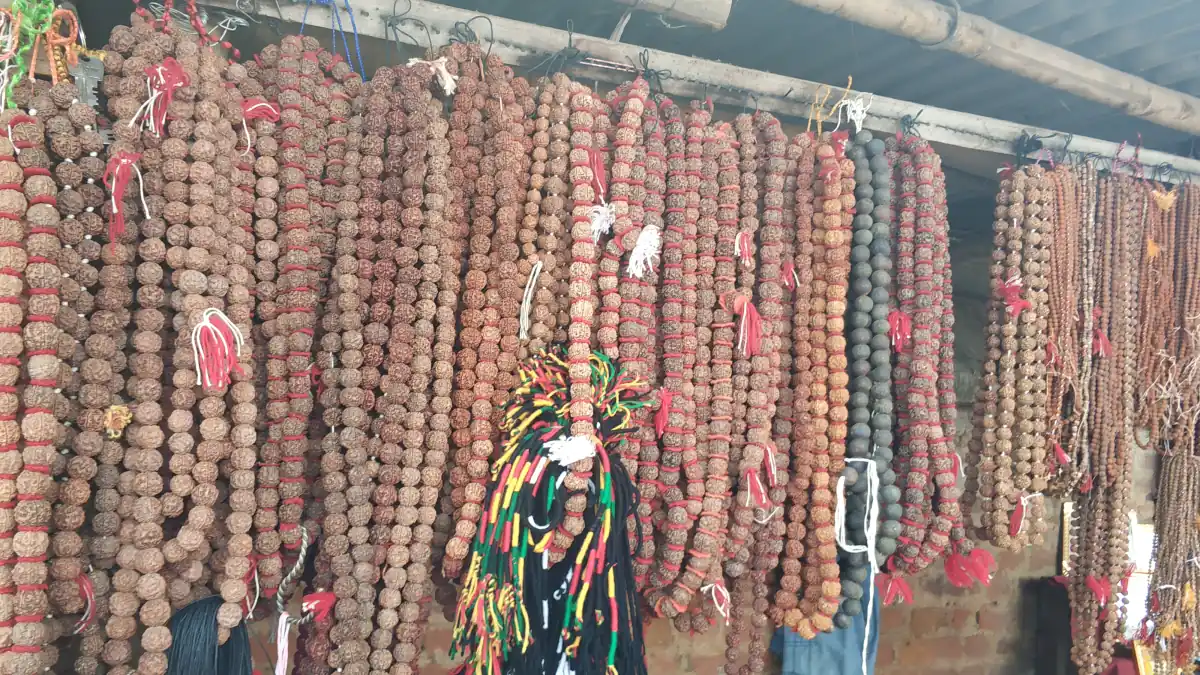
Saying Om Namah Shivaya on a mala at home
All three are said as japa (repeating a mantra quietly, usually counted on a mala). How many rounds, at what hour and facing which direction are questions the texts named on this page do not settle, so there is no count here (if your family priest has given you one, keep to it).
If you are starting out, or sitting with an elderly parent who wants to begin, start with Om Namah Shivaya. Six syllables fit on one bead without losing your place, while the Mahamrityunjaya is a full Rigveda verse of two lines.
You may also have read that these mantras clear past karma or balance energy. None of the texts named here says so. Tirth does not repeat it.
Some families would rather have the Mahamrityunjaya jaap done by priests at a temple town. Tirth arranges that through its puja bookings, including a Mahamrityunjaya jaap in Ujjain and a Rudrabhishek at a ghat in Varanasi. The mantras recited in a full abhishek have their own page, the Maha Rudrabhishek mantra.
For singing rather than japa, there is the Shiva Chalisa and the Shivratri aarti, and for the Sun, the Surya mantra.
Frequently asked questions
Which Shiva mantra is most powerful?
None of the texts cited here ranks them, so Tirth does not either. Om Namah Shivaya is the shortest to learn, and the Mahamrityunjaya is the one taken straight from the Rigveda, at 7.59.12.
What is the difference between Om Namah Shivaya and Namah Shivaya?
One syllable. Namah Shivaya has five syllables and is called the Panchakshari, and it occurs in the Taittiriya Samhita at 4.5.8. With Om in front it has six and is called the Shadakshari.
What does Om Tryambakam Yajamahe mean?
It means “we worship the three-eyed one”, Tryambaka, a name of Rudra who is identified with Shiva. The verse goes on to call him fragrant and the one who increases well-being, then asks to be freed from death like a cucumber from its stem.
Where does the Mahamrityunjaya mantra come from?
It is Rigveda 7.59.12. The same verse also appears in the Yajurveda, at Taittiriya Samhita 1.8.6.i and Vajasaneyi Samhita 3.60.
Where is the Shiva Gayatri mantra from?
Gayatri verses of its kind are found in the Mahanarayana Upanishad (Taittiriya Aranyaka 10.1.5 to 7). No single verse is confirmed for the exact Shiva wording.
How many times should a Shiva mantra be chanted?
No fixed number. The texts named on this page do not give one, so if your family or your priest follows a count, keep to it.