
Shiv Chalisa: lyrics in Hindi and English with meaning
Tirth editorial · 6 Jan 2026 · 10 min read
The Shiv Chalisa is a Hindi hymn to Lord Shiva, signed by a poet who calls himself Ayodhyadas. It has one opening doha, 41 chaupai lines and two closing dohas, and the full text is set out below in Devanagari with Roman letters under every line, taken from a printed Haridwar edition of 2004.
It does not begin with Shiva, though.
The opening doha turns first to Ganesh, the son of Girija, and asks him for the boon of fearlessness. Only then does the poem move to Girjapati, Lord Shiva. It stays with him to the last line.
Shiv Chalisa lyrics in Hindi and Roman letters
Every line follows the 2004 edition of 51 Chalisa Sangrah Artiyon Sahit, published by Randhir Prakashan in Haridwar, pages 17 to 20. The Roman lines are Tirth’s own transliteration.
दोहा (Doha)
जय गणेश गिरिजा सुवन, मंगल मूल सुजान।
Jai Ganesh Girija suvan, mangal mool sujaan.
कहत अयोध्यादास तुम, देहु अभय वरदान॥
Kahat Ayodhyadas tum, dehu abhay vardaan.
चौपाई (Chaupai)
जय गिरजापति दीनदयाला, सदा करत सन्तन प्रतिपाला।
Jai Girjapati deendayala, sada karat santan pratipala.
भाल चन्द्रमा सोहत नीके, कानन कुण्डल नागफनी के।
Bhaal chandrama sohat neeke, kaanan kundal naagaphani ke.
अंग गौर शिर गंग बहाये, मुण्डमाल तन छार लगाये।
Ang gaur shir gang bahaye, mundmaal tan chhaar lagaye.
वस्त्र खाल बाघम्बर सोहे, छवि को देख नाग मुनि मोहे।
Vastra khaal baaghambar sohe, chhavi ko dekh naag muni mohe.
मैना मातु कि हवे दुलारी, वाम अंग सोहत छवि न्यारी।
Maina maatu ki have dulari, vaam ang sohat chhavi nyari.
कर त्रिशूल सोहत छवि भारी, करत सदा शत्रुन क्षयकारी।
Kar trishool sohat chhavi bhaari, karat sada shatrun kshaykaari.
नन्दि गणेश सोहैं तहँ कैसे, सागर मध्य कमल हैं जैसे।
Nandi Ganesh sohain tahan kaise, saagar madhya kamal hain jaise.
कार्तिक श्याम और गणराऊ, या छवि को कहि जात न काऊ।
Kartik Shyam aur Ganraau, ya chhavi ko kahi jaat na kaau.
देवन जबहीं जाय पुकारा, तबहीं दुःख प्रभु आप निवारा।
Devan jabahin jaay pukaara, tabahin dukh Prabhu aap nivaara.
किया उपद्रव तारक भारी, देवन सब मिलि तुमहिं जुहारी।
Kiya upadrav Tarak bhaari, devan sab mili tumahin juhaari.
तुरत षडानन आप पठायउ, लव निमेष महँ मारि गिरायऊ।
Turat Shadanan aap pathaayau, lav nimesh mahan maari giraayau.
आप जलंधर असुर संहारा, सुयश तुम्हार विदित संसारा।
Aap Jalandhar asur sanhaara, suyash tumhaar vidit sansaara.
त्रिपुरासुर सन युद्ध मचाई, सबहिं कृपा कर लीन बचाई।
Tripurasur san yuddh machaai, sabahin kripa kar leen bachaai.
किया तपहिं भागीरथ भारी, पुरब प्रतिज्ञा तासु पुरारी।
Kiya tapahin Bhagirath bhaari, purab pratigya taasu Puraari.
दानिन महँ तुम सम कोई नाहिं, सेवक अस्तुति करत सदाहीं।
Daanin mahan tum sam koi naahin, sevak astuti karat sadaahin.
वेद नाम महिमा तव गाई, अकथ अनादि भेद नहिं पाई।
Ved naam mahima tav gaai, akath anaadi bhed nahin paai.
प्रगटी उदधि मंथन में ज्वाला, जरे सुरासुर भये विहाला।
Pragati udadhi manthan mein jwaala, jare suraasur bhaye vihaala.
कीन्हीं दया तहँ करी सहाई, नीलकण्ठ तब नाम कहाई।
Keenhin daya tahan kari sahaai, Neelkanth tab naam kahaai.
पूजन रामचन्द्र जब कीन्हा, जीत के लंक विभीषण दीन्हा।
Poojan Ramchandra jab keenha, jeet ke Lank Vibhishan deenha.
सहस कमल में हो रहे धारी, कीन्ह परीक्षा तबहिं पुरारी।
Sahas kamal mein ho rahe dhaari, keenh pariksha tabahin Puraari.
एक कमल प्रभु राखे जोई, कमल नयन पूजन चहँ सोई।
Ek kamal Prabhu raakhe joi, kamal nayan poojan chahan soi.
कठिन भक्ति देखी प्रभु शंकर, भए प्रसन्न दिए इच्छित वर।
Kathin bhakti dekhi Prabhu Shankar, bhae prasann die ichchhit var.
जै जै जै अनन्त अविनासी, करत कृपा सबकी घटवासी।
Jai jai jai anant avinaasi, karat kripa sabki ghatvaasi.
दुष्ट सकल नित मोहि सतावै, भ्रमत रहौं मोहि चैन न आवै।
Dusht sakal nit mohi sataavai, bhramat rahaun mohi chain na aavai.
त्राहि त्राहि मैं नाथ पुकारो, यहि अवसर मोहि आन उबारो।
Traahi traahi main Naath pukaaro, yahi avsar mohi aan ubaaro.
लै त्रिशूल शत्रुन को मारो, संकट से मोहि आन उबारो।
Lai trishool shatrun ko maaro, sankat se mohi aan ubaaro.
मातु पिता भ्राता सब कोई, संकट में पूछत नहीं कोई।
Maatu pita bhraata sab koi, sankat mein poochhat nahin koi.
स्वामी एक है आस तुम्हारी, आय हरहु मम संकट भारी।
Swami ek hai aas tumhaari, aay harahu mam sankat bhaari.
धन निर्धन को देत सदाहीं, जो कोई जाँचे वो फल पाहीं।
Dhan nirdhan ko det sadaahin, jo koi jaanche vo phal paahin.
अस्तुति केहि विधि करों तिहारी, क्षमहु नाथ अब चूक हमारी।
Astuti kehi vidhi karon tihaari, kshamahu Naath ab chook hamaari.
शंकर हो संकट के नाशन, मंगल कारण विघ्न विनाशन।
Shankar ho sankat ke naashan, mangal kaaran vighn vinaashan.
योगि यति मुनि ध्यान लगावैं, नारद शारद शीश नवावैं।
Yogi yati muni dhyaan lagaavain, Narad Sharad sheesh navaavain.
नमो नमो जय नमो शिवाये, सुर ब्रह्मादिक पार न पाए।
Namo namo jai namo Shivaaye, sur Brahmaadik paar na paae.
जो यह पाठ करे मन लाई, तापर होत हैं शम्भु सहाई।
Jo yah paath kare man laai, taapar hot hain Shambhu sahaai.
ऋनिया जो कोई हो अधिकारी, पाठ करे सो पावन हारी।
Riniya jo koi ho adhikaari, paath kare so paavan haari.
पुत्रहीन इच्छा कर कोई, निश्चय शिव प्रसाद तेहि होई।
Putraheen ichchha kar koi, nishchay Shiv prasaad tehi hoi.
पंडित त्रयोदशी को लावे, ध्यान पूर्वक होम करावे।
Pandit trayodashi ko laave, dhyaan poorvak hom karaave.
त्रयोदशी व्रत करे हमेशा, तन नहिं ताके रहे कलेशा।
Trayodashi vrat kare hamesha, tan nahin taake rahe kalesha.
धूप दीप नैवेद्य चढ़ावे, शंकर सम्मुख पाठ सुनावे।
Dhoop deep naivedya chadhaave, Shankar sammukh paath sunaave.
जन्म जन्म के पाप नसावे, अन्त वास शिवपुर में पावे।
Janm janm ke paap nasaave, ant vaas Shivpur mein paave.
कहै अयोध्या आस तुम्हारी, जानि सकल दुःख हरहु हमारी।
Kahai Ayodhya aas tumhaari, jaani sakal dukh harahu hamaari.
दोहा (Doha)
नित्त नेम कर प्रातः ही, पाठ करौं चालीस।
Nitt nem kar praatah hi, paath karaun chaalees.
तुम मेरी मनोकामना, पूर्ण करो जगदीश॥
Tum meri manokaamna, poorn karo Jagdeesh.
मगसर छठि हेमन्त ऋतु, संवत् चौंसठ जान।
Magsar chhathi Hemant ritu, samvat chaunsath jaan.
अस्तुति चालीसा शिवहि, पूर्ण कीन कल्याण॥
Astuti chaalisa Shivahi, poorn keen kalyaan.
That makes one opening doha, 41 chaupai lines and two closing dohas. Bhakti Bharat numbers only to 40, ending the count at the line about Shivpur and leaving the poet’s own line after it without a number.
What the Shiv Chalisa says, from Shiva’s form to the poet’s plea
The first eight chaupai lines are a portrait. The moon sits on his forehead, his earrings are snake hoods, Ganga flows from his head, and he wears a garland of skulls, ash on his body and a tiger skin. Maina’s daughter, Parvati, sits at his left side (she has a hymn of her own, the Parvati chalisa). He holds the trident, with Nandi, Ganesh and Kartik around him.
Lines 9 to 22 tell his deeds, in the chalisa’s own order. When Tarak torments the devas they go to Shiva, and he sends Shadanan, who kills Tarak in an instant. He destroys the asura Jalandhar. He fights Tripurasur and fulfils the tapas of Bhagirath. When fire rises from the churning of the ocean he takes it, which is how he comes to be called Neelkanth. Ramchandra worships him and, after the victory, gives Lanka to Vibhishan. Then comes a test, the last of the deeds, in which Shiva hides one of a thousand lotuses from the lotus-eyed worshipper and then grants the boon that was wished for.
Line 23 is where the poem turns into a plea.
The poet cries “traahi traahi” and asks Shiva to take up the trident against his troubles. In trouble, he says, no mother, father or brother asks after him. He asks forgiveness for his faults. And he closes the plea with “Namo namo jai namo Shivaaye”.
Lines 34 to 40 turn to whoever recites it. They describe what the chalisa says comes to those who read it with a focused mind, from a son to an end to suffering and, at the last, a home in Shivpur. Those are the poem’s own words about recitation, and they are given here as the text gives them.
Words in the chalisa that need a gloss
A few words in the chalisa are old Hindi forms. The table gives the sense each one has in Platts’ dictionary of Urdu, Classical Hindi and English.
| Word in the chalisa | Dictionary sense (Platts) |
|---|---|
| गिरिजा (Girija) | The mountain-born, a name of the goddess Parvati |
| सुजान (sujaan) | Well-informed, wise, intelligent |
| बाघम्बर (baaghambar) | Tiger’s skin |
| छार (chhaar) | Ashes; dust, earth |
| जुहार (juhaar) | Salutation, obeisance; falling at the feet |
| लव, निमेष (lav, nimesh) | A moment, an instant; a twinkling of the eye |
| घट (ghat) | The body; mind, heart, soul |
| अविनाशी (avinaashi) | Indestructible, imperishable, everlasting |
| त्राहि (traahi) | Save! deliver! mercy! |
| त्रयोदशी (trayodashi) | The thirteenth day of the lunar fortnight |
| चालीसा (chaalisa) | An aggregate of forty |
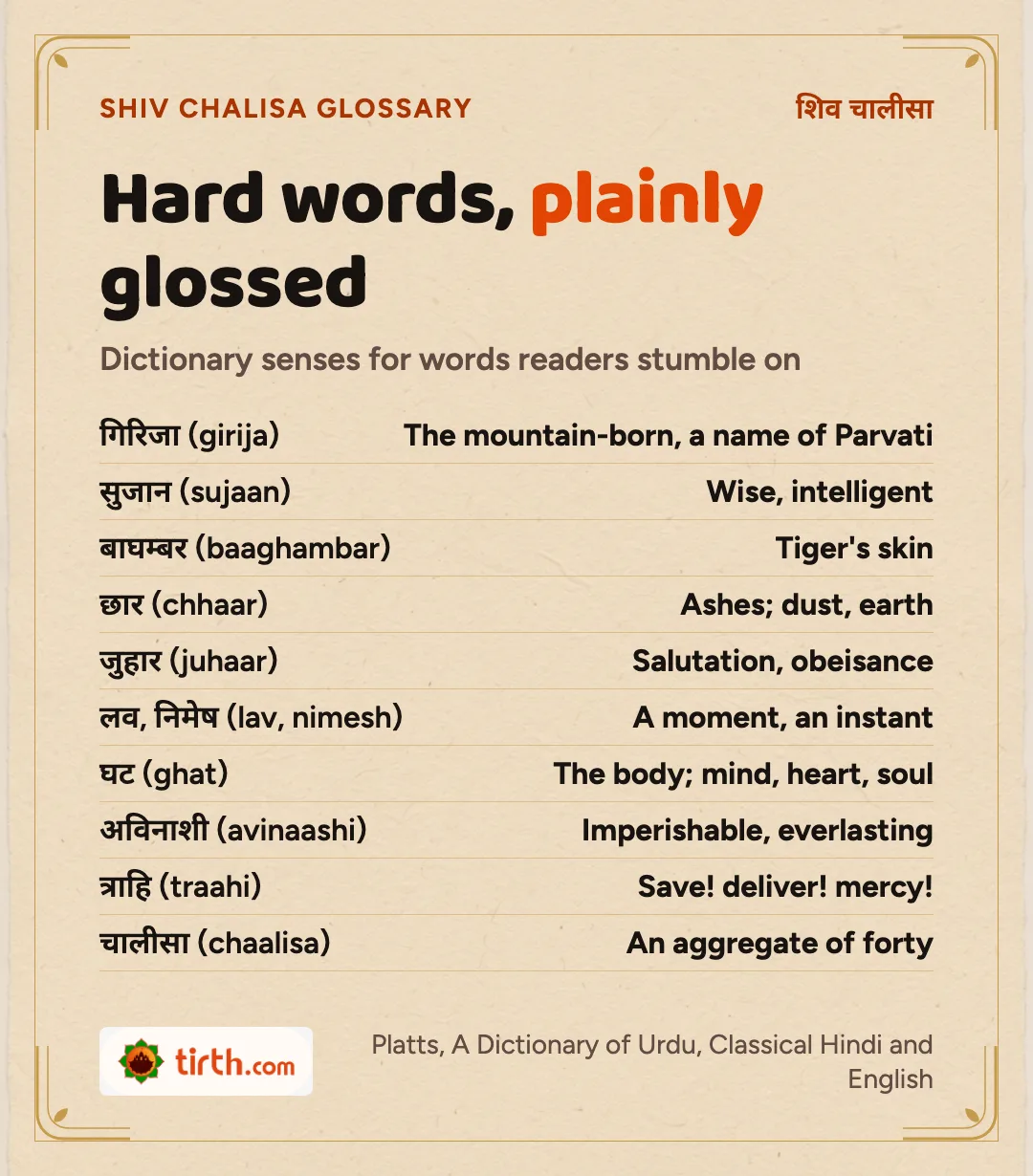
So “lav nimesh mahan maari giraayau” says Tarak was struck down in a blink. Platts also lists ghata-ghata-nivasi, dwelling in the inward parts, as an epithet of the Deity, and that is the sense of “ghatvaasi” in line 23.
Why your copy may read differently, and the Gita Press booklet
Copies of the Shiv Chalisa differ in a handful of lines. Where some online copies read “Ved maahi mahima tum gaai”, the printed edition has “Ved naam mahima tav gaai”. It has “sankat se” for “sankat te”. It has “Putraheen ichchha kar koi” where some copies have “Putra hon kar ichchha joi”, and in the closing doha it reads “Nitt nem kar … paath karaun chaalees” where others read “Nitt nem uthi … paath karo chaalisa”. On the Ved line, the Pehowa temple booklet of 2007 and Bhakti Bharat both agree with the print.
Then there is the Gita Press mix-up. Gita Press booklet no. 1185 is titled Shri Shiv Chalisa, but the chalisa inside is a different one, which opens “Jai Shiv Shankar audhardaani” (जय शिव शंकर औढरदानी). The booklet also carries a Shivashtak, an aarti and the Shiv Panchakshar stotra. The Ayodhyadas text is not in it.
Our advice is to pick one printed copy and stay with it, because the lines really do differ from one copy to the next, and if you recite with others, read from the same text they use.
When families recite the Shiv Chalisa
The chalisa sets its own time. The first closing doha says “Nitt nem kar praatah hi”, a daily rule kept in the morning (which is one more reason to keep the printed copy where you do your morning puja). Lines 37 and 38 add calling a pandit on trayodashi for a hom and keeping the trayodashi vrat.
Bhakti Bharat notes that devotees recite it especially on Mondays, Shivratri, Pradosh vrat, trayodashi vrat and in Sawan, usually early in the morning after bathing. Pradosh is the evening twilight. The Pradosham guide explains that vrat, and for Sawan there is the Shravana Mahatmya katha. Pradosh vrat dates are on the Tirth vrat calendar.
To go on after the chalisa, there are the Shivratri aarti and a set of Shiva mantras. Readers who recite other hymns can browse the Chalisa collection, which includes the Hanuman Chalisa. If you would like a priest to perform a puja for Shiva for your family, see the pujas on Tirth.
Frequently asked questions
Who wrote the Shiv Chalisa?
A poet who names himself Ayodhyadas. He does it twice, in the opening doha and again in the last chaupai line, and the text gives nothing else about him.
How many lines are in the Shiv Chalisa?
The printed edition has one opening doha, 41 chaupai lines and two closing dohas. Bhakti Bharat numbers the chaupais to 40 and leaves the poet’s closing line unnumbered.
When was the Shiv Chalisa written?
The last doha says it was completed on the sixth of Magsar, in the Hemant season, in samvat chaunsath (sixty-four). It does not say which century, so the year cannot be fixed from the text alone.
Is the Gita Press Shiv Chalisa the same text?
No. Gita Press booklet no. 1185, Shri Shiv Chalisa, prints a different chalisa that opens “Jai Shiv Shankar audhardaani”, while the Ayodhyadas text opens “Jai Girjapati deendayala”.
Can the Shiv Chalisa be recited on Monday?
Yes. Bhakti Bharat names Mondays first among the days devotees choose, along with Shivratri, Pradosh, trayodashi and Sawan. The chalisa itself asks to be recited every morning.