
Shani Dev mantras: words, meaning and where they come from
Tirth editorial · 10 Jan 2026 · 8 min read
The Shani Dev mantras people say most often are seven: the moola mantra Om Sham Shanaishcharaya Namah, the beej mantra, the single syllable Sham, two forms of the Shani Gayatri, the Nilanjana verse from Vyasa’s Navagraha Stotra, and Rig Veda 10.9.4, used in Shani worship. Shanaishchara, Shani’s name in most of them, means moving slowly.
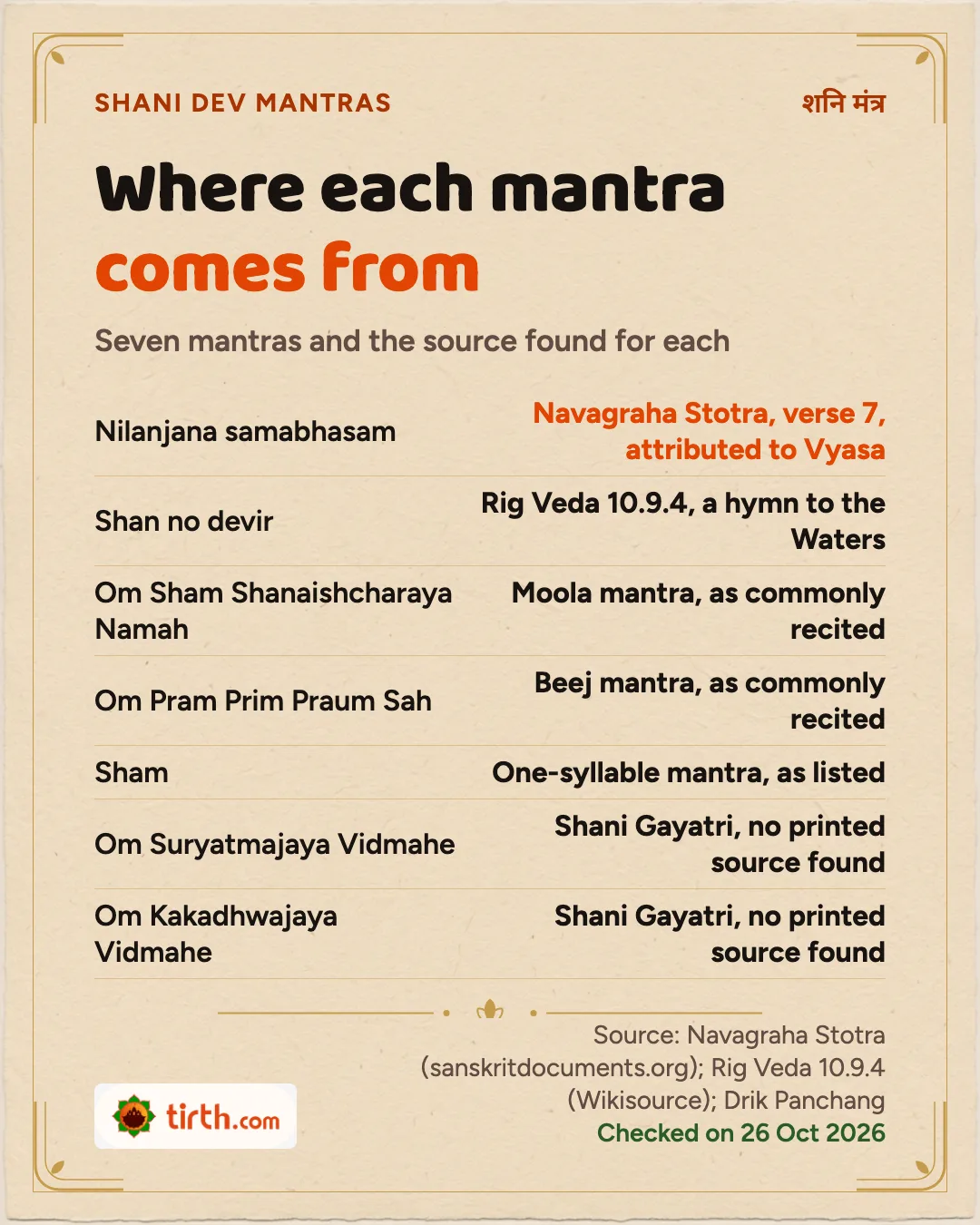
We could trace two of them to a named text. Verse seven of the Navagraha Stotra is the Nilanjana verse, and the Vedic one is from the Rig Veda’s tenth book. For the moola, beej, Gayatri and one-syllable mantras, all we have is Drik Panchang listing them as commonly recited, since no printed scripture we found names any of them. Mantras for the other deities sit in the Tirth mantra collection.
Om Sham Shanaishcharaya Namah, the moola mantra
ॐ शं शनैश्चराय नमः
Om Sham Shanaishcharaya Namah
After Om and Sham, the line bows to Shanaishchara, the slow-moving one, and the bow is namah, a word that also covers an obeisance or a reverential salutation. Monier-Williams finds three senses in Shani’s own name. Walking slowly, the planet Saturn or its regent, and Saturday.
We leave Om and Sham unglossed as seed syllables, and Drik Panchang lists Sham by itself as Shani’s one-syllable mantra.
It also calls this whole line the Shani moola mantra, without naming a source text. Which is why we treat it as a mantra people recite and not as a verse out of a book.
Nilanjana samabhasam, Shani’s verse from the Navagraha Stotra
This mantra comes from a named text. Nine grahas, one verse each, is how the Navagraha Stotra is laid out, with Shani coming seventh, straight after Shukra, and the colophon at the very end reads श्रीव्यासविरचितं, “composed by Vyasa”. Drik Panchang carries the same two lines as the Shani Pranama mantra. They sit beside the other grahas’ verses in our Navagraha mantras post.
नीलांजनसमाभासं रविपुत्रं यमाग्रजम् ।
छायामार्तण्डसंभूतं तं नमामि शनैश्चरम् ॥ ७॥
Nilanjana samabhasam raviputram yamagrajam,
chhaya-martanda-sambhutam tam namami shanaishcharam
Son of the Sun, elder brother of Yama, born of Chhaya and Martanda (the Sun), looking like dark collyrium. That is Shanaishchara, and the verse says I bow to him.
Anjana, in the opening word, is the black pigment put on the eyelids, so before the verse tells you anything about Shani’s family it has already painted his colour.
Nilanjana verse word by word
| Word in the verse | Dictionary meaning (Monier-Williams) |
|---|---|
| nila | of a dark colour, dark blue or black |
| anjana | black pigment or collyrium applied to the eyelashes or eyelids |
| samabhasa | appearing like (from sam-a-bha, to appear like) |
| ravi | the sun, the sun-god |
| putra | son |
| yama | the god who rules the spirits of the dead; Judge of the dead |
| agraja | first-born, elder brother |
| chhaya | shade, shadow; here the name of the Sun’s wife Chhaya |
| martanda | the sun or the sun-god |
| sambhuta | born, produced or arisen from |
| namami | I bow (from nam, to bend or bow, the root of namas: bow, obeisance, reverential salutation) |
| shanaishchara | walking or moving slowly; the planet Saturn or its regent; Saturday |
Learn one Shani mantra and we would want it to be this one. It traces to a named stotra. Every word in it has a dictionary meaning (the table above has them), and two short lines are enough to tell you whose son Shani is, whose brother, and what he looks like.
The Shani beej mantra, and Sham on its own
ॐ प्रां प्रीं प्रौं सः शनैश्चराय नमः
Om Pram Prim Praum Sah Shanaishcharaya Namah
This is the beeja mantra, on Drik Panchang’s list for Shani. Pram Prim Praum Sah, the four syllables ahead of the name, have no gloss in any dictionary we cite, and we have left them alone rather than guess. What follows them is plain enough, the same salutation to Shanaishchara that ends the moola mantra. Some sites close it with Shanaye Namah in place of Shanaishcharaya Namah, which is a variant ending of the same mantra.
Shortest of the lot is the ekakshari (one-syllable) mantra, शं, Sham, which Drik Panchang gives by itself.
Which Shani Gayatri, Suryatmajaya or Kakadhwajaya?
There are two Shani Gayatris in use. Neither has a printed or scriptural source that we could find. The first is the one Drik Panchang gives, while the second used to be on this page and is repeated widely across devotional sites.
Om Suryatmajaya Vidmahe Mrityurupaya Dhimahi Tannah Saurih Prachodayat
Om Kakadhwajaya Vidmahe Khadgahastaya Dhimahi Tanno Mandah Prachodayat
Both are cut to the pattern of the original Gayatri mantra, so first we know (vidmahe) him, then may we meditate (dhimahi) on him, and last may he inspire (prachodayat) us. Suryatmaja, son of the Sun, is what the first version calls him, and then Sauri, Saturn as the Sun’s son. In the second he holds a sword, has the crow on his banner and goes by Manda, the slow one.
| Word | Dictionary meaning (Monier-Williams) |
|---|---|
| suryatmaja | son of the Sun, the planet Saturn |
| vidmahe | we know (a form of vid, to know) |
| dhimahi | may we meditate (dhi: thought, meditation) |
| sauri | the planet Saturn, as son of the Sun |
| prachodayat | may he urge, impel, inspire |
| kaka | a crow |
| dhvaja (in kakadhwaja) | a banner, flag; emblem, attribute of a deity |
| khadga | a sword |
| hasta | the hand; at the end of a compound, holding in the hand |
| manda | slow, moving slowly |
As for which to say, go with the one your family or your pandit already uses. On the evidence we have, neither is more correct than the other.
Shan no devir, the Rig Veda verse said for Shani
शं नो देवीरभिष्टय आपो भवन्तु पीतये । शं योरभि स्रवन्तु नः
Shan no devir abhishtaya apo bhavantu pitaye, shan yor abhi sravantu nah
Rig Veda 10.9.4 belongs to a hymn to the Waters (Apah), set in the gayatri metre, with its seer given as Trishiras Tvashtra or Sindhudvipa Ambarisha. Put plainly, it asks the divine Waters to be with us as help and as drink, and to flow towards us with health and well-being.
Nowhere does the hymn name Shani. Shani worship took it up later, and its first word, sham, echoes his name. Drik Panchang calls it the Shani Vedic mantra. Fair enough, as a description of how the verse is used today, provided nobody takes it for the Veda’s own Shani mantra.
Why is Shani called the son of Chhaya?
The story is a short one, and the Vishnu Purana has it in Book 3, chapter 2. His heat was too much for Sanjna, the Sun’s wife, and so she put Chhaya, her own shadow, in her place. Shanaishchara was born to the Sun and Chhaya, and so were another Manu called Savarni and a daughter, Tapati. Yama, though, is Sanjna’s son. Which is how Shani and Yama come to be half-brothers, and where the Nilanjana verse gets its “yamagraja”.
Raviputra, Suryatmaja and Sauri all point back to his father. His Bhagwan page has more on Shani Dev himself, and the Sun’s own verses are in our Surya mantra post.
Which day suits a Shani mantra, and what about the count?
Saturday is Shani’s day. Monier-Williams lists Saturday as one meaning of śanaiścara, right beside the planet, so the link is there in the word itself. Choose one of the mantras above and stay with it, in the form your family or pandit uses (rather than whichever version turned up on your phone that week). If an aarti is part of your Saturdays, our Shani Dev aarti post has the words.
23,000 is the number you will keep running into for Shani japa. It comes from astrology sites, which give it as the total for an anushthan (a vow of japa finished over several days), so it is not a daily count, and no primary text we found makes it a scriptural rule.
A priest can do the japa or a graha puja on your behalf, and you can book a puja on Tirth for that. On Tirth you will also find the Brihaspati graha mantra, the Kaal Bhairav beej mantra and the Hanuman Chalisa.
Frequently asked questions
Which is the most powerful Shani mantra?
No text we found ranks them. Devotional sites put forward several (the moola mantra, the beej mantra, the Gayatri, the Nilanjana verse etc.), and only the last of those traces back to a named stotra, the Navagraha Stotra attributed to Vyasa.
What is the meaning of Om Sham Shanaishcharaya Namah?
It bows (namah) to Shanaishchara, Shani’s name, meaning the slow-moving one. Om and Sham are seed syllables that we leave unglossed, and Sham also stands alone as Shani’s one-syllable mantra.
Where does the Nilanjana samabhasam verse come from?
Shani’s verse in the Navagraha Stotra, number 7. The stotra closes on a line naming Vyasa as the one who composed it.
How many times should a Shani mantra be chanted?
None of the scriptures we found fixes a count. The 23,000 you see quoted is an astrology-site figure, the total for an anushthan spread over several days, and not a number for each day.
Why is Shani called Shanaishchara?
Because walking or moving slowly is what the name means. It is built on shanaih (quietly, gently, gradually), and Saturday is another meaning of the same word.
Who are Shani’s parents?
The Sun and Chhaya. Sanjna put Chhaya in her place, says the Vishnu Purana (Book 3, chapter 2), and Chhaya bore the Sun Shanaishchara, Savarni Manu and Tapati. Shani’s half-brother Yama is Sanjna’s son.