
Shani aarti: Jai jai Shri Shani Dev lyrics in Hindi and English
Tirth editorial · 8 Jan 2026 · 6 min read
“Jai jai Shri Shani Dev, bhaktan hitkari” opens the Shani aarti, which hails Shani Dev as the son of Surya and Chhaya. The full Hindi lyrics are below, then Roman letters with a plain English meaning for each verse.
Checked on 28 Oct 2026 against the Gita Press Aarti Sangrah (scan on the Internet Archive, 102 aartis): this aarti was not found in it. The text below is the widely sung traditional version, and its wording differs slightly between booklets and websites.
No author’s name is attached to it.
VandanaBhakti, Purab Pashchim and Drik Panchang, read on the same day as the Gita Press scan, give the words with no author, compiler or printed book behind them.
Shani aarti lyrics in Hindi: Jai jai Shri Shani Dev
The refrain comes first, then the verses in order, and the refrain closes the aarti. Each line is written once, with no repeats.
जय जय श्री शनिदेव, भक्तन हितकारी।
सूर्य पुत्र प्रभु छाया महतारी।।
श्याम अंग वक्र दृष्टि चतुर्भुजा धारी।
नीलाम्बर धार नाथ गज की असवारी।।
क्रीट मुकुट शीश रजित दिपत है लिलारी।
मुक्तन की माला गले शोभित बलिहारी।।
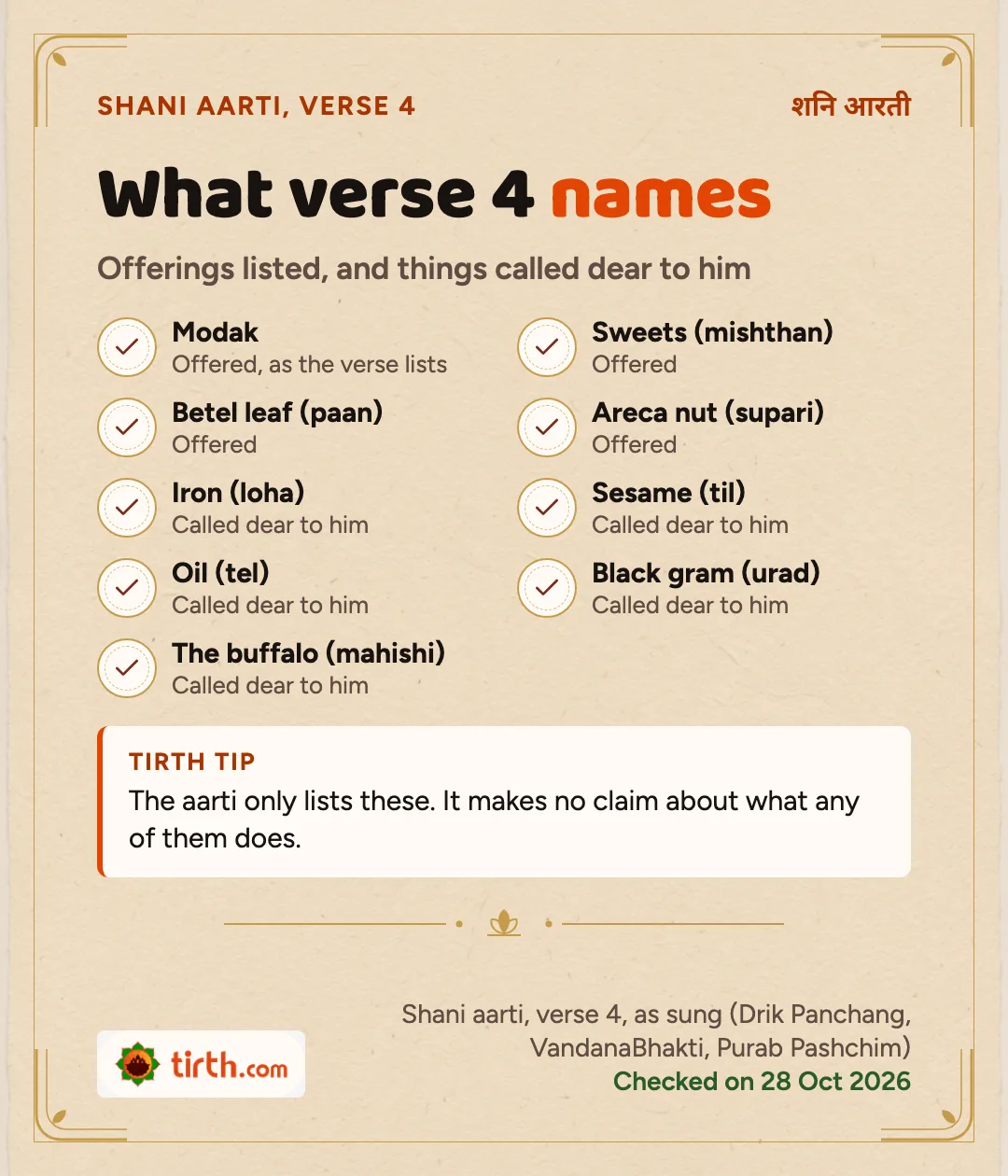
मोदक मिष्ठान पान चढ़त हैं सुपारी।
लोहा तिल तेल उड़द महिषी है अति प्यारी।।
देव दनुज ऋषि मुनि सुमिरत नर नारी।
विश्वनाथ धरत ध्यान शरण हैं तुम्हारी।।
जय जय श्री शनिदेव, भक्तन हितकारी।।
Some lines differ between versions. In the first verse, this text has “सूर्य पुत्र प्रभु छाया महतारी”, while some lyric pages carry it as “sooraj ke putra prabhu chaaya mahatari”, with Sooraj for Surya.
Shani Dev aarti in English letters, with a meaning for each verse
| Verse | In Roman letters | Plain meaning (Tirth’s rendering) |
|---|---|---|
| Refrain | Jay Jay Shri Shani Dev, Bhaktan Hitkari. | Victory to Shani Dev, who works for the good of those who worship him. |
| 1 | Surya Putra Prabhu Chhaya Mahatari. | Shani Dev is hailed as the helper of his devotees, the son of Surya and Chhaya. |
| 2 | Shyam Ang Vakra Drishti Chaturbhuja Dhaari, Neelambar Dhaar Nath, Gaj Ki Aswaari. | He is dark-bodied, with a sidelong glance and four arms. He wears blue and rides an elephant. |
| 3 | Kreet Mukut Sheesh Rajit, Dipat Hai Lilari, Muktan Ki Mala Gale, Shobhit Balihari. | A crown shines on his forehead and a garland of pearls adorns his neck. The singer offers themselves to him in devotion. |
| 4 | Modak Mishtan Paan Chadhat Hain Supari, Loha Til Tel Urad, Mahishi Hai Ati Pyari. | The aarti lists the offerings, modak, sweets, betel leaf and areca nut, and names iron, sesame, oil, black gram and the buffalo as dear to him. |
| 5 | Dev Danuj Rishi Muni, Sumirat Nar Naari, Vishwanath Dharat Dhyan, Sharan Hain Tumhaari. | Gods, demons, sages, ascetics and people all remember him. Naming Vishwanath, the singer says, “we are in your refuge”. |
If you are learning it for the first time, start with the refrain. It is the line the aarti repeats, and in the Hindi text above it stands at the start and again at the end.
Who is the Shani Dev of this aarti?
The aarti places him in a family first.
He is the son of Surya, the Sun, and of Chhaya. The Surya Dev aarti, for his father, is on Tirth too. Verse 2 then gives his form as the singer sees it: a dark body, a sidelong look, four arms, blue clothes and an elephant to ride. Verse 4 names offerings: modak, sweets, paan and supari. Then it turns to the things the text calls dear to him (iron, til, oil, urad and the buffalo). The aarti names them and says nothing about what they bring about; that is a question for a priest.
The last verse names Vishwanath, and the aarti says nothing more about him. One lyric site reads the name as Lord Shiva, but gives no source for that reading, so here it is left as it stands in the text: a name, followed by the closing words “sharan hain tumhaari”, we are in your refuge.
What the Gita Press introduction says about aarti
The Shani aarti was not found in the scanned Gita Press Aarti Sangrah, but the book’s opening section, “आरती क्या है और कैसे करनी चाहिये” (what aarti is and how it should be done), is about aarti in general and does not mention Shani. It gives two other names for aarti, aratrik and nirajan. It places aarti at the end of puja and quotes the Skanda Purana on the completion of worship.
It also speaks of an odd number of wicks. Source: Gita Press, Aarti Sangrah, introductory section (page number not read).
More texts on Tirth: the Navagraha mantras for all nine grahas, the Shani Dev mantras, the Hanuman Chalisa, the Chandra Dev aarti, the Brihaspati Dev aarti and the Friday aarti.
If you would like a priest to perform a Shani puja for your family, see the pujas on Tirth.
Frequently asked questions
What are the first words of the Shani aarti?
It opens with “Jai jai Shri Shani Dev, bhaktan hitkari”, victory to Shani Dev, the benefactor of his devotees. The aarti repeats those words as its refrain, and they close it as well.
Who are Shani Dev’s father and mother in the aarti?
His father is Surya, the Sun. His mother is Chhaya. Some lyric pages carry that line of the first verse as “sooraj ke putra prabhu chaaya mahatari”, with Sooraj for Surya.
What does the Shani aarti say Shani Dev looks like?
He is dark-bodied and four-armed, with a sidelong glance. He wears blue and rides an elephant, and in the next verse a crown shines on his forehead and a garland of pearls adorns his neck.
Which offerings does the Shani aarti mention?
Modak, sweets, betel leaf and areca nut are offered in verse 4, which also names iron, sesame, oil, black gram and the buffalo as dear to him. The aarti lists them and makes no claim about what they do.
Who is Vishwanath in the last verse of the Shani aarti?
The aarti does not say. No source we found names him as the author, and the one site that calls him Lord Shiva gives no basis for it.
Is the Shani aarti in the Gita Press Aarti Sangrah?
Not in the scanned edition on the Internet Archive, checked on 28 Oct 2026. Its 102 aartis do not include it, and the only mention of Shani is a weekday line inside the Jwala-Kali Devi aarti. Anyone holding a printed copy can confirm this against their own edition.
Continue on Tirth
- Tirth: Shani Dev