
Satyanarayan aarti: Jai Lakshmiramana lyrics with meaning
Tirth editorial · 7 Jan 2026 · 9 min read

Jai Lakshmiramana is the Satyanarayan aarti, the one families sing at the close of Satyanarayan puja. Lakshmiramana means the husband of Lakshmi, and a few lines further on the aarti calls the same lord Hari, a name of Lord Vishnu.
Sing it slowly once and the whole katha turns up in miniature. An old Brahmin, a weak Bhil, a merchant who let go of his faith and a king who worshipped in the forest alongside cowherd boys all pass through its short couplets, each one a piece of the story you have just heard read.
The words here are the ones Gita Press, Gorakhpur printed in its Aarti-Sangrah (book code 0153), where this aarti is item 12, “Bhagwan Shri Satyanarayanji”, on pages 14 to 15. In that book it follows the Vishnu-vandana and comes just before the aarti of Shri Lakshminarayan.
Jai Lakshmiramana in Hindi, with each couplet in Roman letters
Gita Press prints a refrain and eight couplets. The refrain is marked “टेक”, and every couplet closes with “जय०”, the book’s way of telling the singers to go back to the refrain each time round. If you are leading the aarti at home and some of the family read Hindi slowly or not at all, the Roman line under each couplet is for them (a second phone open at this page saves passing one around in the middle of the aarti).
जय लक्ष्मीरमणा, श्रीलक्ष्मीरमणा।
सत्यनारायण स्वामी जन-पातक-हरणा॥ जय०॥ टेक॥
Jai Lakshmiramana, Shri Lakshmiramana.
Satyanarayan Swami jan-patak-harana. (Refrain)
रत्नजटित सिंहासन अदभुत छबि राजै।
नारद करत निराजन घंटा ध्वनि बाजै॥ जय०॥
Ratnajatit singhasan adabhut chhabi raajai.
Narad karat nirajan ghanta dhvani baajai.
प्रकट भये कलि कारण, द्विजको दरस दियो।
बूढ़े ब्राह्मण बनकर कंचन-महल कियो॥ जय०॥
Prakat bhaye Kali karan, dvij ko daras diyo.
Boodhe Brahman bankar kanchan-mahal kiyo.
दुर्बल भील कठारो, जिनपर कृपा करी।
चन्द्रचूड़ एक राजा, जिनकी बिपति हरी॥ जय०॥
Durbal Bhil katharo, jin par kripa kari.
Chandrachud ek raja, jinki bipati hari.
वैश्य मनोरथ पायो, श्रद्धा तज दीन्हीं।
सो फल भोग्यो प्रभुजी फिर अस्तुति कीन्हीं॥ जय०॥
Vaishya manorath payo, shraddha taj dinhin.
So phal bhogyo Prabhuji phir astuti kinhin.
भाव-भक्तिके कारण छिन-छिन रूप धरयो।
श्रद्धा धारण कीनी, तिनको काज सरयो॥ जय०॥
Bhav-bhakti ke karan chhin-chhin roop dharyo.
Shraddha dharan kini, tinko kaaj saryo.
ग्वाल-बाल सँग राजा वनमें भक्ति करी।
मनवांछित फल दीन्हों दीनदयालु हरी॥ जय०॥
Gwal-baal sang raja van mein bhakti kari.
Manvanchhit phal dinhon Deendayalu Hari.
चढ़त प्रसाद सवायो कदलीफल, मेवा।
धूप-दीप-तुलसीसे राजी सत्यदेवा॥ जय०॥
Chadhat prasad savayo kadaliphal, meva.
Dhoop-deep-Tulsi se raji Satyadeva.
(सत्य) नारायणजीकी आरति जो कोइ नर गावै।
तन-मन-सुख-सम्पति मन-वांछित फल पावै॥ जय०॥
(Satya) Narayanji ki aarati jo koi nar gaavai.
Tan-man-sukh-sampati man-vanchhit phal paavai.
Every spelling above is the edition’s own, so अदभुत, छबि, दरस, बिपति, अस्तुति, आरति, कोइ and सम्पति stay exactly as Gita Press set them. Drik Panchang uses the standard forms instead (अद्भुत, छवि, दर्श, विपति, स्तुति). Its refrain and first seven couplets carry the same wording, give or take small differences of form such as इन पर where Gita Press has जिनपर.
Homes often sing it differently. Many families open with “ॐ जय लक्ष्मी रमणा, स्वामी जय लक्ष्मी रमणा”, a refrain that neither printed source has. Drik Panchang also ends on a signature line naming Shivanand Swami, “कहत शिवानन्द स्वामी मनवांछित फल पावे”. Gita Press prints none. We have kept to the Gita Press words line for line, because a printed edition can be checked page by page and a family variant cannot.
What do Lakshmiramana, nirajan and astuti mean?
The meanings in this table are Tirth’s own rendering, pieced together from dictionary senses of each word (Platts for the Hindi, Monier-Williams for the Sanskrit). Wherever no dictionary meaning turned up, the word is left in the edition’s own form, in italics.
| Couplet | Plain meaning (Tirth’s rendering) |
|---|---|
| Jai Lakshmiramana (refrain) | Hail, husband of Lakshmi, Shri husband of Lakshmi. Satyanarayan, the lord who takes away the sins of the people. |
| Ratnajatit singhasan | On a throne studded with jewels, a wonderful splendour shines. Narada waves the lights in adoration (karat nirajan), and the sound of the bell rings out. |
| Prakat bhaye Kali karan | Made manifest for the sake of the Kali age, darshan (sight) to a Brahmin (daras diyo). As an old Brahmin, kanchan-mahal kiyo (kanchan: gold). |
| Durbal Bhil katharo | Compassion for the weak Bhil, the katharo. Chandrachud, a king, whose adversity was taken away. |
| Vaishya manorath payo | The merchant and his heart’s wish (manorath payo); faith abandoned (shraddha taj dinhin). He was requited for it, Prabhuji, then came a hymn of praise (phir astuti kinhin). |
| Bhav-bhakti ke karan | For the sake of feeling and devotion, a form assumed chhin-chhin. Those who kept faith, their work was accomplished. |
| Gwal-baal sang raja | The king, together with the cowherd boys, worshipped in the forest. The fruit the heart wished for (dinhon): Hari, compassionate to the afflicted. |
| Chadhat prasad savayo | Chadhat prasad, one and a quarter in measure: bananas and dry fruits. With incense, lamp and holy basil, Satyadeva is pleased. |
| (Satya) Narayanji ki aarati | Whoever among people sings the aarti of (Satya) Narayanji, body, mind, happiness, prosperity and the fruit the heart wishes for, he obtains (paavai). |
Nirajan is the waving of lights before an image in worship. Or rather the very act an aarti accompanies, which is what Narada is doing in the first couplet while the bell rings. Astuti, the word in the merchant’s couplet, is stuti, praise. Having paid for the vow he broke, the merchant finally turns to praising the Lord.
Satyadeva, in the prasad couplet, is simply the katha’s own name for Satyanarayan.
Which katha stories does the aarti retell?
Most couplets point back to the Satyanarayan vrat katha, which runs to five chapters (adhyayas), and the colophon at the end of each chapter names the Skanda Purana, Reva Khanda. Suta tells it to the sages. In chapter 1 Vishnu explains the vrata to Narada, the same Narada who waves the lights in the aarti’s first couplet, and the verse numbers in the table are taken from the Sanskrit text on sanskritdocuments.org.
| Couplet | Who it is in the katha | Katha |
|---|---|---|
| Prakat bhaye Kali karan | The katha calls the vrata an easy means, especially in the Kali age. | 1.24, 5.14 |
| Boodhe Brahman bankar | A very poor Brahmin of Kashi, begging. The Lord comes to him as an old Brahmin, teaches him the vrata and vanishes. | 2.1 to 2.7 |
| Durbal Bhil katharo | A woodcutter who sees the Brahmin’s vrata, gets double the price for his wood and keeps the vrata himself. Verse 5.20 calls him a Bhil carrying a load of wood. | 2.17 to 2.26; 5.20 |
| Chandrachud ek raja | No king of this name appears in the katha text. Its kings are Ulkamukh, Chandraketu and Tungadhvaja. | none |
| Vaishya manorath payo | A merchant vows the vrata for a child, and his daughter Kalavati is born, but he keeps putting it off. King Chandraketu jails him and his son-in-law in Ratnasarapura; his wife Lilavati and Kalavati keep the vrata, and the king, told in a dream, frees them. | Chapter 3 |
| Gwal-baal sang raja | King Tungadhvaja scorns the prasad of cowherds worshipping under a banyan, loses his hundred sons and his wealth, then worships with them and recovers it all. | 5.1 to 5.9 |
| Chadhat prasad savayo | Naivedya in a measure of one and a quarter (sapada): ripe banana, ghee, milk and wheat flour, or rice flour, sugar or jaggery when these are lacking. | 1.19 to 1.21 |
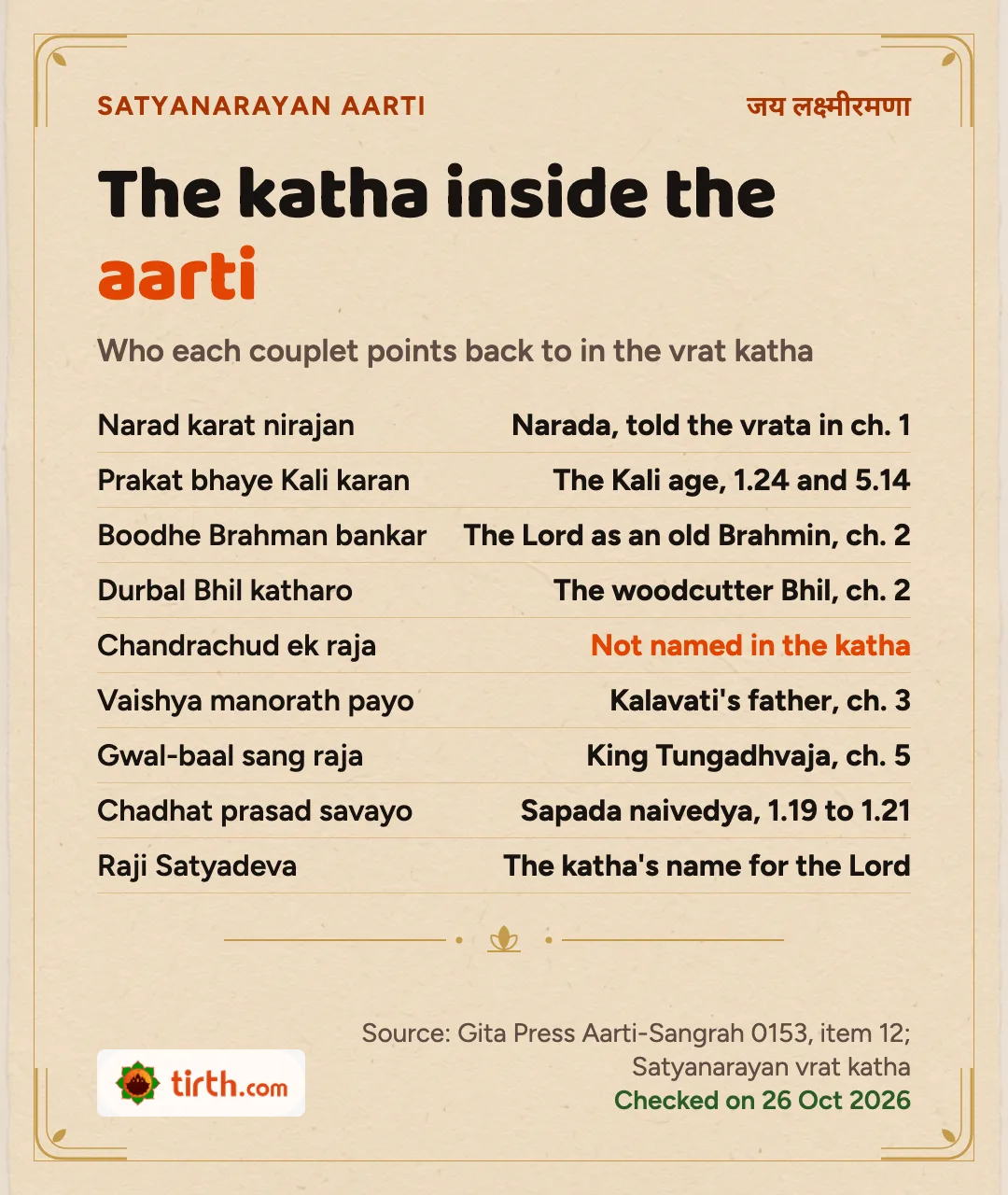
Chandrachud is the one name that does not fit. The aarti calls him a king whose trouble was taken away, yet the katha text has no king by that name, only Ulkamukh, Chandraketu and Tungadhvaja. Nor does the katha let these people go after one life (5.19 to 5.23). Shatananda, the wise Brahmin, was born again as Sudama, and the Bhil who carried wood came back as Guha. King Ulkamukh became Dasharatha. The merchant became Mayuradhvaja and Tungadhvaja became Svayambhuva. The full-moon fast has a separate story of its own, in the Purnima vrat katha.
When is Jai Lakshmiramana sung in the puja?
Right at the end. By then the katha has been read and the worship is done. Drik Panchang describes “Jai Lakshmiramana” as the Satyanarayan aarti sung on most occasions connected with him, and above all at Satyanarayan puja.
As for the hour and the day, the katha answers both itself. Verse 1.19 asks for the worship at nightfall, with family and Brahmins, and in 4.43 the merchant, home again, keeps it on Purnima and on Sankranti. The Purnima vrat guide covers the full-moon fast, and the Tirth Spiritual Calendar lists the Purnima dates for your city.
The aarti speaks of reward only once, in its closing couplet. Whoever sings it, the couplet says, obtains happiness, prosperity and the fruit the heart wishes for, and those are the text’s own words about itself.
If you would like a priest to read the katha for your family, Tirth can arrange a Satyanarayan katha puja.
More Vishnu texts on Tirth include Om Jai Jagdish Hare, the Vishnu aarti and Vishnu mantras.
Frequently asked questions
What does “Lakshmi Ramana” mean?
Raman is a lover or a husband. So Lakshmiramana is the husband of Lakshmi, and later in the aarti the same lord is given the name Hari, one of the names of Vishnu.
Is the Satyanarayan aarti sung after the katha?
Yes, at the close of Satyanarayan puja, once the katha has been read.
Who is the old Brahmin in the aarti?
The Lord himself. In chapter 2 of the katha a very poor Brahmin of Kashi is out begging when the Lord comes to him looking like an old Brahmin, teaches him the vrata and vanishes, and the second couplet sings of that meeting.
Who are the Bhil, the merchant and the king in the aarti?
The Bhil is the woodcutter of chapter 2. The merchant is Kalavati’s father in chapter 3, and the king who worships with the cowherd boys is Tungadhvaja of chapter 5. King Chandrachud is not named anywhere in the katha text.
What is “savayo” prasad?
Prasad in the measure of savaya, which means one and a quarter. The katha (1.20) asks for naivedya in exactly that measure, which it calls sapada, made of ripe banana, ghee, milk and wheat flour.
On which days is Satyanarayan puja done?
The katha’s own answer is in 4.43, where the merchant keeps the worship on Purnima, the full-moon day, and on Sankranti. Each Purnima date for your city is in the Tirth Spiritual Calendar.