
Saraswati Chalisa: lyrics in Hindi and English with meaning
Tirth editorial · 6 Jan 2026 · 15 min read
“Give me strength, intelligence and learning; hear me, Mother Saraswati.” That plea, bal buddhi vidya dehu mohi, opens the last doha of the Saraswati Chalisa. The chalisa is a Hindi hymn to Maa Saraswati made of two opening dohas, 39 chaupais and two closing dohas, and its poet signs his name, Ramsagar, three times inside it.
So it is a prayer for learning in its own words. The text names no festival, but Tirth suggests it for Vasant Panchami, the day of the year kept as Saraswati Puja. Every line is given here in Devanagari, then in English letters with a plain meaning, from one printed edition.
Saraswati Chalisa lyrics in Hindi
The words follow 51 Chalisa Sangrah Artiyon Sahit (Randhir Prakashan, Haridwar, 2004), where the Shri Saraswati Chalisa runs from page 192 to page 195 under the headings Doha, Chaupai and Doha. Shubh Panchang and a second Randhir Prakashan booklet agree with it on almost every line, apart from spelling and the few lines set out further down; a handful of plain spelling slips in the print have been set right here (that booklet’s title also calls it the Sharada Chalisa, a name worth trying if you are hunting for a printed copy).
One word in the first line needs a flag: both Randhir printings read पदम दुरज there, an evident misprint, so the text below gives पद्म रज, “the dust of the lotus feet”, the sense that Bhakti Bharat, Drik Panchang and Shubh Panchang all carry. There are 39 chaupais. The title says forty; every printing checked still counts 39.
॥ दोहा ॥
जनक जननि पद्म रज, निज मस्तक पर धारि।
बन्दौं मातु सरस्वती, बुद्धि बल दे दातारि॥
पूर्ण जगत में व्याप्त तव, महिमा अमित अनंतु।
रामसागर के पाप को, मातु तुही अब हन्तु॥
॥ चौपाई ॥
जय श्रीसकल बुद्धि बलरासी, जय सर्वज्ञ अमर अविनाशी।
जय जय जय वीणाकर धारी, करती सदा सुहंस सवारी।
रूप चतुर्भुजधारी माता, सकल विश्व अन्दर विख्याता।
जग में पाप बुद्धि जब होती, तबही धर्म की फीकी ज्योति।
तबहि मातु का निज अवतारा, पाप हीन करती महि तारा।
बाल्मीकि जी थे हत्यारा, तब प्रसाद जानै संसारा।
रामचरित जो रचे बनाई, आदि कवि पदवी को पाई।
कालिदास जो भये विख्याता, तेरी कृपा दृष्टि से माता।
तुलसी सूर आदि विद्वाना, भये और जो ज्ञानी नाना।
तिन्ह न और रहेउ अवलम्बा, केवल कृपा आपकी अम्बा।
करहु कृपा सोई मातु भवानी, दुखित दीन निज दासहि जानी।
पुत्र करई अपराध बहूता, तेहि न धरइ चित सुन्दर माता।
राखु लाज जननि अब मेरी, विनय करु भाँति बहुतेरी।
मैं अनाथ तेरी अवलंबा, कृपा करऊ जय जय जगदंबा।
मधु कैटभ जो अति बलवाना, बाहुयुद्ध विष्णु से ठाना।
समर हजार पांच में घोरा, फिर भी मुख उनसे नहीं मोरा।
मातु सहाय कीन्ह तेहि काला, बुद्धि विपरीत भई खलहाला।
तेहि ते मृत्यु भई खल केरी, पुरवहु मातु मनोरथ मेरी।
चंड मुण्ड जो थे विख्याता, छण महु संहारेउ तेहि माता।
रक्तबीज से समरथ पापी, सुरमुनि हृदय धरा सब काँपी।
काटेउ सिर जिम कदली खम्बा, बार बार बिनऊं जगदंबा।
जगप्रसिद्ध जो शुंभनिशुंभा, छण में वधे ताहि तू अम्बा।
भरत-मातु बुद्धि फेरेऊ जाई, रामचन्द्र बनवास कराई।
एहिविधि रावन वध तू कीन्हा, सुर नर मुनि सबको सुख दीन्हा।
को समरथ तव यश गुन गाना, निगम अनादि अनंत बखाना।
विष्णु रुद्र अज सकहिं न मारी, जिनकी हो तुम रक्षाकारी।
रक्त दन्तिका और शताक्षी, नाम अपार है दानव भक्षी।
दुर्गम काज धरा पर कीन्हा, दुर्गा नाम सकल जग लीन्हा।
दुर्ग आदि हरनी तू माता, कृपा करहु जब जब सुखदाता।
नृप कोपित को मारन चाहै, कानन में घेरे मृग नाहै।
सागर मध्य पोत के भंजे, अति तूफान नहिं कोऊ संगे।
भूत प्रेत बाधा या दुःख में, हो दरिद्र अथवा संकट में।
नाम जपे मंगल सब होई, संशय इसमें करइ न कोई।
पुत्रहीन जो आतुर भाई, सबै छाँडि पूजें एहि माई।
करै पाठ नित यह चालीसा, होय पुत्र सुन्दर गुण ईशा।
धूपादिक नैवेद्य चढ़ावै, संकट रहित अवश्य हो जावै।
भक्ति मातु की करैं हमेशा, निकट न आवै ताहि कलेशा।
बंदी पाठ करें सत बारा, बंदी पाश दूर हो सारा।
रामसागर बाधि हेतु भवानी, कीजै कृपा दास निज जानी।
॥ दोहा ॥
मातु सूर्य कान्ति तव, अन्धकार मम रूप।
डूबन से रक्षा करहु, परूँ न मैं भव कूप॥
बल बुद्धि विद्या देहु मोहि, सुनहु सरस्वती मातु।
राम सागर अधम को आश्रय तू ही ददातु॥
Saraswati Chalisa in English with meaning
Each line is set out in English letters, then in plain English. Word senses in brackets follow Platts’ Dictionary of Urdu, Classical Hindi and English. A handful of words (savari, toofan, manorath etc.) are left in italics as they stand, because no dictionary sense was found for the form used in this text. If you are reading aloud with a child or an elderly parent who does not read Devanagari, keep the middle column open and let them follow the English letters.
| Line | In English letters | Plain meaning (Tirth’s rendering) |
|---|---|---|
| Opening doha | Janak janani padma raj, nij mastak par dhaari. Bandaun maatu Saraswati, buddhi bal de daataari. | Holding on my own head (mastak) the dust of the lotus feet of the one who is father and mother (janak, janani), I bow in praise (vandana) to Mother Saraswati, giver (datar) of intelligence and strength (buddhi, bal). |
| Opening doha | Poorn jagat mein vyaapt tav, mahima amit anantu. Ramsagar ke paap ko, maatu tuhi ab hantu. | Your greatness (mahima) pervades (vyapt) the whole world (jagat), beyond measure (amit) and without end (anant). Mother, you alone now destroy (hanta) the sins (paap) of Ramsagar. |
| 1 | Jai Shri sakal buddhi balraasi, jai sarvagya amar avinaashi. | Victory to you, heap (rashi) of all intelligence and strength. Victory to the all-knowing (sarvagya), undying (amar) and imperishable (avinashi) one. |
| 2 | Jai jai jai veenaakar dhaari, karti sada suhans savaari. | Victory, victory, victory to you who hold the veena in your hand (kar), ever suhans savari (hans: swan). |
| 3 | Roop chaturbhujdhaari maata, sakal vishv andar vikhyaata. | Mother of the chaturbhuj form (roop), you are famed (vikhyat) through the whole world (sakal vishva). |
| 4 | Jag mein paap buddhi jab hoti, tabahi dharm ki pheeki jyoti. | When sinful thinking (paap buddhi) rises in the world, the light (jyoti) of dharma grows faint (pheeki). |
| 5 | Tabahi maatu ka nij avataara, paap heen karti mahi taara. | Then the Mother takes her own avatar (descent), makes the earth (mahi) free of sin (paap heen) and delivers (tara) it. |
| 6 | Baalmiki ji the hatyaara, tab prasaad jaanai sansaara. | Valmiki ji was a killer (hatyara); the world knows it was by your grace (prasad). |
| 7 | Ramcharit jo rache banaai, aadi kavi padavi ko paai. | He composed (rache) the deeds of Ram (charit) and won the title (padavi) of first (aadi) poet (kavi). |
| 8 | Kalidas jo bhaye vikhyaata, teri kripa drishti se maata. | Kalidas, who became famous, did so through your gracious glance (kripa drishti), Mother. |
| 9 | Tulsi Soor aadi vidvaana, bhaye aur jo gyaani naana. | Tulsi, Sur and the other learned men (vidvan), and the many (nana) others who became wise (gyani): |
| 10 | Tinh na aur raheu avalamba, keval kripa aapki Amba. | they had no other support (avalamb), only your grace (kripa), Mother (Amba). |
| 11 | Karahu kripa soi maatu Bhavani, dukhit deen nij daasahi jaani. | Show that same grace, Mother Bhavani, knowing me as your own servant (das), afflicted (dukhit) and poor (deen). |
| 12 | Putra karai apraadh bahoota, tehi na dharai chit sundar maata. | A son commits many (bahut) faults (apradh), yet his mother does not hold them in her mind (chit). |
| 13 | Raakhu laaj janani ab meri, vinay karu bhaanti bahuteri. | Keep my honour (laaj) now, Mother; I make my plea (vinay) in very many (bahuteri) ways. |
| 14 | Main anaath teri avalamba, kripa karau jai jai Jagdamba. | I have no protector (anath); you are my support. Show grace, victory, victory to Jagdamba, mother of the world. |
| 15 | Madhu Kaitabh jo ati balvaana, baahuyuddh Vishnu se thaana. | Madhu and Kaitabh, who were very strong (balvan), resolved (thana) on a hand-to-hand fight (bahuyuddh) with Vishnu. |
| 16 | Samar hajaar paanch mein ghora, phir bhi mukh unse nahin mora. | A terrible (ghor) battle (samar) of five thousand, and still mukh unse nahin mora (the sense of these last words is not settled in the dictionaries checked). |
| 17 | Maatu sahaay keenh tehi kaala, buddhi vipreet bhai khalhaala. | The Mother gave help (sahay) at that time, and their thinking (buddhi) was turned the wrong way (viprit), khalhala. |
| 18 | Tehi te mrityu bhai khal keri, puravahu maatu manorath meri. | From that came the death of the wicked (khal). Mother, fulfil (puravna) my manorath. |
| 19 | Chand Mund jo the vikhyaata, chhan mahu sanhaareu tehi maata. | Chand and Mund, who were famous, you destroyed (sanharna) in an instant (chhan), Mother. |
| 20 | Raktabeej se samarath paapi, surmuni hriday dhara sab kaanpi. | Raktabeej, a sinner (paapi) so able (samarath) that the hearts of gods (sur) and sages (muni) and all the earth (dhara) trembled (kanpi). |
| 21 | Kaateu sir jim kadali khamba, baar baar binaun Jagdamba. | You cut off his head like (jim) a plantain (kadali) pillar (khamba). Again and again I bow down (binaun) to Jagdamba. |
| 22 | Jagprasiddh jo Shumbh Nishumbha, chhan mein vadhe taahi tu Amba. | Shumbh and Nishumbh, famed across the world, you slew (vadh) in an instant, Amba. |
| 23 | Bharat-maatu buddhi phereu jaai, Ramchandra banvaas karaai. | You went and turned (pherna) the mind (buddhi) of Bharat’s mother, and had Ramchandra sent to live in the forest (banvas). |
| 24 | Ehi vidhi Ravan vadh tu keenha, sur nar muni sabko sukh deenha. | In this way you brought about Ravan’s death (vadh) and gave happiness (sukh) to gods, men and sages. |
| 25 | Ko samarath tav yash gun gaana, nigam anaadi anant bakhaana. | Who is able (samarath) to sing your glory (yash) and virtues (gun)? The Vedas (nigam) describe (bakhan) you as without beginning (anadi) and without end (anant). |
| 26 | Vishnu Rudra Aj sakahin na maari, jinki ho tum rakshaakaari. | Vishnu, Rudra and Aj cannot kill those whom you protect (raksha). |
| 27 | Rakt Dantika aur Shataakshi, naam apaar hai daanav bhakshi. | Rakt Dantika and Shatakshi are among your names, devourer (bhakshi) of the danavs (demons). |
| 28 | Durgam kaaj dhara par keenha, Durga naam sakal jag leenha. | You did a deed (kaaj) on earth (dhara) that was hard to accomplish (durgam), and the whole world took up the name Durga. |
| 29 | Durg aadi harni tu maata, kripa karahu jab jab sukhdaata. | Mother, you who remove (harna) Durg and the rest, giver of happiness (sukh), show grace whenever we call. |
| 30 | Nrip kopit ko maaran chaahai, kaanan mein ghere mrig naahai. | If an enraged (kopit) king (nrip) wants you killed, or in the forest (kanan) you are hemmed in by animals (mrig) and naahai (if read as nahar: tiger), |
| 31 | Saagar madhya pot ke bhanje, ati toofaan nahin kou sange. | if the ship (pot) breaks up (bhanjan) in mid-ocean in a great toofan, with no one at your side (sang), |
| 32 | Bhoot pret baadha ya dukh mein, ho daridra athva sankat mein. | in trouble from bhoot and pret (spirits of the dead), in sorrow, in poverty (daridra) or in danger (sankat), |
| 33 | Naam jape mangal sab hoi, sanshay ismein karai na koi. | whoever repeats (japna) the name, the line says, all goes well (mangal). Let no one doubt (sanshay) this. |
| 34 | Putraheen jo aatur bhaai, sabai chhaandi poojen ehi maai. | A man without a son (putra heen), grieved (aatur), should worship this Mother; the sense of sabai chhaandi is not settled in the dictionaries checked. |
| 35 | Karai paath nit yah chaalisa, hoy putra sundar gun eesha. | If he reads (paath) this chalisa daily, the line says, a son is born to him, fair and full of good qualities (gun). |
| 36 | Dhoopaadik naivedya chadhaavai, sankat rahit avashya ho jaavai. | The line names incense (dhoop) and the rest and naivedya (food consecrated to a deity), and says the devotee is surely freed of trouble (sankat). The sense of the verb chadhaavai is not settled in the dictionaries checked. |
| 37 | Bhakti maatu ki karain hamesha, nikat na aavai taahi kalesha. | Whoever keeps up devotion to the Mother always, the line says, affliction (kalesh) does not come near them. |
| 38 | Bandi paath karen sat baara, bandi paash door ho saara. | If a prisoner (bandi) reads it a hundred (sat) times, says the line, every noose (paash) that binds him is removed. |
| 39 | Ramsagar baadhi hetu Bhavani, keejai kripa daas nij jaani. | Bhavani, for the sake (hetu) of Ramsagar’s troubles (badha), show grace, knowing him as your own servant (das). |
| Closing doha | Maatu soorya kaanti tav, andhakaar mam roop. Dooban se raksha karahu, paroon na main bhav koop. | Mother, your splendour (kanti) is the sun’s; my form (roop) is darkness (andhkar). Protect me from drowning (doobna), so that I do not fall into the well (koop) of worldly existence (bhav). |
| Closing doha | Bal buddhi vidya dehu mohi, sunahu Saraswati maatu. Ram Sagar adham ko aashray tu hi dadaatu. | Give me strength, intelligence and learning (bal, buddhi, vidya); hear me, Mother Saraswati. For Ram Sagar, the lowly one (adham), you alone are the shelter (aashray). |
Hatyara or bahm gyani: which Saraswati Chalisa text is this?
Two versions are in circulation, and they differ in five places. The one above is the printed Randhir text. Bhakti Bharat follows it, and so does Shubh Panchang except in two lines, the first line of the opening doha (पद-रज) and the very last line. In this version chaupai 6 calls Valmiki hatyara, a killer, and chaupai 7 says he composed the Ramcharit. Drik Panchang prints chaupai 6 as बाल्मीकि जी थे बहम ज्ञानी, chaupai 7 as रामायण जो रचे बनाई, the last chaupai as करहु कृपा भवमुक्ति भवानी, मो कहं दास सदा निज जानी and the last line as अधम रामसागरहिं तुम, आश्रय देउ पुनातु (Shubh Panchang ends the same way), and it opens the closing doha with माता सूरज कान्ति तव.
Even the second Randhir booklet has its own wording for chaupais 6 and 7 (बाल्मीकिजी जो थे ज्ञानी, तव प्रसाद महिमा जन जानी). All of them agree on the count of 39 chaupais (Shubh Panchang’s own FAQ still says 40, a slip of its own). Keep to one printed version.
Madhu, Kaitabh and Kaikeyi: the stories behind the verses
Chaupais 15 to 29 move fast through stories the reader is expected to know already. Most come from the Devi Mahatmya, also called the Durga Saptashati, where these deeds belong to the Devi; the chalisa credits them to the Mother it is praising. (For the chalisa addressed to Maa Durga herself, see the Durga Chalisa.)
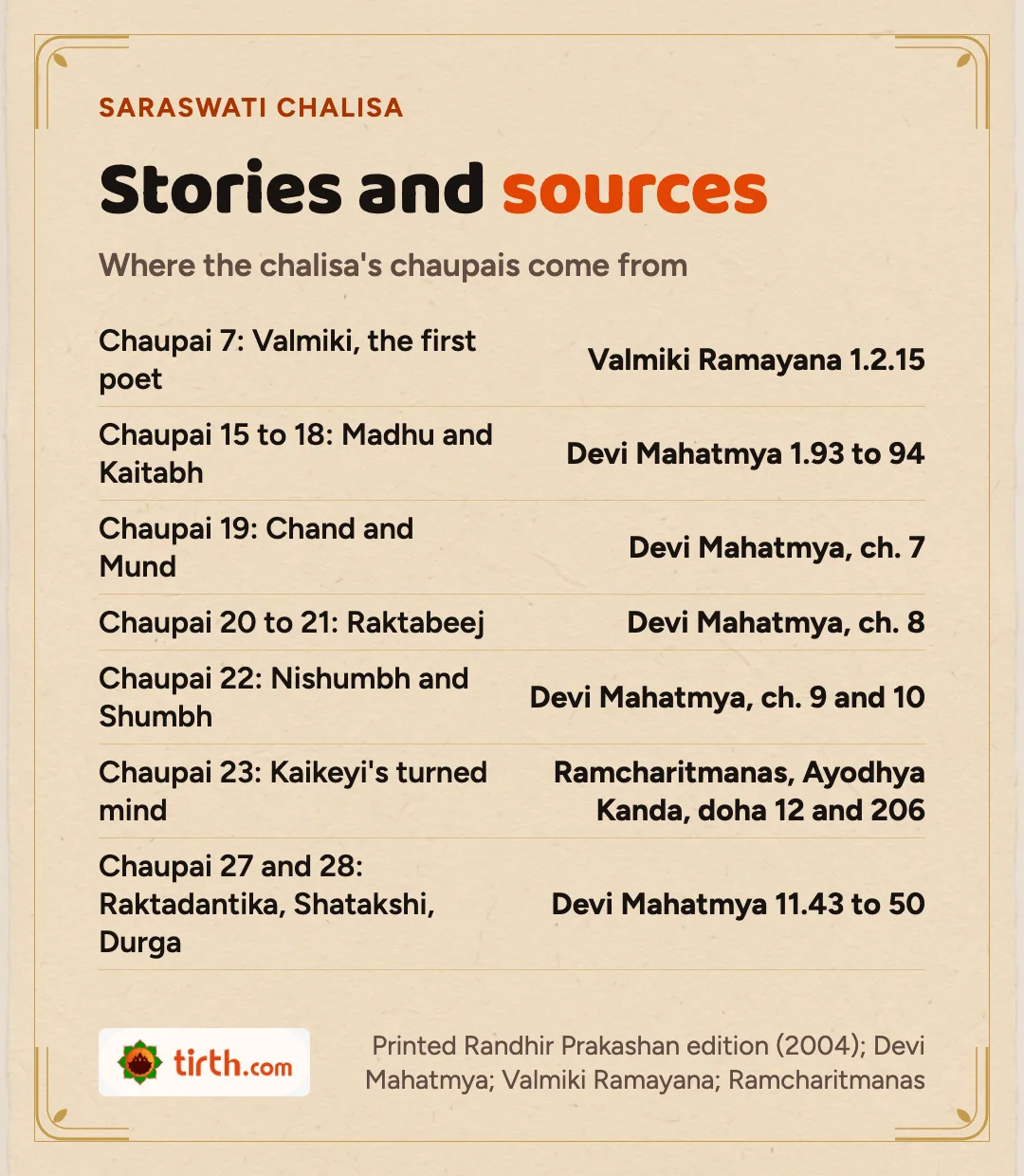
| Chaupai | Story | Where it is told |
|---|---|---|
| 6 | The chalisa calls Valmiki a killer (hatyara) and says the world knows him by the Mother’s grace | Chaupai 6 itself; no source checked |
| 7 | Valmiki earns the title of adi kavi, the first poet | Valmiki Ramayana 1.2.15, the ma nishada verse, traditionally called the first verse of human metre |
| 15 to 18 | Vishnu fights Madhu and Kaitabh arm to arm for five thousand years; the two are deluded by Mahamaya | Devi Mahatmya (Durga Saptashati) 1.93 to 94 |
| 19 | Chand and Mund are killed | Devi Mahatmya, chapter 7 |
| 20 to 21 | Raktabeej is killed | Devi Mahatmya, chapter 8 |
| 22 | Nishumbh and Shumbh are killed | Devi Mahatmya, chapters 9 and 10 |
| 23 | Bharat’s mother turns against Ram and he is sent to the forest | Ramcharitmanas, Ayodhya Kanda, dohas 12 and 206 |
| 27 and 28 | The names Raktadantika, Shatakshi and Durga | Devi Mahatmya 11.43 to 45, 11.46 to 47 and 11.49 to 50 |
Chaupai 23 reads oddly at first. It has Saraswati turning the mind of a queen, Kaikeyi herself, against Ram. The Ramcharitmanas says the same. In doha 206 of the Ayodhya Kanda, the sage Bharadwaj tells Bharat at Prayag not to blame Kaikeyi, because Gira, the goddess of speech, had deluded her mind, and in doha 12 Gira turns the mind of Manthara, Kaikeyi’s maid. That is the chain the chalisa follows into chaupai 24, where Ravan’s death is put down to the same Mother. The three names in chaupais 27 and 28 are prophecies in the Devi Mahatmya’s eleventh chapter: teeth red as pomegranate flowers after slaying the Vaiprachitta danavs (Raktadantika), a hundred eyes turned on the sages in a hundred-year drought (Shatakshi), and the slaying of the asura Durgama (Durga). Chaupai 7’s adi kavi has a text behind it too. Chaupai 6 is different: it calls Valmiki a killer, hatyara, and says nothing more about how he came to be one.
Reading the Saraswati Chalisa on Vasant Panchami and through the year
The chalisa names no festival or hour. On how often, chaupai 35 speaks of reading it daily, chaupai 37 of devotion kept up always and chaupai 38 of a hundred readings, and the lines around them, chaupais 32 to 38, are the text’s own account of what reading brings: good in trouble, poverty or fear of spirits, a son for a childless devotee, release from every bond for a prisoner who reads it a hundred times. Those are the poet’s claims about his hymn, given here as the chalisa says them and not as results anyone can promise.
The day in the year given to Saraswati is Vasant Panchami, kept as Saraswati Puja. It next falls on Thursday, 11 February 2027 (New Delhi), and the Tirth Spiritual Calendar has the day.
If you are new to the text, start with the meaning table. Read it once with the table open before reciting on your own. The stories in chaupais 15 to 29 go past in a few seconds, and they land better when you already know who Madhu and Kaitabh were.
The sangrah prints the Saraswati aarti straight after the chalisa, on page 196, and the Sharada Chalisa booklet follows it with a Saraswati Devi Stuti that includes Ya kundendu tushara hara dhavala. A fair guide to what to read next. For shorter prayers to her, see these Saraswati mantras.
Frequently asked questions
Who wrote the Saraswati Chalisa?
Its poet names himself Ramsagar, in the second opening doha, in the last chaupai and again in the last doha. No source has been found for who Ramsagar was or when he wrote, so treat any date or life story given for him with care.
How many verses are in the Saraswati Chalisa?
It has 39 chaupais, with two dohas before them and two after. The printed Randhir edition, Shubh Panchang, Drik Panchang and Bhakti Bharat all have 39, although the title says forty, so a copy that claims 40 verses has miscounted.
Can the Saraswati Chalisa be read daily?
Yes. Chaupai 35 itself speaks of reading it daily, and chaupai 37 of devotion to the Mother kept up always. Chaupai 38 adds a count, a hundred readings, for a prisoner seeking release.
When is the Saraswati Chalisa read, and is it read on Vasant Panchami?
The chalisa does not name a festival, so it can be read on any day. Vasant Panchami is the day kept as Saraswati Puja, and Tirth suggests it as a day to read the hymn; the Tirth Spiritual Calendar has the day.
Which poets and demons does the Saraswati Chalisa name?
Among poets it names Valmiki, Kalidas, Tulsi and Sur. Among demons it names Madhu and Kaitabh, Chand and Mund, Raktabeej, Shumbh and Nishumbh, and Ravan, and it also tells of Bharat’s mother.
For a Saraswati puja performed on your family’s behalf in Ayodhya, see the Saraswati Vandana Bija Mantra Laghu Puja.
Related reading: the Hanuman Chalisa.