
Saraswati Aarti in Hindi and English with Meaning
Tirth editorial · 8 Jan 2026 · 8 min read
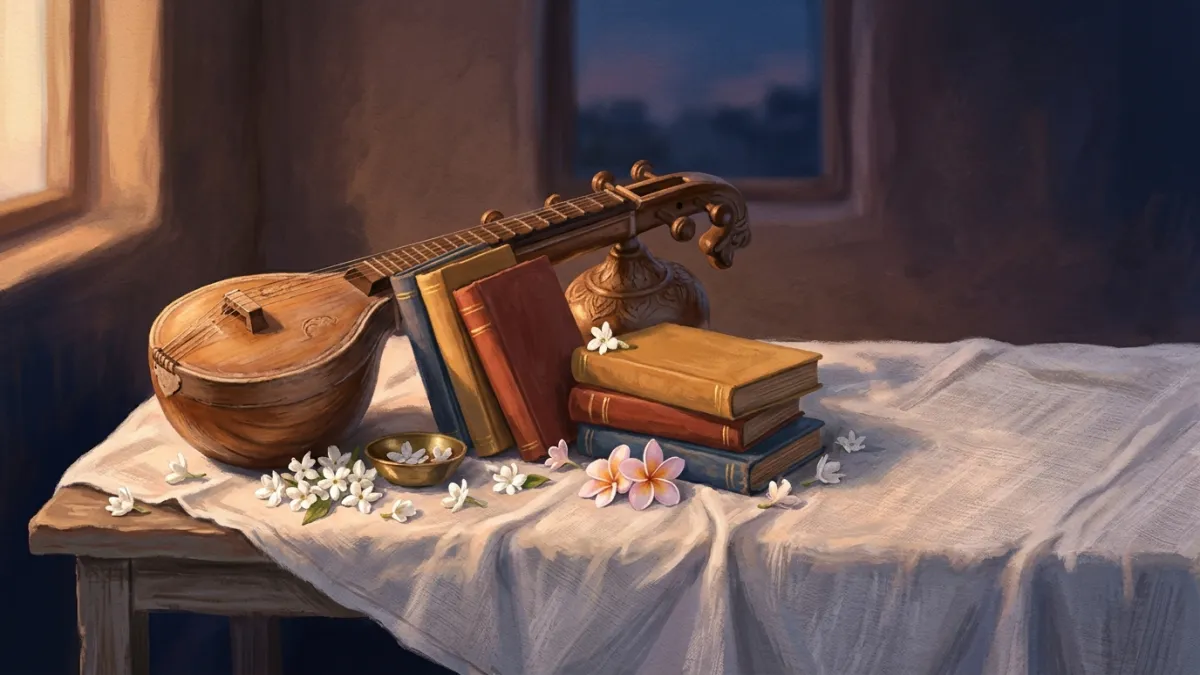
The lamp is lit and the books are placed in front of the picture of Goddess Saraswati. Then comes the Saraswati aarti, “Jai Saraswati Mata”, a traditional aarti of seven stanzas that families and schools sing at Vasant Panchami and at Saraswati puja.
Copies online often drop stanzas or mix in a second aarti that shares the name. The text here is the standard one, read against three published Hindi copies that agree with each other on the words of every stanza.
Saraswati aarti lyrics, Jai Saraswati Mata in Hindi and roman letters
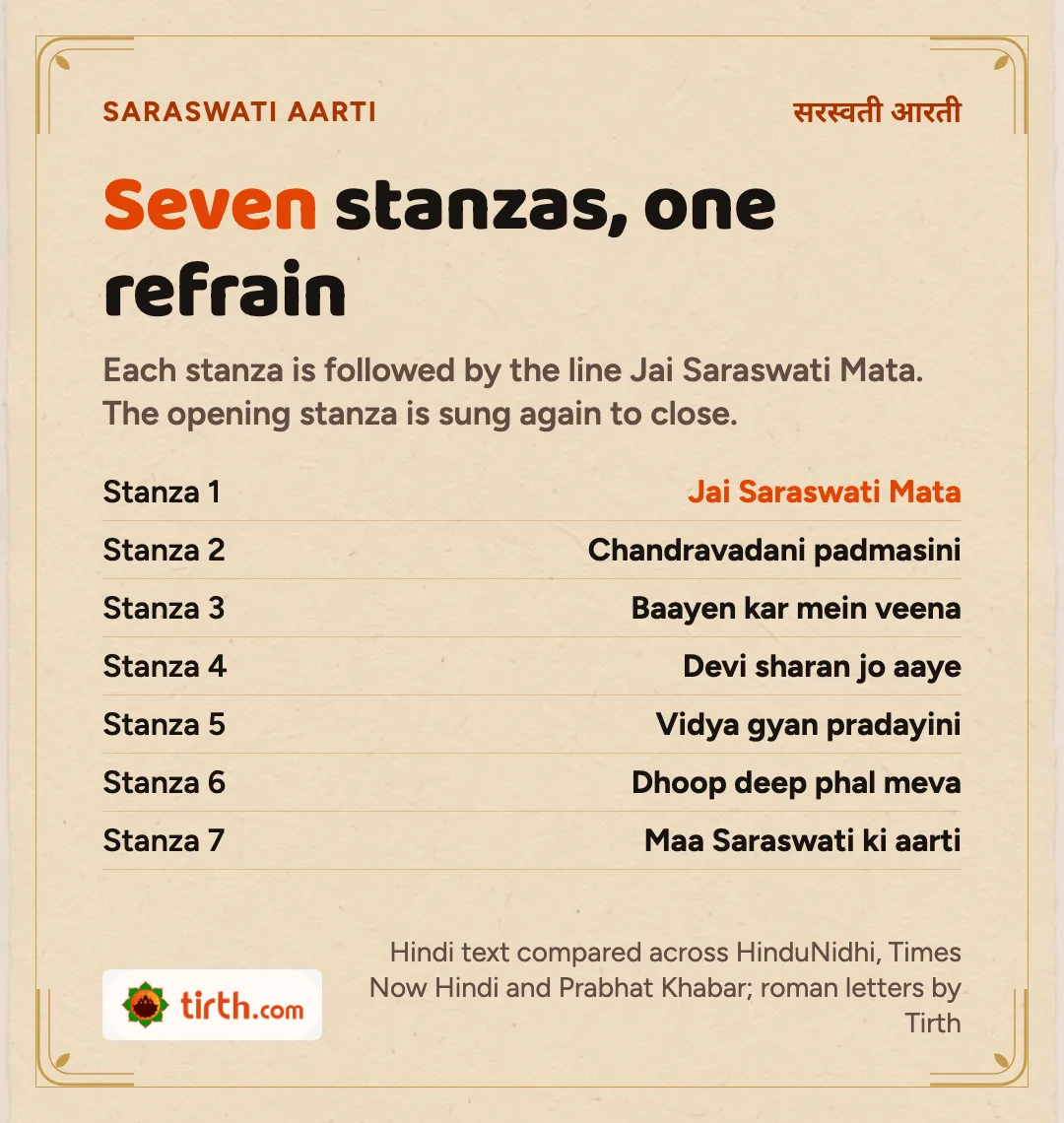
The refrain “Jai Saraswati Mata” follows every stanza. The opening stanza is sung once more at the very end. (Some singers repeat a line with “maiya” in front of it, but the copies compared give each line once and so does this page. Two of the three print the refrain as “Jai jai Saraswati Mata”; this page follows the third.)
जय सरस्वती माता,
मैया जय सरस्वती माता ।
सदगुण वैभव शालिनी,
त्रिभुवन विख्याता ॥
॥ जय सरस्वती माता…॥
Jai Saraswati Mata,
Maiya jai Saraswati Mata.
Sadgun vaibhav shalini,
Tribhuvan vikhyata.
Jai Saraswati Mata…
चन्द्रवदनि पद्मासिनि,
द्युति मंगलकारी ।
सोहे शुभ हंस सवारी,
अतुल तेजधारी ॥
॥ जय सरस्वती माता…॥
Chandravadani padmasini,
Dyuti mangalkari.
Sohe shubh hans savari,
Atul tejdhari.
Jai Saraswati Mata…
बाएं कर में वीणा,
दाएं कर माला ।
शीश मुकुट मणि सोहे,
गल मोतियन माला ॥
॥ जय सरस्वती माता…॥
Baayen kar mein veena,
Daayen kar mala.
Sheesh mukut mani sohe,
Gal motiyan mala.
Jai Saraswati Mata…
देवी शरण जो आए,
उनका उद्धार किया ।
पैठी मंथरा दासी,
रावण संहार किया ॥
॥ जय सरस्वती माता…॥
Devi sharan jo aaye,
Unka uddhar kiya.
Paithi Manthara dasi,
Ravan sanhar kiya.
Jai Saraswati Mata…
विद्या ज्ञान प्रदायिनि,
ज्ञान प्रकाश भरो ।
मोह अज्ञान और तिमिर का,
जग से नाश करो ॥
॥ जय सरस्वती माता…॥
Vidya gyan pradayini,
Gyan prakash bharo.
Moh agyan aur timir ka,
Jag se naash karo.
Jai Saraswati Mata…
धूप दीप फल मेवा,
माँ स्वीकार करो ।
ज्ञानचक्षु दे माता,
जग निस्तार करो ॥
॥ जय सरस्वती माता…॥
Dhoop deep phal meva,
Maa sweekar karo.
Gyanchakshu de Mata,
Jag nistar karo.
Jai Saraswati Mata…
माँ सरस्वती की आरती,
जो कोई जन गावे ।
हितकारी सुखकारी,
ज्ञान भक्ति पावे ॥
॥ जय सरस्वती माता…॥
Maa Saraswati ki aarti,
Jo koi jan gaave.
Hitkari sukhkari,
Gyan bhakti paave.
Jai Saraswati Mata…
जय सरस्वती माता,
जय जय सरस्वती माता ।
सदगुण वैभव शालिनी,
त्रिभुवन विख्याता ॥
॥ जय सरस्वती माता…॥
Jai Saraswati Mata,
Jai jai Saraswati Mata.
Sadgun vaibhav shalini,
Tribhuvan vikhyata.
Jai Saraswati Mata…
Watch the first word of the second stanza.
It is printed chandravadani in all the copies compared, so that is the spelling above.
Saraswati aarti meaning, from chandravadani to gyanchakshu
The meanings in this table are Tirth’s own plain rendering, stanza by stanza. Only one word, timir, is traced to a dictionary here. Monier-Williams gives timira as dark or gloomy, and as darkness, and in the fifth stanza it stands beside moh (attachment) and agyan (ignorance), so the line asks the goddess to clear away the darkness of not knowing.
| Stanza | Plain meaning (Tirth’s rendering) |
|---|---|
| Jai Saraswati Mata | Glory to Mother Saraswati. She is rich in good qualities and splendour, and known across the three worlds. |
| Chandravadani padmasini | Moon-faced and seated on a lotus, her radiance brings good. She rides a fine swan and carries a brilliance nothing can equal. |
| Baayen kar mein veena | A veena in her left hand and a mala in her right. A jewelled crown shines on her head and a string of pearls hangs at her neck. |
| Devi sharan jo aaye | Those who came to the goddess for shelter, she lifted up. She entered the maid Manthara, and Ravan was destroyed. |
| Vidya gyan pradayini | Giver of learning and knowledge, fill us with the light of knowledge. Rid the world of attachment, ignorance and darkness. |
| Dhoop deep phal meva | Incense, lamp, fruit and dry fruit: Mother, accept them. Give us the eye of knowledge, Mother, and carry the world across. |
| Maa Saraswati ki aarti | Whoever sings this aarti of Mother Saraswati gains knowledge and devotion, which do good and bring happiness. |
| Jai Saraswati Mata (closing) | The opening stanza, sung again to close. |
Gyanchakshu is the eye of knowledge. Nistar is liberation, or a carrying across. (If a child asks about either word halfway through the aarti, those two short answers are enough for that moment, and the longer talk can wait until the prasad.)
The last stanza does make a promise of its own, that whoever sings the aarti gains knowledge and devotion. That line belongs to the aarti, and this page repeats it as the aarti’s own claim and nothing more. Nothing in it mentions marks or exam results.
What does “paithi Manthara dasi, Ravan sanhar kiya” mean?
This is the line people stop at. Why would an aarti to the goddess of learning bring in Kaikeyi’s maid and the end of Ravan?
The usual reading takes it back to Tulsidas’s Ramcharitmanas, and not to Valmiki’s Ramayana. In the Ayodhya Kanda (doha 11 in the Gita Press numbering) the gods appeal to Saraswati to turn Shri Ram towards the forest, and in doha 12 she goes to Manthara, the maid of Kaikeyi, and turns her mind.
नामु मंथरा मंदमति चेरी कैकेइ केरि। अजस पेटारी ताहि करि गई गिरा मति फेरि
Naamu Manthara mandmati cheri Kaikei keri. Ajas petari tahi kari gai Gira mati pheri.
Gira here is the goddess of speech, Saraswati herself. Manthara’s counsel to Kaikeyi set Shri Ram’s exile in motion, so the aarti folds a long stretch of the Ramcharitmanas into two short lines.
The aarti never names Tulsidas or the episode, so this is the accepted reading of the line and not something the aarti itself states.
Om Jai or Jai Saraswati Mata, and who wrote it
No source we compared names the author of this aarti. The closing stanza names no poet, and none of the copies compared names one.
The muddle over the first words comes from a second aarti. It opens “Om Jai Saraswati Mata”, is written in the style of Om Jai Jagdish Hare in the Vishnu Aarti post, runs to nine stanzas (Hansavahini Mata, Veena Vadan Kushala, Nirgun Sagun Swarupini etc.) and ends with a line naming Shivanand Swami. Separate text altogether.
We would rather you sing one of the two all the way through than switch halfway, because after the opening line the two aartis have different words, and a room where half the people sing one and half the other loses its way very quickly.
One smaller difference sits in the last stanza. A romanised copy has “jo koi nar gaave” where the Hindi copies print “jan”, and both mean whoever sings it.
When the Saraswati aarti is sung, from Vasant Panchami to the school puja
Vasant Panchami falls on Magha Shukla Panchami, the fifth day of the bright half of Magh, and homes and schools that keep a Saraswati puja close it with these seven stanzas. Vasant Panchami in 2027 is on Thursday, 11 February, and the Tirth Spiritual Calendar gives the timing for your city.
The same aarti closes a Saraswati puja on any other day too.
The rest of the day’s puja, and what the festival marks, is in Tirth’s Vasant Panchami guide.
Doing the Saraswati aarti at home with a lamp and your books
A short mantra to her can come first, and Tirth’s page of Saraswati mantras has them with their meanings. If you are leading the aarti for the first time, keep the roman lines open on your phone and let someone else hold the lamp for the opening stanza.
Nothing printed with the aarti fixes an order. This is simply what many families do.
- Place the picture or image of Goddess Saraswati on a clean cloth, with flowers in front of her.
- Set your books, pens or a musical instrument before her.
- Light the lamp and the incense, and put out fruit or dry fruit. The sixth stanza names dhoop, deep, phal and meva as the offerings the singer asks the Mother to accept.
- Sing from the first stanza to the closing repeat, waving the lamp slowly in front of the image.
- Share the prasad once the aarti ends.
The published copies give no count of repetitions and no fixed hour. One full singing, done with attention, is plenty.
For other prayers to her there is the Saraswati Chalisa and the Sharada Aarti, which is a different text addressed to her as Maa Sharada, and the Gayatri Aarti is in the same aarti category, along with more aartis on the Tirth blog. If you would like a priest to perform a Saraswati puja for your family, you can book a puja with Tirth.
Frequently asked questions
Who wrote the Saraswati aarti?
No source we found names a poet. The closing stanza carries no name, and one of the copies compared says plainly that the author is not known. A byline on a website belongs to whoever wrote that page, not to the aarti.
Is it “Om Jai Saraswati Mata” or “Jai Saraswati Mata”?
The seven-stanza aarti on this page opens “Jai Saraswati Mata”. A different nine-stanza aarti opens with “Om Jai Saraswati Mata” and ends by naming Shivanand Swami.
What is gyanchakshu in the Saraswati aarti?
Gyanchakshu means the eye of knowledge. In the sixth stanza the singer asks the Mother for it, and then asks her to carry the world across.
Why does the aarti mention Manthara and Ravan?
The line is usually read as recalling the Ramcharitmanas, where Saraswati turns the mind of Kaikeyi’s maid Manthara (Ayodhya Kanda, doha 12). Manthara’s counsel set Shri Ram’s exile in motion.
Where can I read the Saraswati aarti lyrics in English?
Each stanza above has the Hindi text followed by the same lines in roman letters, and the table gives a plain English meaning of every stanza. All seven stanzas and the closing repeat are there.