
Santoshi Chalisa: Hindi text, Roman letters and word meanings
Tirth editorial · 3 Jan 2026 · 10 min read
The Santoshi Chalisa is a Hindi prayer to Santoshi Mata, two opening dohas and a long run of chaupai couplets closed by one more doha, and families read it on Fridays, the day the chalisa itself calls pleasing for her vrat (Shukravaar ka divas suhaavan). The full text follows, first in Devanagari and then in Roman letters, couplet by couplet.
Santosh means contentment or satisfaction, so she is, by her name, the one of contentment. In the vrat katha she is the daughter of Lord Ganesha, and one line of the chalisa says so too.
Its opening doha speaks of crossing the ocean of sorrow (dukh saagar se paar) by meditating on her. Read that as the prayer of those who recite it, not a promise.
One thing before you start. Two different chalisas carry this name, so if your family reads from a printed book, check its first line against the one below (it takes a few seconds, and saves finding out halfway through).
Santoshi Chalisa in Hindi, from Bandau Santoshi charan to the closing doha
This is the version found on Hindi devotional websites, and the one this page has carried from the start. It opens by bowing at her feet (charan) and calling her the giver (dataar) of Riddhi and Siddhi, and it has 38 chaupais between its dohas, while Bhakti Bharat and Webdunia, two websites that carry the same text, have two more.
बन्दौं सन्तोषी चरण रिद्धिसिद्धि दातार। ध्यान धरत ही होत नर दुःख सागर से पार॥
भक्तों को संतोष दे संतोषी तव नाम। कृपा करहु जगदम्ब अब आया तेरे धाम॥
जय सन्तोषी मात अनुपम। शांति दायिनी रूप मनोरम॥
सुन्दर वरण चतुर्भुज रूप। वेश मनोहर ललित अनुपा॥
श्वेताम्बर रूप मनहारी। माँ तुम्हारी छवि जग से न्यारी॥
दिव्य स्वरूपा आयत लोचन। दर्शन से हो संकटमोचन॥
जय गणेश की सुता भवानी। रिद्धि सिद्धि की पुत्री ज्ञानी॥
अगम अगोचर तुम्हरी माया। सब पर करो कृपा की छाया॥
नाम अनेक तुम्हारे माता। अखिल विश्व है तुमको ध्याता॥
तुमने रूप अनेकों धारे। को कहि सके चरित्र तुम्हारे॥
धाम अनेक कहाँ तक कहिये। सुमिरन तब करके सुख लहिये॥
विन्ध्याचल में विन्ध्यवासिनी। कोटेश्वर सरस्वती सुहासिनी॥
कलकत्ते में तू ही काली। दुष्ट नाशिनी महाकराली॥
सम्बल पुर बहुचरा कहाती। भक्तजनों का दुख मिटाती॥
ज्वाला जी में ज्वाला देवी। पूजत नित्य भक्त जन सेवी॥
नगर बम्बई की महारानी। महा लक्ष्मी तुम कल्याणी॥
मदुरा में मीनाक्षी तुम हो। सुख दुख सबकी साक्षी तुम हो॥
राजनगर में तुम जगदम्बे। बनी भद्रकाली तुम अम्बे॥
पावागढ़ में दुर्गा माता। अखिल विश्व तेरा यश गाता॥
काशीपुराधीश्वरी माता। अन्नपूर्णा नाम सुहाता॥
सर्वानंद करो कल्याणी। तुम्हीं शारदा अमृतवाणी॥
तुम्हरी महिमा जल में थल में। दुःख दारिद्र सब मेटो पल में॥
जेते ऋषि और मुनीशा। नारद देव और देवेशा।
इस जगती के नर और नारी। ध्यान धरत हैं मात तुम्हारी॥
जापर कृपा तुम्हारी होती। वह पाता भक्ति का मोती॥
दुःख दारिद्र संकट मिट जाता। ध्यान तुम्हारा जो जन ध्याता॥
जो जन तुम्हरी महिमा गावै। ध्यान तुम्हारा कर सुख पावै॥
जो मन राखे शुद्ध भावना। ताकी पूरण करो कामना॥
कुमति निवारि सुमति की दात्री। जयति जयति माता जगधात्री॥
शुक्रवार का दिवस सुहावन। जो व्रत करे तुम्हारा पावन॥
गुड़ छोले का भोग लगावै। कथा तुम्हारी सुने सुनावे॥
विधिवत पूजा करे तुम्हारी। फिर प्रसाद पावे शुभकारी॥
शक्ति सामरथ हो जो धनको। दान दक्षिणा दे विप्रन को॥
वे जगती के नर औ नारी। मनवांछित फल पावें भारी॥
जो जन शरण तुम्हारी जावे। सो निश्चय भव से तर जावे॥
तुम्हरो ध्यान कुमारी ध्यावे। निश्चय मनवांछित वर पावै॥
सधवा पूजा करे तुम्हारी। अमर सुहागिन हो वह नारी॥
विधवा धर के ध्यान तुम्हारा। भवसागर से उतरे पारा॥
जयति जयति जय संकट हरणी। विघ्न विनाशन मंगल करनी॥
हम पर संकट है अति भारी। वेगि खबर लो मात हमारी॥
संतोषी माँ के सदा बंदहूँ पग निश वास। पूर्ण मनोरथ हो सकल मात हरौ भव त्रास॥
॥ इति श्री संतोषी माता चालीसा ॥
The Santoshi Mata aarti is a separate prayer.
Santoshi Chalisa in Roman letters, couplet by couplet
The same chalisa in the same order, for anyone who follows Hindi more easily by ear than by script. Where the Roman spelling and the Devanagari differ by a letter or a word (Mahakaali and महाकराली in chaupai 11, for one), go by the Devanagari.
| Line | In Roman letters |
|---|---|
| Opening doha 1 | Bandau Santoshi charan, RiddhiSiddhi dataar। Dhyan dharat hi hot nar, dukh saagar se paar॥ |
| Opening doha 2 | Bhakton ko santosh de, Santoshi tav naam। Kripa karahu Jagdamba, ab aaya tere dham॥ |
| Chaupai 1 | Jai Santoshi Mata anupam। Shanti daayini roop manoram॥ |
| Chaupai 2 | Sundar varan chaturbhuj roop। Vesh manohar lalit anup॥ |
| Chaupai 3 | Shvetambar roop manhaari। Maa tumhari chhavi jag se nyaari॥ |
| Chaupai 4 | Divya swaroopa aayat lochan। Darshan se ho sankat mochan॥ |
| Chaupai 5 | Jai Ganesh ki suta Bhavani। RiddhiSiddhi ki putri gyani॥ |
| Chaupai 6 | Agam agochar tumhari maya। Sab par karo kripa ki chhaya॥ |
| Chaupai 7 | Naam anek tumhare mata। Akhil vishv hai tumko dhyata॥ |
| Chaupai 8 | Tumne roop anekon dhare। Ko kahi sake charitra tumhare॥ |
| Chaupai 9 | Dhaam anek kahan tak kahiye। Sumiran tab karke sukh lahiye॥ |
| Chaupai 10 | Vindhyachal mein Vindhyavasini। Koteswar Saraswati suhasini॥ |
| Chaupai 11 | Kalkatte mein tu hi Kali। Dusht nashini Mahakaali॥ |
| Chaupai 12 | Sambhalpur Bahuchara kahati। Bhaktjanon ka dukh mitati॥ |
| Chaupai 13 | Jwala Ji mein Jwala Devi। Poojat nitya bhakt jan sevi॥ |
| Chaupai 14 | Nagar Bambai ki Maharani। Maha Lakshmi tum Kalyani॥ |
| Chaupai 15 | Madura mein Meenakshi tum ho। Sukh dukh sabki sakshi tum ho॥ |
| Chaupai 16 | Rajnagar mein tum Jagdambe। Bani Bhadrakali tum Ambe॥ |
| Chaupai 17 | Pavagadh mein Durga Mata। Akhil vishv tera yash gata॥ |
| Chaupai 18 | Kashipuradhishwari Mata। Annapurna naam suhata॥ |
| Chaupai 19 | Sarvanand karo Kalyani। Tumhi Sharada Amritvani॥ |
| Chaupai 20 | Tumhari mahima jal mein thal mein। Dukh daridra sab meto pal mein॥ |
| Chaupai 21 | Jete rishi aur munisha। Narad dev aur devesha॥ |
| Chaupai 22 | Is jagti ke nar aur naari। Dhyan dharat hain maat tumhari॥ |
| Chaupai 23 | Jaapar kripa tumhari hoti। Wah paata bhakti ka moti॥ |
| Chaupai 24 | Dukh daridra sankat mit jata। Dhyan tumhara jo jan dhyata॥ |
| Chaupai 25 | Jo jan tumhari mahima gaave। Dhyan tumhara kar sukh paave॥ |
| Chaupai 26 | Jo man rakhe shuddh bhavana। Taaki poorn karo kamana॥ |
| Chaupai 27 | Kumati nivari sumati ki daatri। Jayati Jayati Mata Jagdhatri॥ |
| Chaupai 28 | Shukravaar ka divas suhaavan। Jo vrat kare tumhara paavan॥ |
| Chaupai 29 | Gud chhole ka bhog lagave। Katha tumhari sune sunaave॥ |
| Chaupai 30 | Vidhivat pooja kare tumhari। Phir prasad paave shubhkaari॥ |
| Chaupai 31 | Shaktisaamarth ho jo dhanko। Daandakshina de vipran ko॥ |
| Chaupai 32 | Ve jagti ke nar au naari। Manvaanchhit phal paave bhaari॥ |
| Chaupai 33 | Jo jan sharan tumhari jaave। So nishchay bhav se tar jaave॥ |
| Chaupai 34 | Tumharo dhyan kumari dhyave। Nishchay manvaanchhit var paave॥ |
| Chaupai 35 | Sadhva pooja kare tumhari। Amar suhagin ho vah naari॥ |
| Chaupai 36 | Vidhwa dhar ke dhyan tumhara। Bhavsagar se utre paara॥ |
| Chaupai 37 | Jayati Jayati Jai Sankat Harni। Vighn Vinashan Mangal Karni॥ |
| Chaupai 38 | Hum par sankat hai ati bhaari। Veg khabar lo Maat hamaari॥ |
| Closing doha | Santoshi Maa ke sada, bandahun pag nish vaas। Poorn manorath ho sakal, Maat haro bhav traas॥ ॥ Iti Shri Santoshi Mata Chalisa ॥ |
What anupam, agochar and suhagin mean in the Santoshi Chalisa
The meanings below are from John Platts’ dictionary of Urdu, classical Hindi and English, published in 1884, and each one is the sense that fits the line. Words the dictionary does not list in the form the chalisa uses are left out rather than guessed at.
| Word | Where it comes | Meaning in Platts (1884) |
|---|---|---|
| संतोष, संतोषी (santosh, Santoshi) | Opening doha 2 | contentedness, content, satisfaction |
| चरण (charan) | Opening doha 1 | the foot |
| दातार (dataar) | Opening doha 1 | giver |
| दुःख (dukh) | Opening doha 1 | pain, affliction, suffering, distress, sorrow |
| जगदम्ब (Jagdamba) | Opening doha 2, chaupai 16 | mother of the world |
| मात (mat) | Chaupai 1 | mother |
| अनुपम (anupam) | Chaupai 1 | incomparable, unequalled, matchless |
| संकट (sankat) | Chaupai 4, 24, 37, 38 | difficulty, trouble, anguish, affliction |
| अगम (agam) | Chaupai 6 | inaccessible, incomprehensible, unfathomable |
| अगोचर (agochar) | Chaupai 6 | imperceptible, unseen, hidden, mysterious |
| दारिद्र (daridra) | Chaupai 20, 24 | poverty |
| सुहावन (suhavan) | Chaupai 28 | pleasing, agreeable |
| व्रत (vrat) | Chaupai 28 | rite, observance, a religious act or obligation |
| भोग (bhog) | Chaupai 29 | food offered (in worship) |
| प्रसाद (prasad) | Chaupai 30 | food offered to a deity; also favour, graciousness |
| शरण (sharan) | Chaupai 33 | protection, refuge, shelter |
| भव (bhav), as in भवसागर | Chaupai 33, 36, closing doha | existence, the world; in bhavarnav, the ocean of existence |
| सधवा (sadhva) | Chaupai 35 | a wife whose husband is living |
| सुहागिन (suhagin) | Chaupai 35 | a fortunate woman |
| विघ्न (vighn) | Chaupai 37 | obstacle, impediment, hindrance |
| त्रास (tras) | Closing doha | alarm, fear, dread, terror |
Manorath, in the closing doha, is the odd one out. Platts sends the reader to manas (mind) and gives it no meaning of its own, so the table skips it.
Friday and the gud chhole line in the Santoshi Chalisa
The chalisa names Friday itself, and the vrat katha pamphlets that the scholar Philip Lutgendorf studied keep the vrat on Fridays too. One line does need a note. This chalisa says gud chhole ka bhog lagave, while those pamphlets and the 2004 Randhir Prakashan print name gur-chana (jaggery and roasted chickpeas) as the offering. The verse itself stays. For the offering, go by the pamphlet or the elder who taught you the vrat. The puja, the fast and the udyapan are set out in the Santoshi Mata worship guide, and the Friday aarti and the Tirth vrat calendar have pages of their own.
Why your book may have a different Santoshi Chalisa
Two different chalisas go by the name Santoshi Chalisa. They part company at the very first line.
The one on this page, opening Bandau Santoshi charan, is the text found on Hindi devotional sites such as Bhakti Bharat and Webdunia, and neither of them names a printed edition for it. The other is the “Shri Santoshi Maa Chalisa” on pages 236 to 239 of 51 Chalisa Sangrah evam Aartiyan (Randhir Prakashan, Hardwar, 2004), with its own aarti on page 240, and its opening doha and chaupai are different words altogether. Only the closing doha, Santoshi Maa ke sada bandahun pag nish vaas, is shared by both.
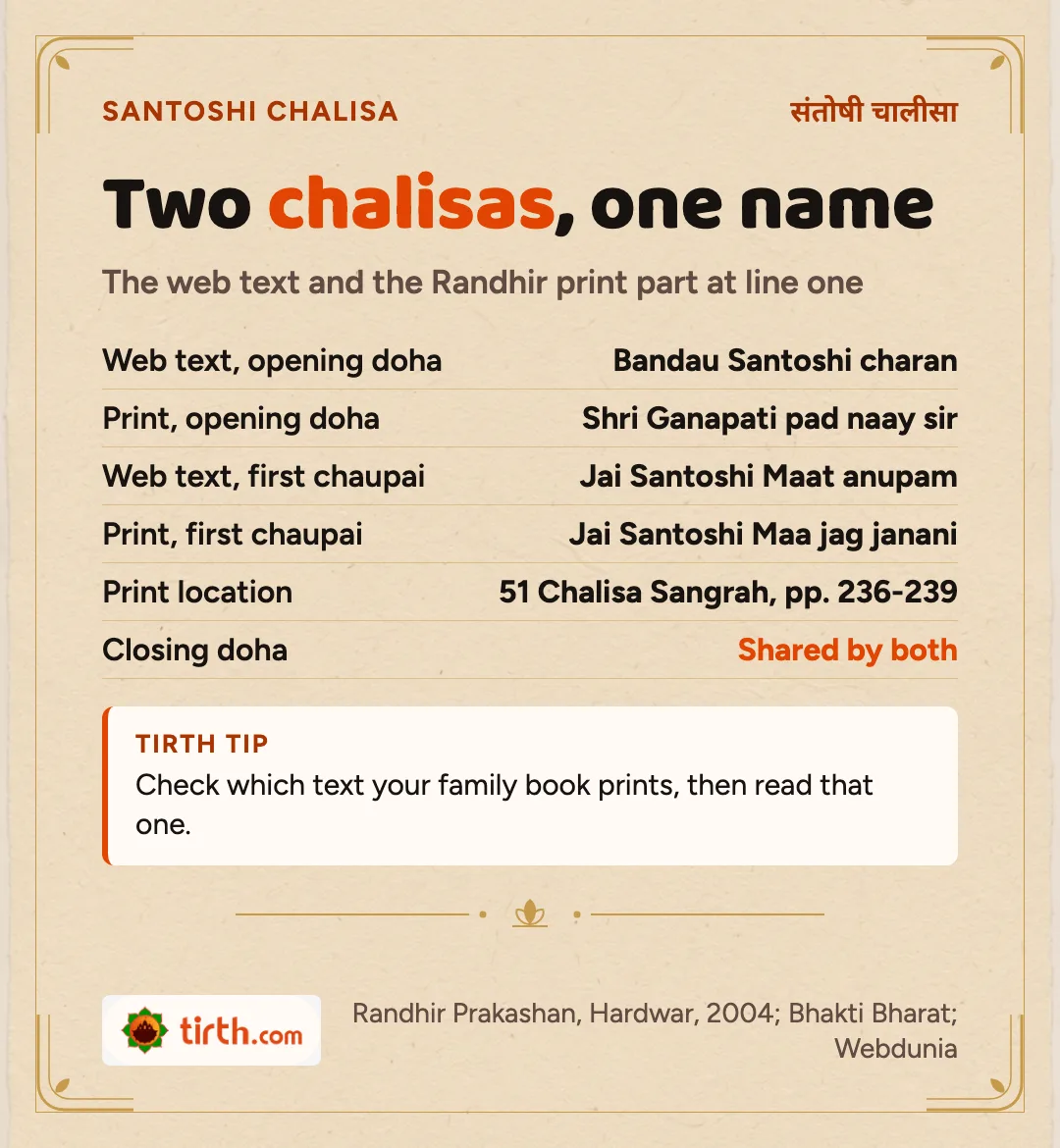
A third text exists as well. Or rather a third booklet, Jay Santoshi Chalisa, published by Shri Santoshi Mata ka Prachin Mandir in Pushkar, which is different again.
We would rather say all this plainly than call the version here the original, because no printed edition of it has been traced yet. If your family’s book has the Randhir or the Pushkar text, read that one through.
How a Friday vrat pamphlet and a 1975 film spread Santoshi Mata’s worship
Her Friday vrat had been spreading in northern India for more than a decade prior to the film Jai Santoshi Maa, Lutgendorf writes, and the film took its story from a popular vrat katha pamphlet. Released in 1975, the year of Sholay and Deewar, it carried her worship far wider than the pamphlets had.
His article in Manushi 131 (2002) is the place to read that history in full.
For other chalisas to the Devi, Tirth has the Durga Chalisa and the Mahalakshmi Chalisa, along with the Saraswati Chalisa.
Frequently asked questions
Who wrote the Santoshi Chalisa?
No author is recorded for it. Bhakti Bharat names no author or book for it, and Webdunia credits its page to the WD Feature Desk, the site’s own byline, not a writer of the chalisa.
On which day is the Santoshi Chalisa read?
Friday. The chalisa calls Friday the pleasing day for her vrat, and the vrat katha pamphlets keep the fast on Fridays.
Is Santoshi Mata the daughter of Lord Ganesha?
Yes, in the vrat katha, and the chalisa line Jai Ganesh ki suta Bhavani calls her Ganesha’s daughter as well.
What is offered on the Santoshi Mata Friday vrat?
Gur-chana, jaggery with roasted chickpeas, in the vrat pamphlets and in the 2004 Randhir Prakashan chalisa. The version of the chalisa on this page says gud chhole ka bhog. The rest of the vrat is on the Santoshi Mata page.
Is the Santoshi Chalisa the same as the Santoshi Mata aarti?
No, they are separate prayers. The 2004 Randhir Prakashan book prints the aarti on its own page right after the chalisa, and Tirth keeps the aarti to Santoshi Mata on a page of its own.