
Samudra Manthan Story: A Curse, a Truce and a Pot of Amrit
Tirth editorial · 7 Nov 2026 · 9 min read
A garland lies in the dirt because an elephant threw it there. That garland opens the Samudra Manthan story in the Vishnu Purana, the Samudra Manthan ki kahani where gods and asuras churn the ocean of milk side by side for amrit, the nectar of immortality.
Rishi Durvasa had tossed it to Indra Dev, who hung it on his elephant Airavata.
Rishi Durvasa loses his temper. To him the garland was the dwelling of Maa Lakshmi, Fortune herself, and his sentence on Indra Dev reads “thy sovereignty over the three worlds shall be subverted.” That is in H. H. Wilson’s 1840 translation. No amount of begging helps. From there the three worlds lose their vigour. Plants wither. The Danavas & the sons of Diti attack the weakened gods.
The Bhagavata Purana mentions Rishi Durvasa only in passing and opens on a lost war. I am following its order and stopping wherever the other books differ. Which is often.
Samudra Manthan ki kahani: why did the gods make a truce with the asuras?
Brahma ji, up on Sumeru, takes the beaten gods on to Bhagwan Vishnu at Shvetadvipa in the ocean of milk.
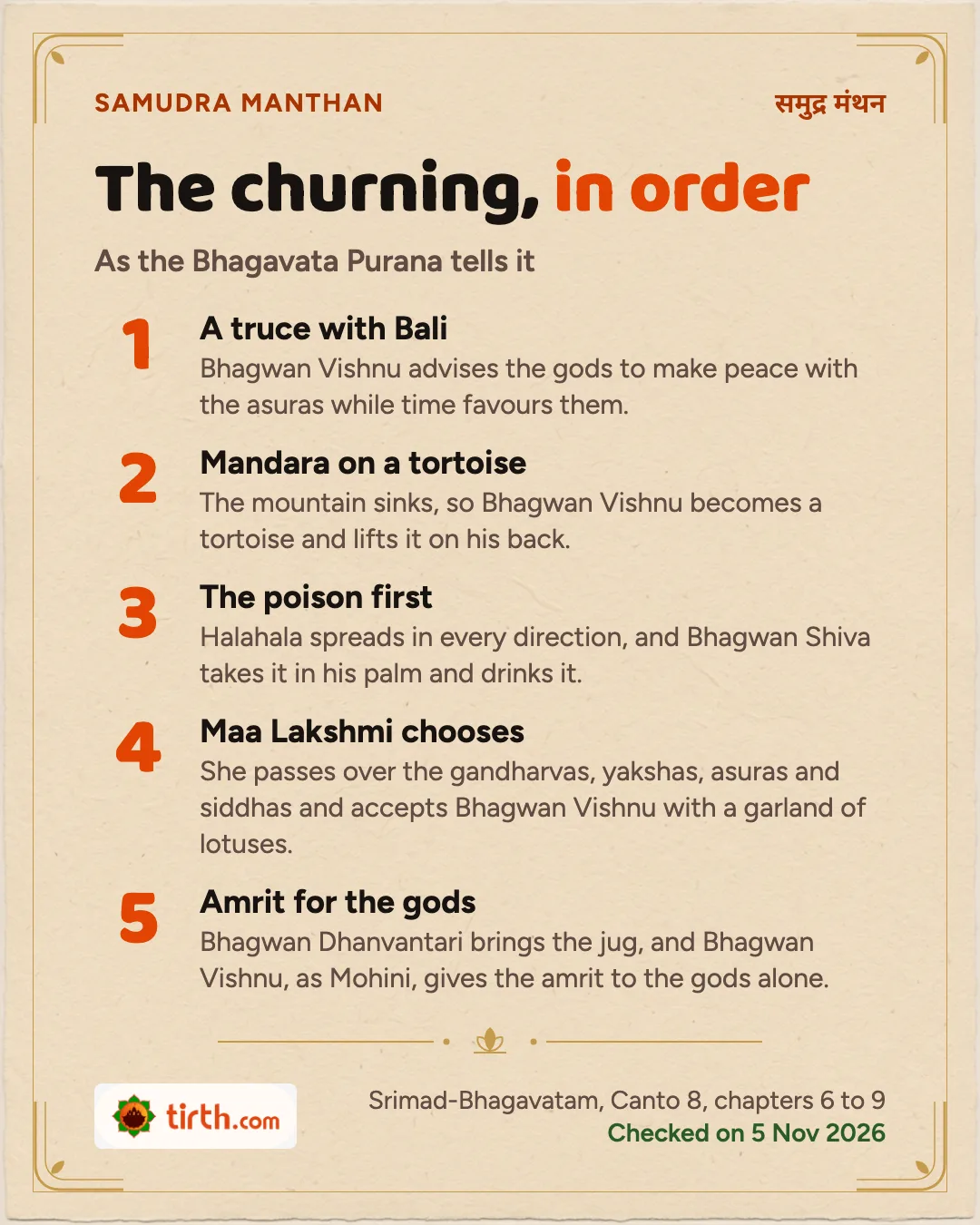
Bhagwan Vishnu says make a truce with the asuras while time is on their side. Self-interest can call for peace even with an enemy, as in the logic of the snake and the mouse. Herbs and creepers into the ocean of milk, Mandara for the rod, Vasuki for the rope. Give the asuras whatever they ask. A poison will come, which he names kalakuta, and they are not to fear it or get greedy or angry over anything else that rises (Bhagavata, canto 8, chapter 6). I think that last part is the hardest.
Bali, the asura king, hears the gods out and agrees to it.
The Vishnu Purana is blunter. Bhagwan Vishnu tells the gods to offer the Daityas, the enemies of the gods, an equal share. He will make sure they get the labour and none of the amrit.
How did a mountain and a snake churn the ocean?
Getting Mandara to the water goes badly. Gods & asuras pull it from the earth together and carry it till they drop it, exhausted, and it crushes many of them. Bhagwan Vishnu arrives on Garuda. A glance, and the crushed are alive. With one hand he puts the mountain on Garuda and takes it to the ocean of milk. Vasuki becomes the rope for a promised share of the amrit. The asuras insist on his head end, and Bhagwan Vishnu smiles and takes the tail with the gods.
They start, and Mandara sinks. So Bhagwan Vishnu goes into the water as Kurma, a tortoise, and takes it on his back (Bhagavata 8.7.8).
Vasuki’s fiery breath wears out the asuras at his head and blackens the gods at his tail, though the gods get clouds and cool spray by Bhagwan Vishnu’s grace. Still no amrit. So he grabs hold and churns himself.
In the Mahabharata the serpent Ananta tears Mandara up and a king among tortoises bears it. The Ramayana lets it sink all the way to Patala before Bhagwan Vishnu, as a tortoise, takes it.
Why did Bhagwan Shiva drink the halahala poison?
The first thing out of the ocean is the poison Bhagwan Vishnu warned about. In chapter 7 the Bhagavata calls it halahala, and it spreads everywhere.
The gods and Bhagwan Vishnu find Bhagwan Shiva on Mount Kailasa with Maa Parvati (Bhavani), and he tells her that protecting beings who suffer is his duty. She knows what he can do, so she says yes, and he takes all of the poison in his palm and drinks it.
It leaves a blue line on his neck. He wears it as an ornament now, the Bhagavata says, and the few drops that fell went to scorpions, cobras and poisonous herbs (Bhagavata 8.7.46).
Each of the other books does this scene its own way. Over in the Ramayana, Bhagwan Vishnu tells Bhagwan Shiva the first thing to rise is his, as the foremost god, and he drinks it like nectar. The Vishnu Purana gives the poison to the Nagas, and that chapter does not say Bhagwan Shiva drinks it. And the Mahabharata keeps its Kalakuta for the very end, when Bhagwan Shiva holds it in his throat at Brahma ji’s request. Which is where the name comes from, “from that time he is called Nilakantha.”
What rose from the ocean, and were there really 14 ratnas?
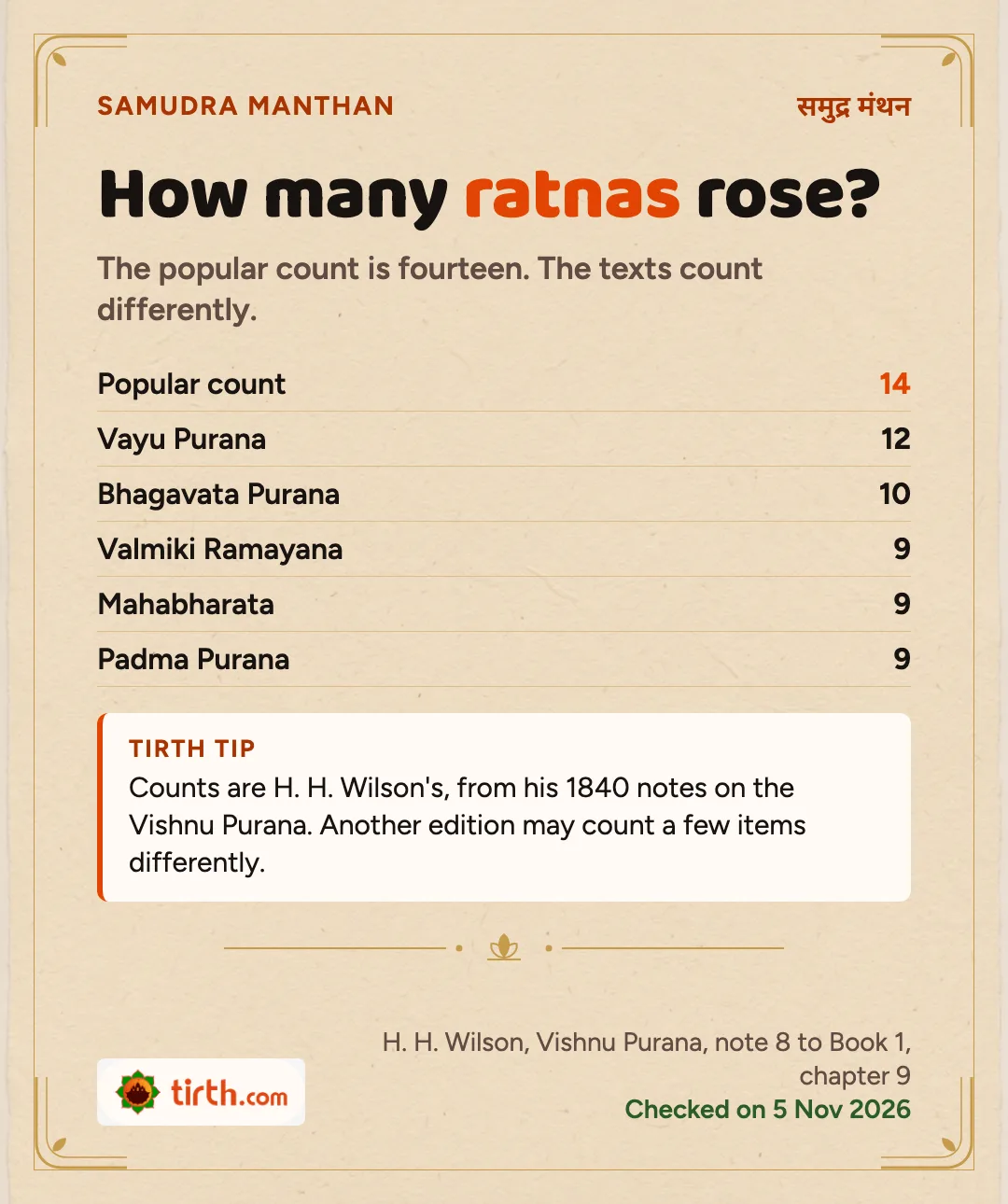
None of these four books gets to fourteen ratnas (treasures). The Bhagavata does not number them.
| Text and verses | What rose, in order | The poison |
|---|---|---|
| Bhagavata Purana 8.7.18 to 8.8.35 | Halahala, Surabhi the cow, the horse Uchchaihshravas, Airavata with eight elephants and eight she-elephants, the gems Kaustubha and Padmaraga, the Parijata flower, the apsaras, Maa Lakshmi, Varuni Devi, Bhagwan Dhanvantari with the jug of amrit | First. Bhagwan Shiva drinks it (8.7.42) |
| Vishnu Purana, Book 1, chapter 9 | Surabhi, Varuni Devi, the Parijata tree, the apsaras, the moon (taken by Bhagwan Shiva), the poison, Bhagwan Dhanvantari with the vessel of amrit, Maa Lakshmi as Shri on a lotus | After the moon. The Nagas take it, and Bhagwan Shiva is not said to drink it |
| Mahabharata, Adi Parva, Astika Parva, Section XVIII (English translation) | The moon, Maa Lakshmi, the white horse Uchchaihshravas, Kaustubha, Bhagwan Dhanvantari with the vessel of amrit, Airavata, the Kalakuta poison | Last. Bhagwan Shiva holds it in his throat |
| Valmiki Ramayana, Bala Kanda 1.45.19 to 39 | Halahala, Bhagwan Dhanvantari, the apsaras, Varuni Devi, Uchchaihshravas, Kaustubha, the amrit | First. Bhagwan Shiva drinks it at Bhagwan Vishnu’s word (1.45.25 to 26) |
Fourteen is the popular number. Wilson said so in 1840, counting ten for the Bhagavata, nine each for the Mahabharata & the Padma Purana and twelve for the Vayu Purana, and he says the bow and the conch of Bhagwan Vishnu were slipped into the popular lists on sectarian grounds, without good authority.
The Ramayana sarga, in the edition we read, does not list Maa Lakshmi, Airavata, Kamadhenu or the Parijata.
Who did Maa Lakshmi choose when she rose from the ocean?
Once the poison is dealt with, the treasures come. Surabhi the cow is taken by the sages for ghee, Bali wants the horse Uchchaihshravas, and Bhagwan Vishnu the two gems for his chest. Maa Lakshmi rises a little later. She looks over the gandharvas, yakshas, asuras etc. for a husband, finds every one of them short of some quality and chooses Mukunda, Bhagwan Vishnu, and puts a garland of fresh lotuses on his shoulders (Bhagavata 8.8.23 to 24).
The Vishnu Purana goes all out for Maa Lakshmi. The Shri Sukta, a bath from the rivers and the elephants of the four quarters, and a garland from the ocean itself.
Which brings a garland back into the story, a fresh one for Maa Lakshmi, whose old one ended up in the dust.
Back in the Bhagavata, Varuni Devi, the deity of wine, goes to Bali’s asuras. Then comes Bhagwan Dhanvantari with a jug of amrit, a master of medicine and a full portion of a full portion of Bhagwan Vishnu. The asuras grab the jug.
The Bhagavata names no day for either rising. The festival calendar joins Bhagwan Dhanvantari to Dhanteras on Trayodashi and Maa Lakshmi to Lakshmi Puja on the Amavasya of Diwali. For the Dhanvantari puja on Dhanteras and the Dhanvantari mantra, Tirth has separate pages.
Who got the amrit, and what happened to Rahu?
Bhagwan Vishnu has promised to set the asuras quarrelling. As Mohini he gets the pot off them, and they agree to go by her decision. Two rows, gods in one and asuras in the other, and only the gods get amrit (Bhagavata 8.9.20 to 21). Rahu gets some anyway, disguised in the gods’ row. Surya Dev and Chandra Dev point him out and Bhagwan Vishnu’s disc takes his head off. Too late, though, because the amrit has already touched it. Which is how the head lives on, and Brahma ji accepts it as a planet.
Indra Dev gets his throne back at the end of the Vishnu Purana’s telling and praises Maa Lakshmi. She grants him two boons. The three worlds will not lose her again, and the Purana says anyone who recites his hymn morning and evening will not find her face turned away.
Four tellings and no fourteen
That is the churning, from a truce with Bali to amrit for the gods. The fourteen ratnas everyone quotes are a popular count, and honestly I think the way these four books disagree is the most interesting part of the story.
For Dhanteras & Diwali timings in your city there is the Tirth Spiritual Calendar, and Maa Lakshmi’s elder sister gets her own telling in the story of Alakshmi.
I hope you found this useful and will open the Bhagavata yourself some day.
Frequently asked questions
Why was the Samudra Manthan done?
For amrit. The Vishnu Purana blames Rishi Durvasa’s words, but H. H. Wilson saw that episode as added later. By his reading the Ramayana and the Mahabharata give only the gods’ wish to be immortal, and the Ramayana spells that out as a life without age, illness or death.
Are there really 14 ratnas in the Samudra Manthan?
None of the four texts above has fourteen. Wilson thought the Matsya Purana perhaps had all of them. A separate list sits in the Uttara Khanda of the Padma Purana, he adds, and it includes Alakshmi and Nidra.
Does the Mahabharata have Mohini too?
The Mahabharata tells the episode with an enticing woman. Once the Kalakuta is in Bhagwan Shiva’s throat, Bhagwan Narayana takes that form, and the asuras hand the amrit over to her.
Is the Samudra Manthan in the Ramayana and the Mahabharata?
Both. Vishvamitra tells it in the Ramayana. His listeners are Shri Ram and Lakshmana, on the morning after the two have crossed the Ganga and reached Vishala. In the Mahabharata it is Sauti, telling Shaunaka.
Continue on Tirth
- The Maa Lakshmi page, her forms and her worship.
- Bhagwan Vishnu, who holds up Mandara as Kurma and takes back the amrit as Mohini.
- The story of Alakshmi, Maa Lakshmi’s elder sister.
- The Dhanvantari mantra, to Bhagwan Dhanvantari, who rose with the jug of amrit.