
Sai Baba Aarti: Om Jai Sai Hare in Hindi and English
Tirth editorial · 7 Jan 2026 · 8 min read

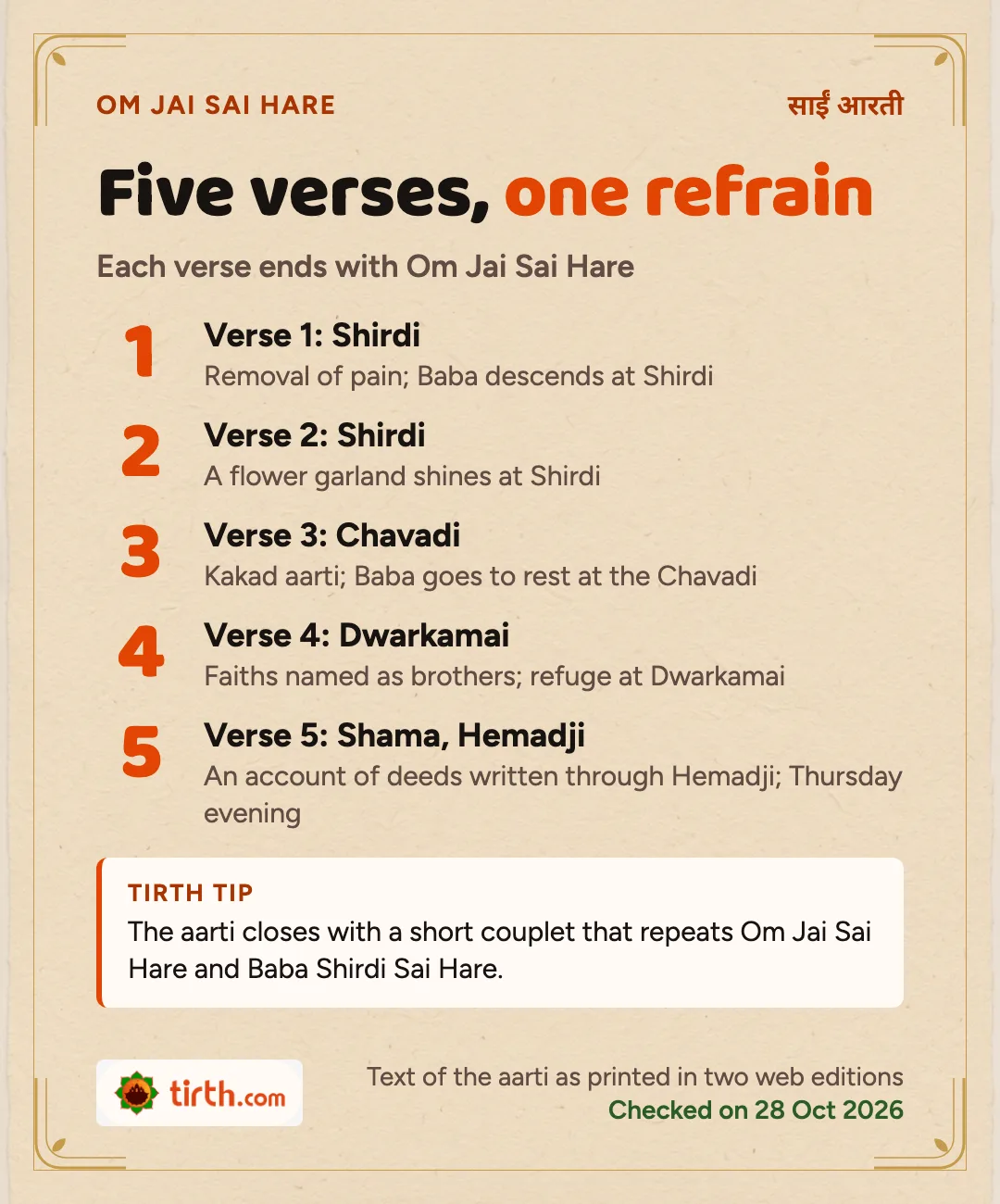
It is Thursday evening, and a family stands before a picture of Sai Baba of Shirdi to sing “Om Jai Sai Hare, Baba Shirdi Sai Hare”. That line opens the popular Hindi Sai Baba aarti, five verses with an “Om Jai” refrain after each and a closing couplet, given here in full in Devanagari and in Roman letters.
Copies of it do not all agree. Some Roman versions online, including the English page of Sri Mandir and the one this page used to carry, drop the third verse, the one that begins “Kakad aarat bhaktan gaaven”, even though the Hindi text has it.
No copy names a composer or a year, so neither does this page.
Om Jai Sai Hare lyrics, all five verses in Hindi and Roman
The text below follows the Hindi pages of two web publishers, Sri Mandir and Neoastro, which agree on the words of all five verses and on their order. Sing the refrain after every verse, and close with the couplet printed last.
This text was checked on 28 Oct 2026 against those two web editions. No printed booklet was checked.
ॐ जय साईं हरे, बाबा शिरडी साईं हरे।
भक्तजनों के कारण, उनके कष्ट निवारण॥
शिरडी में अवतरे, ॐ जय साईं हरे,
॥ ॐ जय…॥
Om Jai Sai Hare, Baba Shirdi Sai Hare.
Bhaktjanon ke karan, unke kasht nivaran.
Shirdi mein avtare, Om Jai Sai Hare.
Om Jai…
दुखियन के सब कष्टन काजे, शिरडी में प्रभु आप विराजे।
फूलों की गल माला राजे, कफनी, शैला सुन्दर साजे॥
कारज सब के करें, ॐ जय साईं हरे,
॥ ॐ जय…॥
Dukhiyan ke sab kashtan kaaje, Shirdi mein Prabhu aap viraaje.
Phoolon ki gal mala raaje, kafni, shaila sundar saaje.
Karaj sab ke karen, Om Jai Sai Hare.
Om Jai…
काकड़ आरत भक्तन गावें, गुरु शयन को चावड़ी जावें।
सब रोगों को उदी भगावे, गुरु फकीरा हमको भावे॥
भक्तन भक्ति करें, ॐ जय साईं हरे,
॥ ॐ जय…॥
Kakad aarat bhaktan gaaven, Guru shayan ko Chavdi jaaven.
Sab rogon ko Udi bhagaave, Guru Fakira hamko bhaave.
Bhaktan bhakti karen, Om Jai Sai Hare.
Om Jai…
हिन्दू मुस्लिम सिख ईसाई, बौद्ध जैन सब भाई भाई।
रक्षा करते बाबा साईं, शरण गहे जब द्वारकामाई॥
अविरल धूनी जरे, ॐ जय साईं हरे,
॥ ॐ जय…॥
Hindu Muslim Sikh Isai, Bauddh Jain sab bhai bhai.
Raksha karte Baba Sai, sharan gahe jab Dwarkamai.
Aviral dhuni jare, Om Jai Sai Hare.
Om Jai…
भक्तों में प्रिय शामा भावे, हेमडजी से चरित लिखावे।
गुरुवार की संध्या आवे, शिव, साईं के दोहे गावे॥
अंखियन प्रेम झरे, ॐ जय साईं हरे,
॥ ॐ जय…॥
Bhakton mein priya Shama bhaave, Hemadji se charit likhaave.
Guruvar ki sandhya aave, Shiv, Sai ke dohe gaave.
Ankhiyan prem jhare, Om Jai Sai Hare.
Om Jai…
ॐ जय साईं हरे, बाबा शिरडी साईं हरे।
शिरडी साईं हरे, बाबा ॐ जय साईं हरे॥
Om Jai Sai Hare, Baba Shirdi Sai Hare.
Shirdi Sai Hare, Baba Om Jai Sai Hare.
The Roman lines, which many sites call the English version, spell out the Hindi sounds and follow the Devanagari letter by letter. The first verse has “Bhaktjanon ke karan” for भक्तजनों where some Roman sheets say “Bhakton ke karan”. The second verse has “Dukhiyan ke sab kashtan kaaje” in place of “Dukhiyon ke sab kashton”, ends “Karaj sab ke karen” for कारज where some sheets say “Kaam sab ke kare”, and the flower garland line ends “raaje”, for राजे.
Other Hindi copies spell a few words differently (ओम for ॐ, सिक्ख for सिख, द्वारिकामाई for द्वारकामाई, धूनि for धूनी etc.), and these are spellings of the same words, not different lines, so either sheet is fine to sing from. Neoastro also adds a last line, श्री सद्गुरु साईंनाथ महाराज की जय. Sri Mandir leaves it out, and because the two pages differ on it, this page does not print it.
Kasht, nivaran, viraaje: what the words of Om Jai Sai Hare mean
For the meanings, this page goes to one dictionary, John T. Platts’ A Dictionary of Urdu, Classical Hindi and English, in the University of Chicago’s online edition. Platts lists most verbs under their base form, so avatare appears under avatarna, and the table gives both. What follows is the meaning of single words, not a full translation of each verse, because no sourced verse translation was checked.
| Word in the aarti | Verse | Platts headword | Platts gives |
|---|---|---|---|
| कष्ट (kasht) | 1 | kasht | evil; difficulty; pain, misery, wretchedness |
| निवारण (nivaran) | 1 | nivaran | keeping back, defending; removal of |
| अवतरे (avtare) | 1 | avatarna | to descend (especially as an incarnation of the deity) |
| दुखियन (dukhiyan) | 2 | dukhiya | afflicted one, sufferer, distressed person |
| विराजे (viraaje) | 2 | birajna | to shine, be splendid or conspicuous; to adorn, grace |
| राजे (raaje) | 2 | rajna | to be adorned; to shine |
| साजे (saaje) | 2 | sajna | to prepare, fit out; to dress, decorate, bedeck |
| गावें (gaaven) | 3 | gana | to sing, chant, to celebrate |
| शयन (shayan) | 3 | shayan | lying down, sleeping, repose; a bed |
| भगावे (bhagaave) | 3 | bhagana | to cause to flee, put to flight |
| भावे (bhaave) | 3, 5 | bhana | to be pleasing, acceptable (to) |
| भक्ति (bhakti) | 3 | bhakti | faith, devotion, adoration, worship |
| बौद्ध (Bauddh) | 4 | bauddh | a follower of the religion of Buddha |
| जैन (Jain) | 4 | jain | a Jain |
| रक्षा (raksha) | 4 | raksha | preservation, protection, care |
| शरण (sharan) | 4 | sharan | protection, refuge, shelter |
| गहे (gahe) | 4 | gahna | to seize, catch, lay hold of |
| माई (mai, in Dwarkamai) | 4 | mai | mother |
| अविरल (aviral) | 4 | aviral | uninterrupted; close, dense |
| जरे (jare) | 4 | jalna | to burn, be kindled |
| चरित (charit) | 5 | charit, charitra | charit: acting, doing, practice, behaviour; charitra: acts, deeds; story, history, or account of any one’s deeds |
| लिखावे (likhaave) | 5 | likhana | to cause to write; to get written |
| दोहे (dohe) | 5 | doha | a popular Hindi metre; a couplet |
| प्रेम (prem) | 5 | prem | love, affection, kindness |
| झरे (jhare) | 5 | jharna | to flow in a slender stream, trickle |
The second verse fits three verbs into two lines. In Platts, viraaje and raaje come back to shining or to being adorned, and saaje to dressing, decorating or bedecking.
The first verse leans on two nouns. Kasht is pain or misery, and nivaran is its removal.
In the fourth verse sharan gahe puts refuge (sharan) together with a verb for laying hold of something (gahna), and the verse closes on aviral and jare, uninterrupted and burning.
Who is Hemadji in the fifth verse?
The fifth verse says “Hemadji se charit likhaave”, and with Platts’ meanings for charit and its longer form charitra (deeds, an account of someone’s deeds) and likhana (to cause to write) the line says an account of deeds is to be written down through Hemadji.
The history page of the Shri Saibaba Sansthan Trust in Shirdi names Govind Raghunath Dabholkar, called Hemadpant, as the man who wrote Shri Sai Satcharita, the book about Baba.
The names are close. No source checked here says the aarti’s Hemadji is Hemadpant, so this page leaves that open.
Om Jai Sai Hare and the Marathi Aarti Sai Baba are two different aartis
Search for “Sai Baba aarti” and you will also meet “Aarti Sai Baba Saukhyadatara Jiva”. That one is in Marathi. It is a separate text, with its own words.
The Shri Saibaba Sansthan Trust lists Saibaba Aarati booklets in Hindi, English, Marathi and other languages among its publications, a published text to check any sheet against. This page does not say which of the two aartis is sung at the Shirdi Sai Baba Temple, or when.
Singing Om Jai Sai Hare at home on guruvar evening
The aarti names its own evening. “Guruvar ki sandhya aave”, says the fifth verse, Thursday evening comes, and the line goes on to the singing of dohe, couplets, of Shiv and Sai.
If the children in the house read Roman letters and the grandparents read Hindi, print this page with both scripts on the same sheet. We recommend it because some Roman copies online leave out the Kakad verse, so check that every sheet in the room has all five verses before the first line is sung (one sheet per person is plenty, kept folded with the puja things).
Sing “Om Jai” after each verse, then the closing couplet printed last. If your family also sings other texts on Thursday, the Sai Baba Chalisa and the Brihaspati Dev Aarti are on Tirth with their full text, and so is the Gurudev Aarti.
For a puja performed by a priest on the family’s behalf, see pujas you can book on Tirth.
Frequently asked questions
Who wrote the Sai Baba aarti Om Jai Sai Hare?
No copy found names a composer or a year. The fifth verse names Hemadji. The Sansthan’s history page names Hemadpant as the author of Shri Sai Satcharita, but no source checked here ties the two names together.
Which Sai aarti is sung at Shirdi?
This page does not say which aarti the Shirdi temple sings at which hour, because the Sansthan’s own text for it was not available to check. The Shri Saibaba Sansthan Trust publishes Saibaba Aarati booklets in Marathi, Hindi, English and other languages, a published text to check against.
When is the Sai Baba aarti sung at home?
The aarti’s own fifth verse names guruvar ki sandhya, Thursday evening. Times for the aartis at the Shirdi temple are not given here, so go by the Sansthan’s notices for those.
Why do some Roman versions online have only four verses?
They drop the third verse, which begins “Kakad aarat bhaktan gaaven” and ends “Bhaktan bhakti karen”. The Hindi text on both pages compared here has it, so the full aarti has five verses and a closing couplet.
Can people of other faiths sing this aarti?
The fourth verse itself names Hindu, Muslim, Sikh, Isai, Bauddh and Jain in a single line. The aarti sets no condition on who may sing it.