
Ramkund in Nashik: Bhagwan Ram’s Ghat and the 2027 Kumbh Snan Days
Tirth editorial · 3 Mar 2026 · 6 min read
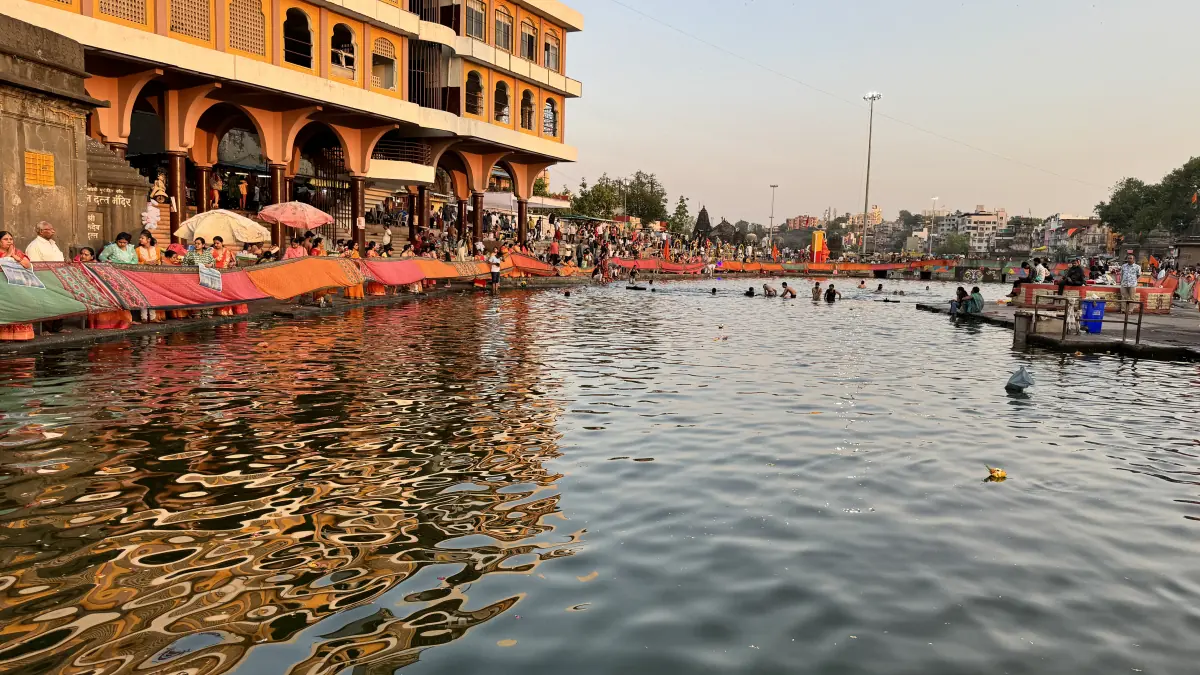
At dawn, in the season Valmiki calls Hemanta, Bhagwan Ram walks down to the Godavari at Panchavati to bathe, with Lakshman ji following him carrying a vessel. The city’s belief places that bath at Ram Kund in Nashik, the stone tank on the Godavari.
Ramkund is Nashik’s bathing centre for the 2027 Simhastha Kumbh, and the Authority’s interim plan lists its Amrit Snan days as Monday, 2 August, Tuesday, 31 August and Saturday, 11 September 2027.
Did Bhagwan Ram bathe at Ramkund? Valmiki’s Godavari and Nashik’s tank
Valmiki builds the scene over three sargas of the Aranya Kanda. In sarga 13, Rishi Agastya tells Bhagwan Ram of Panchavati, about two yojanas from his own hermitage, an ever-flowering forest with the Godavari close by, a place he says Maa Sita will like. In sarga 15 Bhagwan Ram settles there, and Lakshman ji builds the cottage of leaves and bamboo at his word. Sarga 16 is the one to read before a snan, because it holds the Hemanta dawn bath. Bhagwan Ram bathes with Lakshman ji and Maa Sita, and the three of them offer water to the gods and to the ancestors (verses 41 and 42 in the valmikiramayan.net edition).
Valmiki never names Ramkund.
The text speaks of the Godavari at Panchavati and stops there. That this particular tank is the spot where Bhagwan Ram bathed is Nashik’s belief, recorded by the district administration and by Incredible India, and it is why the city holds Ramkund as its holiest place on the river. The river is worshipped in her own right too, as Maa Godavari.
Ramkund or Kushavarta: which Simhastha ghat is yours?
Ramkund is the Simhastha’s bathing centre in Nashik city, and Kushavarta at Trimbakeshwar, about 30 km away by road, is the other, with the Vaishnava akharas bathing at Ramkund and the Shaiva akharas at Kushavarta. If your family’s plan is built around Bhagwan Shiv and the Trimbakeshwar Jyotirlinga, Kushavarta is the kund that goes with it, and why the Nashik Kumbh is unique looks at the two-location set-up.
Amrit Snan days at Ramkund in 2027, with the tithi for each
The Authority’s plan lists three Amrit Snan days at Nashik. That plan, the first edition of the Kumbh Mela Plan dated 15 June 2026, is marked interim, so a date can still move, and neither the akhara order nor the timings for 2027 have been announced. The official list is kept up to date on the Nashik Kumbh dates page on KumbhMela.info.
| Amrit Snan day (interim plan) | Tithi at Nashik | Sunrise at Nashik |
|---|---|---|
| Monday, 2 August 2027 | Amavasya (Krishna paksha) until 3:34 PM, then Pratipada | 6:10 AM |
| Tuesday, 31 August 2027 | Amavasya from 2:40 AM to 11:10 PM | 6:18 AM |
| Saturday, 11 September 2027 | Shukla Ekadashi until 7:35 PM, then Dwadashi | 6:21 AM |
The tithi and sunrise columns come from the Tirth panchang, worked out for Nashik. Two of the days are Amavasya, new moon. On 2 August it is Amavasya of Shravana by the purnimanta month and of Ashadha by the amanta month. It ends at 3:34 PM.

31 August is Amavasya again, running from 2:40 AM to 11:10 PM. So the whole snan morning is Amavasya.
11 September is Shukla Ekadashi of Bhadrapada until 7:35 PM, and it is the day the Vaishnava akharas’ Amrit Snan is reported at Ramkund, with the Shaiva akharas at Kushavarta on 12 September. If your family can come for only one of the three days and wants to be at Ramkund on the day of the Vaishnava akharas’ bath, hold 11 September, and check the official list again before you book anything.
For everything beyond this one ghat, read the complete Nashik Kumbh 2027 guide, or the Kumbh Mela 2027 overview for all four Kumbh cities side by side.
What a snan at Ramkund involves
No clock times here, because none have been announced for 2027. What the sources do give is Valmiki’s order in sarga 16, where the bath comes first and the tarpana, water offered to the gods and to the ancestors, follows it.
Rites for the dead take place at the ghat every day.
Asthi visarjan at Ramkund and the Asthi Vilaya Tirtha
Ramkund holds the Asthi Vilaya Tirtha, the place where bones dissolve. Families bring the ashes of their dead here for immersion in the Godavari, and rites for the dead take place at the ghat every day. The district administration’s page on Ramkund notes that the ashes of several national leaders were immersed here.
The ghat also has its own story of Bhagwan Ram in mourning. It is said at Ramkund that he performed the last rites of his father, King Dasharath, here. Valmiki places those rites elsewhere. In sarga 76 of the Ayodhya Kanda it is Bharat who performs them, on the bank of the Sarayu, so the Ramkund account is the ghat’s own belief and Valmiki’s account belongs to Ayodhya.
Who built Ramkund? Chitrarao Khatav and Gopikabai
Ramkund was built in the late 1600s by Chitrarao Khatav, a landholder of Khatav in Satara. Incredible India gives the year as 1696. It spells his name Khatarkar. It was later repaired by Gopikabai, mother of Madhavrao, the fourth Peshwa. It is a tank on the left bank of the Godavari, open 24 hours.
The Ramkund page on Tirth has the sacred place itself, and Nashik’s wider sacred story takes in the rest of the city.
When the Godavari rises at Ramkund in the rains
The three Amrit Snan days fall in the monsoon, in August and September 2027, and the Authority’s plan includes heavy rain and floods in its preparations. When the Gangapur dam releases water, the Godavari rises at Ramkund, and after the river crossed the danger mark on 24 July 2026 an official said the Ramkund area would stay closed for the next two days.
On a snan morning the district and police notices decide whether the ghat is open. Check them that morning.
Panchavati temples a short walk from Ramkund
Nashik Road railway station is about 10 km from Ramkund, and the rest of the travel detail is on the Nashik page on Tirth.
The Kalaram Temple and the Naroshankar Temple are a short walk from the steps, and Sita Gufa, Kapaleshwar Mahadev and Sundar Narayan sit on the same Panchavati map. We would give one unhurried afternoon to this stretch after the snan, because it is the ground Nashik reads as Valmiki’s Panchavati, and the sargas you read at home make far more sense standing in it.
If you would rather have the travel and the stay arranged, see Tirth’s Nashik yatra packages.
Frequently asked questions
Why is Ramkund famous?
Nashik believes it is the spot where Bhagwan Ram bathed during his exile at Panchavati, and the city holds it as its holiest place on the Godavari. It is also the Nashik bathing centre of the Simhastha Kumbh, where the Vaishnava akharas take their Amrit Snan.
Who built Ramkund?
Chitrarao Khatav, a landholder of Khatav in Satara, built it in the late 1600s (Incredible India gives 1696). Gopikabai, mother of the fourth Peshwa Madhavrao, later had it repaired.
Can ashes be immersed at Ramkund?
Yes. Ramkund holds the Asthi Vilaya Tirtha, the place where bones dissolve, and families bring the ashes of their dead here. Rites for the dead take place at the ghat every day.
Is Ramkund open all day?
Ramkund is open 24 hours.
How far is Ramkund from Nashik Road station?
About 10 km.
Continue on Tirth
- Tirth, Panchang (tithi and sunrise at Nashik for each snan day).