
Ram aarti: Shri Ramchandra Kripalu and Janakinath aarti, with meaning
Tirth editorial · 8 Jan 2026 · 12 min read
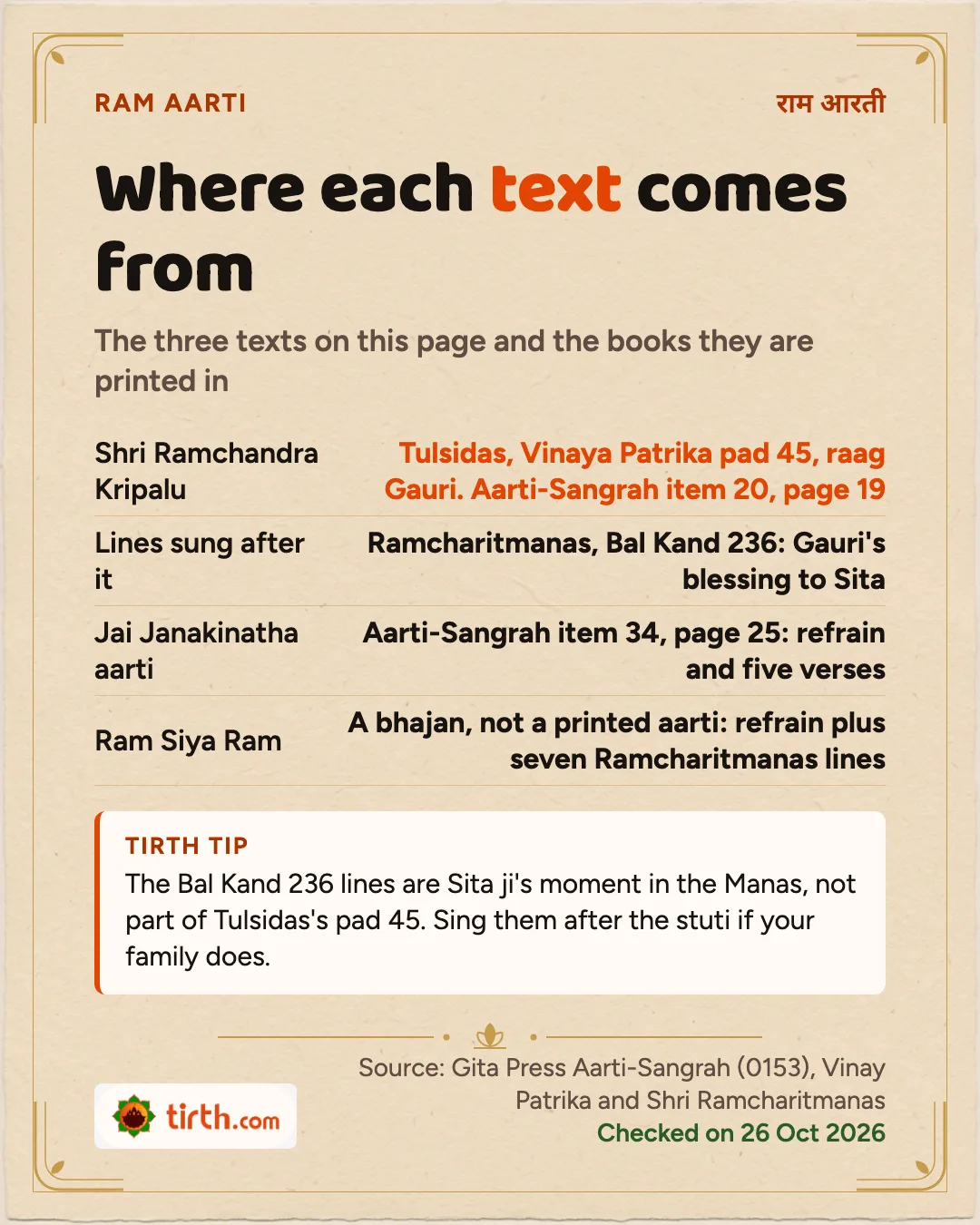
The Ram aarti Gita Press prints for Bhagwan Shri Ramchandra is Shri Ramchandra Kripalu, which Goswami Tulsidas wrote as pad 45 of his Vinaya Patrika. It sits on page 19 of the Aarti-Sangrah. The Janakinath aarti (Jai Janakinatha) and the Ram Siya Ram bhajan follow it here, each with Hindi words, Roman letters and a plain English meaning.
Each Hindi line here was copied from a printed Gita Press edition, all of it except the Ram Siya Ram refrain. Nothing was typed from memory. The Ram aarti that used to sit at this address had slipped in a few places (छवी where the book has छबि, नीरज for नीरद, ह्रदय for हृदय).
Shri Ramchandra Kripalu bhajman: lyrics and meaning
The pad is set in raag Gauri, five stanzas of two lines. In the Aarti-Sangrah it is item 20, and the heading over it reads “Bhagwan Shri Ramchandra”, while Tulsidas signs the last stanza himself with “iti vadati Tulsidas” (so says Tulsidas). The meanings follow the Hindi bhavarth (explanation) that Gita Press prints under pad 45, retold in plain words in a short paragraph after every stanza. For Shri Ram himself, see the Bhagwan Rama page.
श्रीरामचंद्र कृपालु भजु मन हरण भव भय दारुणम्। नवकंजलोचन, कंज-मुख कर कंज पद कंजारुणम्॥ १॥
Shri Ramchandra kripalu bhaju man harana bhav bhay darunam.
Navakanja-lochana, kanja-mukha kara kanja pada kanjarunam.
Turn to Shri Ram the gracious, O mind, since he is the one who takes away that terrible fear of birth and death. Eyes like fresh lotuses. Face, hands and feet like red ones.
कंदर्प अगणित अमित छबि, नवनील नीरद सुंदरम्। पटपीत मानहु तड़ित रुचि शुचि नौमि जनक सुता वरम्॥ २॥
Kandarpa aganita amita chhabi, navanila nirada sundaram.
Patapita manahu tadita ruchi shuchi naumi Janaka suta varam.
Countless Kamadevas put together would still fall short of his beauty. His body is the colour of a new dark rain cloud, and the yellow cloth he wears flashes on it like lightning. To that pure one, husband of the daughter of Janak, I bow.
भजु दीनबंधु दिनेश दानव-दैत्यवंश निकंदनम्। रघुनंद आनँदकंद कोशलचंद दशरथ-नंदनम्॥ ३॥
Bhaju dinabandhu dinesha danava-daityavansha nikandanam.
Raghunanda anandakanda Koshalachanda Dasharatha-nandanam.
Worship him, friend of the lowly and bright as the sun, the one who uproots the clans of the danavas and daityas. Joy of the Raghus. Root of all delight, moon of Koshal, Dasharatha’s son.
सिर मुकुट कुंडल तिलक चारु उदार अंग विभूषणम्। आजानुभुज शर-चाप-धर संग्राम-जित-खर-दूषणम्॥ ४॥
Sira mukuta kundala tilaka charu udara anga vibhushanam.
Ajanubhuja shara-chapa-dhara sangrama-jita-Khara-Dushanam.
On his head a crown. Earrings, a lovely tilak and an ornament on every limb, with arms so long they reach his knees, bow and arrow in his hands, and the battle against Khara and Dushana won.
इति वदति तुलसीदास शंकर-शेष-मुनि-मन-रंजनम्। मम हृदय कंज निवास कुरु कामादि-खल-दल-गंजनम्॥ ५॥
Iti vadati Tulsidas Shankara-Shesha-muni-mana-ranjanam.
Mama hridaya kanja nivasa kuru kamadi-khala-dala-ganjanam.
So says Tulsidas. He is the one who delights the minds of Shankar, Shesha and the sages, and who scatters the whole army of wicked foes, desire and its kind. May he come and live in the lotus of my heart.
If you are reading off a phone in the middle of the aarti and a spelling looks different from your book, carry on. The Vinaya Patrika edition writes भवभय as one word and uses -णं endings where the Aarti-Sangrah has -णम्. Same words, in the same order. It is one hymn either way.
Lines sung after the stuti (Ramcharitmanas, Bal Kand 236)
In a lot of homes the singing does not stop at the end of the stuti. Two chhand lines and a soratha follow. Bhakti Bharat prints them straight after it as well, but pad 45 does not have them and the Gita Press aarti page leaves them out. Their home is the Ramcharitmanas, Bal Kand, in the chhand and soratha that close doha group 236. Before the bow ceremony, Sita ji has gone to pray to Goddess Gauri. Only the first line is Gauri’s blessing, and the second line and the soratha are Tulsidas telling of Sita’s joy.
मनु जाहिं राचेउ मिलिहि सो बरु सहज सुंदर साँवरो। करुना निधान सुजान सीलु सनेहु जानत रावरो॥
Manu jahin racheu milihi so baru sahaj sundar sanvaro.
Karuna nidhan sujan silu sanehu janat ravaro.
The groom your heart has settled on, dark and handsome by nature, is the one you will have. He is all-knowing and a treasure of compassion, and he knows your devotion and your love.
एहि भाँति गौरि असीस सुनि सिय सहित हियँ हरषीं अली। तुलसी भवानिहि पूजि पुनि पुनि मुदित मन मंदिर चली॥
Ehi bhanti Gauri asis suni Siya sahit hiyan harashin ali.
Tulsi Bhavanihi puji puni puni mudit man mandir chali.
Sita and her friends were overjoyed to hear Gauri bless her this way. Tulsi tells us that she worshipped Bhavani over and over, then went home with a glad heart.
सो०- जानि गौरि अनुकूल सिय हिय हरषु न जाइ कहि। मंजुल मंगल मूल बाम अंग फरकन लगे॥ २३६॥
So. Jani Gauri anukul Siya hiya harashu na jai kahi.
Manjul mangal mul bam ang pharakan lage.
Sita knew now that Gauri was on her side, and her joy was more than words could hold. Her left limbs began to throb. A sign of good fortune. The older version of this page called this last verse a doha, though Gita Press marks it सो०, a soratha.
Next in the story comes the bow ceremony, and after it the wedding. Families remember that wedding on Vivah Panchami, and you can look up its date for your own city on the Tirth Spiritual Calendar.
Jai Janakinatha aarti lyrics with meaning
Janaki is Sita ji, so Janakinath is Ram as her lord. Gita Press prints this aarti in the Aarti-Sangrah as item 34, on page 25. There is a refrain, which the book marks टेक, and then five verses, and each verse ends on “Jay…” so that the singers go back into the refrain. We wrote the meanings in our own plain English and looked up the harder words in Platts’ Hindustani dictionary and the Hindi Shabdasagar. We found no source for what lahiya and Maniram mean, so neither is glossed.
जय जानकिनाथा, जय श्रीरघुनाथा। दोउ कर जोरें बिनवौं प्रभु! सुनिये बाता॥ टेक ॥
Jay Janakinatha, jay Shri Raghunatha.
Dou kar joren binavaun Prabhu! suniye bata.
Glory to the lord of Janaki, glory to Shri Raghunath. Both hands folded, I make my plea. Listen to me, Lord.
तुम रघुनाथ हमारे प्रान, पिता-माता। तुम ही सज्जन-संगी भक्ति-मुक्ति-दाता॥ जय०॥
Tum Raghunath hamare pran, pita-mata.
Tum hi sajjan-sangi bhakti-mukti-data.
Raghunath, you are our very breath, and our father and mother too. You alone stand by the good as their companion, and you give bhakti and mukti, devotion and liberation.
लख चौरासी काटो मेटो यम-त्रासा। निसिदिन प्रभु मोहि राखिये अपने ही पासा॥ जय०॥
Lakh chaurasi kato meto yam-trasa.
Nisidin Prabhu mohi rakhiye apne hi pasa.
Cut through the round of the eighty-four lakh and rub out yam-trasa (trās means fear or dread, so this is the dread of Yama). By night and by day, Lord, keep me near you.
राम भरत लछिमन सँग शत्रुहन भैया। जगमग ज्योति विराजै, सोभा अति लहिया॥ जय०॥
Ram Bharat Lachhiman sang Shatruhan bhaiya.
Jagamag jyoti virajai, sobha ati lahiya.
Ram is there with Bharat and Lakshman, and their brother Shatrughan beside them, while the light shines and shimmers and the splendour is very great.
हनुमत नाद बजावत; नेवर झमकाता। स्वर्णथाल कर आरती कौसल्या माता॥ जय०॥
Hanumat nad bajavat; nevar jhamakata.
Svarnathal kar arati Kausalya mata.
Hanuman ji plays the nad while the nevar flash and jingle. Nevar is an anklet, the nupur of Sanskrit, and jhamkana means making ornaments jingle or flash. With a golden plate in her hands, Mother Kausalya does the aarti.
सुभग मुकुट सिर, धनु सर कर सोभा भारी। मनीराम दर्शन करि पल-पल बलिहारी॥ जय०॥
Subhag mukut sir, dhanu sar kar sobha bhari.
Maniram darshan kari pal-pal balihari.
On his head a beautiful crown, in his hands bow and arrow, and the beauty of it is great. Maniram takes his darshan and gives himself up to him moment after moment (balihari comes from bali, giving oneself as an offering, and says “I am devoted to you”).
In many homes the aarti opens with “Om Jai Janakinatha”, people sing “karat Kausalya mata”, and the end gets extra jaikaras for Sita ji, Lakshman, the four brothers and Hanuman ji. None of these are in the Gita Press text, which is why you will not find them above. If your family sings them, keep singing them. Sita ji has an aarti of her own as well, the Sita Mata aarti.
Ram Siya Ram bhajan: which Ramcharitmanas lines are in it?
Ram Siya Ram belongs with the bhajans (it is a dhun), and it is not among the aartis Gita Press prints. The Aarti-Sangrah runs its Ram and Sita pieces from item 18 to item 38 and it is nowhere in that stretch, while Bhakti Bharat keeps it with its bhajans. Each verse is one chaupai line out of Tulsidas’s Ramcharitmanas.
राम सिया राम सिया राम, जय जय राम।
Ram Siya Ram Siya Ram, jai jai Ram.
Sing the refrain twice to open and twice to close, and once after every line in between. You will not find it in the Manas at all, since it belongs to the bhajan as people sing it.
The story is in the seven lines. Look at who is speaking in each one, because two of them are easily put in Shri Ram’s mouth and he says neither. The line on fortitude is Anasuya teaching Sita ji. The one about keeping the promise of Raghu’s line is Dasharatha, and he is speaking to Kaikeyi, so check the speaker before you quote either line under a picture of Shri Ram. The table gives each line the way the Gita Press Ramcharitmanas prints it, a word or two away from how it is sung, with द्रवउ in the first line where singers say “drabahu” and जिन्ह कें in the fifth where they say “jaki”.
| Line | Where in the Ramcharitmanas | Who says it, when, and what it means |
|---|---|---|
| मंगल भवन अमंगल हारी। द्रवउ सो दसरथ अजिर बिहारी॥ Mangal bhavan amangal hari. Dravau so Dasharath ajir bihari. | Bal Kand, doha 112, chaupai 2 (second half) | Shiva, as he begins the Ram katha for Parvati: may he who is the home of blessings and the remover of ill, who plays in Dasharatha’s courtyard, show me grace. |
| होइहि सोइ जो राम रचि राखा। को करि तर्क बढ़ावै साखा॥ Hoihi soi jo Ram rachi rakha. Ko kari tarka badhavai sakha. | Bal Kand, doha 52, chaupai 4 (first half) | Shiva’s thought after Sati goes to test Ram: whatever Ram has ordained will happen, so why argue and add branches to it? |
| धीरज धर्म मित्र अरु नारी। आपद काल परिखिअहिं चारी॥ Dhiraj dharma mitra aru nari. Apad kal parikhiahin chari. | Aranya Kand, doha 5, chaupai 4 (first half) | Anasuya teaching Sita ji: fortitude, dharma, a friend and a wife, these four are tested only in hard times. |
| जेहि कें जेहि पर सत्य सनेहू। सो तेहि मिलइ न कछु संदेहू॥ Jehi ken jehi par satya sanehu. So tehi milai na kachhu sandehu. | Bal Kand, doha 259, chaupai 3 (second half) | Sita ji’s resolve at the bow ceremony: one surely meets the one for whom one holds true love, and there is no doubt of it. |
| जिन्ह कें रही भावना जैसी। प्रभु मूरति तिन्ह देखी तैसी॥ Jinh ken rahi bhavana jaisi. Prabhu murati tinh dekhi taisi. | Bal Kand, doha 241, chaupai 2 (second half) | As Ram and Lakshman enter the hall of the bow ceremony: each person saw the Lord’s form according to the feeling they held. |
| हरि अनंत हरिकथा अनंता। कहहिं सुनहिं बहुबिधि सब संता॥ Hari anant harikatha ananta. Kahahin sunahin bahubidhi sab santa. | Bal Kand, doha 140, chaupai 3 (first half) | Shiva to Parvati: Hari is endless and so is his story, and the saints tell it and hear it in many ways. |
| रघुकुल रीति सदा चलि आई। प्रान जाहुँ बरु बचनु न जाई॥ Raghukul riti sada chali ai. Pran jahun baru bachanu na jai. | Ayodhya Kand, doha 28, chaupai 2 (second half) | Dasharatha to Kaikeyi: it has always been the way of Raghu’s line that life may go, but a promise given must not. More on why Ram is called Maryada Purushottam. |
The book these lines come from has an aarti too, Shri Ramayan ji ki aarti.
Which order to sing the three in at home
No printed text sets an order. Your family’s habit decides it. If you are the one leading it for the first time, say for parents who know the tune but not the words, learn the Janakinath refrain before anything else, because it comes round after every verse and the whole room will follow you back into it. The Kripalu stuti takes longer to learn, with its long compounds and its -am endings.
We would rather you sang the stuti from the printed words than from memory, even if you have sung it for years, and that is why it is set out here line by line. Go on into the Gauri lines afterwards if your family does, as plenty of people do, only knowing that they are Sita ji’s moment in the Manas and were never part of Tulsidas’s pad. For something short to say daily there is the Ram mantra. The Hanuman aarti fits well after this one (Hanuman ji is already there in verse four of the Janakinath aarti).
To have pandits in Ayodhya pray for the family, book a Ram Raksha Stotram jaap in Ayodhya on Tirth.
Frequently asked questions
Which aarti is sung for Lord Ram?
Shri Ramchandra Kripalu is the aarti Gita Press prints for Bhagwan Shri Ramchandra, as item 20 in its Aarti-Sangrah, and the Janakinath aarti is item 34 in the same book. Ram Siya Ram is a bhajan made of Ramcharitmanas lines, and the Ram Chalisa is there when you want something longer to recite.
Who wrote Shri Ramchandra Kripalu?
Goswami Tulsidas wrote it, as pad 45 of the Vinaya Patrika in raag Gauri. He signs the last stanza with “iti vadati Tulsidas” (so says Tulsidas).
What does “Shri Ramchandra Kripalu bhajman” mean?
It means “O mind, worship gracious Shri Ramchandra.” The rest of the line calls him the remover of the terrible fear of birth and death.
Is Ram Siya Ram an aarti or a bhajan?
It is a bhajan. Gita Press does not print it with its aartis. Its seven verses are single Ramcharitmanas lines, and between them people sing the refrain “Ram Siya Ram Siya Ram, jai jai Ram”.
Where is “Mangal bhavan amangal hari” in the Ramcharitmanas?
In the Bal Kand, at doha 112, chaupai 2, where Shiva starts telling Parvati the story of Ram. In the Gita Press text the second half reads “द्रवउ सो दसरथ अजिर बिहारी”, about the one who plays in Dasharatha’s courtyard.