
Radha Mantra: Shri Radhayai Swaha, Meaning and How to Chant
Tirth editorial · 12 Jan 2026 · 10 min read
In Book 9 of the Devi Bhagavata Purana, Narayana is speaking to the sage Narada, and in chapter 50 he gives him the Radha mantra itself. It is Shri Radhayai Swaha, six-lettered, as the Purana calls it, and Narayana adds that Hreem may be joined to it.
If you learn only one Radha mantra, learn that one, because the Devi Bhagavata names it as hers.
The Devi Bhagavata passages quoted here were checked against its printed English translation as of October 2026. The Brahma Vaivarta points rest on summaries. The Sanskrit prayer lines come from devotional sites and are marked as such.
The chapter is called On the Glory of Sakti. The English translation cited here is Swami Vijnanananda’s of 1921, which prints the mantra as Sri Radhayai Svaha. In the printed volume from the Panini Office, Allahabad (Sacred Books of the Hindus, volume 26, part 3), the Radha section of the chapter, with its hymn, runs from page 1002 to page 1005. Spellings in Roman letters drift from page to page (Swaha or Svaha) without changing a word of what is said. Narayana also tells Narada where the mantra came from. Krishna first received it in the Rasa Mandalam in Goloka. From him it passed to Vishnu, then to Brahma, to Virat, to Dharma and at last to Narayana himself.
Which Radha mantras have a Purana behind them?
Two of them do.
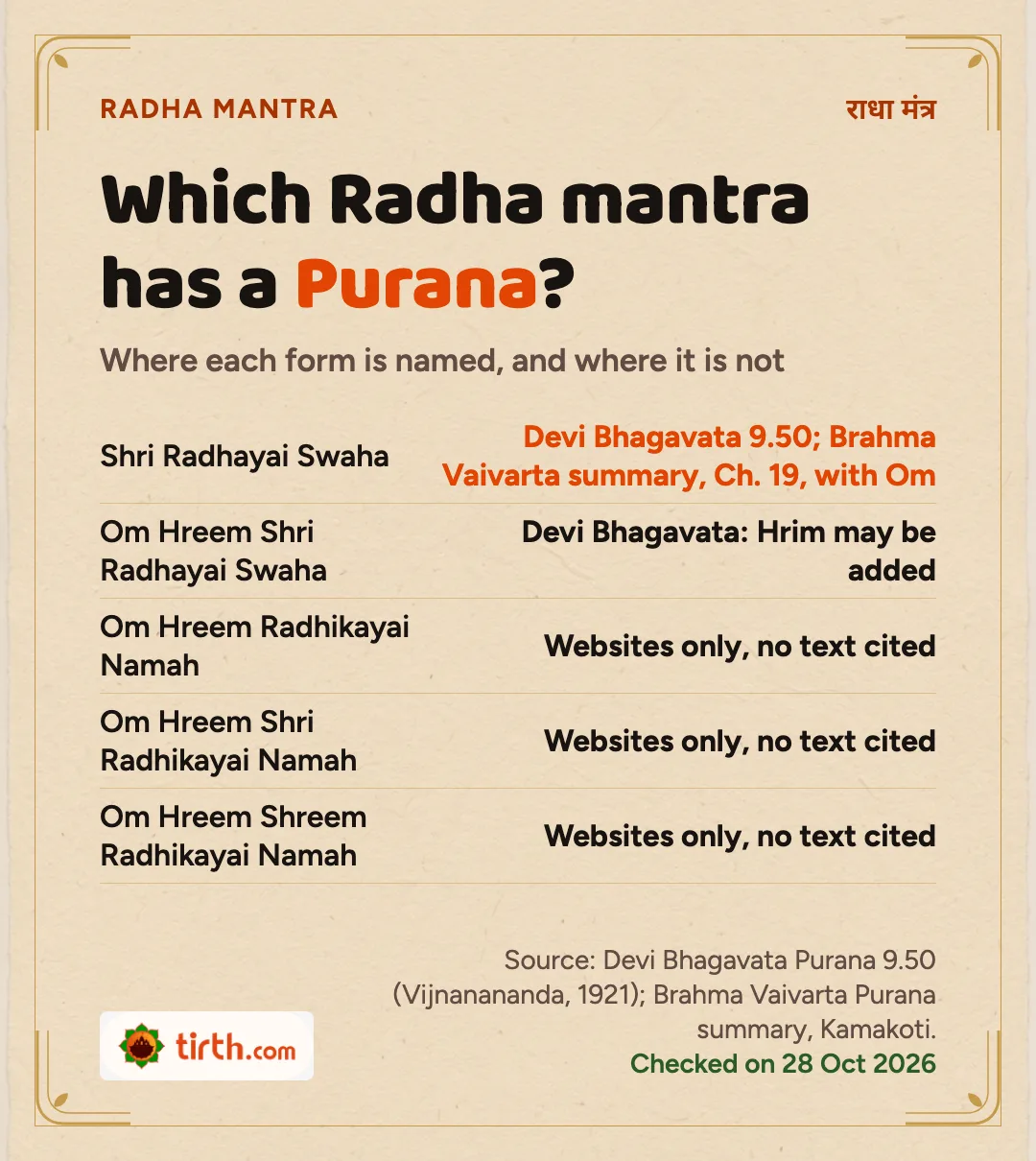
The table sets out the five short Radha mantras people search for, in the spelling this page has always used, with the place each one is named. Read the second column first.
| Mantra | Where it is named |
|---|---|
| Shri Radhayai Swaha | Devi Bhagavata Purana, Book 9, Chapter 50, as Radha’s six lettered mantra. The Kamakoti summary of the Brahma Vaivarta Purana, chapter 19, gives the same line with Om in front as her mula (root) mantra. |
| Om Hreem Shri Radhayai Swaha | The same Devi Bhagavata chapter, which says Hrim may be added to the six lettered mula mantra. |
| Om Hreem Radhikayai Namah | Printed on devotional websites with the label Saptakshar. No text or chapter is given for it there. |
| Om Hreem Shri Radhikayai Namah Om Hreem Shreem Radhikayai Namah | Printed on the same sites as the Ashtakshar mantras. No text or chapter is given for them either. |
Single words in these lines (Swaha, Namah, Hreem) are left without a gloss here, because no dictionary gloss was checked for them.
The Saptakshar and Ashtakshar lines need a plainer word than they usually get. Mantra websites print a count of 1.6 million repetitions for the Ashtakshar lines with no text behind it, and none of the Purana chapters cited here uses those labels. Say them by all means if your family says them.
Namaste Parameshani and Namastrailokya Janani, with their meaning
The first of these two prayers belongs to the same Devi Bhagavata chapter, where Narayana gives Narada a stotra (hymn of praise) to Radha. The English of its opening salutation matches these lines.
| Prayer | Meaning (Tirth’s rendering) |
|---|---|
| Namaste Parameshani Rasamandalavasini। Raseshwari Namaste’stu Krishna Pranadhik Priye। | O Highest Deity, dweller in the Rasa Mandalam, I bow to you. Goddess of the Rasa, I bow to you, dearer than life to Krishna. |
Rasa Mandalam is the circle of the Rasa dance. The translator gives the opening as a bow to the Highest Deity who dwells there, and the phrase dearer than life to Krishna is also one of the names in the Radha Shoddasha Nama Stotram (the sixteen names of Radha), alongside Rasesvari, goddess of the Rasa. One caution, though. The 1921 translation prints English only, so the Sanskrit wording above is the one devotional sites carry; it has not been checked against a printed edition.
| Prayer | Meaning (Tirth’s rendering) |
|---|---|
| Namastrailokya Janani Praseeda Karunarnave। Brahmavishnvadibhih Devair Vandyamana Padambuje। | Salutation to you, mother of the three worlds. Be gracious, ocean of compassion, you whose lotus feet are worshipped by Brahma, Vishnu and the other gods. |
The second prayer looks harder to place, since Devkatha and The Bhajan print it without an edition or a chapter. Turn the page of that translation, though. The next lines of the same stotra read, in English, Mother of the three Lokas, Ocean of mercy, be pleased; Brahma, Vishnu and the other Devas bow before your lotus feet.
So the meaning sits in the Devi Bhagavata, and only the Sanskrit spelling above comes from the devotional sites.
Why the Devi Bhagavata puts Radha before Krishna
The chapter is blunt. Without the worship of Radha, it says, the worship of Shri Krishna can never be done, and Brahma, Vishnu and the others always worship her mantra.
The Brahma Vaivarta Purana ranks neither. In chapter 19 of the summary published by the Kanchi Kamakoti Peetham, Radha worships Krishna and Krishna worships Radha, so each is both the one worshipped (aradhya) and the one who worships (aradhaka).
Her name stands by itself in that Purana. Verse 4.17.223 of the Shri Krishna Janma Khanda calls Radha a perfected word, says the syllable ra signifies giving, and says that she who herself bestows liberation is called Radha, which makes it the one verse cited here that stands behind chanting her name on its own.
Since both texts tie the worship of Krishna so closely to hers, it does no harm to say a Krishna mantra alongside Shri Radhayai Swaha.
The Prakriti Khanda of the Brahma Vaivarta describes Prakriti appearing as five goddesses, Durga, Radha, Lakshmi, Sarasvati and Savitri, so the two stand side by side there. Tradition goes further. It holds that Radha is a form of Lakshmi. The nearest line in print is in the Devi Bhagavata stotra, which tells Radha that she is Sarasvati, Savitri, Ganga, Tulasi, Durga and Lakshmi in turn, and then that she is all. That is a hymn seeing every goddess in her. No single verse makes her one goddess in particular. For mantras addressed to Lakshmi herself, see Tirth’s page of Lakshmi mantras.
What Shri Radhayai Swaha is said to give, in the Purana’s words
Read the text before any list of benefits. The Devi Bhagavata says Dharma and the other fruits are obtained with ease by the six lettered mantra, and that with Hrim added it yields gems and jewels as desired. Of the stotra it says that whoever remembers Radha and reads it three times a day does not feel the want of anything in this world.
Those are the Purana’s own claims, in its translator’s English.
Nothing in these texts speaks of healing illness or of fixing a marriage. People still ask which Radha mantra is for love. None of the chapters cited here names one for that, though they describe at length Radha and Krishna worshipping each other. Pages that print the sixteen names of Radha attribute that stotra to the Brahma Vaivarta Purana and say that reciting it three times a day gives devotion at the feet of Radha and Madhava (the chapter number they give is uncertain). A line seen online about 28 names of Radha freeing a person from rebirth names no text at all. So it is left out.
The same Devi Bhagavata chapter also says that keeping Radha’s birthday on the full moon of Kartik brings her blessings, while Radha Ashtami in Bhadrapada is the other day families keep for her. The date for the year is on the Tirth festival calendar.
Chanting the Radha mantra at home, step by step
The steps below are the way many households set up a Radha puja before the chant. They are common practice. Neither Purana sets them as a rule.
- Bathe and change into fresh clothes prior to sitting down.
- Set a Kalash (a pot of water) on the altar and lay a red or yellow cloth in front of it. A full Kalash is an old sign of abundance and the source of life. The Devi Bhagavata goes further. It names a jar as one of the places where Radha is bathed and worshipped.
- Place a murti or a picture of Radha Rani. If it is a murti, bathe it with Panchamrit, the mix of milk, curd, honey, sugar and ghee. The word means five nectars. Poured over the deity in puja, it is shared out afterwards as prasad.
- Offer fresh flowers, sandalwood paste, fruits and sweets.
- Keep Krishna beside her and worship the two together.
- Wave incense and a lamp for the aarti. Many families sing the Krishna aarti at this point.
- Sit quietly and say Shri Radhayai Swaha, 108 times on a mala if you keep count. The beads do the counting. Your mind stays on the words.
108 is the usual household count, one round of a mala, and it is not a number from the Purana. The Devi Bhagavata describes a purascarana, a set course of repetitions closed with a homa of one tenth using ghee, honey, milk and sesame, but the translation cited here gives no number of beads or lakhs for it. Its own order of worship begins like this. Say the mula mantra six times, meditate on Radha, then bathe her on a Salagrama stone, a jar, a yantra or an eight petalled lotus, speaking the mantra with every offering. The Kamakoti summary of the Brahma Vaivarta describes a fuller worship of Radha in sixteen services (shodashopachara) after meditation, from a seat and cloth to water for the feet, sandal, incense, lamp, flowers, food, betel etc., and it ends with a stuti. Panchamrit, the Kalash and the count of 108 do not appear in it.
(If your mother can no longer sit on the floor for a full puja, the chant alone, said from a chair in front of the altar, is a perfectly good place to start.)
If you would rather have a priest perform the worship for your family, Tirth’s puja booking page lists what is on offer. For more to say to her, the Radha Chalisa is on Tirth too, and so is the Govardhan mantra for the days you pray to Krishna. Krishna’s birthday has its own Janmashtami festival guide, and there is a Vrindavan destination page.
Frequently asked questions
What is the Radha mantra?
The best known is Shri Radhayai Swaha, which the Devi Bhagavata Purana, Book 9, Chapter 50, calls Radha’s six lettered mantra. The same chapter says Hreem may be added to it, which gives Om Hreem Shri Radhayai Swaha.
What is the meaning of Shri Radhayai Swaha?
The Devi Bhagavata gives it as Radha’s six lettered mula mantra, the one Brahma, Vishnu and others worship. No dictionary gloss was checked for its single words.
How many times should I chant the Radha mantra?
108 times, one round of a mala, is the common household count. The Devi Bhagavata describes a fuller purascarana with a homa of one tenth but gives no number in the translation cited here, and the 1.6 million figure seen online has no text behind it.
Which Radha mantra is for love or marriage?
None of the texts cited here names a Radha mantra for marriage. They describe Radha and Krishna worshipping each other, and praying to her for love is a matter of personal faith. The Chalisa to Radha is another prayer to her.
What are the benefits of chanting the Radha mantra?
The Devi Bhagavata says Dharma and the other fruits are obtained with ease by Shri Radhayai Swaha, and that reading Radha’s stotra three times a day leaves a person without want. These are the text’s own words. It says nothing about healing illness or fixing a marriage.
Is Radha a form of Lakshmi?
Summaries of the Brahma Vaivarta Purana say so, and its Prakriti Khanda lists Radha and Lakshmi among five forms of Prakriti, with Durga, Sarasvati and Savitri. The Devi Bhagavata stotra to Radha calls her Lakshmi too, along with Sarasvati, Ganga, Durga and others, and then says she is all of them. It is a belief the hymns support, and no single verse defines her.