
Radha Chalisa: Hindi Lyrics, Roman Text and Verse Meaning
Tirth editorial · 3 Jan 2026 · 14 min read
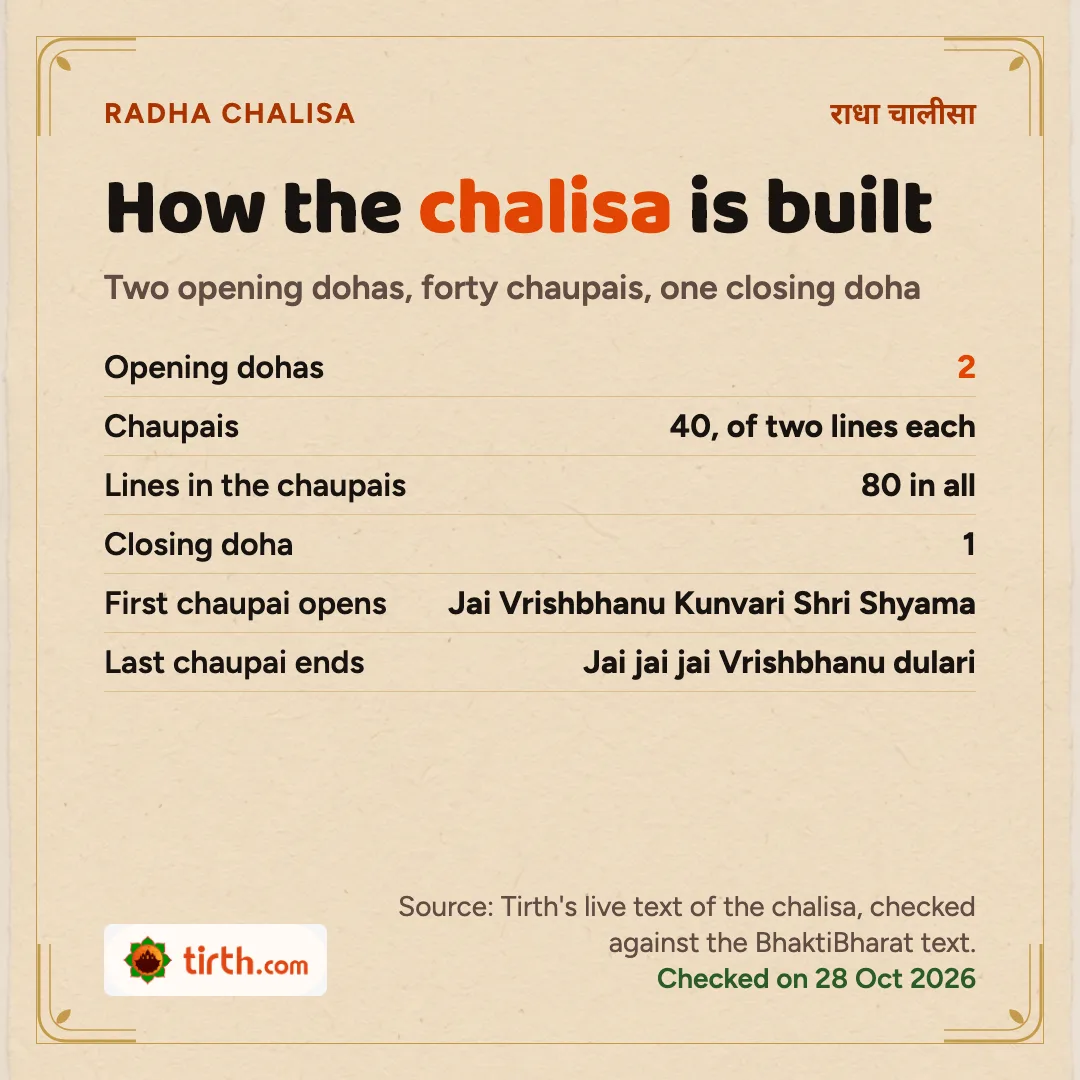
The Radha Chalisa is a Hindi prayer to Radha Rani in 40 chaupai verses, set between two opening dohas and one closing doha. Its first chaupai opens with “Jai Vrishbhanu Kunvari Shri Shyama”, victory to Vrishbhanu’s daughter, and the closing doha asks to live always in Shri Vrindavan Dham.
Look at the last word of its first line. Monier-Williams gives śyāmā only as an adjective, dark-coloured, a mark of beauty, the feminine of śyāma. The chalisa turns it into a name for Radha, in chaupai 1, again in 27 and once more in 39.
No poet is named for it.
BhaktiBharat, Braj Rasik and Radhashtami.org print the text without an author, so this page credits nobody. Two printed Hindi booklets carry it too. Their inside pages could not be opened, so they settle nothing about the poet. Chaupai 39, near the end, turns to her as the lady of Barsana and asks for her grace.
Jai Vrishbhanu Kunvari: the Radha Chalisa in Hindi, Roman letters and meaning
Each row has the Hindi first, then the same line in Roman letters for reading aloud, then a meaning in plain English. That last column is Tirth’s own rendering of the Hindi, and each and every chaupai is numbered, 1 to 40.
A few lines can be read more than one way, chaupai 6, 10 and 16 and the second doha among them, and there we have kept the English close to the words and added nothing. (On a phone the table is easier turned sideways.)
| Verse | Hindi (Devanagari) | Roman letters | Meaning (Tirth’s plain rendering) |
|---|---|---|---|
| Doha 1 | श्री राधे वृषभानुजा,भक्तनि प्राणाधार। वृन्दाविपिन विहारिणि,प्रणवौं बारंबार॥ | Shri Radhe Vrishbhanuja, Bhaktani Pranadhar । Vrindavipin Viharini, Pranavaun Barambar ॥ | O Radha, Vrishbhanu’s daughter, lifeline of your devotees, you who roam the groves of Vrindavan, I bow to you again and again. |
| Doha 2 | जैसौ तैसौ रावरौ,कृष्ण प्रिया सुखधाम। चरण शरण निज दीजिये,सुन्दर सुखद ललाम॥ | Jaisau Taisau Ravarau, Krishna Priya Sukhadham । Charan Sharan Nij Deejiye, Sundar Sukhad Lalam ॥ | As I am, I am yours, dear one of Krishna, home of joy. Give me shelter at your feet, lovely giver of joy. |
| Chaupai 1 | जय वृषभानु कुंवरि श्री श्यामा।कीरति नंदिनी शोभा धामा॥ | Jai Vrishbhanu Kunvari Shri Shyama । Kirati Nandini Shobha Dhama ॥ | Victory to Vrishbhanu’s daughter, Shri Shyama, Kirti’s daughter, home of beauty. |
| Chaupai 2 | नित्य विहारिनि श्याम अधारा।अमित मोद मंगल दातारा॥ | Nitya Viharini Shyam Adhara । Amit Mod Mangal Datara ॥ | Ever at play, the support of Shyam, she gives endless joy and auspiciousness. |
| Chaupai 3 | रास विलासिनि रस विस्तारिनि।सहचरि सुभग यूथ मन भावनि॥ | Raas Vilasini Ras Vistarini । Sahachari Subhag Yooth Man Bhavani ॥ | She delights in the Raas and spreads its sweetness, dear to the circle of her sakhis. |
| Chaupai 4 | नित्य किशोरी राधा गोरी।श्याम प्राणधन अति जिय भोरी॥ | Nitya Kishori Radha Gori । Shyam Pranadhan Ati Jiya Bhori ॥ | Ever-young Kishori, fair Radha, whom Shyam holds dear as his life, simple of heart. |
| Chaupai 5 | करुणा सागर हिय उमंगिनी।ललितादिक सखियन की संगिनी॥ | Karuna Sagar Hiya Umangini । Lalitadik Sakhiyan Ki Sangini ॥ | An ocean of compassion with a heart full of feeling, companion of Lalita and the other sakhis. |
| Chaupai 6 | दिन कर कन्या कूल विहारिनि।कृष्ण प्राण प्रिय हिय हुलसावनि॥ | Din Kar Kanya Kool Viharini । Krishna Pran Priya Hiya Hulasavani ॥ | She roams the bank of the Sun’s daughter, dear as life to Krishna, gladdening his heart. |
| Chaupai 7 | नित्य श्याम तुमरौ गुण गावैं।राधा राधा कहि हरषावैं॥ | Nitya Shyam Tumarau Gun Gavain । Radha Radha Kahi Harashavain ॥ | Shyam sings your qualities always and gladly says “Radha, Radha”. |
| Chaupai 8 | मुरली में नित नाम उचारें।तुव कारण लीला वपु धारें॥ | Murali Mein Nit Naam Ucharen । Tuv Karan Leela Vapu Dharen ॥ | In his flute he calls your name each day. For you he takes his playful form. |
| Chaupai 9 | प्रेम स्वरूपिणि अति सुकुमारी।श्याम प्रिया वृषभानु दुलारी॥ | Prem Swaroopini Ati Sukumari । Shyam Priya Vrishbhanu Dulari ॥ | Love given form, very tender, dear to Shyam, Vrishbhanu’s darling. |
| Chaupai 10 | नवल किशोरी अति छवि धामा।द्युति लघु लगै कोटि रति कामा॥ | Naval Kishori Ati Chhavi Dhama । Dyuti Laghu Lagai Koti Rati Kama ॥ | Ever-new Kishori, home of beauty. Beside her radiance crores of Rati and Kama look small. |
| Chaupai 11 | गौरांगी शशि निंदक बदना।सुभग चपल अनियारे नयना॥ | Gaurangi Shashi Nindak Badana । Subhag Chapal Aniyare Nayana ॥ | Golden-limbed, her face shames the moon, fortunate, with restless, matchless eyes. |
| Chaupai 12 | जावक युत युग पंकज चरना।नूपुर धुनि प्रीतम मन हरना॥ | Javak Yut Yug Pankaj Charana । Noopur Dhuni Preetam Man Harana ॥ | Her lotus feet are tinted with lac dye. The sound of her anklets steals her beloved’s heart. |
| Chaupai 13 | संतत सहचरि सेवा करहीं।महा मोद मंगल मन भरहीं॥ | Santat Sahachari Seva Karahin । Maha Mod Mangal Man Bharahin ॥ | Her sakhis always serve her and fill their hearts with joy and good fortune. |
| Chaupai 14 | रसिकन जीवन प्राण अधारा।राधा नाम सकल सुख सारा॥ | Rasikan Jeevan Pran Adhara । Radha Naam Sakal Sukh Sara ॥ | She is the life-breath of the rasikas, those who savour rasa. Her name is the essence of all happiness. |
| Chaupai 15 | अगम अगोचर नित्य स्वरूपा।ध्यान धरत निशिदिन ब्रज भूपा॥ | Agam Agochar Nitya Swaroopa । Dhyan Dharat Nishidin Braj Bhoopa ॥ | Beyond reach and perception in her eternal form, Krishna, king of Braj, meditates on her night and day. |
| Chaupai 16 | उपजेउ जासु अंश गुण खानी।कोटिन उमा रमा ब्रह्मानी॥ | Upajeu Jasu Ansh Gun Khani । Kotin Uma Rama Brahmani ॥ | From a share of her, the mine of virtues, came crores of Uma, Rama and Brahmani. |
| Chaupai 17 | नित्य धाम गोलोक विहारिनि।जन रक्षक दुख दोष नसावनि॥ | Nitya Dham Golok Viharini । Jan Rakshak Dukh Dosh Nasavani ॥ | She lives in eternal Golok, a protector of people, and ends sorrow and fault. |
| Chaupai 18 | शिव अज मुनि सनकादिक नारद।पार न पांइ शेष अरु शारद॥ | Shiv Aj Muni Sanakadik Narad । Paar Na Pain Shesh Aru Sharad ॥ | Shiva, Brahma, sages such as Sanaka, Narad, Shesh and Sharada cannot find her limit. |
| Chaupai 19 | राधा शुभ गुण रूप उजारी।निरखि प्रसन्न होत बनबारी॥ | Radha Shubh Gun Roop Ujari । Nirakhi Prasann Hot Banbari ॥ | The beauty of Radha’s qualities shines. Seeing it, the flute-player is pleased. |
| Chaupai 20 | ब्रज जीवन धन राधा रानी।महिमा अमित न जाय बखानी॥ | Braj Jeevan Dhan Radha Rani । Mahima Amit Na Jay Bakhani ॥ | Radha is the life and wealth of Braj. Her greatness cannot be told. |
| Chaupai 21 | प्रीतम संग देइ गलबांही।बिहरत नित वृन्दावन मांही॥ | Preetam Sang Dei Galbanhi । Biharat Nit Vrindavan Manhi ॥ | She roams Vrindavan with her beloved’s arm round her neck. |
| Chaupai 22 | राधा कृष्ण कृष्ण कहैं राधा।एक रूप दोउ प्रीति अगाधा॥ | Radha Krishna Krishna Kahain Radha । Ek Roop Dou Preeti Agadha ॥ | “Radha says Krishna, Krishna says Radha”: two forms of one love, deep beyond measure. |
| Chaupai 23 | श्री राधा मोहन मन हरनी।जन सुख दायक प्रफुलित बदनी॥ | Shri Radha Mohan Man Harani । Jan Sukh Dayak Praphulit Badani ॥ | Shri Radha steals Mohan’s heart, gives joy to people, her face in bloom. |
| Chaupai 24 | कोटिक रूप धरें नंद नंदा।दर्श करन हित गोकुल चन्दा॥ | Kotik Roop Dharen Nand Nanda । Darsh Karan Hit Gokul Chanda ॥ | Nanda’s son, the moon of Gokul, takes crores of forms to have her darshan. |
| Chaupai 25 | रास केलि करि तुम्हें रिझावें।मान करौ जब अति दुःख पावें॥ | Raas Keli Kari Tumhen Rijhaven । Maan Karau Jab Ati Dukh Paven ॥ | In the play of the Raas they please you. When you sulk in pride they suffer greatly. |
| Chaupai 26 | प्रफुलित होत दर्श जब पावें।विविध भांति नित विनय सुनावें॥ | Praphulit Hot Darsh Jab Paven । Vividh Bhanti Nit Vinay Sunaven ॥ | They are glad when they see you, and in many ways offer humble prayers. |
| Chaupai 27 | वृन्दारण्य विहारिनि श्यामा।नाम लेत पूरण सब कामा॥ | Vrindaranya Viharini Shyama । Naam Let Pooran Sab Kama ॥ | Queen of the Vrindavan groves, calling your name fulfils every wish. |
| Chaupai 28 | कोटिन यज्ञ तपस्या करहू।विविध नेम व्रत हिय में धरहू॥ | Kotin Yagya Tapasya Karahu । Vividh Nem Vrat Hiya Mein Dharahu ॥ | One may do crores of yajnas and austerities and keep many vows. |
| Chaupai 29 | तऊ न श्याम भक्तहिं अपनावें।जब लगि राधा नाम न गावें॥ | Tau Na Shyam Bhaktahin Apanaven । Jab Lagi Radha Naam Na Gaven ॥ | Even so Shyam does not accept the devotee until he sings Radha’s name. |
| Chaupai 30 | वृन्दाविपिन स्वामिनी राधा।लीला वपु तब अमित अगाधा॥ | Vrindavipin Swamini Radha । Leela Vapu Tab Amit Agadha ॥ | Mistress of the Vrinda forest, your play is endless and unfathomable. |
| Chaupai 31 | स्वयं कृष्ण पावैं नहिं पारा।और तुम्हें को जानन हारा॥ | Swayam Krishna Pavain Nahin Paara । Aur Tumhen Ko Janan Hara ॥ | Krishna himself does not reach its end. Who else could know you? |
| Chaupai 32 | श्री राधा रस प्रीति अभेदा।सादर गान करत नित वेदा॥ | Shri Radha Ras Preeti Abheda । Sadar Gaan Karat Nit Veda ॥ | The sweetness of the love of Radha and Krishna is undivided. Even the Vedas sing it with respect. |
| Chaupai 33 | राधा त्यागि कृष्ण को भजिहैं।ते सपनेहु जग जलधि न तरि हैं॥ | Radha Tyagi Krishna Ko Bhajihain । Te Sapanehu Jag Jaladhi Na Tari Hain ॥ | Those who leave Radha and worship only Krishna will not cross the ocean of the world even in a dream. |
| Chaupai 34 | कीरति कुंवरि लाड़िली राधा।सुमिरत सकल मिटहिं भवबाधा॥ | Kirati Kunvari Ladili Radha । Sumirat Sakal Mitahin Bhavbadha ॥ | Kirti’s beloved daughter Radha: remembering her ends the obstacles of worldly life. |
| Chaupai 35 | नाम अमंगल मूल नसावन।त्रिविध ताप हर हरि मनभावन॥ | Naam Amangal Mool Nasavan । Trividh Taap Har Hari Manbhavan ॥ | Her name uproots what is inauspicious and takes away the three kinds of suffering, a joy to Hari’s heart. |
| Chaupai 36 | राधा नाम लेइ जो कोई।सहजहि दामोदर बस होई॥ | Radha Naam Lei Jo Koi । Sahajahi Damodar Bas Hoi ॥ | He who takes Radha’s name easily brings Damodar (Krishna) under his sway. |
| Chaupai 37 | राधा नाम परम सुखदाई।भजतहिं कृपा करहिं यदुराई॥ | Radha Naam Param Sukhadai । Bhajatahin Kripa Karahin Yadurai ॥ | Radha’s name gives the highest happiness. Sung with devotion, the Lord of the Yadus shows grace. |
| Chaupai 38 | यशुमति नन्दन पीछे फिरिहैं।जो कोऊ राधा नाम सुमिरिहैं॥ | Yashumati Nandan Peechhe Phirihain । Jo Kou Radha Naam Sumirihain ॥ | Yashoda’s son follows behind whoever remembers Radha’s name. |
| Chaupai 39 | रास विहारिनि श्यामा प्यारी।करहु कृपा बरसाने वारी॥ | Raas Viharini Shyama Pyari । Karahu Kripa Barsane Vari ॥ | Dear Shyama, who plays in the Raas, show grace, O lady of Barsana. |
| Chaupai 40 | वृन्दावन है शरण तिहारी।जय जय जय वृषभानु दुलारी॥ | Vrindavan Hai Sharan Tihari । Jai Jai Jai Vrishbhanu Dulari ॥ | Vrindavan is your refuge. Victory, victory, victory to Vrishbhanu’s darling. |
| Closing doha | श्रीराधा सर्वेश्वरी,रसिकेश्वर घनश्याम। करहुँ निरंतर बास मैं,श्रीवृन्दावन धाम॥ | Shri Radha Sarveshwari, Rasikeshwar Ghanashyam । Karahun Nirantar Baas Main, Shri Vrindavan Dham ॥ | Shri Radha, sovereign of all, and Ghanashyam, lord of the rasikas: may I live always in Shri Vrindavan Dham. |
Here the order is the one the text itself follows, two dohas, the 40 chaupais, then the last doha.
Fourteen words in the Radha Chalisa, from Vrishbhanu to Golok
Many words in the chalisa come into Hindi from Sanskrit, and for those a dictionary settles what a word meant before it reached Braj. The senses below are from Monier-Williams, A Sanskrit-English Dictionary (1899), with the printed page number, so you can find each one yourself (the page numbers are those of the 1899 printing, not of the website).
| Word in the chalisa | Where | Sanskrit word | Monier-Williams sense | MW page |
|---|---|---|---|---|
| Vrishbhanu | Doha 1, chaupai 1, 9, 40 | vṛṣabhānu | N. of a Vaishya (the son of Sura-bhana and father of Radha) | 1012 |
| Kirati (Kirti) | Chaupai 1, 34 | kīrti | fame, renown, glory (MW also records Fame personified) | 285 |
| Shyama | Chaupai 1, 27, 39 | śyāmā | dark-coloured, dark blue or brown (a mark of beauty). MW gives the adjective; the chalisa uses it as Radha’s name | 1094 |
| Kishori (the feminine of kishora, Tirth’s inference) | Chaupai 4, 10 | kiśora | a youth, lad | 284 |
| Karuna | Chaupai 5 | karuṇā | compassion | 255 |
| Sakhiyan (sakhi) | Chaupai 5 | sakhī | friend, assistant, companion | 1130 |
| Lalita | Chaupai 5 | lalita | playing, charming, lovely, soft, gentle (Lalita as the name of a sakhi comes from tradition, not from MW) | 897 |
| Ras, rasikan | Chaupai 3, 14, 32 | rasa | sap or juice; essence, the finest part of anything | 869 |
| Raas | Chaupai 3, 25, 39 | rāsa | a rustic dance of cowherds, especially the dance of Krishna and the Gopis | 879 |
| Viharini | Doha 1, chaupai 2, 6, 17, 27, 39 | vihārin | wandering about for pleasure, roaming, strolling; delighting in | 1003 |
| Noopur | Chaupai 12 | nūpura | an anklet, an ornament for the toes, ankles or feet | 567 |
| Golok | Chaupai 17 | goloka | ‘cow-world’, Krishna’s heaven | 366 |
| Yagya | Chaupai 28 | yajña | worship, devotion, offering, sacrifice | 839 |
| Tapasya | Chaupai 28 | tapas | warmth, heat; the fires a devotee sits among, hence austerity | 437 |
Kunvari, dulari, bhori, gal bahin, lalam etc. are missing on purpose. They are Hindi and Braj forms with no Sanskrit headword to look up, and we have not yet checked them in a printed Hindi dictionary, so they are left out rather than guessed.
What the 40 chaupais say, from her beauty to the power of her name
The chalisa moves in a clear order. Chaupai 1 to 19 describe Radha herself, her parents Vrishbhanu and Kirti, her play in Vrindavan, her golden limbs, the sound of the anklets that steals her beloved’s heart, and the sakhis who serve her.
Chaupai 20 to 27 turn to the two together. Which is where chaupai 22 sits, “Radha Krishna Krishna kahain Radha”, Radha says Krishna and Krishna says Radha.
From chaupai 28 the subject changes to her name, and the claims get bigger. Chaupai 28 and 29 say a person may do crores of yajnas and keep many vows, and still Shyam does not accept him until he sings Radha’s name, while chaupai 33 goes further and says those who leave Radha and worship Krishna alone will not cross the ocean of the world even in a dream.
These are the chalisa’s own statements about her name. This page gives them as the text says them and adds no promise of its own.
Chaupai 36 says that whoever takes her name easily brings Damodar under his sway.
The close asks for one thing. Or rather two, shelter at her feet in the second doha and a home in Vrindavan in the closing one.
When to read the Radha Chalisa, and why Radha Ashtami
None of the meaning lines in the table mentions a puja, a mala or samagri, and none names an hour of the day or a number of readings.
Many devotees choose Radha Ashtami for a special reading, and its Radha Ashtami 2027 date for your own city is in the Tirth Spiritual Calendar.
We would rather you read it once, slowly, with the meaning column open, than three times at speed, because the second half is all about her name and the meaning column is the only way most of us will follow the Braj words as they go past.
If you are reading for a parent whose eyes no longer manage small Devanagari, the Roman column lets you read it aloud for them. Short of time for all 40 verses? Tirth’s page on the Radha mantra is another place to turn.
Who wrote the Radha Chalisa, and which booklets print it
No composer is named for this chalisa in the pages checked: BhaktiBharat, Braj Rasik, Radhashtami.org and the Exotic India listing for the Brajadham booklet. A few websites do give a name, but either for a different Radha Chalisa with another opening doha or with nothing that could be confirmed. The two booklets below cannot settle it either, because their inside pages could not be opened. So we name none.
In print the text is sold as small Hindi booklets, and we found two, Shree Radha Chalisa from Brajadham Prakashan, Mathura (32 pages), and Shree Krishna Chalisa Aur Radha Chalisa from Randhir Prakashan (2023, 32 pages). The Exotic India listing for the Brajadham booklet gives no author, ISBN or year. We know both from their shop listings only and have not compared their pages with this text line by line, so the verses here are cited by the chalisa’s own parts, the two opening dohas, chaupai 1 to 40 and the closing doha, and never by page.
Text and word meanings checked on 28 October 2026.
More to read on Tirth: the Krishna aarti, the Krishna mantra, Janmashtami, the Vrindavan parikrama on foot, the Radha Damodar Temple in Vrindavan, and the Vishnu Chalisa and Hanuman Chalisa, and for another Braj text, the Govardhan Maharaj aarti.
To see the places the chalisa keeps returning to, start with Tirth’s guides to Vrindavan and Barsana.
Frequently asked questions
What is the Radha Chalisa?
It is a Hindi prayer to Radha Rani, 40 chaupai verses between two opening dohas and a closing doha. It praises her beauty and her love with Krishna, then the power of her name.
How many verses are in the Radha Chalisa?
Forty chaupais of two lines each, 80 lines in all. Add the two opening dohas and the one closing doha and you have the whole text.
Who wrote the Radha Chalisa?
None is named in the sources checked, BhaktiBharat, Braj Rasik and Radhashtami.org among them. The credits found online belong to a different Radha Chalisa or could not be confirmed, and the inside pages of the two printed booklets could not be opened.
When is the Radha Chalisa read?
None of its meaning lines names a time of day. Many choose Radha Ashtami, which next falls on Wednesday, 8 September 2027 for New Delhi, though a panchang that counts the tithi differently may show 7 September. On any other day, read it slowly.
Can I read the Radha Chalisa without a puja?
As far as the text goes, yes. None of its meaning lines mentions a puja, a mala or samagri, so you can read it straight from this page.
How is the Radha Chalisa different from the Radha mantra?
The chalisa is a long hymn in Hindi verse, 40 chaupais and three dohas, read through from the first doha to the last. The Radha mantra is a separate text with its own page on Tirth.