
Onam Festival: Mahabali, the Ten Days, Pookalam and Sadya
Tirth editorial · 10 Feb 2026 · 10 min read
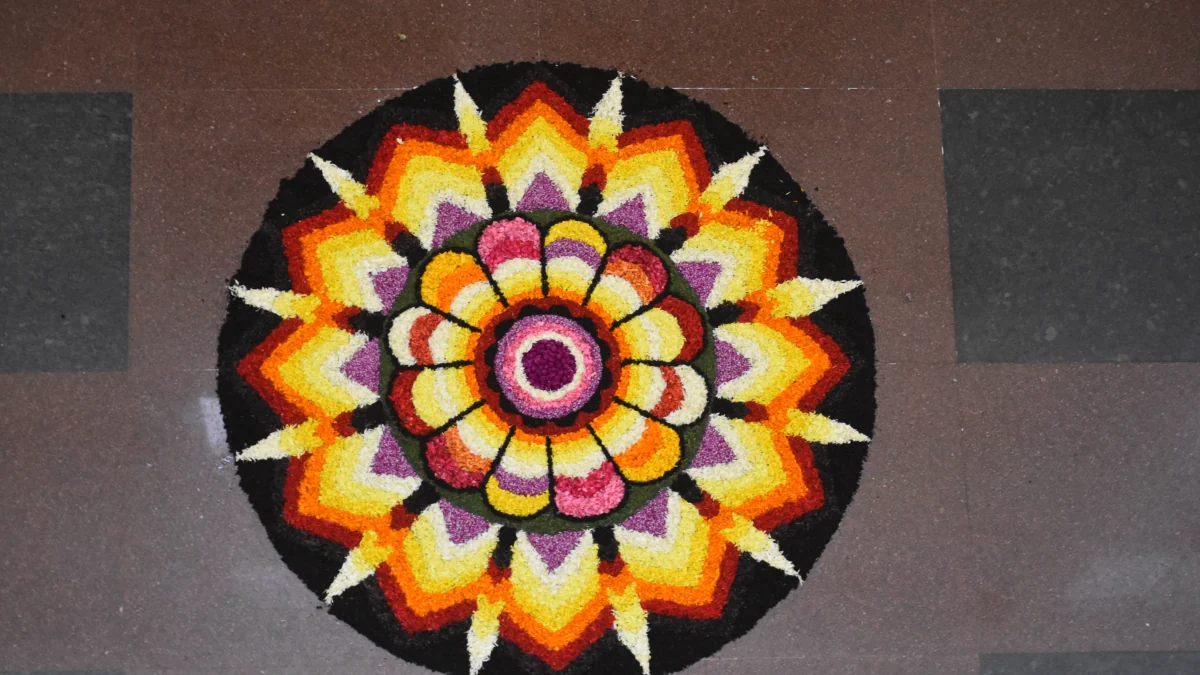
In southern Travancore, Onam is also kept as the birthday of rice. Across Kerala the Onam festival is the ten days of the Malayalam month of Chingam from Atham to Thiruvonam, when homes get ready for King Mahabali, the asura king who, in the Kerala telling, comes back once a year to see the people he ruled.
It is a harvest feast as much as a homecoming. Chingam follows Karkidakam, the hard month, and opens the harvest, so the first rice of the season (puthari) goes into the Onam meal. Flowers go down in the front yard from the first morning, a clay figure joins them on the last, and the family eats from a plantain leaf only after the first serving has been set aside for Ganapathy and for Mahabali.
Onam, next Thiruvonam: Sunday, 12 September 2027 (Thiruvananthapuram). Thiruvonam nakshatra: 2:58 AM on 12 September to 6:04 AM the next morning. Thiruvonam in 2026 fell on Wednesday, 26 August.
Checked on 28 Oct 2026. Festival days and nakshatra timings for your city in the Tirth Spiritual Calendar
Dates and timings are calculated for Thiruvananthapuram from the Thiruvonam nakshatra in the Malayalam month of Chingam. Timings change from city to city, sometimes by more than an hour for moonrise; see the Tirth Spiritual Calendar for your location.
How is the day of Thiruvonam worked out?
Thiruvonam is the day in Chingam on which the Thiruvonam nakshatra (the one most of India calls Shravana) holds in the middle of the day, the madhyahna.
The nakshatra often begins the evening before, so a panchang looks at where it stands at sunrise and at midday rather than at the moment it starts. Count back ten nakshatras, Thiruvonam included, and you reach Atham, the first day. Kerala Tourism says the festival runs from Atham for ten days till Ponnonam, which is Thiruvonam by its other name. Now and then a nakshatra is skipped and the count shifts by one. Which is one reason printed calendars do not always agree on the first day, and why we only give Thiruvonam in the box above.
In North Indian practice the Vamana avatar has his own day, Vamana Jayanti, on Bhadrapada Shukla Dwadashi, which can fall a month after Thiruvonam or very close to it, and it is a separate observance altogether.
Mahabali, Vamana and three steps of land
Mahabali was an asura king, the son of Virochana and the grandson of Prahlada, and like his grandfather he was devoted to Bhagwan Vishnu. Kerala Tourism’s telling calls him a righteous king, one his own people loved.
The devas, afraid of losing their power, went to Vishnu, and he came to Mahabali’s yajna as Vamana, a Brahmin boy, asking for only as much land as he could cover in three steps. The king agreed. Vamana grew until two steps covered the universe, and with nothing left to give, Mahabali offered his own head for the third. Vishnu sent him down to Pathala, the netherworld, and allowed him to visit his subjects once every year.
Kerala places that visit on Thiruvonam.
It helps to keep apart what comes from scripture and what Kerala added. The Bhagavata Purana tells the Vamana story in Canto 8. The yearly homecoming is Kerala’s own, sung in the folk song “Maveli nadu vaneedum kalam” (Maveli is the Malayalam form of Mahabali’s name), and Kerala Tourism lists other mentions of Onam in the Kerala Mahatmyam, which is linked to the Brahmanda Purana, in Pathupattu, and in Mangudi Maruthanar’s Madurai Kanji, along with folk tales of a different kind, one of them tying Parashurama to the festival.
Thrikkakara, in Kochi, is where Kerala ties the event, and the name is explained as Thrikkalkkara, the place of the holy foot. Its temple compound holds two shrines, a Shiva temple and the main one, the Vamanamoorthy temple, which faces east and has a statue of Mahabali.
If you would like to pray to Vamana’s own Lord on Thiruvonam morning, the Vishnu aarti and these Vishnu mantras are a simple place to start.
What happens on each of the ten days of Onam?
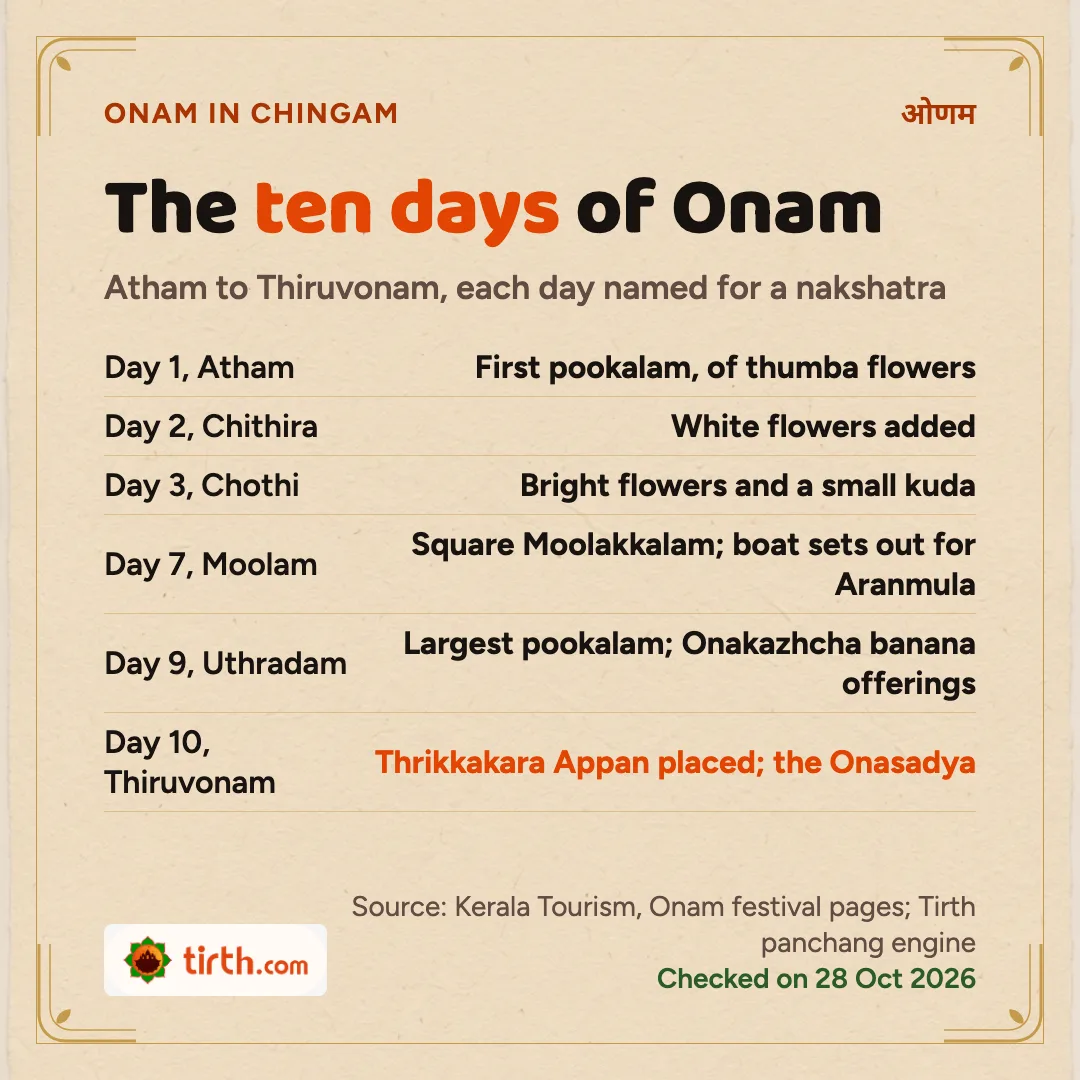
Each day carries the name of the nakshatra it falls on. Kerala Tourism describes the pookalam (the flower carpet) growing day by day, and its pages tie a few other customs to particular days. Where it gives nothing for a day, the table says so rather than filling the gap.
| Day | Nakshatra | What is done |
|---|---|---|
| 1 | Atham | The first pookalam, simple, of thumba flowers |
| 2 | Chithira | White flowers are added |
| 3 | Chothi | Bright flowers such as hibiscus, and a small kuda (umbrella) of coconut-leaf strips in the centre |
| 4 | Vishakam | No separate custom given by Kerala Tourism |
| 5 | Anizham | No separate custom given by Kerala Tourism |
| 6 | Thriketta | No separate custom given by Kerala Tourism |
| 7 | Moolam | A square pookalam, the Moolakkalam. The Thiruvonathoni boat sets out for Aranmula |
| 8 | Pooradam | No separate custom given by Kerala Tourism |
| 9 | Uthradam | The largest pookalam. Bunches of nendran bananas offered at temples such as Guruvayur (Onakazhcha) |
| 10 | Thiruvonam | Only thumbakudam and sometimes tulsi on the pookalam. Thrikkakara Appan placed and worshipped. The Onasadya |
| After | Chathayam | Most Onam rituals end |
Spellings change from one source to the next (Chothi or Chodhi, Thriketta or Thrikketta), so do not worry if your family calendar writes them differently.
How to lay a pookalam, from thumba flowers to the Moolakkalam
A pookalam is made in the front yard to welcome Mahabali, and it is meant to grow over the ten days. Kerala Tourism describes it like this.
- On Atham, start small and simple, with thumba flowers only.
- On Chithira, add white flowers to what is already there.
- From Chothi, bring in bright flowers such as hibiscus, and set a small kuda made of coconut-leaf strips in the centre.
- On Moolam, lay the carpet as a square. This is the Moolakkalam.
- On Uthradam, make the largest pookalam of the ten days.
- On Thiruvonam, go back to plain thumbakudam, with tulsi if you have it, and place the Thrikkakara Appan figure on the pookalam.
If you are trying this for the first time, I would start on Atham with a small circle of thumba and let it build, rather than saving every flower for one big carpet on the last morning, because the custom itself keeps Thiruvonam’s pookalam plain and puts the grand one on Uthradam. Detail varies from region to region (pick a spot nobody needs to walk across, whatever your region does).
What is served at an Onasadya, and who eats first?
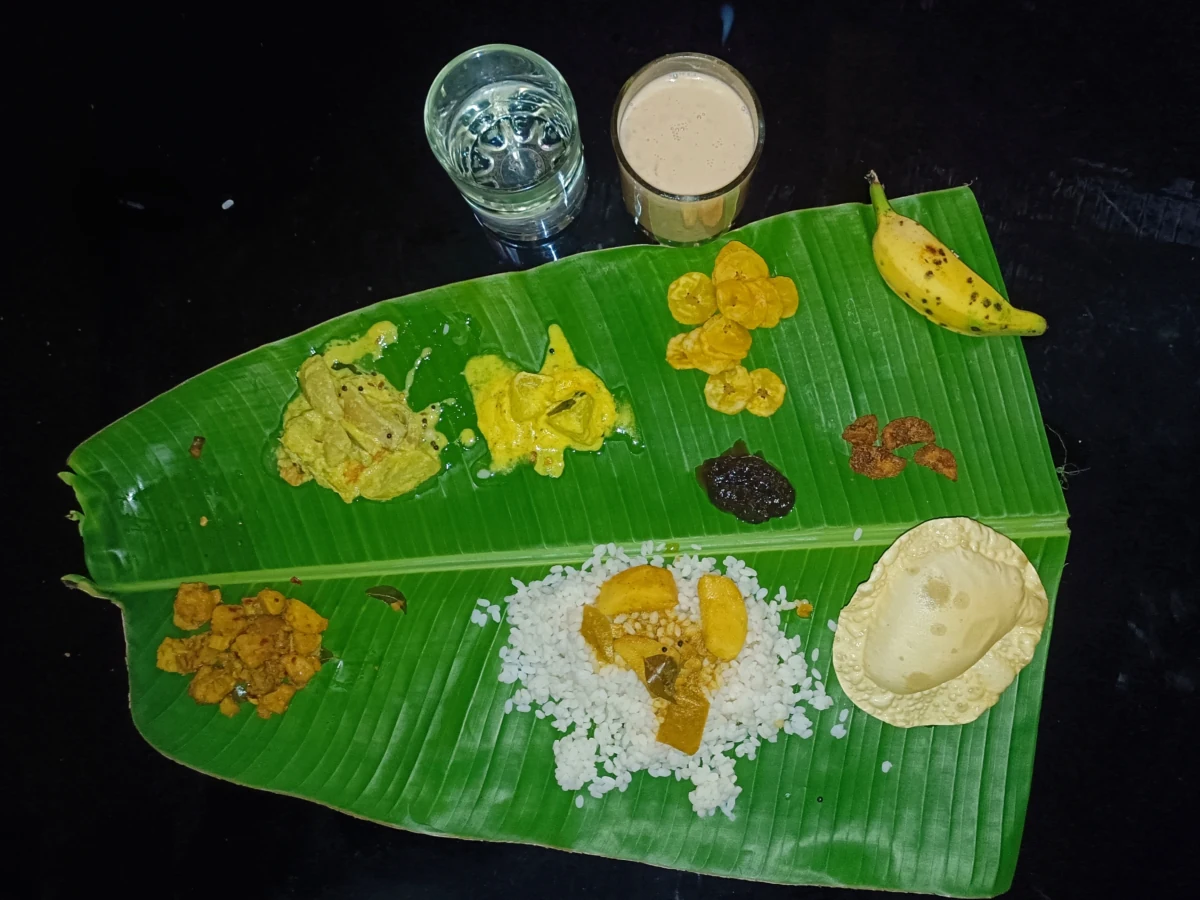
When the Onasadya is ready, the family does not eat first. The first serving is set aside for Ganapathy, the Lord whose own festival is Ganesh Chaturthi, and for Mahabali. A lamp and incense are lit in the kannimoola, the south-west corner of the house, and a pinch of salt and some jaggery go on the leaf. Only after that does everyone sit down. In some regions the offering is made in memory of ancestors instead.
Then the dishes come, in a set order, on a plantain leaf, and if you are hosting for the first time that order is the one thing worth learning properly.
For a sense of scale, look at a temple feast rather than a home one. The Aranmula Valla Sadya, held for Ashtami Rohini at the Aranmula Parthasarathy Temple, serves 36 dishes on plantain leaf, sometimes as many as 71, with no onion or garlic in any of them. Kerala Tourism’s list for it runs to inji, kadumanga, uppumanga, pachadi, kichadi, kaalan, olan, parippu, avial, sambar, varutha erissery, rasam, buttermilk and four kinds of pradhaman. That is a temple feast, though.
Thrikkakara Appan, Athachamayam and the boat to Aranmula
Thrikkakara Appan, also called Mathevar, is a pyramid-shaped clay figure. On Thiruvonam it goes onto the pookalam and is worshipped on a plantain leaf laid over a kalam (a pattern) drawn in rice batter. In some places the figure is placed from Uthradam, with Mahabali’s on Thiruvonam. In North Kerala the Mathevar set has three figures, Maveli, Thrikkakara Appan and Lord Shiva.
Is Thrikkakara Appan Mahabali or Vamana? Kerala Tourism calls the question disputed. The Thrikkakara temple’s own understanding is that he is Vishnu.
The festival starts in public at Thripunithura in Ernakulam district, with the Athachamayam parade in Chingam. It was once the Cochin Maharaja’s procession and was resumed in 1961.
That was also the year, Kerala Tourism records, in which the Government of Kerala under Chief Minister Pattom Thanu Pillai declared Onam the national festival of Kerala, as Kerala Tourism puts it, and it grew from there into a public one.
On Moolam day the eldest Bhattathiri of the Kattoor Mangadu Illam family sets out by boat carrying the Thiruvonam feast, and reaches the Aranmula Parthasarathy Temple in Pathanamthitta district on the morning of Thiruvonam, with Aranmula’s palliyodams (snake boats) as escort. This is the Thiruvonathoni.
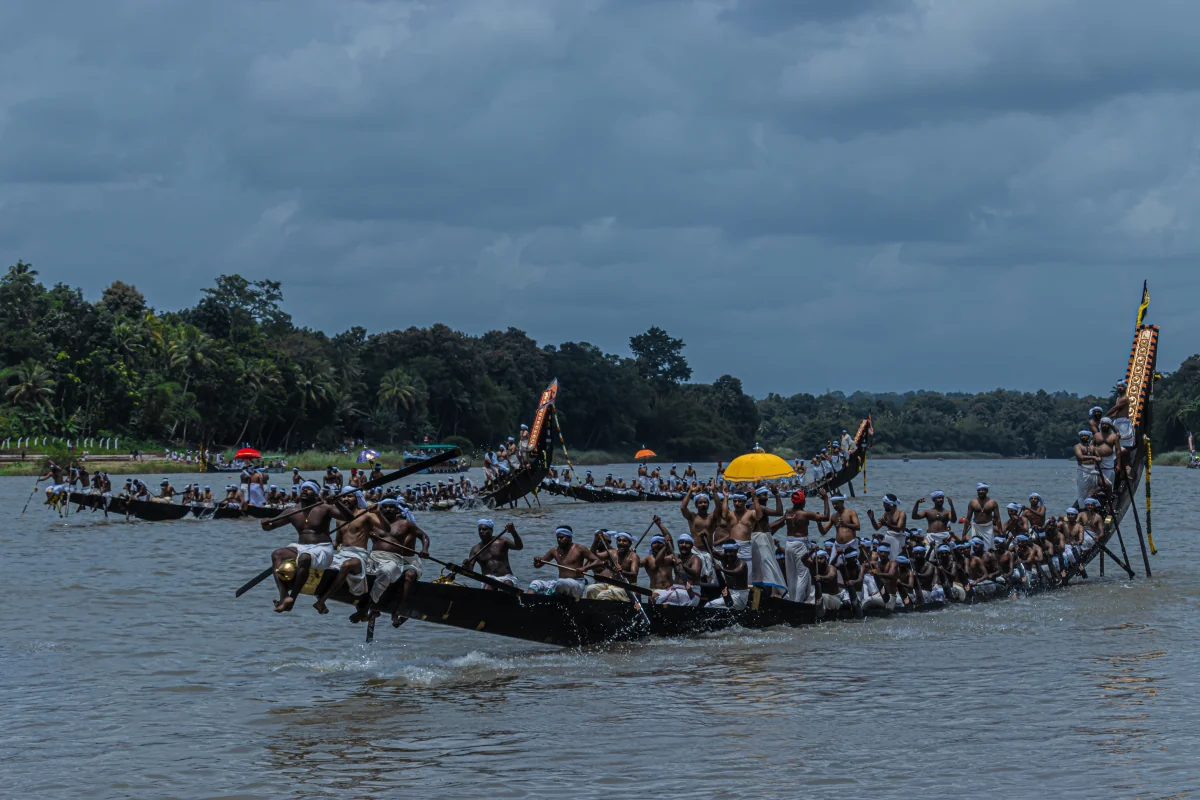
Guruvayur and other temples take Onakazhcha, offerings of nendran banana bunches, mostly on Uthradam, and at Guruvayur the bananas go into the ripe-plantain payasam for Thiruvonam. The custom goes back to the days when tenant farmers owed the best of their produce to the landlord. Around all this sit the games and races Kerala Tourism lists under Onam, from Vallam Kali snake-boat races (the Aranmula race among them) and Pulikali, the tiger dance, to Kummattikali, Thiruvathirakali, Thumbi Thullal, Onathallu, Uriyadi, Kilithattu Kali, tug of war etc. Race days change, so check the local notice for the year you go.
Is Onam a harvest festival or a religious one?
Kerala Tourism treats it as the harvest season festival of Kerala and also tells the Mahabali legend behind it. The harvest side is plain in the calendar, with Chingam opening the harvest after Karkidakam (the cutting is called Onakoythu or Chingakoythu) and new rice in the feast. The devotional side sits in the Vamana story, the Thrikkakara temple and the figure on the pookalam.
Practice differs inside Kerala more than people expect. Southern Travancore keeps Onam as the birthday of rice. North Kerala places three Mathevar figures where other homes place one, and some homes start Thrikkakara Appan on Uthradam while others wait for Thiruvonam. Follow what your own family or temple does, and if you are visiting Kerala for Onam, the temples and towns above are a good place to begin planning with Tirth destinations.
For other festivals, see Janmashtami, Raksha Bandhan, Makar Sankranti (another harvest festival), Govardhan Puja and the festivals in the Tirth Spiritual Calendar.
Frequently asked questions
What is the main significance of Onam?
Kerala keeps Onam to welcome King Mahabali, who in the Kerala telling visits his people once a year on Thiruvonam, and to mark the harvest that Chingam opens. The story of Vamana and Mahabali itself is told in the Bhagavata Purana, Canto 8.
Is Onam only for Kerala?
Onam is Kerala’s festival, and the Government of Kerala declared it the national festival of Kerala in 1961, in Kerala Tourism’s words. Its calendar follows the Malayalam month of Chingam, and its best-known customs belong to Kerala places such as Thrikkakara, Thripunithura and Aranmula.
What is Onasadya?
Onasadya is the Onam feast, served in a set order on a plantain leaf. The first serving is set aside for Ganapathy and Mahabali, with a lamp lit in the south-west corner of the house, before the family eats.
What is a pookalam?
A pookalam is the flower carpet made in the front yard during Onam to welcome Mahabali. It starts with thumba flowers on Atham, grows over the ten days, is largest on Uthradam and goes back to thumbakudam on Thiruvonam.
Who is Thrikkakara Appan?
Thrikkakara Appan, also called Mathevar, is the pyramid-shaped clay figure placed on the pookalam and worshipped on Thiruvonam. Whether he is Mahabali or Vamana is disputed, though the Thrikkakara temple understands him as Vishnu.
Continue on Tirth
- Tirth Spiritual Calendar, Tirth