
Ramayana Characters: Who Is Who, Through One Valmiki Scene Each
Tirth editorial · 9 Mar 2026 · 8 min read
Paduka. Bhagwan Ram’s sandals.
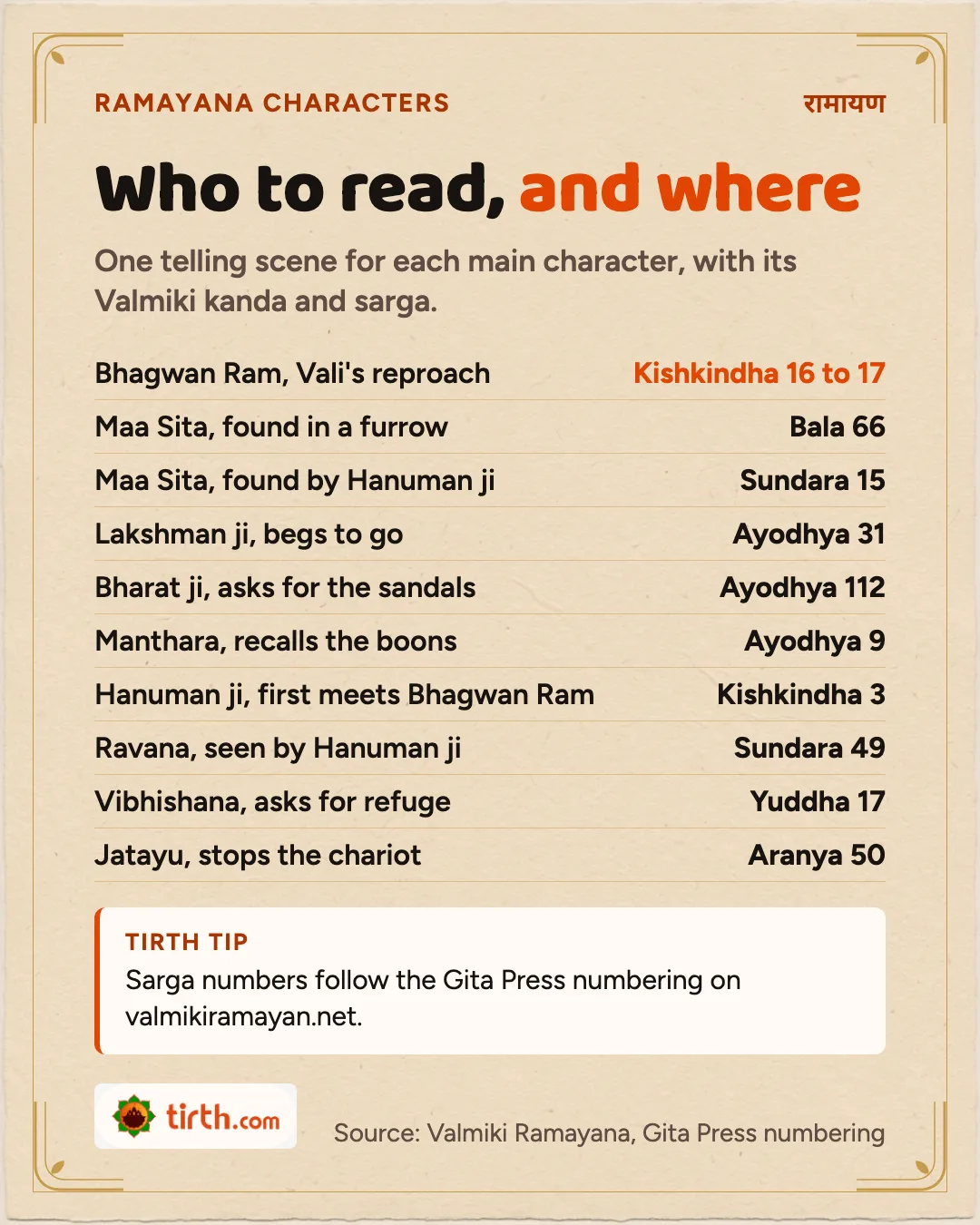
That one word tells you who Bharat ji is, and the Ramayana characters can all be met like that, through one scene each. The five at the centre are Bhagwan Ram, Maa Sita, Lakshman ji, Hanuman ji and Ravana. Around them stand Bharat ji, Shatrughna, King Dasharatha, Kaikeyi, Sugriva, Vali, Vibhishana and old Jatayu.
Every scene here comes with its kanda and sarga, because I think you should be able to open Valmiki and check a character for yourself.
Sarga numbers follow the Gita Press numbering used on valmikiramayan.net.
Ramayana characters at a glance, with the sarga to read
| Character | Who they are in the story | The one scene (Valmiki) | Read also |
|---|---|---|---|
| Bhagwan Ram | Son of Dasharatha and Kausalya, the hero | Kishkindha 16 to 17 | Yuddha 118 |
| Maa Sita | Found by King Janaka in a furrow, Shri Ram’s wife | Yuddha 116 to 118 | Bala 66, Sundara 15 |
| Lakshman ji | Sumitra’s son, goes into exile with Shri Ram | Aranya 45 | Ayodhya 31 |
| Bharat ji | Kaikeyi’s son, rules in Shri Ram’s name | Ayodhya 112 | Ayodhya 73 |
| Shatrughna | Lakshman ji’s twin | Bala 18 | |
| Hanuman ji | Vanara, son of Vayu Dev, sent by Sugriva to meet Shri Ram | Yuddha 74 | Kishkindha 3, Sundara 1, Sundara 15 |
| Ravana | King of Lanka, carries Maa Sita away | Sundara 49 | Aranya 50 |
| Dasharatha | King of Ayodhya, Shri Ram’s father | Ayodhya 64 | Ayodhya 9 |
| Kaikeyi | Dasharatha’s queen, Bharat ji’s mother | Ayodhya 9 | Ayodhya 73 |
| Sugriva | Vanara, Vali’s brother, Shri Ram’s ally | Kishkindha 16 to 17 | Kishkindha 3 |
| Vali | Sugriva’s brother, struck by Shri Ram’s arrow | Kishkindha 16 to 17 | |
| Vibhishana | Leaves Lanka and asks Shri Ram for refuge | Yuddha 17 | |
| Jatayu | Aged, fights Ravana’s chariot | Aranya 50 |
Bhagwan Ram, and the arrow Vali argued with
The scene I would send you to is a hard one, Kishkindha Kanda 16 and 17. Sugriva and his brother Vali are fighting, and Bhagwan Ram’s arrow strikes Vali in the middle of that fight.
Vali falls. He does not go quietly. He reproaches Shri Ram to his face for striking from concealment.
Valmiki gives Vali his full say, then gives Bhagwan Ram his reply in the next sarga, which tells me the poet wanted us to sit with the question instead of rushing on to the next battle.
Why people still call him the ideal man is its own subject, taken up in Maryada Purushottam, what it means. For his forms and worship there is the Bhagwan Ram page, and the Ram aarti is there to sing.
Maa Sita and the fire she walked into
This is the scene everyone argues about, and it runs across three sargas of the Yuddha Kanda.
After hearing Shri Ram’s harsh words in sarga 116, Maa Sita answers him back. Then she has Lakshman ji build a pyre, prays to Agni Dev and walks into the fire, and it is her own call to build it.
Then the gods come. Bhagwan Brahma tells Shri Ram that Sita ji is Maa Lakshmi. Or rather, that is where Valmiki puts the claim, spoken by Bhagwan Brahma here and not at her birth.
By sarga 118 Agni Dev rises with her in his arms and declares her sinless. Bhagwan Ram takes her back, saying he let her enter the fire so that the three worlds would see her purity.
The whole debate is laid out in the Agni Pariksha explained. The Maa Sita page covers her worship.
Lakshman ji, Bharat ji and Shatrughna, three kinds of brother
Lakshman ji’s worst moment comes in Aranya Kanda 45. Maa Sita hears the false call for help and tells him to go, and when he hesitates she accuses him bitterly, and he leaves the hut very much against his will.
That quarrel is all there is, with no line drawn on the ground. The Lakshman Rekha so many of us grew up with is not in Valmiki’s text at all.
More on him is on the Lakshman ji page, and the role of Surpanakha is a separate read.
Bharat ji’s loyalty looks nothing like that.
He goes to the forest in Ayodhya Kanda 112, asks Shri Ram for his padukas and carries them back to Ayodhya. He vows to live as an ascetic and rule in Bhagwan Ram’s name for 14 years.
Then Shatrughna, the quiet one of the four.
Bala Kanda 18 tells us he is Lakshman ji’s twin, born to Sumitra. Valmiki gives him little to do in these scenes, and I’d rather leave him quiet than make things up. Two names people ask about less often have their own post, Taksha and Pushkala.
Dasharatha, Kaikeyi and the two boons Manthara remembered
You may have heard that Kaikeyi brought up the boons herself. In Valmiki she didn’t.
Ayodhya Kanda 9 gives that job to the maid Manthara. Long ago Dasharatha was helping Indra Dev against Shambara in the war of the gods and asuras, Kaikeyi saved his life, and he gave her two boons.
Manthara tells her to use them now. One for Bharat ji’s coronation, and the other to send Bhagwan Ram into the forest for 14 years.
Dasharatha keeps his word. It kills him.
He tells Kausalya about the blind ascetic whose son he had killed by the Sarayu long before, and near midnight he dies of grief for Shri Ram (Ayodhya Kanda 64).
If you want the full argument about Kaikeyi, read why Kaikeyi sent Shri Ram into exile.
Hanuman ji, the vanara who carried a mountain
Yuddha Kanda 74 finds Bhagwan Ram, Lakshman ji and the vanara army struck down by Indrajit’s Brahma missile.
Jambavan sends Hanuman ji, son of Vayu Dev, for healing herbs. He uproots the whole mountain instead, and its fragrance alone revives them.
So the one who saves the army here is the same vanara Sugriva first sent out as a messenger, dressed as an ascetic, to check on two strangers.
The Bhagwan Hanuman page covers how he is worshipped, and the Hanuman Chalisa has its own page.
Ravana, and two who stood up to him
Valmiki lets even the enemy see Ravana’s greatness.
Hanuman ji, standing in Lanka in Sundara Kanda 49, is struck by his splendour. He thinks this king could have guarded the heavens beside Indra Dev, if not for his adharma.
Coming from the one who crossed the ocean to find Maa Sita, that praise counts for a lot.
Two others in these scenes stand up to him, each in a different way. Old Jatayu confronts Ravana’s chariot as he carries Maa Sita away in Aranya Kanda 50, tells him off for taking another man’s wife, and fights him though he is old and Ravana is an armoured archer in a chariot.
Vibhishana comes to Bhagwan Ram asking for refuge in Yuddha Kanda 17. He had told Ravana to give Sita ji back, Ravana refused, and he left Lanka.
Sugriva and the others don’t trust him. Hanuman ji speaks up for him.
How Ravana is remembered today is in Dussehra and Ravana.
Where popular tellings part from Valmiki
| What people often hear | What Valmiki’s text has |
|---|---|
| Lakshman ji draws a line around the hut | Aranya 45 has a bitter spoken quarrel and no line |
| An illusory Maya Sita is carried off and tested | Maa Sita herself enters the fire and Agni Dev returns her (Yuddha 116 to 118). Maya Sita comes from later Puranic and devotional retellings |
| Kaikeyi reminds Dasharatha of the boons | Manthara reminds Kaikeyi of them (Ayodhya 9) |
| Sita ji is Maa Lakshmi from the moment she is found | Bala 66 has the furrow. Bhagwan Brahma names her Maa Lakshmi in Yuddha 117 |
Later retellings changed a lot, and that is fine, as long as you know which one you are reading.
Ayodhya is where it all begins, the city Bharat ji kept for Bhagwan Ram with nothing but a pair of sandals and a vow. Start with the Ayodhya page and Ram naam in Ayodhya, meet each of them again on the Bhagwan Ram, Maa Sita and Bhagwan Hanuman pages, or keep reading in the deities and epics section, with a yatra to Ayodhya there when you are ready.
Frequently asked questions
Who are the main characters of the Ramayana?
Bhagwan Ram, Maa Sita, Lakshman ji, Hanuman ji and Ravana carry the story. Kaikeyi and Manthara set the exile going, while Bharat ji, Sugriva, Vali, Vibhishana and Jatayu each change its course at one point.
Who is the main villain of the Ramayana?
Ravana, the king of Lanka, because he carries Maa Sita away. Valmiki still gives him greatness through Hanuman ji’s eyes, and the trouble in Ayodhya starts earlier, with Manthara.
What is Hanuman ji’s role in the Ramayana?
He starts as Sugriva’s messenger to Shri Ram in Kishkindha Kanda 3. Later he crosses the ocean to Lanka (Sundara Kanda 1), finds Maa Sita in the Ashoka grove (Sundara Kanda 15) and fetches the herb mountain (Yuddha Kanda 74).
Did Sita ji really enter the fire, and who asked for it?
Valmiki says she did. She asks for the pyre herself after Shri Ram’s words in Yuddha Kanda 116, and Agni Dev brings her out unharmed two sargas later.
Was the Lakshman Rekha in the original Ramayana?
No, Valmiki has no such line. Aranya Kanda 45 shows only a quarrel before Lakshman ji leaves, and the line belongs to later retellings.
What did Bharat ji do with Shri Ram’s sandals?
He took the padukas home to Ayodhya and vowed to rule in his brother’s name for 14 years, living as an ascetic (Ayodhya Kanda 112). Earlier, in Ayodhya Kanda 73, he had refused what his mother asked for him.
Continue on Tirth
- Bhagwan Ram, Maa Sita, Lakshman ji and Bhagwan Hanuman, Tirth