
Maha Mrityunjay Mantra in Sanskrit and English, with each word explained
Tirth editorial · 10 Jan 2026 · 6 min read
The Maha Mrityunjay Mantra is Rigveda 7.59.12, a single verse that asks Tryambaka to set us free from death the way a cucumber comes away from its stalk. Today it is chanted as a prayer to Lord Shiva. It closes hymn 59 of the seventh book, which spends eleven verses on the Maruts before the twelfth turns to Rudra.
Vasishtha is the rishi the hymn is ascribed to. Tryambaka is a name of Rudra, one that later came to mean Shiva, and the Sanskrit index of the hymn on Wikisource even gives this verse a label of its own, the mṛtyuvimocanī ṛk (the verse that frees from death).
Maha Mrityunjay Mantra lyrics in Sanskrit and English
Copied straight from the Rigveda, without the Om that so many people put in front.
त्र्यम्बकं यजामहे सुगन्धिं पुष्टिवर्धनम् । उर्वारुकमिव बन्धनान्मृत्योर्मुक्षीय माऽमृतात् ॥
tryambakaṃ yajāmahe sugandhiṃ puṣṭivardhanam | urvārukam iva bandhanān mṛtyor mukṣīya mā’mṛtāt
For anyone who finds the dots and dashes hard going, the same line in plain English letters runs Tryambakam yajamahe sugandhim pushtivardhanam, urvarukamiva bandhanan mrityor mukshiya mamritat.
One small difference from the printed Samhita. It writes the last word as मामृतात्, and we have shown माऽमृतात् instead, which is the same pair of words, mā and amṛtāt, only pulled apart so the eye can find them.
Tryambakam yajamahe meaning, word by word
Our own plain English for it goes like this. We worship the three-eyed one, fragrant, the one who makes nourishment and well-being grow. As a cucumber is freed from its stalk, so may I be freed from death, and not from immortality.
The table leans on one book for every gloss, the Monier-Williams Sanskrit-English Dictionary.
| Word | Devanagari | Meaning |
|---|---|---|
| tryambakam | त्र्यम्बकम् | three-eyed one (Tryambaka) |
| yajāmahe | यजामहे | we worship |
| sugandhim | सुगन्धिम् | fragrant |
| puṣṭivardhanam | पुष्टिवर्धनम् | who increases nourishment and well-being |
| urvārukam | उर्वारुकम् | cucumber, gourd |
| iva | इव | like, as |
| bandhanāt | बन्धनात् | from its bond (the stalk) |
| mṛtyoḥ | मृत्योः | from death |
| mukṣīya | मुक्षीय | may I be freed |
| mā | मा | not |
| amṛtāt | अमृतात् | from immortality |
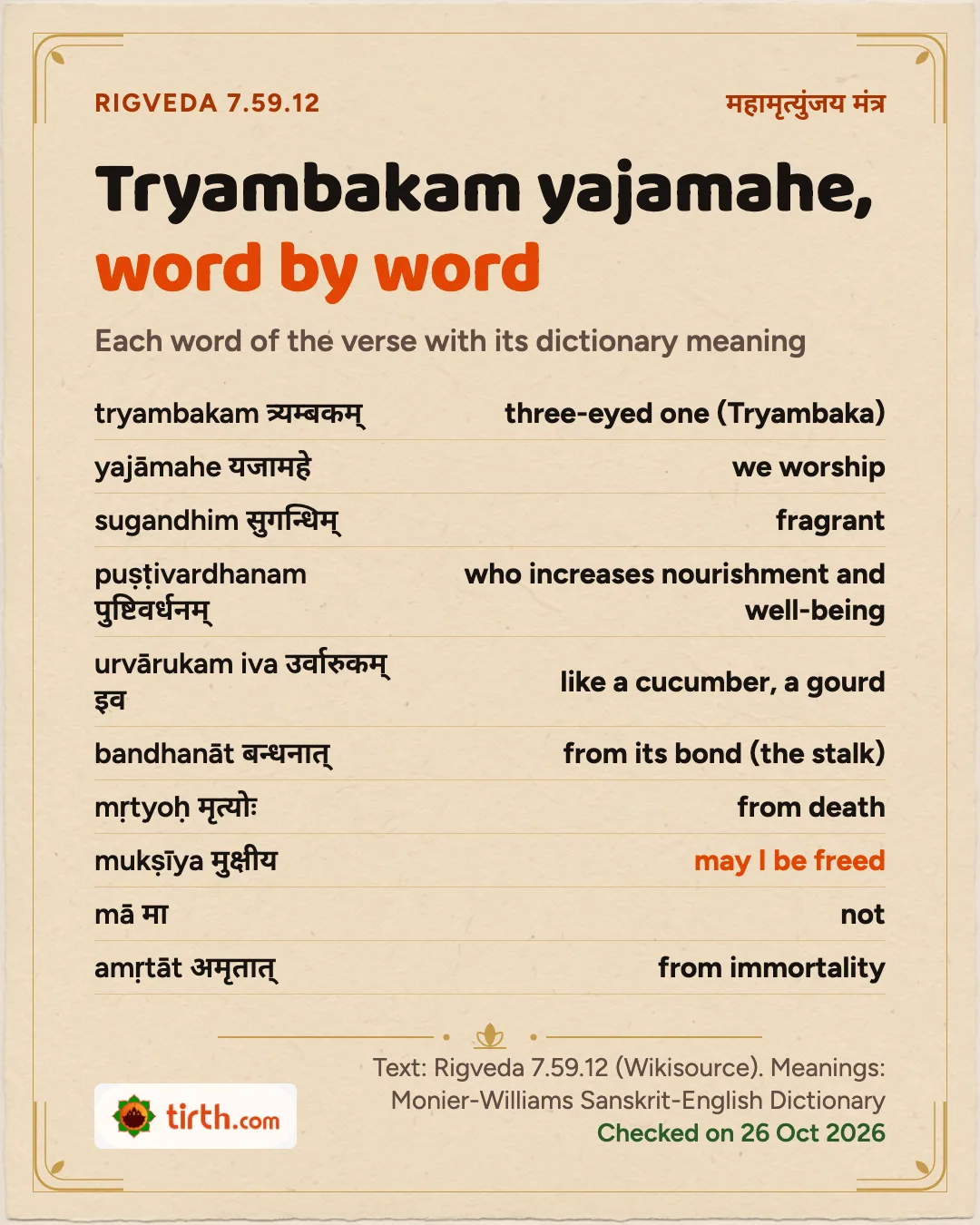
Puṣṭivardhanam joins puṣṭi (nourishment, thriving) to vardhanam (who increases). In the closing words, mā is a particle that negates, so the prayer is to be let go from death but not from the immortal, and Max Müller, translating the hymn in 1891, argued for exactly this reading of amṛtāt in his notes, giving the line as “May I be detached from death, like a gourd from its stem, but not from the immortal.”
Tryambaka is the word people argue over. Many who chant the mantra hear “three-eyed” in it, the first sense Monier-Williams gives, but he also notes that it originally probably meant “three-mothered”. Müller thought “having three mothers” would be its natural meaning. The Shatapatha Brahmana (2.6.2.9) links the name to Ambika, whom it calls Rudra’s sister.
Whichever way you read it, Tryambaka names Rudra, later understood as Shiva, which is why the verse sits so comfortably next to the Rudra mantra. Pilgrims headed for a Jyotirlinga can start with our guide to the Trimbakeshwar Jyotirlinga.
Which Veda is the Maha Mrityunjay Mantra from?
The Rigveda is where its reference starts, and the Yajurveda uses the same verse. In hymn 7.59, verses 1 to 11 go to the Maruts and verse 12, in the Anushtubh metre, goes to Rudra, with the rishi Vasishtha named for the whole hymn. From there the verse travels. The Yajurveda has it in the Vajasaneyi Samhita 3.60, the Taittiriya Samhita 1.8.6.2 and the Maitrayani Samhita 1.10.4, the Atharvaveda carries a variant form (14.1.17), and it turns up again in the Taittiriya Aranyaka (10.56) and the Shatapatha Brahmana (2.6.2.12).
We call it a Rigveda verse first, because that is where its reference begins. So a person who tells you it comes from the Yajurveda is half right.
The oldest account of anyone using the verse in a rite is in the Shatapatha Brahmana (2.6.2), during the Tryambaka offerings to Rudra. Once the cakes have gone in, the sacrificer and the priests go round the altar three times, reciting it. Eggeling’s translation gives their words as “We worship Tryambaka, the fragrant increaser of prosperity”, then the gourd and its stem, and then the plea to be cut loose from death, not from immortality.
The same rite has a quieter second part (Shatapatha Brahmana 2.6.2.13 to 14). Unmarried girls walk round the altar too. What they recite is a second half of the Yajurveda verse (Vajasaneyi Samhita 3.60b), where pativedanam, the bestower of husbands, stands in for puṣṭivardhanam and “from this, not from thence” stands in for “from death, not from immortality”. If a Rudrabhishek at home is on your list, the Maha Rudrabhishek mantra is on a page of its own.
How do families chant it, and when do they turn to it?
No text quoted on this page lays down a routine for the home. What many families do is roughly this, cut down to the parts that count.
- A bath comes first, then a clean and quiet spot to sit, often the family prayer corner.
- Some families light a diya and sit on a kusha grass mat kept just for this, facing east or north.
- The count goes on a mala, often a Rudraksha one, and 108 is the number many families hold to. Take it slowly, because a steady round beats a hurried one.
- If you can, sit in the same place every day, and say the words exactly as printed above.
Many families turn to this verse when someone at home is ill, to pray that they recover. What the verse itself asks for is release from death the way the fruit leaves its stalk, and not release from the immortal. Anything more than that is what families believe, not a promise the verse makes.
Say it alongside the doctor’s care, never in place of it.
There are more prayers to Mahadev in our Shiva mantras and the Shiv Chalisa. And if you would like a priest to do the jaap for your family, Tirth arranges a Maha Mrityunjay jaap in Ayodhya.
Other mantras on Tirth include the Gayatri Mantra, the Surya Mantra and the Maha Kaal Bhairav Beej Mantra.
Frequently asked questions
Does the Maha Mrityunjay Mantra start with Om?
No, not in the Rigveda, where verse 7.59.12 opens on tryambakam. Adding Om is a habit of recitation that many people keep, and it is not part of the printed verse.
Who is the Maha Mrityunjay Mantra addressed to?
Tryambaka, a name of Rudra later understood as Shiva. In its own hymn the Maruts get the first eleven verses, and only this twelfth goes to Rudra.
Is the Maha Mrityunjay Mantra in the Yajurveda?
Yes. It is in the Vajasaneyi Samhita (3.60), the Taittiriya Samhita (1.8.6.2) and the Maitrayani Samhita (1.10.4), and the Yajurveda uses it in the Tryambaka offerings to Rudra. Its Rigveda reference is 7.59.12.
How many times should the Maha Mrityunjay Mantra be chanted?
Many families hold to 108 on a mala. None of the old texts cited here fixes a number at all, and the Shatapatha Brahmana only has the priests going three times round the altar while they recite it.
What does “mukshiya mamritat” mean?
“May I be freed, not from immortality.” Taken word by word, mukṣīya is “may I be freed”, mā is “not” and amṛtāt is “from immortality”. Put mṛtyoḥ (“from death”) in front of them and the line asks for freedom from death but not from the immortal.
What does Tryambakam mean?
Usually “the three-eyed one”. Monier-Williams says the word originally probably meant “three-mothered”, and Max Müller took “having three mothers” to be its natural meaning.