
Maha Lakshmi Puja on Diwali: vidhi, samagri and the story of Shri
Tirth editorial · 6 Feb 2026 · 12 min read
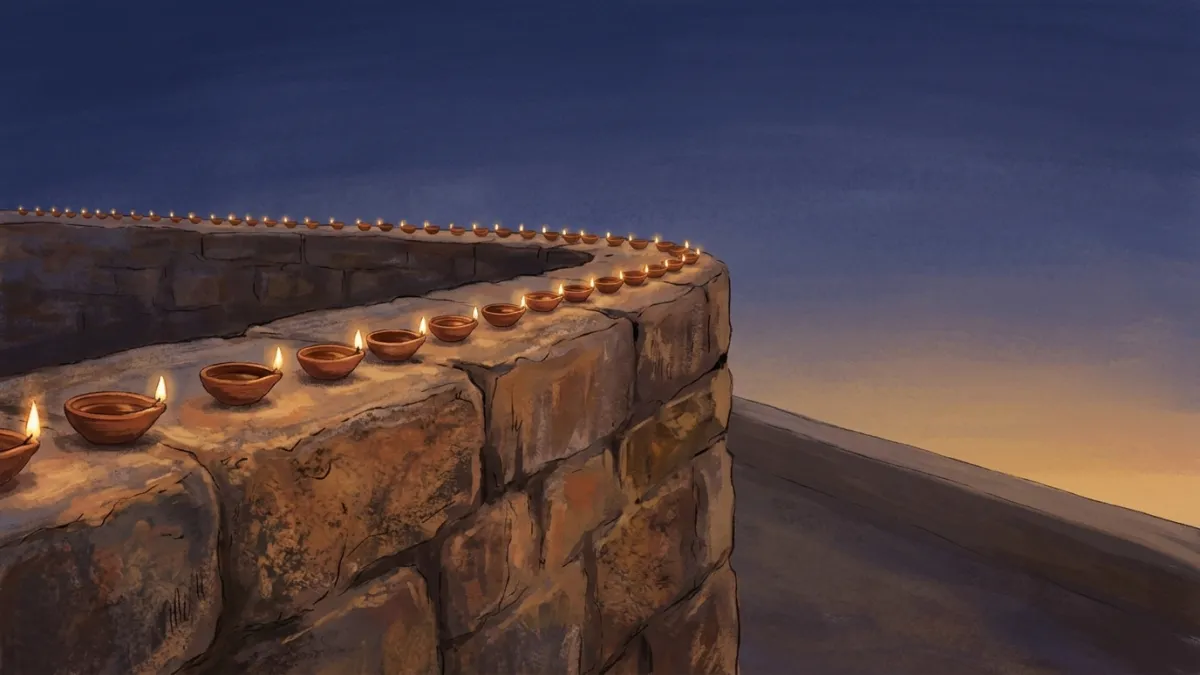
Lakshmi Puja at home on Diwali starts with Ganesha. Lay a red cloth, put the Lakshmi and Ganesha murtis on it and worship him before her. After that the goddess receives the upacharas (offerings) of the shodashopachara puja, one by one, in pradosh kaal, the window that opens after sunset on the Amavasya (new moon) night of Diwali. Many homes worship Saraswati along with them.
The Lakshmi Puja vidhi on this page follows the sixteen-step (shodashopachara) order printed for the Diwali Lakshmi Puja, and wherever a step has a line to say, you will find it printed with that step. How the muhurat is worked out has its own page, Lakshmi Puja date and time.
Diwali Lakshmi Puja in 2026: Sunday, 8 November. Amavasya from 11:27 AM. Lakshmi Puja muhurat in New Delhi: 5:54 PM to 7:50 PM (Vrishabha lagna).
Checked on 25 Oct 2026. Timings for your city in the Tirth Spiritual Calendar
Dates and timings are calculated for New Delhi using the traditional North Indian panchang. See the Tirth Spiritual Calendar for your location.
Why is Lakshmi Puja done on Diwali night?
It follows the moon. The puja is kept on the day when the Amavasya of Kartika Krishna paksha (the month as the Purnimanta calendar names it) is present at dusk, and many families keep it in pradosh kaal, which starts after sunset and which many call the preferred window for householders. Why priests look for a fixed lagna inside that window, and not a Choghadiya, is worked out on the Lakshmi Puja muhurat page.
We would choose dusk if the family is torn between a late-night puja and one at dusk. Many families choose pradosh kaal as a householder. As for Mahanishita kaal at midnight, many say that window mainly suits tantric practitioners and experienced pandits.
Ganesha gets his turn before her. Or rather, before any main deity, because by custom the family priest begins every puja with Ganesha, the remover of obstacles. On Diwali he is installed beside Lakshmi on the same red cloth.
How did Lakshmi rise from the ocean of milk?
Book 1, Chapter 9 of the Vishnu Purana has the story, and it starts with a garland. The sage Durvasa gave it to Indra, Indra put it on his elephant Airavata, and Airavata threw it to the ground. Durvasa, angered, laid a shaap (a sage’s spoken punishment) on Indra. The three worlds lost Shri, prosperity itself, and grew weak. Bhagwan Vishnu told the gods to make peace with the asuras and churn the ocean of milk, with Mount Mandara as the churning rod and the serpent Vasuki as the rope, while he himself, as a tortoise, held the mountain up as its pivot.
Dhanvantari rose holding the cup of amrita. After him came Shri. She rose from the waves seated on a full-blown lotus, a lotus in her hand, and the heavenly elephants poured water over her from golden vases and the ocean of milk gave her a garland of unfading flowers. Vishvakarma adorned her. Then she went to Vishnu’s breast.
One more scene, the choosing, comes from the Bhagavata Purana (8.8.19 to 8.8.25). Lakshmi looked at every god and being gathered there and saw a fault in each. She chose Vishnu, whom the text calls Mukunda. A garland of lotuses went on his shoulders, and she made her home on his chest.
In the Vishnu Purana’s telling, Indra then praised her with a hymn, and the Purana says she granted him two things. She would not leave the three worlds again. And she would not turn her face from anyone who recites that hymn morning and evening.
The same chapter gives her an earlier birth too, prior to the churning, as the daughter of the sage Bhrigu and Khyati. It calls her Vishnu’s shakti and his companion in all his descents. With Vamana she was Padma (Kamala), with Parashurama she was Dharani, with Rama she was Sita and with Krishna she was Rukmini. With Krishna, another telling names Radha instead.
Her pictures keep the lotus and the elephants of the churning. In them Lakshmi usually has four hands. She sits or stands on a lotus, with lotuses in the upper hands and the lower hands in varada (giving) and abhaya (fear-not) mudra, and she wears red with gold ornaments. Often two or four white elephants bathe her. That is the Gaja Lakshmi image. Her vahanas are the owl and the white elephant, and her forms and temples are gathered on the Maa Lakshmi page.
How to get the home and altar ready
Families are up early on Diwali, long prior to the evening puja, to honour their ancestors and worship the family deities. The day is Amavasya, so shraddha for the ancestors is performed as well.
Plenty of people who worship Lakshmi stay on a fast all day and break it once the evening puja is over. A custom. Not a requirement.
Marigolds go up in homes and offices, with ashoka, mango and banana leaves, and a mangal kalash covered with an unpeeled coconut stands on both sides of the main entrance.
Now the altar. The red cloth goes on the right, for the Lakshmi and Ganesha murtis, and the white cloth on the left, for the Navagraha (the nine planets). Nine slots of akshata (unbroken rice) and sixteen slots of wheat are laid out on the cloths in the printed preparation. Many families buy a new Lakshmi murti for Diwali, and the vidhi is written for a new one.
What do you need for Lakshmi Puja?
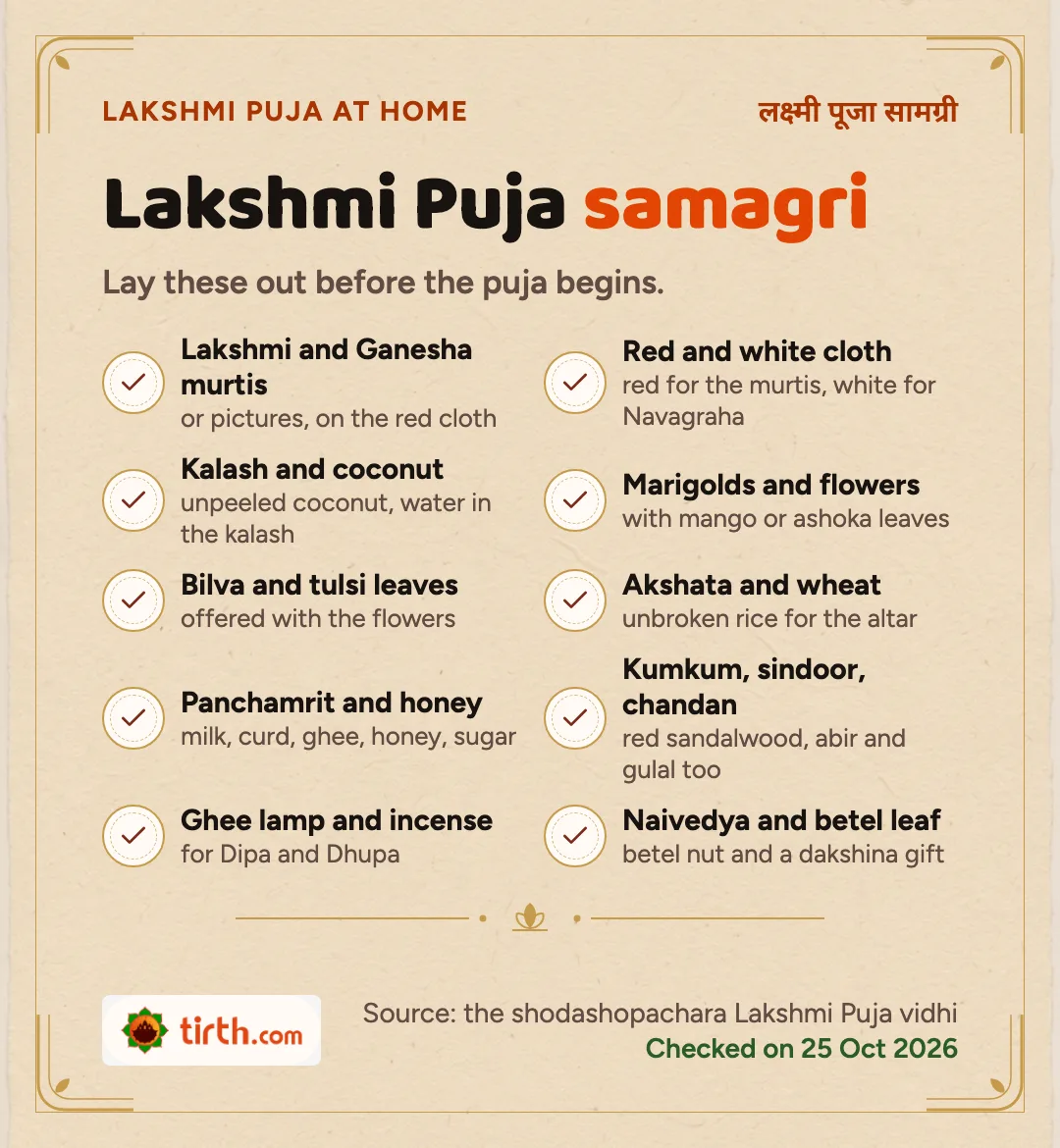
Everything in the table appears either in the preparation or in one of the steps below, and the second column tells you where. Lay it all out before sunset. (A puja paused to hunt for betel nut loses its rhythm, and nobody wants to be opening drawers with the lamp already lit.)
| Item | Used in |
|---|---|
| Lakshmi and Ganesha murtis or pictures | The altar |
| Red cloth and white cloth | The altar (red for Lakshmi and Ganesha, white for the Navagraha) |
| Wheat | The altar layout |
| Akshata (unbroken rice) | The altar layout, marks and colours, anga puja, Ashta-Siddhi and Ashta-Lakshmi |
| Kalash with water and an unpeeled coconut | Both sides of the main entrance |
| Marigolds; ashoka, mango or banana leaves | Decorating the home |
| Seasonal flowers | Asanam (five flowers), Pushpa-Samarpanam, anga puja, Mantra-Pushpanjali, Pradakshina |
| Bilva and tulsi leaves | Pushpa-Samarpanam |
| Water | Padyam, Arghyam, Snanam, Shuddha-Snanam, Achamana |
| Panchamrit (the five nectars) | Panchamrita-Snanam |
| Scented water | Gandha-Snanam |
| Honey and milk | Madhuparkam |
| New cloth, or moli | Vastram |
| Jewellery | Abhushanam |
| Red sandalwood, sindoor, kumkum, abir and gulal, fragrant oil, chandan | Marks and colours |
| Gandha | Anga puja |
| Incense | Dhupa |
| Ghee lamp | Dipa |
| Naivedya (sweets, food) | Naivedya |
| Betel leaf and betel nut | Tambula |
| Dakshina (a gift) | Dakshina |
Bilva earns its place on the list from the Shri Sukta. Verse 6 links the bilva tree to her and says it was born of her tapas, one reason the bilva leaves go in with the flowers at step 8.
The twelve steps of Lakshmi Puja vidhi at home
Start with Ganesha. The shodashopachara vidhi names each offering separately; below they are grouped, with Ganesha’s worship first, into twelve steps. Say the printed line wherever a step has one.
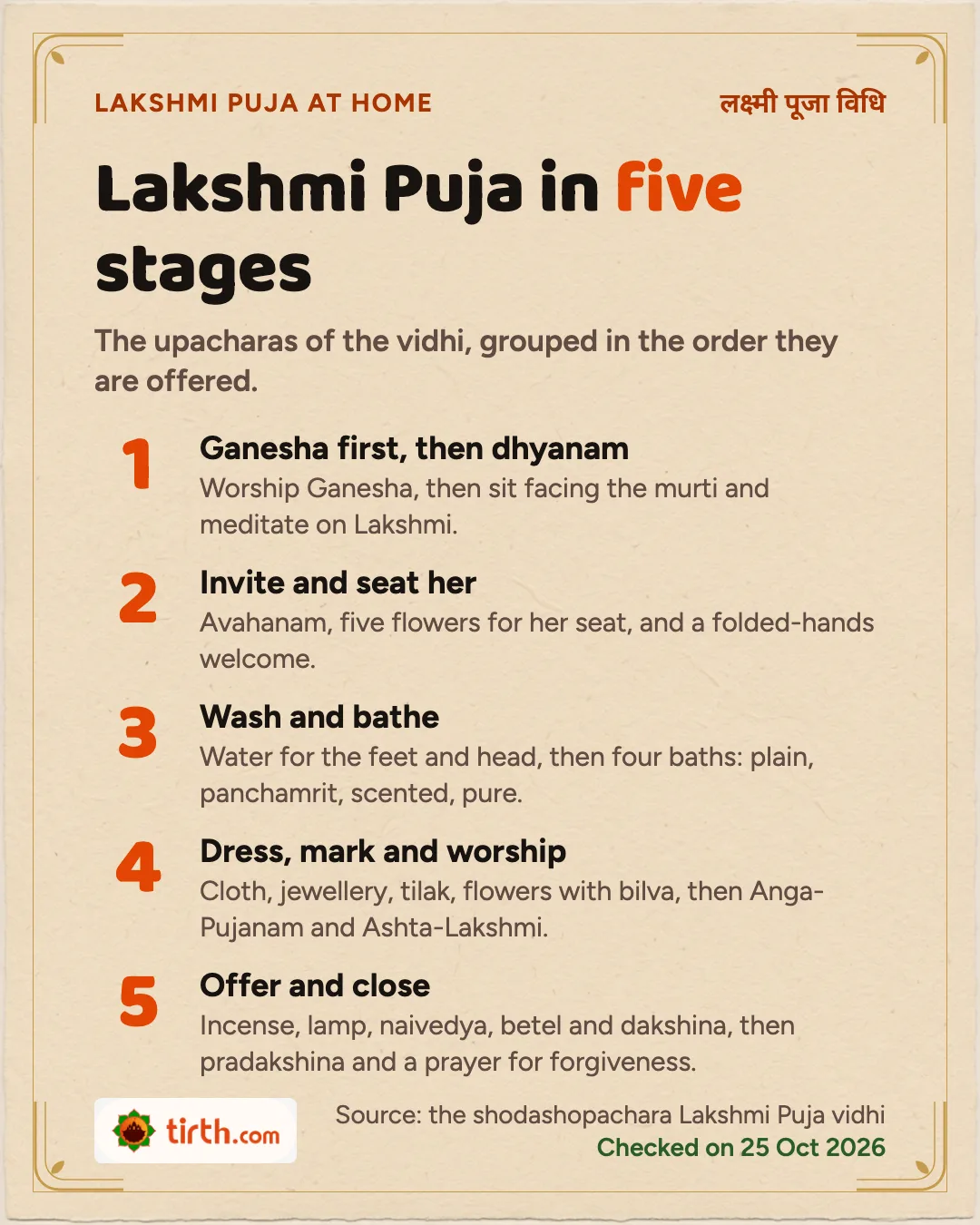
- Begin with Ganesha. Before you turn to Lakshmi, worship him and recite Vakratunda Mahakaya Suryakoti Samaprabha, Nirvighnam Kuru Me Deva Sarva-Karyeshu Sarvada. It means: O Lord with the curved trunk and mighty body, radiant as ten million suns, keep all my work free of obstacles, always.
- Dhyanam, the meditation. Sit facing the murti and hold Lakshmi in mind with the dhyana shloka, Ya sa padmasanastha vipulakatitati padmapatrayatakshi, gambhiravartanabhih stanabharanamita shubhravastrottariya. Lakshmir divyair gajendrair manigana-khachitaih snapita hemakumbhaih, nityam sa padmahasta mama vasatu grihe sarvamangalyayukta. In plain words (our summary of the Sanskrit): Lakshmi seated on a lotus, with eyes long like lotus petals, in white garments, bathed by divine elephants from golden pots set with jewels; may she, lotus in hand and full of all auspiciousness, always dwell in my home.
- Avahanam, Asanam and Swagatam, the invitation, the seat and the welcome. Call her in with the avahana mudra and the words Shri Lakshmi-Devim Aavahayami. Her seat is five flowers, and the line for it is Shri Lakshmi-Devyai Asanarthe Pancha-Pushpani Samarpayami. Fold your hands to welcome her, Shri Lakshmi-Devi! Swagatam.
- Next come Padyam and Arghyam. Water to wash her feet goes first, then water for the head abhisheka, and each has a line of the form Shri Lakshmi-Devyai Namah … Samarpayami.
- Her baths follow. Plain water for Snanam, panchamrit (the five nectars) for Panchamrita-Snanam, scented water for Gandha-Snanam, and pure water for Shuddha-Snanam at the end.
- Then Vastram, Madhuparkam and Abhushanam. New cloth comes first (moli, the red-yellow sacred thread, may stand in for it), honey with milk next, and jewellery last.
- Now the marks and colours, in this order: Raktachandanam (red sandalwood), Sinduram (vermilion for the tilak), Kumkumam (kumkum, a sign of lasting good fortune), Abira-Gulalam (abir and gulal), Sugandhita-Dravyam (fragrant oil), Akshatah (unbroken rice) and Chandanam (sandal paste).
- Pushpa-Samarpanam comes next, seasonal flowers with bilva and tulsi leaves among them.
- After that, Anga-Pujanam, Ashta-Siddhi and Ashta-Lakshmi. With gandha, akshata and flowers, worship each part of her form, using lines such as Om Shriyai Namah Shirah Pujayami. Honour the eight siddhis next, say with Om Vashitayai Namah, and then the eight forms of Lakshmi, say with Om Yoga-Lakshmyai Namah, using akshata, chandan and flowers.
- Dhupa, Dipa, Naivedya and Achamana. Light incense for her, offer the lamp, set down the food offering, and last of all give water to sip and to wash hands and face.
- Tambula and Dakshina. The betel leaf goes with a betel nut, and its line is Mukha-Vasartham Pugi-Phalayuktam Tambulam Samarpayami. Dakshina, the gift, is given as a golden flower, Suvarnapushpa-Dakshina.
- To close, circle her with flowers in Pradakshina (a symbolic circling), offer flowers in Mantra-Pushpanjali (salutation with flowers), bow down in Sashtanga Pranama (prostration with eight limbs touching the ground), and ask forgiveness for any error in the worship with Kshama-Prarthana. The words that end the puja are Shri Lakshmi-Devyai Namah Arpanamastu.
About step 9: the eight forms commonly listed are Adi, Dhana, Dhanya, Gaja, Santana, Veera, Vijaya and Aishwarya Lakshmi. That is one common list, and Yoga-Lakshmi, the example the vidhi uses, is not on it.
One mantra stands apart from these steps, the Lakshmi Gayatri. It is usually printed as Om Shri Mahalakshmyai Cha Vidmahe Vishnupatnyai Cha Dhimahi, Tanno Lakshmih Prachodayat. In simple words (our rendering): we meditate on Mahalakshmi, consort of Vishnu; may Lakshmi inspire us. Its spelling differs a little in the printed Sanskrit edition of the Shri Suktam, where it is verse 26 of the extended text. You will find other Lakshmi lines on our page of Lakshmi mantras with meaning.
If you can’t do the puja yourself this year, Tirth holds a Diwali Samuhik Lakshmi-Ganesh Mahapuja in Ayodhya with a family’s name and gotra recited in the sankalp, or you can book a personal Mahalaxmi puja in Prayagraj.
Which Shri Sukta verses are recited for Lakshmi?
A Vedic hymn to Shri, the Shri Sukta is traditionally recited from the Rig Veda appendices.
Hiranyavarnam harinim suvarnarajatasrajam, chandram hiranmayim Lakshmim Jatavedo ma avaha.
Here Agni, under his name Jatavedas, is asked to bring Lakshmi. She is golden in colour, wears garlands of gold and silver and is radiant like the moon.
Verse 3 also names the elephants. It calls on Shri, heralded by horses and seated amid chariots, whom the trumpeting of elephants wakes (ashvapurvam rathamadhyam hastinadaprabodhinim). Verse 6 is the bilva verse (vanaspatis tava vriksho ‘tha bilvah), and the bilva tree, it says, was born of her tapas. Verse 8 is sterner, a request to drive out of the house Alakshmi, the elder one, marked by hunger, thirst and dirt, along with all lack and misfortune (kshutpipasamalam jyeshtham alakshmim nashayamyaham). The core hymn ends at verse 16, which tells the pure and attentive reciter to offer ghee into the fire daily and to keep reciting these fifteen verses.
Is Lakshmi Puja kept the same way everywhere?
Not in West Bengal, Odisha and Assam. There the Diwali Amavasya belongs to Kali, whose puja follows the Amavasya present at midnight. The main Lakshmi Puja in these states is Kojagara Puja (Bengal Lakshmi Puja) on Ashwin Purnima, kept with a night vigil. A Bengali home has kept its Lakshmi Puja well before Diwali comes round.
Gujarati business families open new account books in the presence of Lakshmi on Diwali, for the coming year, and call it Chopda Pujan. Kubera, guardian of the world’s wealth, has his turn earlier, on Dhanteras (Dhantrayodashi), the first of the five days, when he is worshipped with Lakshmi. What Diwali means across India has more of these regional stories.
Guides to the rest of the festival are here too, on the five days of Diwali, on Govardhan Puja and on Bhai Dooj. For what the festival itself means, read all about Diwali and its history.
Frequently asked questions
Why is Ganesha worshipped with Lakshmi on Diwali?
Because every puja, by custom, begins with Ganesha, the remover of obstacles, before the main deity is worshipped. On Diwali that puts him beside Lakshmi on the red cloth. Many homes worship Saraswati with the two of them.
Should you fast on Diwali for Lakshmi Puja?
It is up to you. A day-long fast, broken after the evening puja, is a custom many who worship Lakshmi keep, and not a requirement.
Is Lakshmi Puja done at night or in the evening?
In the evening. Many families keep pradosh kaal, which starts after sunset, for householders, and say the midnight Mahanishita kaal mainly suits tantric practitioners and experienced pandits. The Tirth Spiritual Calendar has the exact window for your city.
Which mantra is chanted for Lakshmi Puja?
Ganesha’s Vakratunda mantra opens the puja. Lakshmi is invoked with the dhyana shloka that begins Ya sa padmasanastha, and the Lakshmi Gayatri and the first Shri Sukta verse, Hiranyavarnam harinim, are recited to her as well.
What items are needed for Lakshmi Puja?
You need Lakshmi and Ganesha murtis or pictures, red and white cloth, akshata and wheat, water, panchamrit, honey and milk, new cloth or moli, jewellery, red sandalwood, chandan, sindoor, kumkum, abir and gulal, fragrant oil, flowers with bilva and tulsi leaves, incense, a ghee lamp, naivedya, betel leaf and betel nut, and dakshina. At the entrance goes a kalash topped with an unpeeled coconut.
Can Lakshmi Puja be done without a pandit?
Yes. The line to say is written out at each step, so the vidhi on this page can be followed at home. Your family’s own custom comes first.