
Lakshmi mantras: the main mantras with meaning and how to chant them
Tirth editorial · 12 Jan 2026 · 9 min read

One sound runs through the best-known Lakshmi chants: Shreem (श्रीं). It is her bija, her seed syllable, and there is no dictionary meaning to translate. Four chants carry most of the weight in Lakshmi worship, and they are the Lakshmi Gayatri, the Mahalakshmi mantra, the Lakshmi beej mantra and the Shri Sukta, a hymn to Shri kept with the Rigveda.
Maa Lakshmi is worshipped as the giver of fortune, prosperity and beauty. Shri is another of her names. Regarded as the wife of Bhagwan Vishnu (Narayana), she is called on in daily prayer and on Fridays in many families, and the best-known Lakshmi Puja of the year comes on Diwali evening, in pradosh kaal on Kartika Amavasya.
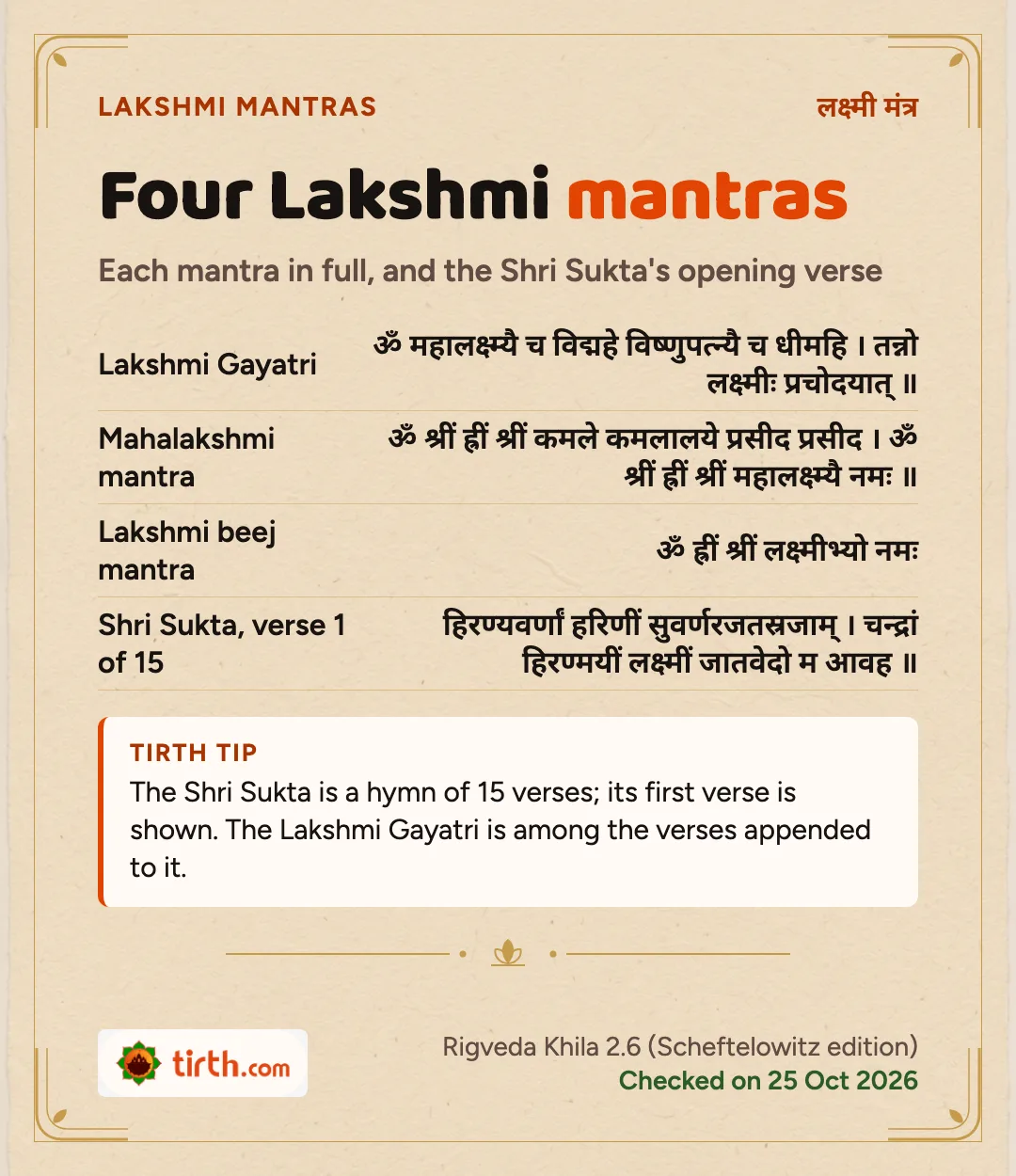
| Mantra | The mantra | Where it comes from |
|---|---|---|
| Lakshmi Gayatri | Om Mahalakshmyai cha vidmahe Vishnupatnyai cha dhimahi, tanno Lakshmih prachodayat | Verses appended to the Shri Sukta (Rigveda Khila 2.6A.26 in the printed edition) |
| Mahalakshmi mantra | Om Shreem Hreem Shreem Kamale Kamalalaye Praseed Praseed, Om Shreem Hreem Shreem Mahalakshmyai Namah | Widely recited; no scripture is named for it |
| Lakshmi beej mantra | Om Hreem Shreem Lakshmibhyo Namah | Widely recited; no scripture is named for it |
| Shri Sukta | A hymn of 15 verses. Verse 1: hiraṇyavarṇāṃ hariṇīṃ suvarṇarajatasrajām, candrāṃ hiraṇmayīṃ lakṣmīṃ jātavedo ma āvaha | Rigveda Khila 2.6 |
We would start with the Lakshmi Gayatri if there is time for only one before Diwali. It is short. You can look up each and every word of it in a Sanskrit dictionary and it is printed alongside the Shri Sukta itself.
Lakshmi Gayatri mantra and its meaning
ॐ महालक्ष्म्यै च विद्महे विष्णुपत्न्यै च धीमहि । तन्नो लक्ष्मीः प्रचोदयात् ॥
Om Mahalakshmyai cha vidmahe Vishnupatnyai cha dhimahi, tanno Lakshmih prachodayat
String the dictionary meanings in the table together and you get something close to this. Om. May we know Mahalakshmi, and meditate on the wife of Bhagwan Vishnu. May that Lakshmi inspire us. The rendering is Tirth’s own. Anyone who already knows the Gayatri mantra will hear the frame straight away, because vidmahe, dhimahi and prachodayat sit in exactly the same places.
| Word | Devanagari | Meaning |
|---|---|---|
| om | ॐ | sacred syllable of solemn affirmation, placed at the start of prayers |
| mahalakshmyai | महालक्ष्म्यै | to Mahalakshmi, the great Lakshmi |
| cha | च | and, also |
| vidmahe | विद्महे | may we know / we know (from the root vid, to know) |
| vishnupatnyai | विष्णुपत्न्यै | (to) the wife of Bhagwan Vishnu (vishnu + patni, wife) |
| dhimahi | धीमहि | may we meditate on, let us contemplate |
| tanno (tat + nah) | तत् + नः | that; us, our |
| lakshmih | लक्ष्मीः | Lakshmi |
| prachodayat | प्रचोदयात् | may (she) inspire, urge on |
Isidor Scheftelowitz brought out a printed edition of the Rigveda Khilas (Breslau, 1906), and both his text and the other common Sanskrit text have mahālakṣmī and viṣṇupatnī where people reciting it say Mahalakshmyai and Vishnupatnyai. Some popular printings put “Om Shree” in front and an “Om” at the end. Even the verse number shifts. In the printed edition it is 26 among the appended verses, and in other printings it becomes 34.
The reading “Vishnupriyayai” turns up in some copies too, but none of these editions reads it that way.
Mahalakshmi mantra (Om Shreem Hreem Shreem Kamale Kamalalaye)
ॐ श्रीं ह्रीं श्रीं कमले कमलालये प्रसीद प्रसीद । ॐ श्रीं ह्रीं श्रीं महालक्ष्म्यै नमः ॥
Om Shreem Hreem Shreem Kamale Kamalalaye Praseed Praseed, Om Shreem Hreem Shreem Mahalakshmyai Namah
This is the Mahalakshmi mantra most people know, and the popular mantra collections print it word for word. None of them names a scripture, though. So read it as a devotional mantra that is recited very widely, with no Vedic or Puranic source named for it.
| Word | Devanagari | Meaning |
|---|---|---|
| shreem | श्रीं | seed syllable of Lakshmi (not translated as a word) |
| hreem | ह्रीं | seed syllable (bija); Monier-Williams lists hrīm only as “an exclamation” |
| kamale | कमले | O Kamala: Kamala, “the lotus one”, is a name of Lakshmi |
| kamalalaye | कमलालये | O you who abide in the lotus (kamalalaya, a name of Lakshmi) |
| praseed | प्रसीद | be gracious, be pleased (repeated for emphasis) |
| mahalakshmyai | महालक्ष्म्यै | to Mahalakshmi, the great Lakshmi |
| namah | नमः | salutation, bow, reverence |
Monier-Williams notes that namah goes with the dative (“salutation to …”). So the ending reads Mahalakshmyai Namah, salutation to Mahalakshmi.
Om Hreem Shreem Lakshmibhyo Namah, the beej mantra
ॐ ह्रीं श्रीं लक्ष्मीभ्यो नमः
Om Hreem Shreem Lakshmibhyo Namah
Popular collections call it the Shri Lakshmi Beej Mantra, and some call the very same words the Lakshmi Moola mantra. Lakshmibhyo means “to Lakshmi”, though the name is in its plural form and nothing we read explains the plural, so here it is read as salutation to Lakshmi and no more than that.
A shorter form is known as the Mahalakshmi beej mantra.
ॐ श्रीं महालक्ष्म्यै नमः
Om Shreem Mahalakshmyai Namah
Monier-Williams defines a bija as the syllable that forms the essential part of a deity’s mantra. Shreem is Maa Lakshmi’s, and devotional collections go a step further and call it the origin of her powers. The noun it is related to, Shri (श्री), does have a meaning. Prosperity, splendour, beauty, and a name of Lakshmi as well. Hreem is a different case: the dictionary gives it nothing beyond an exclamation, and in these mantras it works as a seed syllable.
What does the Shri Suktam say?
Scheftelowitz printed the Shri Sukta as Khila 2.6. It is a hymn to Shri-Lakshmi that survives among the Khilas (the supplementary hymns of the Rigveda), and it opens like this.
हिरण्यवर्णां हरिणीं सुवर्णरजतस्रजाम् । चन्द्रां हिरण्मयीं लक्ष्मीं जातवेदो म आवह ॥
hiraṇyavarṇāṃ hariṇīṃ suvarṇarajatasrajām, candrāṃ hiraṇmayīṃ lakṣmīṃ jātavedo ma āvaha
Meaning: O Jatavedas (Agni Dev), bring to me Lakshmi, golden in colour, tawny, wearing garlands of gold and silver, shining like the moon, made of gold.
The printed edition has mamā vaha where the recited text says ma āvaha. Either way it comes to “bring to me”.
| Word | Devanagari | Meaning |
|---|---|---|
| hiranyavarnam | हिरण्यवर्णां | golden-coloured (she) |
| harinim | हरिणीं | tawny, yellowish (she); also “doe” |
| suvarna | सुवर्ण | gold, golden |
| rajata | रजत | silver |
| srajam | स्रजाम् | wearing garlands (sraj, garland) |
| chandram | चन्द्रां | shining, bright like the moon |
| hiranmayim | हिरण्मयीं | golden, made of gold |
| jatavedah | जातवेदः | O Jatavedas, a name of Agni Dev, the fire god |
| ma avaha | म आवह | bring to me |
The Vishnu Purana (Book 1, Chapter 9) places the hymn at her birth. When the Milky Ocean was churned, Shri rose out of the water seated on a full-blown lotus with a lotus in her hand, the sages praised her with the Shri Sukta, and she went to rest on the chest of Hari, Bhagwan Vishnu. (Bhagwan Vishnu’s own Vishnu mantras have a page to themselves.) The same chapter adds that she was first born of Bhrigu and Khyati. And that beside each of Bhagwan Vishnu’s incarnations she takes a form, Sita ji with Shri Ram, Rukmini ji with Bhagwan Krishna.
Unusually, the hymn spells out how it wants to be recited. According to its phala verse (Khila 2.6A.16), one who desires Shri should become pure and composed, offer ghee into the fire daily, and constantly recite the fifteen-verse hymn. A second appended verse (2.6A.22) says anger, envy, greed and ill thoughts do not arise in meritorious devotees who recite the Shri Sukta.
Chanting a Lakshmi mantra at home
Beyond the hymn’s own instruction to be pure and composed, what families add is custom, and there is no harm in treating it as custom.
Most people settle on a number, usually 11, 21 or 108, and keep count on a mala. No scripture fixes a count for these mantras. If it is your father learning his first Lakshmi mantra, 11 said slowly is a good start (the 108 can wait until the words come without the page in front of him). Stay with one mantra for a while before adding a second.
In many families Friday is Lakshmi’s day. Varalakshmi Vratam is one example, kept on the last Friday of Shravana Shukla Paksha, with its story in the Varalakshmi Vrat Katha. If yours is the other Lakshmi vrat, the Mahalakshmi Vrat Katha tells that one.
Lakshmi mantra for Diwali puja
None of the texts named on this page ties one mantra to the evening. The best-known Lakshmi Puja of the year is done on Diwali in pradosh kaal, the window that opens at sunset, while Kartika Amavasya prevails.
Diwali in 2026: Sunday, 8 November.
Diwali timings for your city in the Tirth Spiritual Calendar
Dates and timings are calculated for New Delhi using the traditional North Indian panchang. Timings change from city to city; see the Tirth Spiritual Calendar for your location.
Households set up images of Bhagwan Ganesha and Maa Lakshmi on a raised seat with lamps. The two are worshipped together. Bhagwan Ganesha’s chants are on the Ganesha mantras page, and the full order of the evening, from the lamps to the mantras, is laid out in our guide to Lakshmi Puja on Diwali. If you would rather a pandit performed it for your family, you can book a Lakshmi puja on Tirth.
The Mahalakshmi Chalisa, a Hindi prayer to Maa Lakshmi, is on Tirth as well. Mantras to other deities are gathered in the Tirth mantra collection.
Frequently asked questions
Which Lakshmi mantra is chanted most?
Most people chant the Mahalakshmi mantra, Om Shreem Hreem Shreem Kamale Kamalalaye Praseed Praseed, Om Shreem Hreem Shreem Mahalakshmyai Namah. No scripture is named for it, though. For a Lakshmi hymn that does have a scripture behind it, look to the Shri Sukta among the supplementary hymns of the Rigveda.
What is the Lakshmi Gayatri mantra?
Om Mahalakshmyai cha vidmahe Vishnupatnyai cha dhimahi, tanno Lakshmih prachodayat. In plain words, may we know Mahalakshmi and meditate on the wife of Bhagwan Vishnu, and may Lakshmi inspire us. You will find it as verse 26 of the verses appended to the Shri Sukta in the printed edition.
What does Shreem mean?
Nothing you can translate as a word. It is Maa Lakshmi’s seed syllable (bija), while Shri, the noun it is related to, means prosperity, splendour and beauty and is also a name of Maa Lakshmi.
How many times do you chant a Lakshmi mantra?
Usually 11, 21 or 108 times, counted on a mala. The count comes from practice, and no text fixes a number for these mantras. The Shri Sukta asks only for constant recitation by one who is pure and composed.
Which day is kept for Lakshmi worship?
Friday, in many families. Varalakshmi Vratam falls on the last Friday of Shravana Shukla Paksha, and Diwali evening on Kartika Amavasya has the best-known Lakshmi Puja of the year.
Continue on Tirth
- Lakshmi Puja on Diwali: the full order of the evening, from the lamps to the mantras.
- Diwali 2026 in the Tirth Spiritual Calendar: the puja muhurat for your city.
- Book a Lakshmi puja with a Tirth Pandit for your family.
- Maa Lakshmi on Tirth: her forms, temples and festivals.