
Khatu Shyam Ji Aarti Lyrics in Hindi and English, with Meaning
Tirth editorial · 7 Jan 2026 · 8 min read

Which aarti do families sing to Khatu Shyam Ji? The Khatu Shyam Ji aarti is “Om Jai Shri Shyam Hare”, a traditional Hindi aarti sung at Khatu Dham in Sikar district, Rajasthan, and in home mandirs once the lamp is lit.
Baba Shyam, as his followers call him, is identified with Barbarika, the son of Ghatotkacha and grandson of Bhima, who is worshipped in the Kali Yuga under Shri Krishna’s own name because of a boon Krishna gave him. Which is why the aarti calls him Shyam.
At the Khatu Shyam temple itself, Rajasthan Tourism says five aartis are performed every day.
Khatu Shyam Ji aarti lyrics in Hindi (Om Jai Shri Shyam Hare)
The refrain comes before every verse. At the close the aarti returns to its opening line, so it ends where it began.
ॐ जय श्री श्याम हरे, बाबा जय श्री श्याम हरे ।
खाटू धाम विराजत, अनुपम रूप धरे॥
ॐ जय श्री श्याम हरे, बाबा जय श्री श्याम हरे ।
रतन जड़ित सिंहासन, सिर पर चंवर ढुरे ।
तन केसरिया बागो, कुण्डल श्रवण पड़े ॥
ॐ जय श्री श्याम हरे, बाबा जय श्री श्याम हरे ।
गल पुष्पों की माला, सिर पर मुकुट धरे ।
खेवत धूप अग्नि पर, दीपक ज्योति जले ॥
ॐ जय श्री श्याम हरे, बाबा जय श्री श्याम हरे ।
मोदक खीर चूरमा, सुवरण थाल भरे ।
सेवक भोग लगावत, सेवा नित्य करे ॥
ॐ जय श्री श्याम हरे, बाबा जय श्री श्याम हरे ।
झांझ कटोरा और घडियावल, शंख मृदंग घुरे ।
भक्त आरती गावे, जय-जयकार करे ॥
ॐ जय श्री श्याम हरे, बाबा जय श्री श्याम हरे ।
जो ध्यावे फल पावे, सब दुःख से उबरे ।
सेवक जन निज मुख से, श्री श्याम-श्याम उचरे ॥
ॐ जय श्री श्याम हरे, बाबा जय श्री श्याम हरे ।
श्री श्याम बिहारी जी की आरती, जो कोई नर गावे ।
कहत भक्त-जन, मनवांछित फल पावे ॥
ॐ जय श्री श्याम हरे, बाबा जय श्री श्याम हरे ।
जय श्री श्याम हरे, बाबा जी श्री श्याम हरे ।
निज भक्तों के तुमने, पूरण काज करे ॥
ॐ जय श्री श्याम हरे, बाबा जय श्री श्याम हरे ।
खाटू धाम विराजत, अनुपम रूप धरे॥
ॐ जय श्री श्याम हरे, बाबा जय श्री श्याम हरे ।
Om Jai Shri Shyam Hare in English letters, with the sense of each verse
If you read Hindi slowly, or not at all, sing from the left column and glance at the right one when a line puzzles you. The meanings are our own plain English for each verse, so they carry the sense of a line and are not a word-for-word gloss.
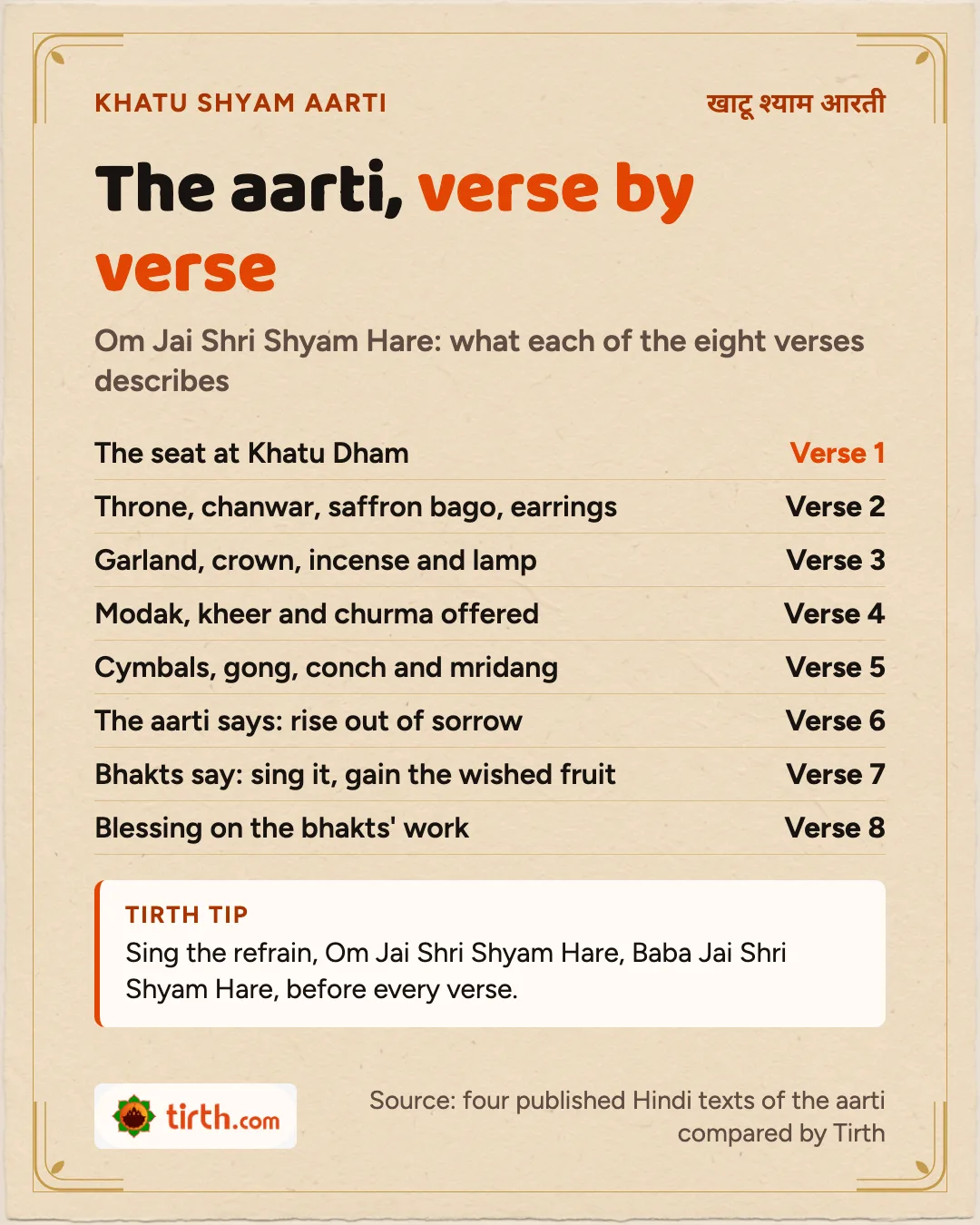
| Roman text (sung) | Meaning (Tirth’s rendering) |
|---|---|
| Om Jai Shri Shyam Hare, Baba Jai Shri Shyam Hare. | Glory to Shri Shyam, glory to Baba Shyam. This refrain is sung before each verse. |
| Khatu Dham Virajat, Anupam Roop Dhare. | You are seated at Khatu Dham, in a form like no other. |
| Ratan Jadit Singhasan, Sir Par Chamar Dhure. Tan Kesariya Bago, Kundal Shravan Pade. | He sits on a jewelled throne while the chanwar is waved over his head. A saffron garment on his body, earrings at his ears. |
| Gal Pushpon Ki Mala, Sir Par Mukut Dhare. Khevat Dhoop Agni Par, Deepak Jyoti Jale. | A garland of flowers round his neck, a crown on his head. Incense smoulders on the fire and the lamp’s flame burns. |
| Modak Kheer Churma, Suvaran Thal Bhare. Sewak Bhog Lagavat, Seva Nitya Kare. | Golden platters are filled with modak, kheer and churma. His servants offer the bhog and serve him every day. |
| Jhanjh Katora Aur Ghadiyaval, Shankh Mridang Ghure. Bhakt Aarti Gave, Jai-Jaikaar Kare. | Cymbals, bowls, the gong, the conch and the mridang ring out. His bhakts sing the aarti and shout his victory. |
| Jo Dhyaave Phal Paawe, Sab Dukh Se Ubre. Sewak Jan Nij Mukh Se, Shri Shyam-Shyam Uchare. | The aarti says whoever meditates on him gains the fruit and rises out of sorrow. His servants call “Shri Shyam, Shyam” with their own lips. |
| Shri Shyam Bihari Ji Ki Aarti, Jo Koi Nar Gaave. Kahat Bhakt-Jan, Manvanchit Phal Paave. | Whoever sings this aarti of Shri Shyam Bihari, his bhakts say, gains the fruit the heart wishes for. |
| Jai Shri Shyam Hare, Baba Ji Shri Shyam Hare. Nij Bhakton Ke Tumne, Puran Kaaj Kare. | Glory to Shri Shyam, glory to Baba ji. You have brought the work of your own bhakts to completion. |
| Om Jai Shri Shyam Hare, Baba Jai Shri Shyam Hare. Khatu Dham Virajat, Anupam Roop Dhare. Om Jai Shri Shyam Hare, Baba Jai Shri Shyam Hare. | The close goes back to the opening line and the refrain. |
Read the seventh verse twice.
The promise of a wished-for fruit is put in the mouths of the bhakt-jan (“kahat bhakt-jan”, say the bhakts), so the aarti itself hands it over as their word, and that is how we leave it. The verse before it carries the same idea as “jo dhyaave phal paawe”. This page repeats their words and makes no promise of its own.
Kundal or Kundan, par or paar? Two words copies of the Shyam aarti get wrong
Kundal is right. All four Hindi texts we compared (Bhakti Bharat, ServDharm, Divine Aarti and Khatoo.in) print कुण्डल श्रवण पड़े, earrings at the ears, yet the English letters on the older version of this very page said “Kundan Shravan Pade”, which is a different word altogether and makes the line about something else.
The second slip is in the Hindi. Three of those four sites print सिर पार मुकुट धरे, with a long “aa”, while Khatoo.in prints सिर पर. Among a dozen more sites we looked at, about half print each, and the Roman text of the line is given as “Sir Par” or “Sir Per” wherever it appears. A crown sits on the head, which is what पर says. So this page prints पर.
Our advice, if you are learning the aarti for the first time, is to learn it from the Devanagari and use the Roman only as a crutch, because the English spellings online drift far more than the Hindi does (Kundan is the proof). If the booklet your family has used for years reads differently in a word or two, sing what your family sings. None of the four texts we compared names a composer, and this page names nobody. A few other online copies end the seventh verse with “kahat Aloo Singh Swami” where the four read “kahat bhakt-jan”. That may be a poet’s signature, but we found no biography or temple record to confirm it, so we leave it there.
Who is Baba Shyam of Khatu, and what is Shyam Kund?
Rajasthan Tourism describes the shrine at Khatu, in Sikar district, as the seat of Barbarika, the son of Ghatotkacha, who received a boon from Krishna. To be known by Krishna’s name, Shyam. That boon is why the aarti above sings to a Mahabharata warrior as “Shri Shyam”.
Shyam Kund is the sacred pond near the temple. Local belief holds that the head of Khatu Shyam Ji was recovered at this spot, and a bath there during the Phalguna Mela is held to be especially auspicious. The mela itself comes once a year, in the Hindu month of Phalguna (February to March). For the season around it, read our post on the Phalguna Mela and Holi at Khatu Shyam, and check the Tirth Spiritual Calendar for when Phalguna falls in the year you plan to travel.
The Khatu Shyam Baba page on Tirth gathers the deity’s story in one place. If you are planning the trip for your parents, the Khatu Shyam temple page has the darshan details in one place.
Hearing the Shyam aarti at Khatu, five times a day
The verses paint the temple at worship. Incense smouldering on the fire, a lamp alight, golden platters of modak, kheer and churma, and the cymbals, gong, conch and mridang going all at once.
Rajasthan Tourism says five aartis are performed at the Khatu Shyam temple every day, so a yatri who stays the day has more than one chance to hear the whole thing sung in the place it describes.
Ask at the temple for the hour. The times printed online differ from one source to another, and we would sooner send you to the temple office than print a time that turns out wrong on the day you arrive.
More aartis sung in the same homes: the Shri Krishna aarti, the Kunj Bihari aarti, the Hanuman ji aarti, the Baba Gorakhnath aarti, the Shri Govardhan Maharaj aarti and the Om Jai Jagdish Hare aarti.
Frequently asked questions
Who wrote the Khatu Shyam aarti?
None of the four published texts we compared names a composer, so it is best called a traditional aarti. A few other online copies sign the seventh verse with the name Aloo Singh, but we found nothing to confirm who he was.
When is the Khatu Shyam aarti sung?
Rajasthan Tourism says five aartis are performed at the Khatu Shyam temple every day. Confirm the hour there.
What does “Baba Jai Shri Shyam Hare” mean?
It is the second half of the refrain, a call of “jai” (glory, victory) to Shri Shyam. Because it returns before every verse, people who do not know the verses can still sing along.
Is there a Khatu Shyam aarti in English?
Yes, in Roman letters. The table on this page sets each Hindi verse in English letters beside its meaning, so you can sing along without reading Devanagari.
How do I reach the Khatu Shyam temple?
Jaipur has the nearest airport, about 80 km away, and the Khatu Shyam temple page has the rest of the route.