
Karwa Chauth katha: Veeravati and the sahukar’s daughter
Tirth editorial · 11 Feb 2026 · 9 min read
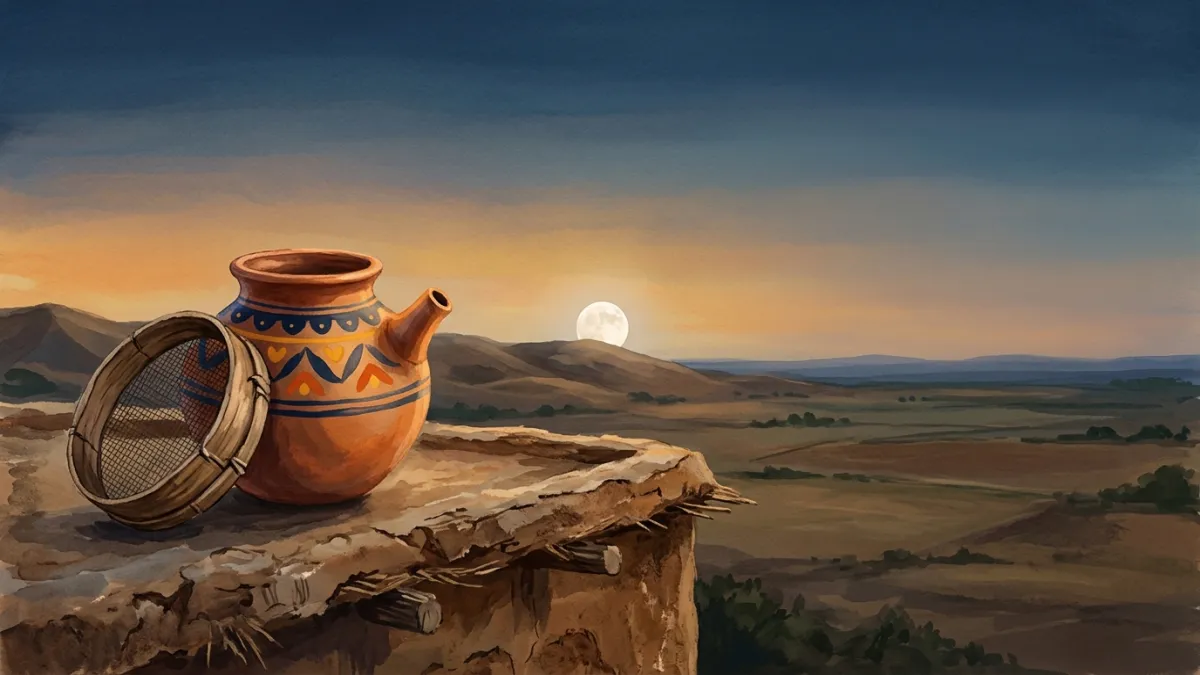
Married women sit down to hear the Karwa Chauth katha in the evening, before moonrise, while they keep a nirjala fast (no food, no water) for the husband’s long life. In it a sister is tricked by her brothers into eating too early, and keeps the vow again until her husband is restored.
The day is the Chaturthi (fourth lunar day) of the Krishna paksha (waning half) of Kartika, and food waits until the arghya (water offering) has been made to the moon.
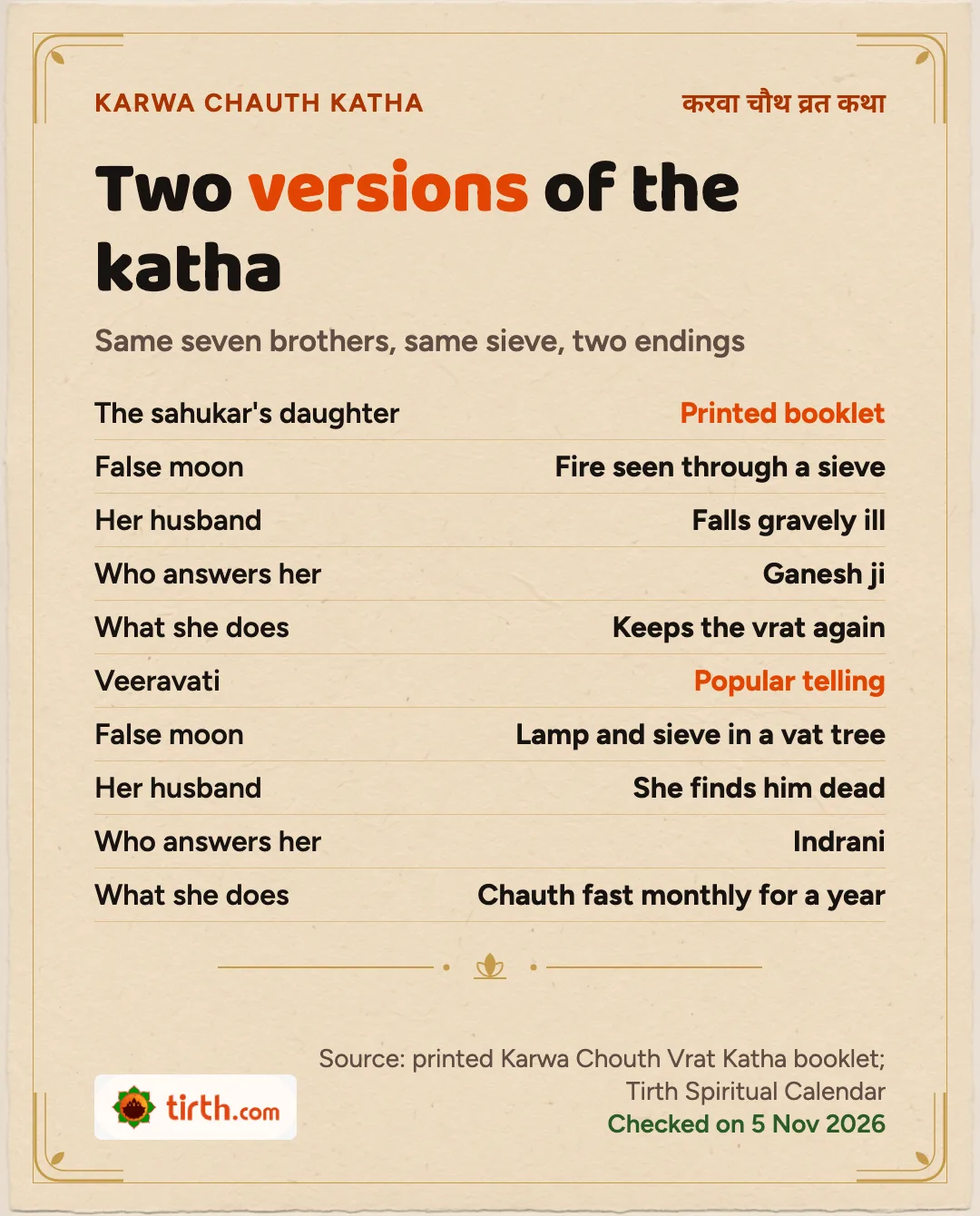
Families tell it two ways. Or rather, they tell one plot with two different heroines. In a printed Hindi katha booklet she is a sahukar’s daughter, and it is Ganesh ji who forgives her broken vrat. In another popular telling she is Veeravati, and Indrani guides her back to her husband. The rest of the day has its own page, our Karwa Chauth puja and sargi guide.
Karwa Chauth in 2026: Thursday, 29 October. Chaturthi tithi: 1:06 AM to 10:09 PM. Moonrise in New Delhi: 8:11 PM.
Checked on 24 Oct 2026. Timings for your city in the Tirth Spiritual Calendar
Dates and timings are calculated for New Delhi using the traditional North Indian panchang. Timings change from city to city, sometimes by more than an hour for moonrise; see the Tirth Spiritual Calendar for your location.
Karwa Chauth ki kahani of the sahukar’s daughter
Karwa Chauth vrat katha is the heading the printed booklet gives this story. Other tellings give it too, with small changes. Nearly all of them sit in one moment. The false moon. There the brothers light their fire on a tree outside the town, and a sieve never comes into it.
A sahukar (a merchant and moneylender) had seven sons and one daughter. On Karwa Chauth the mother, the daughter and the daughters-in-law all kept the fast.
At night the brothers asked their sister to eat. She would not. She said she would eat only after she had offered arghya to the moon.
So the brothers lit a fire outside the town and showed her its light through a sieve, telling her the moon had risen. Her sisters-in-law warned her that it was only fire seen through a sieve, but she paid them no heed, offered arghya to the light and ate.
Because the vrat had been broken, Ganesh ji was displeased. Her husband fell gravely ill, and the household’s wealth went on his treatment.
She repented and asked Ganesh ji’s forgiveness. Then she kept the Chaturthi vrat again, this time with full rites, served everyone around her and sought their blessings. Ganesh ji was pleased with her, restored her husband’s life and health, and gave wealth to the house.
The booklet ends with a line of belief. Whoever keeps the Chaturthi vrat with faith and without deceit, it says, is freed of troubles.
The Veeravati story, as one popular telling gives it
Many families know this one as the Karwa Chauth legend. No scripture is named for it. English retellings keep the same outline (seven brothers, a false moon, a year of prayer), but where this telling names Indrani, some of them credit the gods in general.
Veeravati was the only daughter of the Brahmin Vedsharma and his wife Leelavati of Indraprasthapur, and she had seven brothers. After her marriage, while she was staying at her parents’ home, she kept the Karwa Chauth fast with her sisters-in-law, and fainted from hunger.
One brother climbed a vat (banyan) tree with a lamp and a sieve. Veeravati took the light for the moon and broke her fast. At the meal the omens came one after another: a hair, a sneeze, and then a summons from her in-laws. When she reached her husband’s home, she found him dead.
Indrani (Indra’s queen) told her what had gone wrong, that she had broken the fast without offering arghya to the moon. Indrani advised her to keep a Chauth fast each and every month for a year, and by the merit of that year of fasting her husband returned to life.
Sahukar’s daughter or Veeravati: where the tellings part
| Detail | The sahukar’s daughter | Veeravati |
|---|---|---|
| Where the story comes from | Printed Hindi katha booklet | A popular telling (English retellings agree on the outline) |
| Her family | Daughter of a sahukar, seven brothers | Only daughter of Vedsharma and Leelavati of Indraprasthapur, seven brothers |
| Where she fasts | At home, with her mother and sisters-in-law | At her parents’ home after her marriage, with her sisters-in-law |
| The false moon | A fire outside the town, seen through a sieve | A brother in a vat tree with a lamp and a sieve |
| The warning | Her sisters-in-law tell her it is fire | Omens at the meal: a hair, a sneeze, a summons |
| What happens to her husband | He falls gravely ill and the wealth goes on treatment | She finds him dead |
| Who answers her | Ganesh ji, after she repents | Indrani |
| What she does | Keeps the Chaturthi vrat again with full rites and serves all | Keeps a Chauth fast every month for a year |
| The ending | Ganesh ji restores his life and health and gives wealth | Her husband returns to life |
Take the names out and there is one story underneath. Seven brothers who cannot bear to see their sister fast. A moon made from a light and a sieve, a vrat broken before the real arghya, and a vow kept again until the husband is restored.
If there is time for only one, we would tell the sahukar’s daughter. The reason is practical. The booklet that has her story also prints the listening rite, the Ganesh katha and the udyapan, so one small book carries you through the whole evening. There is a Vat Savitri vrat katha as well, which women hear with the same prayer, a husband’s long life.
How to sit for the Karwa Chauth vrat katha at home
No two households sit for the katha quite alike. The steps here are the printed booklet’s, which makes them one household practice among many. Where your mother-in-law does it differently, follow her.
- Put a lota (pot) of water on a patta (a low wooden seat). Beside it goes a clay karwa filled with wheat, with sugar in its lid and some money.
- Ganapati comes first. Offer jaggery, rice and roli (red powder) to him.
- Mark the karwa with a swastika in roli. Then 13 bindis go on it.
- Pick up 3 grains of wheat in your right hand as the katha begins, and hold them till the story ends (they are kept for the arghya water at moonrise).
- Once the story is finished, the karwa goes to your mother-in-law, after you have touched her feet.
- At moonrise, drop the grains you held into the water and offer it to the moon as your arghya. Only then do you eat.
The wheat, sugar and money go to whoever told the story, whether that was a panditain (a pandit’s wife who reads the katha) or a sister or daughter of the house. Sargi, the evening puja, the arghya etc. are part of the fuller vidhi. Which is in our complete guide to the Karwa Chauth day.
Ganesh ji ki katha and the blind old woman’s boon
One story is not the end of it.
Straight after the Karwa Chauth katha the booklet prints a second, about Ganesh ji and a blind old woman.
A blind old woman worshipped Ganesh ji every day. Pleased with her, he offered her a boon. Her son told her to ask for wealth, and her daughter-in-law wanted a grandson. The neighbours said she should ask for her eyesight.
She asked for all of it in one breath: wealth, a healthy body, her eyesight, a grandson, happiness for the whole family and moksha (release from rebirth) at the end. Ganesh ji said she had outwitted him, and granted every word.
Ganesh ji is worshipped every month as well, on the Chaturthi of every waning moon. That monthly fast is Sankashti Chaturthi (it has a guide of its own).
How is the Karwa Chauth udyapan done?
A vrat is formally completed by its udyapan. The booklet’s name for that rite is the ujman. It takes four short steps.
- Count out 13 sets of puris, 4 in each, and set them on a thali. Every set gets halwa on top, and a sari, a blouse and money go on the thali too.
- Pass roli and rice around the thali in a circle.
- Then the thali goes to your mother-in-law, after you touch her feet.
- Last, feed 13 Brahmins or Brahmin women with respect. Each one gets dakshina (an offering of money) and a roli tilak from you.
Don’t guess the year. Nowhere does the booklet say in which year of the vrat the ujman falls. That call belongs to your family’s elders, or to your family priest. If Ahoi Ashtami is one of your fasts too, the Ahoi Ashtami katha is the next one to read, and the vrat calendar lists the fasts ahead for your city.
Frequently asked questions
What is the story of Karwa Chauth?
A sister keeping the fast is tricked by her seven brothers, who pass off a light seen through a sieve as the moon. She breaks the fast before moonrise. Her husband is struck down. She keeps the vrat again, and goes on until he is restored. Who she is depends on the telling. A sahukar’s daughter whom Ganesh ji forgives, in the printed booklet. Veeravati, guided by Indrani, in another popular telling.
Who is Veeravati?
Heroine of the second Karwa Chauth story. Her father was the Brahmin Vedsharma, her mother Leelavati, both of Indraprasthapur, and she was the only daughter among seven brothers. At a false moon she broke her Karwa Chauth fast. Her husband was dead when she found him. Indrani advised a Chauth fast every month for a year, and she kept it until he returned to life.
Which god is worshipped in the Karwa Chauth katha?
Ganesh ji, in the booklet’s version. Its listening rite opens with Ganapati’s worship, using roli, rice and jaggery. Veeravati’s story turns to Indrani for that, and it is Indrani who explains how to put things right. Sakat Chauth, the Sankashti Chaturthi of Magha, is another day Ganesh ji is worshipped, there alongside Sakat Mata (the Sakat Chauth katha tells that story).
Why is the sieve part of the story?
Because the sieve is how the brothers fool her. Seen through it, a fire or a lamp passes for the moon, and the sister breaks her fast too early. As for the evening custom of looking at the moon through a sieve, neither of the two sources used here explains it.
What do you hold while hearing the katha?
Three grains of wheat, in your right hand, for as long as the katha lasts. That is what the printed booklet says. Later they go into the arghya water, at moonrise.
What is the Karwa Chauth udyapan?
The rite that closes the vrat, which the booklet calls the ujman. On a thali go 13 sets of 4 puris topped with halwa, a sari, a blouse and money. It is circled with roli and rice and given to the mother-in-law, and then 13 Brahmins or Brahmin women are fed, each one given dakshina and a roli tilak.
Continue on Tirth
- Karwa Chauth in the Tirth Spiritual Calendar: tithi and moonrise for your city.