
Kartik Mahatmya katha: seven stories from the Padma Purana
Tirth editorial · 17 Feb 2026 · 10 min read
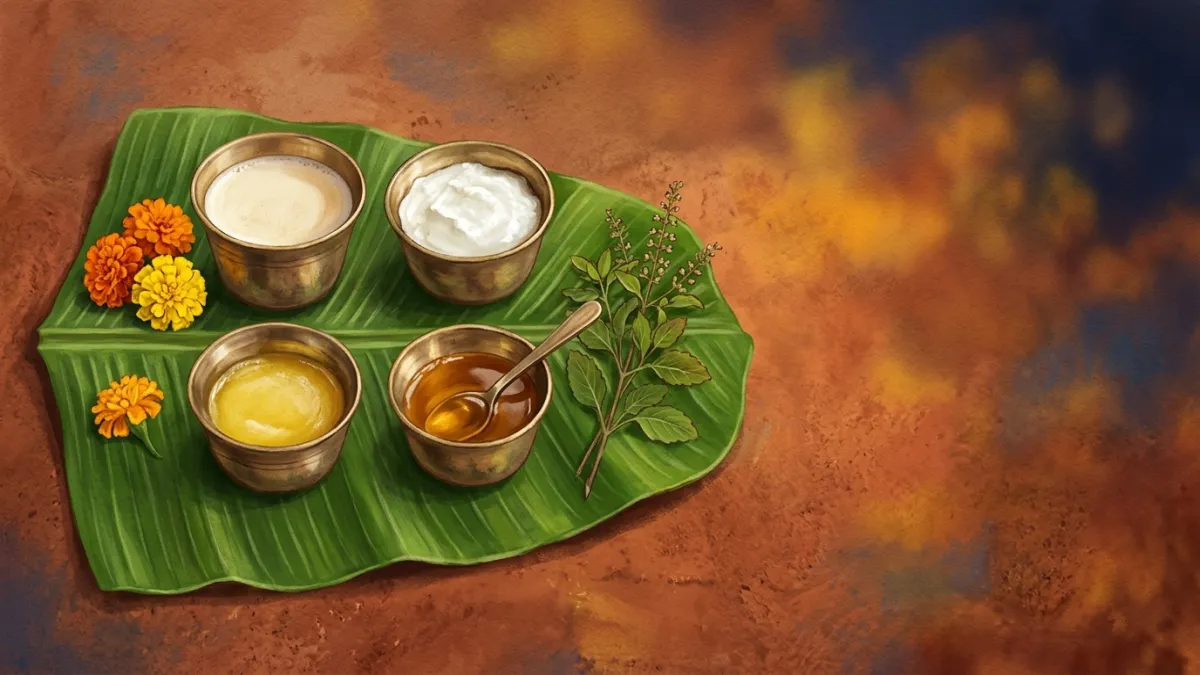
Satyabhama asks Shri Krishna what in a former life made her so dear to him. His answer is the Kartik Mahatmya katha: the stories read through the month of Kartik that explain why its early bath, its lamps and its Tulsi worship matter.
One full version sits in the Padma Purana, Uttara Khanda, chapters 88 to 124 in N. A. Deshpande’s English translation (the name is also spelt Kartika Mahatmyam), and the reading runs from the start of the month to Kartik Purnima. In North India the month opens straight after Sharad Purnima, so the Sharad Purnima katha belongs to the full moon just before it.
Kartik in 2026 (North Indian, purnimanta reckoning): Tuesday, 27 October to Tuesday, 24 November (Kartik Purnima). Purnima tithi in New Delhi: 11:41 PM on 23 November to 8:22 PM on 24 November. In the amanta calendar (Gujarat, Maharashtra and the South) Kartik begins after Diwali.
Checked on 26 Oct 2026. Timings for your city in the Tirth Spiritual Calendar
Dates and timings are calculated for New Delhi using the traditional North Indian panchang. Timings change from city to city; see the Tirth Spiritual Calendar for your location.
Who tells the Kartik Mahatmya, and to whom?
Chapter 88 opens by announcing that the greatness of Kartik will now be told. Satyabhama’s question comes at verses 31 to 33. Krishna answers it first with the story of her own former birth, and then, from chapter 90 and again at the start of chapter 96, he passes the telling to an older conversation: the sage Narada explaining the greatness of Kartik to King Prithu.
Which is why the stories feel nested.
Satyabhama asks Krishna, Krishna repeats what Narada told King Prithu, and inside Narada’s telling come the demons, brahmins, a ghost and kings who met Kartik in one way or another.
The Skanda Purana carries its own Kartikamasa Mahatmya too, the fourth section of its Vaishnava Khanda. The retellings below follow the Padma text only.
Seven stories from the Padma Purana’s Kartik chapters
Chapter numbers below are those of the Deshpande translation. Sanskrit editions and the Hindi adhyaya booklets sold for the month number them differently, so match a story by its people, not its number.
Gunavati, who became Satyabhama (chapters 88 and 89)
Gunavati was the daughter of the brahmin Devasharman. Her father and his disciple Chandrasharman went into the Himalayas and were killed there by a demon. Left alone and poor, she kept two vows for the rest of her life: the Ekadashi vow and the Kartik vow, with an early bath, lamps, and worship at a Tulsi grove. In old age, while bathing in the Ganga, she was taken to Vaikuntha. Krishna then tells Satyabhama who everyone became: Devasharman was reborn as Satrajit, Chandrasharman as Akrura, and Gunavati as Satyabhama herself.
If you read only one story this month, read this one. The whole Mahatmya hangs from it, and it shows the vow as one woman actually kept it, year after year, with nothing to her name.
Shankha and the sleeping Vishnu (chapter 90)
Shankha, son of the Ocean, drove the gods out of heaven and seized the Vedas while Bhagwan Vishnu slept. The Vedas withdrew into the waters. The gods woke Vishnu with music and worship, and he promised to kill Shankha and bring the Vedas back. He then said that he and the Vedas would rest in water each Kartik. He praised the morning bath of this period too. Ekadashi he declared worthy of honour, because the gods had woken him on it.
Jalandhara and Vrinda (chapters 96 to 103)
Narada tells Prithu that Lord Shiva cast the fire of his forehead eye into the ocean where the Ganga meets it. It became a child whom the Ocean claimed as his own. Brahma named him Jalandhara. Only Rudra, he said, could kill him. Jalandhara married Vrinda, daughter of Kalanemi, conquered Indra’s city of Amaravati and went to war with Shiva, a war that runs from chapter 96 to 102.
In chapter 103, through illusion, Vishnu came to Vrinda as a sage who seemed to bring her slain husband back, and so broke her vow of chastity. When she recognised him, she declared that the two doorkeepers he had shown her would become demons and carry off his wife, and that he would wander the forest in grief with monkeys to help him. She entered the fire although he forbade it, and Vishnu stayed by her pyre, grieving.
How amla and Tulsi came to Vaikuntha (chapter 105)
To end Vishnu’s grief, three seeds were sown. Dhatri (amla) grew from the seed of Dhatri, Malati from Lakshmi’s and Tulsi from Gauri’s. Vishnu went back to Vaikuntha with Dhatri and Tulsi. The chapter praises worship of Vishnu at the root of an amla plant in Kartik, and eating a meal under it. Amla worship has its own day as well, told in the Akshaya Navami (Amla Navami) katha.
Kalaha and Dharmadatta (chapters 106 and 107)
Kalaha was the quarrelsome wife of a brahmin named Bhikshu in Saurashtra. She died by poison, passed through lower births and then wandered for 500 years as a ghost. Dharmadatta, a brahmin of Karavira, was on his way to a Kartik night vigil when he met her; remembering Vishnu, he struck her with Tulsi water, and she recalled her past. He had kept the Kartik vow since birth. He gave her half its merit, sprinkled her with Tulsi water while reciting the twelve-syllable mantra, and she was taken to Vaikuntha. Vishnu’s attendants then foretold that Dharmadatta, his two wives and Kalaha would be born again as King Dasharatha and his queens.
King Chola and Vishnudasa (chapters 108 and 109)
King Chola of Kantipura brought a jewelled offering to Vishnu at Anantashayana and found it covered by the Tulsi leaves of a poor brahmin, Vishnudasa. Chola mocked him. Then he began a great sacrifice to win the sight of Vishnu for himself. Vishnudasa kept the Magha and Kartik vows, tended a Tulsi grove, fasted on Ekadashi and repeated the twelve-syllable mantra (see our page of Vishnu mantras).
For seven days his cooked offering vanished. On the eighth he found a starving chandala taking it, offered him ghee and fanned him when he fainted. The chandala rose up as Vishnu and took Vishnudasa to Vaikuntha. Chola, seeing that devotion and not gifts had won Vishnu, entered his own sacrificial fire and was taken as well. Vishnu made the two of them his doorkeepers, Punyashila and Sushila.
Dhaneshvara, the liquor seller of Mahishmati (chapters 113 and 114)
Dhaneshvara was a fallen brahmin who sold liquor at Mahishmati on the Narmada. He mixed with people keeping the Kartik vow. On the night of the festival of Shiva burning the three cities, a serpent bit him. He died sprinkled with Tulsi water. The Kumbhipaka hell turned cool for him; Narada explained that this was the merit of his contact with Kartik observers, and he was shown the hells instead of being punished in them.
Where popular retellings go beyond the Padma text
Three details travel with these stories in booklets and videos. None is in the Padma text. Chapter 90 never names the Matsya avatar in the Shankha story. Chapter 103 has no stone form for Vishnu and no Tulsi rising from Vrinda’s ashes; those belong to other Puranas and later tellings. And chapter 107 does not say which of Dasharatha’s queens Kalaha becomes, though retellings name one or another. If the telling you grew up with has these details, it draws on those other books, not on the Padma chapters.
Which chapter holds which story
The Purana does not assign a story to each day of the month. Most stories take one or two chapters, so one story a sitting is a fair pace if you are reading aloud to someone who cannot sit long (the Jalandhara war, at seven chapters, is the one to split).
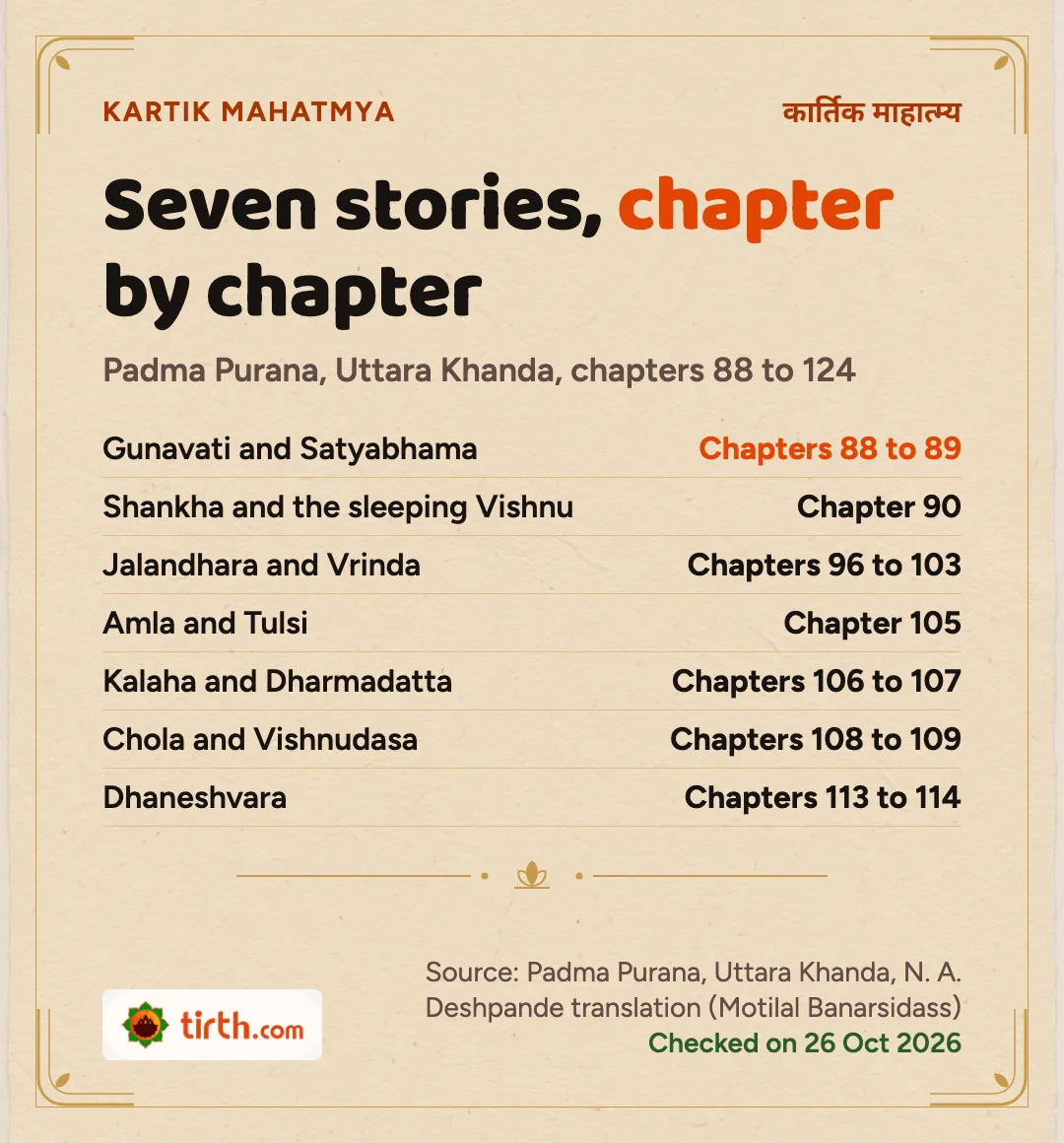
| Story | Chapters (Deshpande translation) | What it says about the Kartik vow |
|---|---|---|
| Gunavati and Satyabhama | 88 to 89 | Early bath, lamps and worship at a Tulsi grove, kept for a lifetime, led her to Vaikuntha |
| Shankha and the sleeping Vishnu | 90 | Gives the reason for the morning bath and for honouring Ekadashi |
| Jalandhara and Vrinda | 96 to 103 | Sets up Vishnu’s grief, which the next chapter resolves |
| Amla and Tulsi | 105 | Worship of Vishnu at the root of the amla, and a meal under it |
| Kalaha and Dharmadatta | 106 to 107 | Half the merit of one person’s vow freed another; Tulsi water and the twelve-syllable mantra |
| Chola and Vishnudasa | 108 to 109 | Tulsi leaves and devotion counted for more than a king’s jewels |
| Dhaneshvara | 113 to 114 | Even contact with people keeping the vow carried merit |
The last chapter, 124, closes the month.
It praises the fast and night vigil of Haribodhini (or Prabodhini) Ekadashi, with singing, Purana recitation and lamps, and then sets out Bhishma Panchaka: a five-day vow from that bright Ekadashi to the full moon, named because Bhishma received it from Vishnu. On the Kartik full moon, the chapter says, jasmine is offered at Vishnu’s head. The full-moon fast itself is covered in our Purnima vrat guide.
What the Kartik vow asks, in the Purana’s own chapters
The rules are not scattered through the stories alone. Chapters 92 to 95 set them out under their own titles: Rules for the Vow of Kartika (92), The Bath Rite (93), Restraints during the Kartika Vow (94) and Bringing the Vow to Conclusion (95). Later chapters take single practices one at a time, among them The Importance of Bathing in Kartika (117), The Greatness of Shalagrama (120), The Importance of Offering Lights (121) and The Celebration of Dipavali (122).
Side by side, the stories keep returning to a few acts: a bath before sunrise, a lamp, Tulsi (her leaves, her water, her grove), the Ekadashi fast, the twelve-syllable mantra. For a text to read at the Tulsi when you light the evening lamp, there is the Tulsi Chalisa. The Padma Purana describes the merit of each act through what happened to Gunavati, Kalaha or Vishnudasa.
For this year’s Ekadashi, Purnima and the other days of the month in your city, see the Tirth festival calendar.
Frequently asked questions
What is the Kartik Mahatmya?
It is the section of a Purana that sets out the greatness of the month of Kartik through stories and rules for the Kartik vow. The Padma Purana’s version is in its Uttara Khanda, and the Skanda Purana has a separate Kartikamasa Mahatmya.
Which Purana has the Kartik Mahatmya, and how many chapters is it?
The Padma Purana, Uttara Khanda, chapters 88 to 124 in N. A. Deshpande’s translation, which makes 37 chapters. The Skanda Purana’s version is the fourth section of its Vaishnava Khanda. Hindi booklets often number the adhyayas their own way.
Who told the Kartik Mahatmya?
Shri Krishna tells it to Satyabhama, in answer to her question about what in a former life made her so dear to him. Inside his answer, the sage Narada tells the greatness of Kartik to King Prithu.
What is the story of Satyabhama’s previous birth?
She was Gunavati, daughter of the brahmin Devasharman. After a demon killed her father and his disciple Chandrasharman, she kept the Ekadashi and Kartik vows all her life and was taken to Vaikuntha while bathing in the Ganga in old age. Krishna says she was reborn as Satyabhama, her father as Satrajit and Chandrasharman as Akrura.
Why is Tulsi worshipped in Kartik?
In the Padma Purana, Tulsi grew from a seed of Gauri’s sown to end Vishnu’s grief after Vrinda’s death, and Vishnu took her to Vaikuntha. Tulsi worship, Tulsi leaves and Tulsi water run through almost every story of the month.
Is there a Mahatmya for other months?
Yes. Shravan has one too; see the Shravana Mahatmya, and more in our collection of vrat and festival kathas.
Continue on Tirth
- Tirth Spiritual Calendar: Kartik Purnima and the Kartik month, calculated for New Delhi.