
Kali Puja History: Why Bengal Worships Maa Kali at Midnight
Tirth editorial · 7 Nov 2026 · 7 min read
The Halder family of Bowbazar switches off every electric light in the house when their Kali Puja begins. Their courtyard on Ramanath Kabiraj Lane is then lit only by candles in bell jars, because the family believes Maa Kali is to be worshipped in darkness.
Kali Puja is Bengal’s worship of Maa Kali on Kartik Amavasya, the same new-moon night as Diwali. The main puja is done at midnight.
The Kali Puja history behind that dark courtyard is usually told through a Nabadwip scholar of the 16th century and a Raja of the 18th. Both come with caveats in the sources.
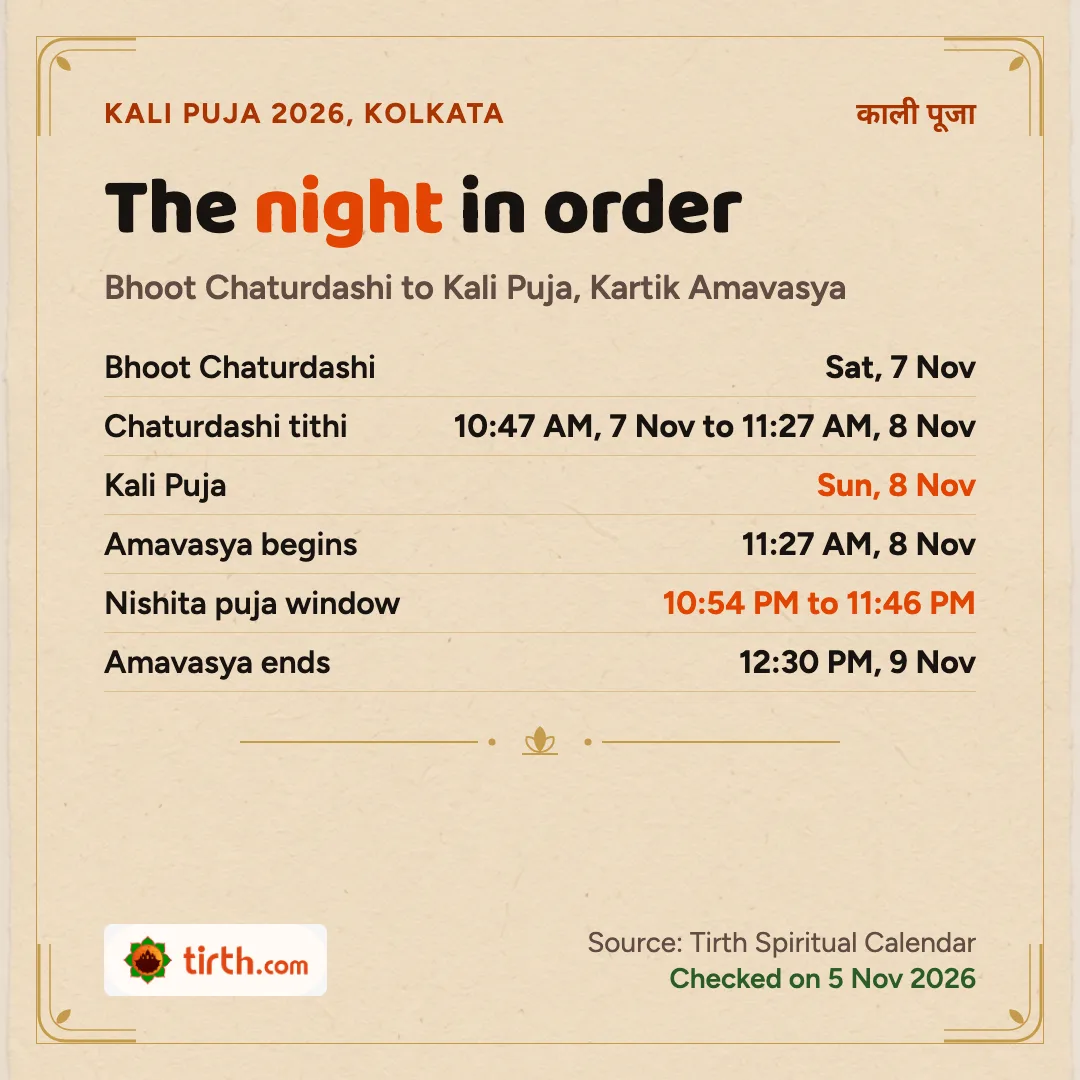
Kali Puja in 2026: Sunday, 8 November, the same night as Diwali. Amavasya in Kolkata: 11:27 AM on 8 November to 12:30 PM on 9 November. Nishita (midnight) puja in Kolkata: 10:54 PM to 11:46 PM. Bhoot Chaturdashi: Saturday, 7 November, with Chaturdashi tithi from 10:47 AM on 7 November to 11:27 AM on 8 November.
Checked on 5 Nov 2026. Timings for your city in the Tirth Spiritual Calendar
What do Bengali homes do on Bhoot Chaturdashi, the night before?
The evening before Kali Puja has its own name in Bengal. Bhoot Chaturdashi.
Lunch that day is choddo shaak, made from 14 leafy vegetables. After sunset Bengali families light 14 clay lamps around the house.
Ask why 14 and different families give different answers, each one a matter of belief.
Some say the lamps remember the ancestors, one lamp for each of 14 generations. Others light them to keep evil away. One account ties the number to Maa Chamunda, a form of Maa Kali, who is said to come with 14 ghostly spirits.
I like the ancestor reading most. That is 14 small flames around the house, one for each of them.
Why is Maa Kali worshipped at midnight, on a night with no moon?
Most deities are worshipped by day. Maa Kali is worshipped at night.
Banglapedia’s entry on Kali Puja suggests this may come from secret rites of non-Aryan origin, and it is careful to put that as a possibility and not a finding.
There is no moon to light the night either. Kali Puja is kept on Amavasya, the new moon of Kartik, and the puja itself waits for nishita, the midnight window, while Amavasya is still running.
The window in the date card is for Kolkata only; your own city’s is on the Tirth Spiritual Calendar.
Banglapedia lists two other special nights for Maa Kali, Ratanti in Magh and Phalaharini in Jyaistha. This is the one with lamps. Banglapedia compares the Kartik new-moon worship, Dipanwita, to Diwali in North India. A festival of lights of its own.
What happens inside the old Kali Pujas of north Kolkata?
Go back to that courtyard on Ramanath Kabiraj Lane.
The Halder family says its puja is about 275 years old, going by old family papers, and every year an artisan from Krishnanagar makes the image of Maa Kali right there in the courtyard and dresses her in daaker saaj, an ornament of foil and beads.
Then the lights go off and the bell jars take over.
Sayan Deb Halder, 21, told The Telegraph’s t2ONLINE that the candlelight is a way of honouring her, not something done for show.
Mahendra Sreemany Bari on Srimani Street traces its puja to Shyamdulal Sreemany, and the family says it is over 300 years old. Maa Kali moved indoors there only when the house was finished in 1911. The elders fast until the rites are over, and a large lamp and a candle burn until dawn.
The Pramanick Kali Bari on Tarak Pramanick Road in Machuabazar has something on paper. A family record from 1930 describes seven households worshipping together for more than 300 years. Her gold and silver jewellery has been given to her over the centuries, and the bhog runs to 16 to 17 kinds of naibedya (food offerings).
As for sacrifice, the Sreemany house offers none of any kind, and the Halder family ended the animal sacrifice its puja once had.
Outside these three houses, Bengali homes and pandals garland Maa Kali with red hibiscus. The images come from Kumartuli, the potters’ quarter of north Kolkata. The bhog can include khichuri, labra, bhajar thali (five fried vegetables), luchi, payesh and naru, and on Kali Puja day more lamps go up along windows, doors and verandahs.
Who began Kali Puja in Bengal, Krishnananda or Krishnachandra?
Tradition credits Krishnananda Agamvagish of Nabadwip with bringing the worship of Maa Dakshina Kali to Bengal. Pinning down when is harder.
Banglapedia gives him two slightly different spans in two of its entries, the first half of the 16th century in one and c. 15th to 16th centuries in the other. Other pages give exact years, and they don’t agree with each other. His book, the Tantrasara, is dated to the 16th century.
So the 16th century is the honest answer, and anyone handing you a single exact year is picking one source over the rest.
The second name belongs to the 18th century. Raja Krishnachandra Roy of Nadia, who lived from 1710 to 1783. Banglapedia says Kali worship was well established in Bengal in his time, and that he encouraged the poet Ramprasad Sen to compose shyamasangit, songs to Maa Shyama, which is a name of Maa Kali.
His own Banglapedia entry does not mention Kali Puja at all. It credits him with being the first to introduce Jagaddhatri Puja in Bengal, a different puja.
The sources give no single founder. Tradition names Krishnananda, with a century and no firm year, and by Krishnachandra’s time the worship was already established.
Which temple calls Kali Puja its holiest night of the year?
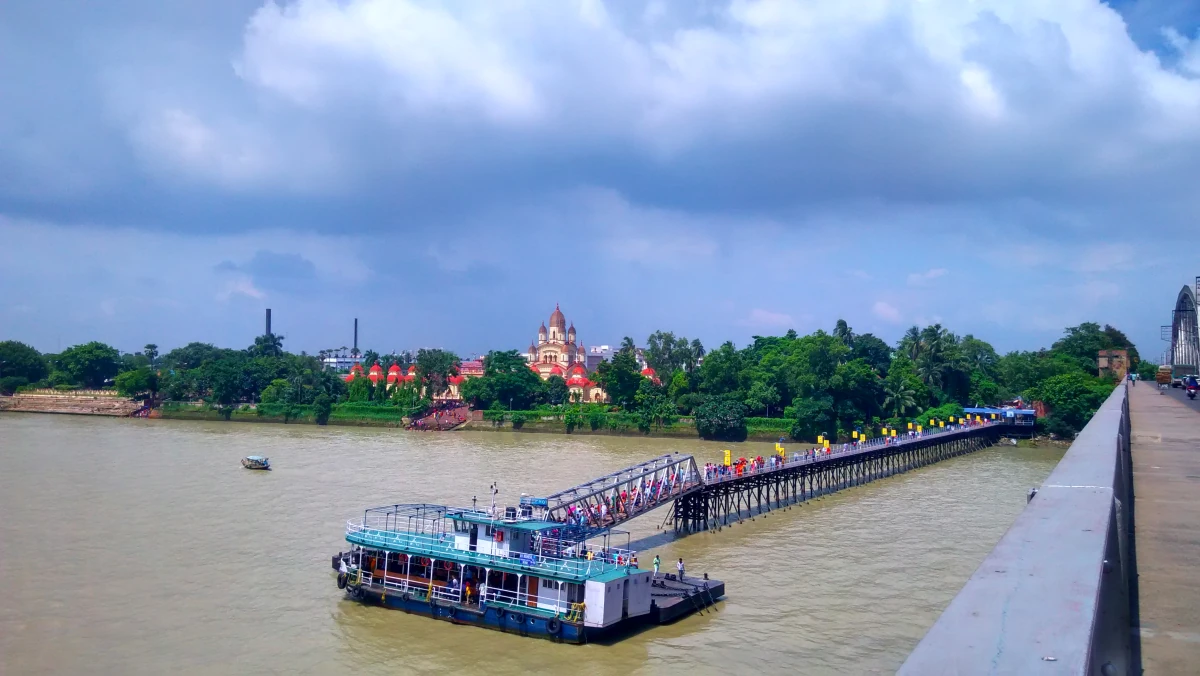
Dakshineswar Kali Temple‘s own festival calendar calls Dipanwita Kali Puja, or Sri Sri Shyama Puja, its holiest night of the year. The rituals run through the night. In the temple’s words, the shrine becomes “a radiant sea of light”. It publishes no ritual timings for the night, so none are given here.
If you want to keep the night where you live, start with your own city’s timings on the Tirth Spiritual Calendar.
Then read the Dakshineswar Kali Temple and Kalighat Kali Temple pages, and Tirth’s guide to Kolkata.
For the night’s prayers there is the Maa Kali mantra, the Kali Chalisa and the Maa Kali aarti, and the Maa Kali page gathers the rest. Bengal’s other big puja, Durga Puja, has a page of its own. So do the other days of Diwali, like Dhanteras and Bhai Dooj.
Frequently asked questions
Is Shyama Puja the same as Kali Puja?
Yes. Shyama Puja is another name for Kali Puja, and Dakshineswar’s calendar lists the night as Sri Sri Shyama Puja (Dipanwita). Maa Shyama is a name of Maa Kali, the name Ramprasad Sen’s songs are addressed to.
Is Kali Puja the same as Kali Chaudas?
No. Kali Chaudas, also called Bhoot Chaturdashi, falls on the Chaturdashi before Kali Puja and is kept mainly in western states. Bengal’s Kali Puja falls one day after it, on the Amavasya.
Who started Kali Puja in Bengal?
Tradition credits Krishnananda Agamvagish of Nabadwip with bringing the worship of Maa Dakshina Kali to Bengal in the 16th century, though sources disagree on his exact dates. Banglapedia says Kali worship was already well established in Bengal in the time of Raja Krishnachandra Roy of Nadia, in the 18th century, and its entry on him does not mention Kali Puja.
Why are 14 lamps lit on Bhoot Chaturdashi?
Families give more than one reason. Some say the lamps are for their ancestors and some light them to keep evil away, while one account links the number to Maa Chamunda, who is said to come with 14 ghostly spirits.
Why does Bengal worship Maa Kali on Diwali night?
Kali Puja and Diwali fall on the same Kartik Amavasya. In West Bengal, Odisha and Assam, families worship Maa Kali on this new moon, and the national encyclopaedia of Bangladesh compares her Dipanwita worship to Diwali in North India. For Maa Lakshmi’s puja on Diwali, read Lakshmi Puja on Diwali.
Continue on Tirth
- Diwali, Tirth Spiritual Calendar