
Maa Kali Mantra: Om Kreem Kalikayai Namah With Meaning
Tirth editorial · 12 Jan 2026 · 5 min read
A widely printed Maa Kali mantra is Om Kreem Kalikayai Namah (ॐ क्रीं कालिकायै नमः), a one-line salutation that bows to Maa Kali under her name Kalika. Devotional sites say it at night, often 108 times, and on Amavasya, including Kali Puja on the Amavasya of Diwali.
You will also see it spelt Krim or Kring, and Kalikaye for Kalikayai.
In the Devi Mahatmya, Kali enters in a battle scene. In its seventh chapter, the troops of the asuras Chanda and Munda have just rushed at Ambika, the Goddess, and her brow knots in anger. Out of that scowl comes Kali, sword and noose in hand, carrying a skull-topped staff and wearing a garland of skulls.
Om Kreem Kalikayai Namah and four more lines printed for Kali
These lines come from devotional sites. None cites a scripture. Where the pages spell a line differently, the table gives each spelling. Two lines that go round online are left out because the copies found are garbled: a longer Dakshina Kali mantra that opens Kring Kring Kring, and Om Klim Kalikayei Namah.
| Line | Devanagari | Roman letters | Plain meaning (Tirth’s rendering) |
|---|---|---|---|
| Kali mantra | ॐ क्रीं कालिकायै नमः | Om Kreem Kalikayai Namah (also Om Krim Kalikaye Namah, Om Kring Kalikaye Namah) | Om, the Kali seed syllable, and “I bow to Kalika” |
| Kali beej mantra | ॐ क्रीं काली | Om Kreem Kali | Om, the Kali seed syllable, and her name |
| Maha Kali mantra | ॐ श्री महा कालिकायै नमः | Om Shri Maha Kalikayai Namah | A salutation (namah) to Kalika |
| Kali Gayatri | Not printed here; the copies we found have errors | Om Maha Kalyai Cha Vidmahe Smashana Vasinyai Cha Dhimahi Tanno Kali Prachodayat | No sourced translation |
Seed syllables of this kind belong to other deities as well, the Maha Kaal Bhairav beej mantra for one. More lines for other deities are collected in the Mantra Collection, and the Shakti mantras post covers the wider family of Goddess prayers.
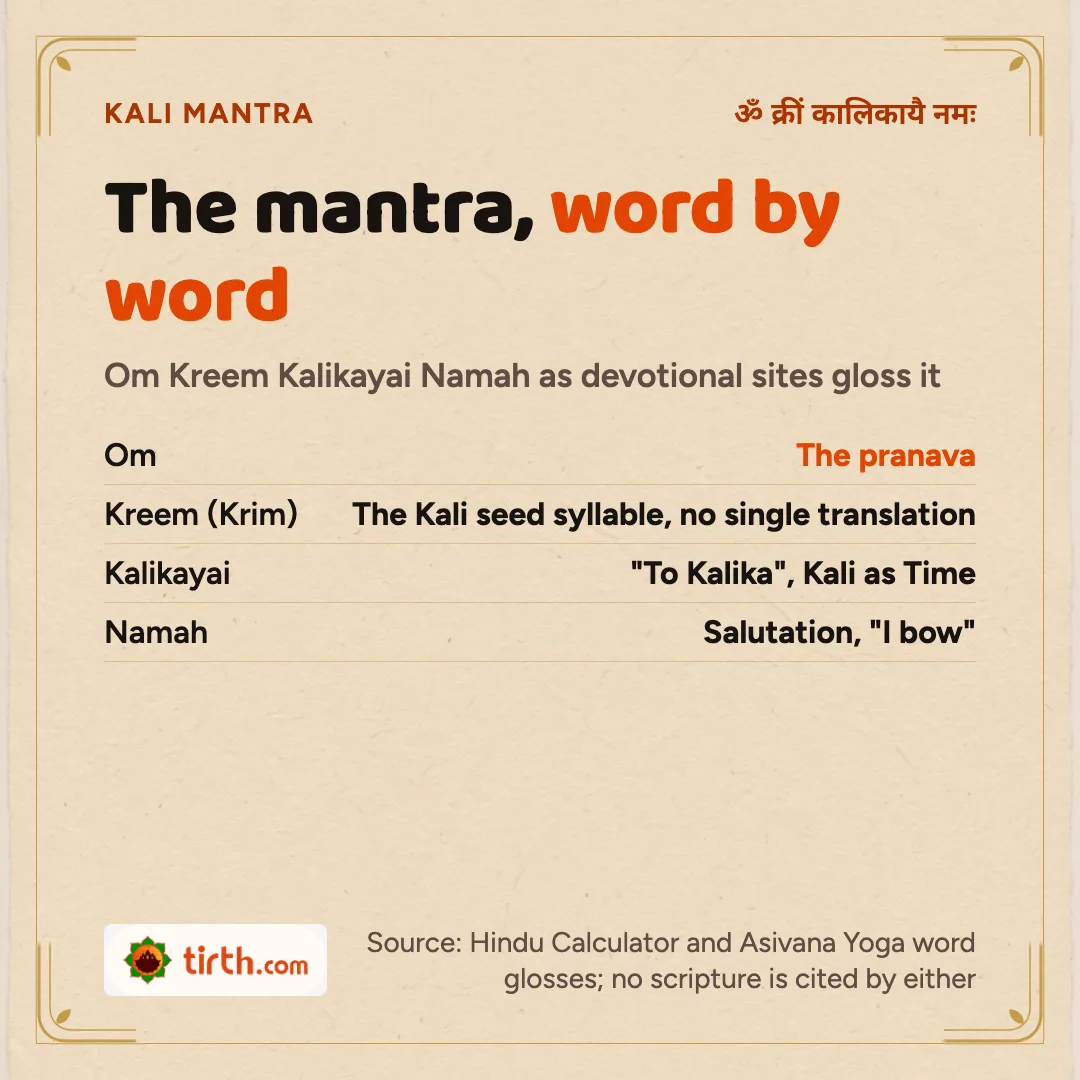
Om Kreem Kalikayai Namah meaning, word by word
| Word | What it means |
|---|---|
| Om | The pranava |
| Kreem (Krim) | The Kali beej, a seed syllable. It has no single dictionary translation. |
| Kalikayai | “To Kalika”, Kali as Time (the dative of Kalika) |
| Namah | Salutation, “I bow” |
Put together, the line says Om, Kreem, I bow to Kalika.
Some pages split Kreem into its letters (ka, ra, ee and the anusvara) and give each one a meaning. Those readings are popular interpretation, not established etymology.
Kali in verse 7.6 of the Devi Mahatmya
bhrukuti-kutilat tasya lalata-phalakad drutam Kali karala-vadana viniskranta-asi-pasini
In plain English (Tirth’s rendering): from the Goddess’s scowling brow springs Kali, armed with sword and noose.
That is verse 7.6 on devimahatmya.com, with the skull-topped staff and garland of skulls in 7.7, while Hindupedia’s text in the Ramachander translation numbers the emergence verse 5.
Her other origin accounts and her forms, Dakshina Kali and Mahakali among them, are set out on the Maa Kali page. Om Shri Maha Kalikayai Namah, in the table above, is the line printed for Mahakali.
How many times is the Kali mantra chanted, and when?
The count devotional sites give is 108.
The time is night or dusk, before a lamp. Amavasya, the new moon night, comes up again and again, along with Tuesdays, Saturdays and Navratri, and Kali Puja on the Amavasya of Diwali, whose date moves each year, so check the Amavasya timings for your city on the Tirth Spiritual Calendar. Sources disagree on which way to face, and one of them says north, so this page names no direction.
Hindu Calculator adds a caution. It notes that intensive sadhana with the Kreem syllable has traditionally been done under a guru’s guidance, while repeating the salutation is open to everyone. If you are starting out, keep to Om Kreem Kalikayai Namah. The Kali Chalisa has a page of its own.
Devotional pages attach benefits to these lines, such as protection, calm and a settled mind, without tracing them to a text. If the family would rather have a pandit perform a puja, the Tirth puja booking page lists what is offered.
Frequently asked questions
What does Om Kreem Kalikayai Namah mean?
Om, then Kreem, the Kali seed syllable, then “I bow to Kalika”, Kalika being Kali as Time. Kreem has no single dictionary translation.
Is it Kreem, Krim or Kring?
All three. They are spellings printed for the same syllable, and pages are just as loose with the next word, writing Kalikaye or Kalikayei where others have Kalikayai.
Can anyone chant the Kali beej mantra?
Hindu Calculator treats repeating the salutation Om Kreem Kalikayai Namah as open to all, and says intensive sadhana with Kreem belongs under a guru’s guidance.
What is the Kali Gayatri mantra?
Temple Purohit prints it as Om Maha Kalyai Cha Vidmahe Smashana Vasinyai Cha Dhimahi Tanno Kali Prachodayat. No scripture is cited for it.
What is the difference between Dakshina Kali and Mahakali?
Dakshina Kali is the form most popular in Bengal, shown four-armed, with her two right hands giving blessings and boons. Mahakali is the ten-armed form Brahma praises in the first chapter of the Devi Mahatmya, when the asuras Madhu and Kaitabha rise while Vishnu sleeps.
When is Kali Puja?
On the Amavasya of Diwali. The date and the Amavasya timings change every year and from city to city, so look them up in the Tirth Spiritual Calendar.