
Janmashtami Meaning: Krishna’s Midnight Birth and the Night Families Keep
Tirth editorial · 8 Feb 2026 · 7 min read
What is Janmashtami, and why do so many homes stay awake until midnight for it? The Janmashtami meaning sits in the name itself: janma (birth) on Ashtami (the eighth day), the festival of Lord Krishna‘s birth, kept in the dark fortnight of Bhadrapada (Shravana in amanta calendars).
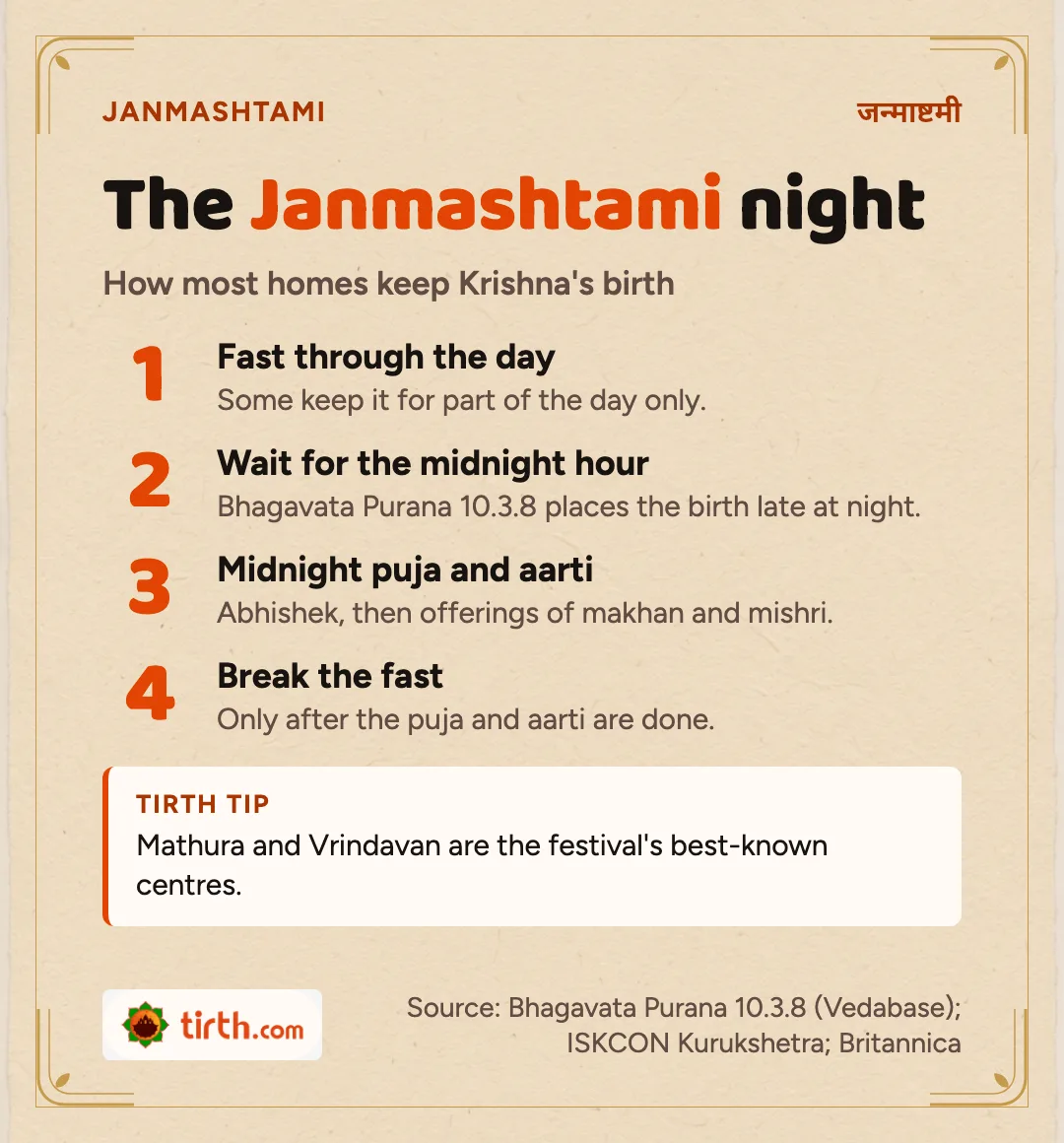
Families fast through the day, wait up for the hour of his birth, and break the fast only after the midnight puja and aarti. Krishna is worshipped as an avatar of Bhagwan Vishnu, and the festival’s best-known centres are Mathura and Vrindavan. You will also see it called Krishna Janmashtami, Gokulashtami or Krishnashtami.
Janmashtami in 2027: Wednesday, 25 August. Ashtami tithi: 8:24 PM on 24 August to 7:19 PM on 25 August. Rohini nakshatra: 12:27 PM on 25 August to 11:42 AM on 26 August. Midnight (nishita) puja in New Delhi: 12:01 AM to 12:45 AM on 26 August.
Calendars that keep the festival on the night Ashtami holds at midnight observe it on Tuesday, 24 August 2027.
Dates and timings are calculated for New Delhi using the traditional North Indian panchang. Timings change from city to city, sometimes by more than an hour for moonrise; see the Tirth Spiritual Calendar for your location.
Checked on 28 Oct 2026. Tirth Spiritual Calendar timings for your city
Why is Janmashtami celebrated? Krishna’s birth to Devaki in Kamsa’s prison
The festival keeps the night Krishna was born. The Bhagavata Purana tells it in the third chapter of its tenth book, and the outline most families know comes from there.
Devaki and Vasudeva were held in the prison of Kamsa, the king of Mathura, and it was there, at night and in the dark, that their son was born. The Purana keeps the setting bare: the dark of the night, and the child appearing in it like the full moon rising in the east.
Why is Janmashtami kept at midnight? What Bhagavata 10.3.8 says
Because the verse itself names the hour. Bhagavata Purana 10.3.8 (printed as 10.3.7 to 8 in the Vedabase edition) says Vishnu appeared from Devaki late at night, nishithe, in deep darkness, shining like the full moon rising in the east.
niśīthe tama-udbhūte jāyamāne janārdane / devakyāṃ deva-rūpiṇyāṃ viṣṇuḥ sarva-guhā-śayaḥ / āvirāsīd yathā prācyāṃ diśīndur iva puṣkalaḥ
Nishitha is the deep middle of the night.
The puja waits for that window, and the window shifts a little from city to city (the Spiritual Calendar gives it for yours).
The verse gives the hour and nothing else, so neither the tithi nor the nakshatra appears in it. The Ashtami comes from the commentaries: the Vedabase purport to these verses says Krishna appeared on the eighth day of the waning moon. Rohini, the nakshatra Vaishnava calendars pair with Ashtami, is not named in this verse either.
The Janmashtami fast ends after the midnight aarti
Most homes fast through the day, and some keep the fast for part of the day only. Either way, it ends after the midnight aarti. ISKCON Kurukshetra puts it plainly: do not break the fast until after midnight, after the prayers and aarti.
Krishna is offered butter and mishri. Some families chant a Krishna mantra (our page of Krishna mantras has several), and the words of the Krishna aarti are on a page of their own. The full home vidhi, the vrat rules and the foods of the day are on the Krishna Janmashtami festival page.
If this is your first Janmashtami fast, or you are keeping it alongside a parent who cannot go the whole day without food, the part-day fast is a fair choice. We would rather you stay awake for the aarti than keep a full fast and sleep through the one hour the festival is about.
Why do some homes keep Janmashtami a day later than others?
Two rules are in use, and in some years they land on different days.
Smarta households keep Janmashtami on the day Ashtami is present at midnight, during nishita kaal, while Vaishnava homes, look for Ashtami together with Rohini nakshatra, so their date can fall a day later.
Published sources disagree on which rule gives which day in particular years, and websites quote different dates for the same temple, so a date you read online is not proof of what your mandir will do. Follow the panchang your family or your local temple keeps. The puja happens there, and the fast should end with theirs. The date card at the top of this page shows both days when the rules split.
What to check in your panchang a week before Janmashtami
- Which rule your family keeps. A Smarta home looks for the night Ashtami holds at midnight; a Vaishnava home looks for Ashtami together with Rohini. Ask an elder or your temple priest if nobody at home is sure, since this decides which day you fast.
- The nishita window for your own city. It is short (well under an hour), and it moves with longitude: the window in Kolkata opens about an hour before the one in Mumbai. Take the timing for the city you are in.
- Your temple’s own notice, if you plan to go for darshan that night.
For parents who cannot stay up late, the window decides it. In some cities it falls close to the usual hour of sleep and in others well past it, so that one number tells you whether a midnight puja at home is realistic for them.
Janmashtami in Mathura, Vrindavan and Maharashtra
In Braj the night belongs to the temples as much as to the home.
All India Radio has reported that the abhishek of Krishna at Shri Krishna Janmasthan in Mathura is performed at midnight, with LED screens put up so that large crowds could have darshan. At the Banke Bihari temple in Vrindavan the midnight Maha Abhishek happens inside the sanctum. It is not open to the public. Mangla aarti, which the temple does not perform on a regular basis, is performed on this night. Visiting details for both towns are on the Mathura and Vrindavan pages.
Maharashtra takes the festival into the street with Dahi Handi, and its pots recall Krishna’s butter-stealing games as a child. Maharashtra Tourism describes a pot of curd and butter hung high between buildings or on a tall pole, and groups called Govindas or Mandals forming human pyramids until the one at the top breaks it. Spectators splash water to make it harder. Mumbai, Thane and Pune are known for the biggest events.
On the day, the sources split. Maharashtra Tourism places Dahi Handi on the day of Janmashtami, while some panchangs list it on the day after the midnight birth.
If you are travelling to Braj for the festival, our guide to the Vrindavan parikrama covers the walk itself.
Radhashtami, Govardhan Puja and the other Krishna days
Radhashtami is the related festival of Braj, and if you want to honour Radha alongside Krishna there is a Radha mantra page as well. Later in the year comes Govardhan Puja, another festival kept for Krishna.
Frequently asked questions
Why is Janmashtami celebrated at midnight?
The Bhagavata Purana (10.3.8) says Vishnu appeared from Devaki late at night, nishithe, in deep darkness. The midnight puja keeps that hour. The verse names the hour only, and the Ashtami tithi comes from the commentaries.
What are the Janmashtami fasting rules, and when is the fast broken?
The usual fast runs through the day, though some people keep it for part of the day only. It is broken after the midnight aarti. Families add their own food rules. Follow what your household keeps, and ask an elder if you are unsure.
What do you offer to Krishna on Janmashtami?
Butter and mishri (rock sugar) are offered to Krishna at the midnight puja, and many families add their own sweets. The festival page has the full list.
What is Dahi Handi?
Dahi Handi is Maharashtra’s street celebration of Janmashtami. Govinda teams form a human pyramid to reach and break a pot of curd and butter hung high above the street, recalling Krishna’s butter-stealing games as a child. Maharashtra Tourism places it on the day of Janmashtami, while some panchangs list it on the day after.
Why do some people celebrate Janmashtami on two different days?
Smarta households keep the day on which Ashtami is present at midnight, while Vaishnava communities, look for Ashtami together with Rohini, so their date can fall a day later. Follow the panchang your family or temple uses.
Which mantra is chanted on Janmashtami?
Families chant the Krishna mantra their own tradition uses during the midnight puja. Tirth’s Krishna mantra page lists several.