
Hartalika Teej Katha in Hindi and English: The Story Shiva Told Parvati
Tirth editorial · 12 Feb 2026 · 7 min read
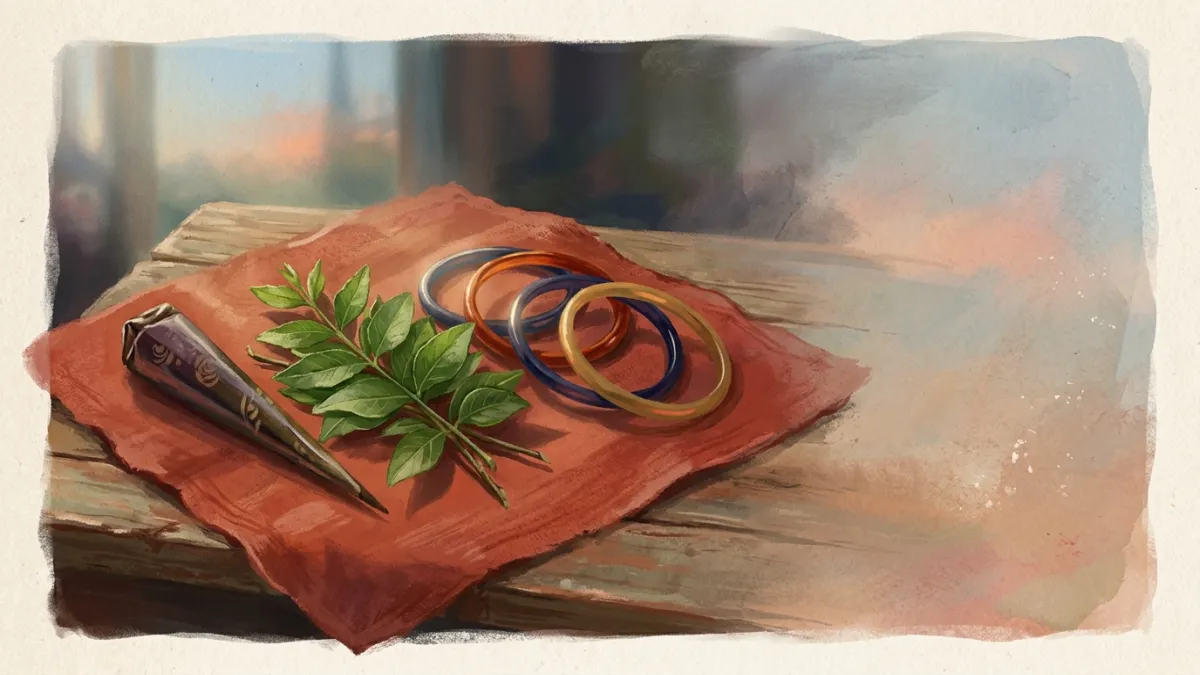
Parvati made up her mind as a child that she would marry Lord Shiva and no one else. The Hartalika Teej katha is the story of what that vow asked of her, told as Lord Shiva reminding Parvati of her earlier birth, when her father agreed to give her to Bhagwan Vishnu and a friend led her away into the forest so that she could keep her word.
Women and girls read or hear it on Bhadrapada Shukla Tritiya, the day of the Hartalika vrat.
Hartalika Teej in 2027: Friday, 3 September. Tritiya tithi: 4:49 PM on 2 September to 2:18 PM on 3 September (New Delhi).
Checked on 28 Oct 2026. Timings for your city in the Tirth Spiritual Calendar
Dates and timings are calculated for New Delhi on Tirth’s panchang, using the traditional North Indian reckoning. Timings change from city to city; see the Tirth Spiritual Calendar for your location.
हरतालिका तीज व्रत कथा, जैसी शिव जी ने पार्वती को सुनाई
यह कथा स्वयं भगवान शिव सुनाते हैं। सुनने वाली हैं पार्वती, और कहानी है उन्हीं के पिछले जन्म की।
हिमालय की बेटी पार्वती ने बचपन में ही ठान लिया था कि पति होंगे तो केवल शिव। उसी के लिए वे छोटी उम्र से तप करने लगीं।
फिर एक दिन नारद जी हिमालय के पास आए। बोले, मैं भगवान विष्णु की ओर से विवाह का प्रस्ताव लाया हूँ। हिमालय ने हाँ कर दी। पार्वती को पता चला तो वे बहुत दुखी हुईं, क्योंकि मन से वे शिव को चुन चुकी थीं।
तब उनकी एक सखी उन्हें घने जंगल में ले गई।
वहाँ नदी किनारे एक गुफा में पार्वती ने अपना तप जारी रखा। कुछ कथाओं में वे बालू का शिवलिंग बनाकर उसकी पूजा करती हैं, कुछ में मिट्टी का। तप कितने बरस चला, यह भी हर कथा में अलग मिलता है। आख़िर शिव जी प्रसन्न हुए और उन्होंने पार्वती से विवाह का वचन दिया।
उधर हिमालय अपनी बेटी को हर जगह ढूँढ रहे थे। जब वे जंगल में पार्वती तक पहुँचे तो पार्वती ने साफ़ कहा कि वे घर तभी लौटेंगी जब पिता उनका विवाह शिव से करने का वचन दें। हिमालय मान गए। आगे शिव जी पार्वती के सामने प्रकट होते हैं और दोनों का विवाह होता है।
सखी का पार्वती को ले जाना पिता की नज़र में हरण था। इसी से इस व्रत का नाम पड़ा हरतालिका।
कथा के अंत में कहा जाता है कि भाद्रपद शुक्ल तृतीया को जो स्त्रियाँ और कन्याएँ यह व्रत रखती हैं, उन पर शिव और पार्वती की कृपा होती है।
The story in English, from Narada’s visit to the river cave
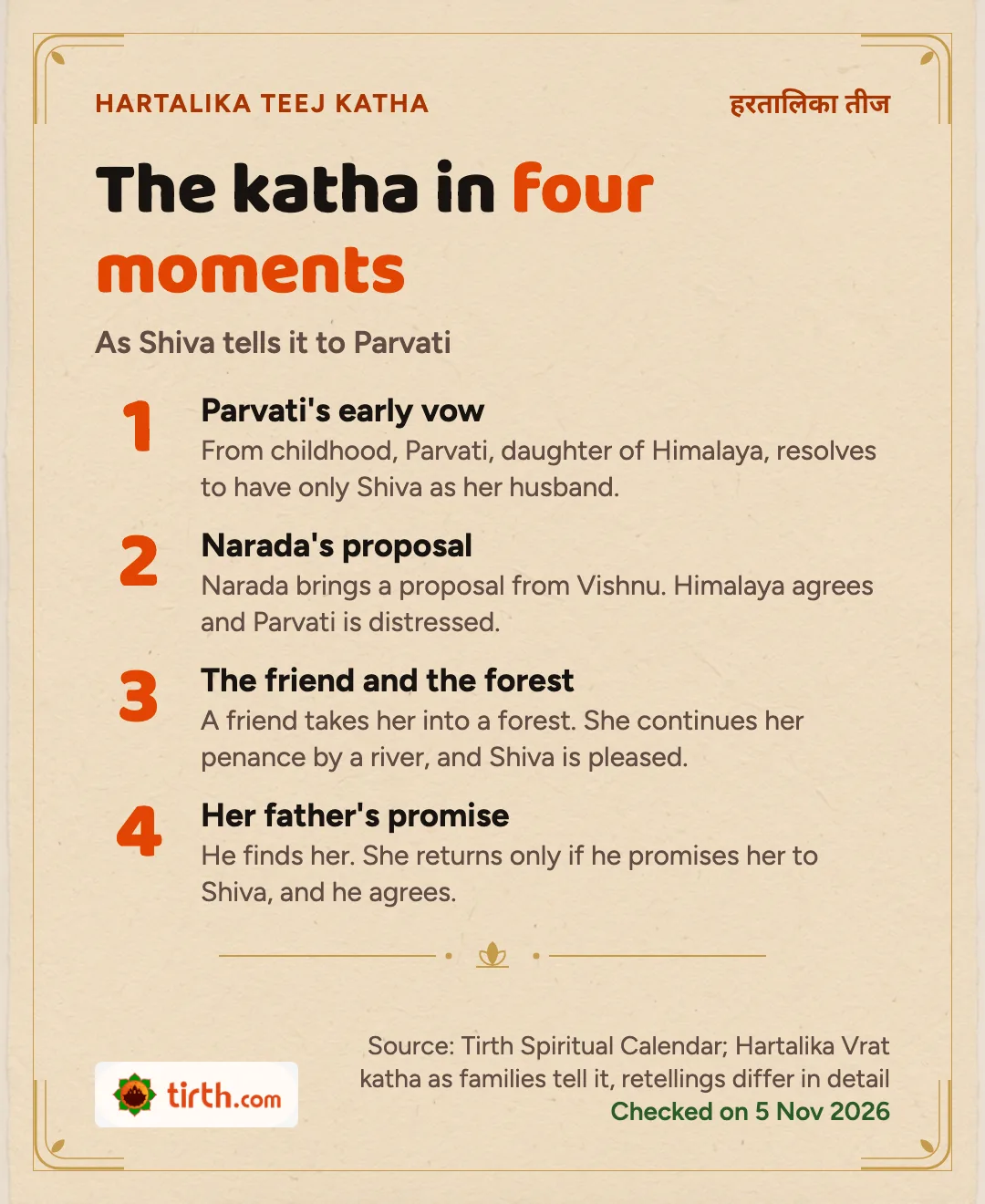
In the story Maa Parvati is the daughter of Himalaya, and she is still a child when she settles on Lord Shiva as the only husband she will accept. She starts her penance young.
Then Narada comes to Himalaya with a proposal from Bhagwan Vishnu, and Himalaya agrees to it. Which leaves Parvati in real distress, because in her own mind the choice was made long ago.
It is a friend who takes her away into a dense forest. There, in a cave beside a river, Parvati carries on with her penance until Lord Shiva is pleased with her and promises to marry her, while back home her father searches for her. When at last he finds her, she sets one condition. She will come home only if he promises her to Shiva, and Himalaya, who had said yes to Narada prior to all this, now gives his word for Shiva instead. In the Hindi retellings Shiva then appears to her and the wedding follows.
If you are reading the katha aloud at the puja, our advice is to read the Hindi and keep the English for anyone in the room who follows English better.
Other stories of the same goddess sit close to this one: the Jaya Parvati Vrat Katha, the Mangala Gauri Vrat Katha, and the Parvati Mata aarti, which can follow the katha once it is done.
Why is it called Hartalika? Harat and alika
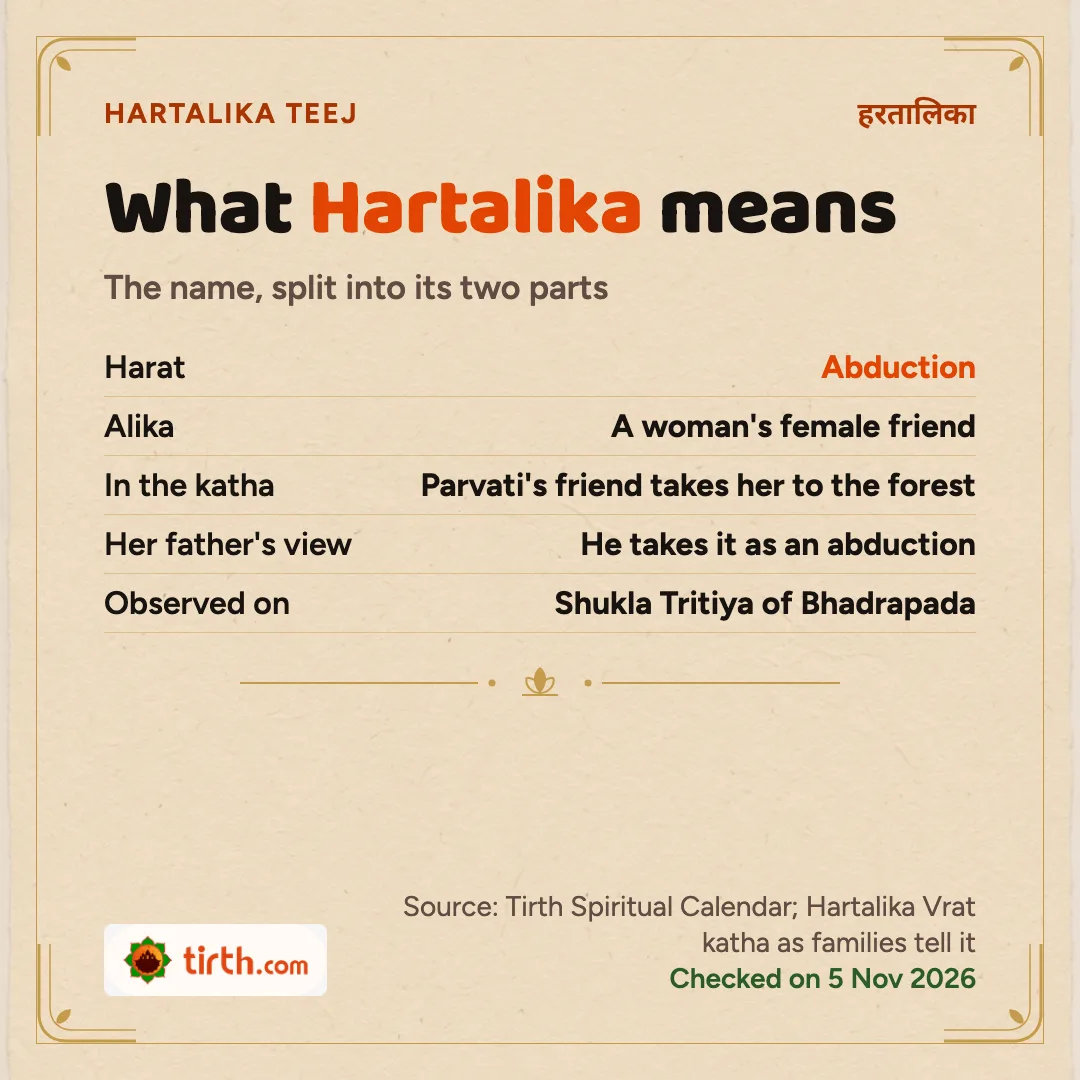
Hartalika joins two words. Harat means abduction, and alika means a woman’s female friend. Put together, the name remembers the friend who led Parvati into the forest, a leaving that her father Himalaya could only read as an abduction when he found her gone.
One popular telling of the legend gives this reading of the name. The friend did not see it that way, of course. Her father did.
Twelve years or sixty-four more? Where the tellings part ways
Ask which Purana the Hartalika katha comes from and the answer depends on the website you open. The Linga Purana and the Shiva Purana both get named, and the Narada Purana too, once even with a chapter and verse attached, yet none of these claims comes with a printed text a reader can open and check. The popular telling, which gives the legend in full, names no scripture at all. The one printed edition that turns up in book listings is a 16-page Haritalika Teej Vrata Katha in Sanskrit with Hindi translation, published in 2009, and its listing does not say which Purana it follows. That is all the listing gives.
We would rather you read the story slowly and in its own order than worry over its address, since no printed source has settled the question.
The details move too. One popular telling says Parvati did penance for 12 years and then for 64 more, while other Hindi retellings say only that she did it for years, with no twelve-year figure anywhere. Even the lingam is not fixed, since some tellings have her shape it from sand and others from clay (so if your family makes it from clay at home, you are following one of the forms the story itself takes).
Keeping the Hartalika vrat on Bhadrapada Shukla Tritiya
Hartalika Teej falls on the Shukla Paksha Tritiya of Bhadrapada, the third day of the bright half of that month. The vrat is kept on the day when that Tritiya is running at sunrise.
A tithi can begin one afternoon and end the next, so the calendar day moves from year to year. Which is why the date sits in the card near the top of this page and on Hartalika Teej date and timings on Tirth’s panchang, for your own city. For how the fast itself is kept, see the Teej festival guide.
If it is Lord Shiva’s side of the story you want, start with the Maha Shivratri Vrat Katha. Two more vrat stories about marriage sit alongside this one, the Vivah Panchami Vrat Katha and the Karwa Chauth katha. The shrines of Shiva are listed in the 12 Jyotirlingas of India guide.
If you would like a puja done in Lord Shiva’s name for your family, you can book a Rudrabhishek or a Maha Mrityunjay jaap on Tirth.
Frequently asked questions
Hartalika Teej ki katha kya hai?
It is the story of Parvati, daughter of Himalaya, who wanted only Lord Shiva as her husband. When her father agreed to a proposal from Bhagwan Vishnu brought by Narada, a friend took her to the forest, where her penance pleased Shiva and her father finally promised her to him.
Why is it called Hartalika Teej?
The name joins harat, abduction, and alika, a woman’s female friend. Parvati’s friend took her into the forest, and her father took that as an abduction.
Who tells the Hartalika katha, Shiva or a sage?
The katha is told as Lord Shiva narrating it to Parvati, reminding her of her earlier birth. Several Hindi retellings frame it this way.
Which Purana is the Hartalika Teej katha from?
No printed text open to readers settles it. Websites variously name the Linga, Narada or Shiva Purana, and the popular telling names no scripture, so read the story as it has been handed down rather than as a quotation from one book.
Why does Parvati make a Shivling of sand or clay?
In the forest she worships Lord Shiva through a lingam she shapes herself. Retellings differ on the material, some saying sand and some clay, and both forms are found.
Can unmarried girls keep the Hartalika Teej fast?
Yes, they can. The Hindi katha ends by saying that women and girls who keep the fast on Bhadrapada Shukla Tritiya receive the grace of Shiva and Parvati, and Parvati herself was unmarried when she kept her penance.
Continue on Tirth
- Festival dates and timings, Tirth Spiritual Calendar