
Hanuman aarti: Aarti kijai Hanuman Lala ki, with meaning
Tirth editorial · 8 Jan 2026 · 9 min read
Sung to Lord Hanuman, Aarti kijai Hanuman Lala ki has one refrain and eleven couplets, and in the Gita Press Shri Aarti-Sangrah you will find it as aarti no. 85, on page 54. Most of it retells what he did for Shri Ram, from the burning of Lanka to the herb that brought Lakshman back.
Hanuman aarti lyrics in Hindi and in English letters
The Hindi below is set exactly as the book prints it, spelling and word joins included. The refrain is printed once, marked टेक (tek). Singers come back to it after every couplet, though the book does not print it again.
आरती कीजै हनुमानललाकी। दुष्टदलन रघुनाथ कलाकी॥ टेक ॥
जाके बलसे गिरिवर काँपै। रोग दोष जाके निकट न झाँपै॥
अंजनिपुत्र महा बलदाई। संतनके प्रभु सदा सहाई॥
दे बीरा रघुनाथ पठाये। लंका जारि सीय सुधि लाये॥
लंका-सो कोट समुद्र-सी खाई। जात पवनसुत बार न लाई॥
लंका जारि असुर संहारे। सीतारामजीके काज सँवारे॥
लक्ष्मण मूर्छित पड़े सकारे। आनि सजीवन प्रान उबारे॥
पैठि पताल तोरि जम-कारे। अहिरावनकी भुजा उखारे॥
बायें भुजा असुरदल मारे। दहिने भुजा संतजन तारे॥
सुर नर मुनि आरती उतारे। जय जय जय हनुमान उचारे॥
कंचन थार कपूर लौ छाई। आरति करत अंजना माई॥
जो हनुमानजीकी आरति गावै। बसि बैकुंठ परम पद पावै॥
Here it is again in English letters, one line under the other.
Aarti kijai Hanuman Lala ki, dusht dalan Raghunath kala ki. (tek)
Jake bal se girivar kanpai, rog dosh jake nikat na jhanpai.
Anjaniputra maha baldai, santan ke prabhu sada sahai.
De bira Raghunath pathaye, Lanka jari Siy sudhi laye.
Lanka-so kot samudra-si khai, jat Pavansut bar na lai.
Lanka jari asur sanhare, Sitaramji ke kaj sanvare.
Lakshman murchhit pare sakare, ani sajivan pran ubare.
Paithi patal tori jam-kare, Ahiravan ki bhuja ukhare.
Bayen bhuja asurdal mare, dahine bhuja santjan tare.
Sur nar muni aarti utare, jay jay jay Hanuman uchare.
Kanchan thar kapur lau chhai, arati karat Anjana mai.
Jo Hanumanji ki arati gavai, basi Baikunth param pad pavai.
Aarti kijai Hanuman Lala ki meaning, couplet by couplet
We worked these plain meanings out ourselves, a word at a time, from Platts’ dictionary. Where a word has no settled sense the table gives the literal words and stops there (better a gap than a guess). Names and titles stay exactly as the aarti has them, so Raghunath, Pavansut, Baikunth, param pad etc. are left alone.
| Line | Plain meaning (Tirth’s rendering) |
|---|---|
| Aarti kijai Hanuman Lala ki, dusht dalan Raghunath kala ki | Sing the aarti of Hanuman Lala (lala: dear boy), the crusher (dalan) of the wicked. Kala means a part or portion, and also any art, so “Raghunath kala” can be read as Raghunath’s portion or Raghunath’s art; the aarti does not say which. |
| Jake bal se girivar kanpai, rog dosh jake nikat na jhanpai | By his strength the mountain trembles. Illness and fault do not come near him to cover him (jhanpai: cover, overshadow). |
| Anjaniputra maha baldai, santan ke prabhu sada sahai | Son of Anjani, maha baldai, lord of the saints and always their helper (sahai: helper, rescuer). |
| De bira Raghunath pathaye, Lanka jari Siy sudhi laye | Raghunath gave him the bira and sent him (pathaye: sent). A bira is the betel-leaf roll given to seal a pledge, and taking it up means taking on a task. He burned Lanka and brought back news of Sita (sudhi). |
| Lanka-so kot samudra-si khai, jat Pavansut bar na lai | A fort (kot: fort, rampart) like Lanka, a moat (khai) like the sea: Pavansut went and made no delay (bar na lai). |
| Lanka jari asur sanhare, Sitaramji ke kaj sanvare | He burned Lanka, killed the asuras (demons) and set right (sanvare) the work of Sita and Ram. |
| Lakshman murchhit pare sakare, ani sajivan pran ubare | Lakshman lay senseless (murchhit) at dawn (sakare). He brought the sajivan, the life-restoring herb, and rescued (ubare) his life. |
| Paithi patal tori jam-kare, Ahiravan ki bhuja ukhare | He forced his way (paithi) into Patal, the world under the earth, broke the jam-kare and tore off (ukhare) Ahiravan’s arms. Jam is Yama; kare can mean black or a prison, so the phrase reads as Yama’s black ones or Yama’s prison. |
| Bayen bhuja asurdal mare, dahine bhuja santjan tare | With his left arm he struck down the army of asuras; with his right he carried the saints across (tare: carry across, save). |
| Sur nar muni aarti utare, jay jay jay Hanuman uchare | Gods, men and sages perform his aarti and call out (uchare) “Jay jay jay Hanuman”. |
| Kanchan thar kapur lau chhai, arati karat Anjana mai | A gold (kanchan) plate (thar) spread with the flame (lau) of camphor (kapur): Mother Anjana performs the aarti. |
| Jo Hanumanji ki arati gavai, basi Baikunth param pad pavai | Whoever sings Hanuman ji’s aarti dwells in Baikunth and attains param pad. These are the aarti’s own closing words. |
Which Ramayana episodes does the Hanuman aarti sing about?
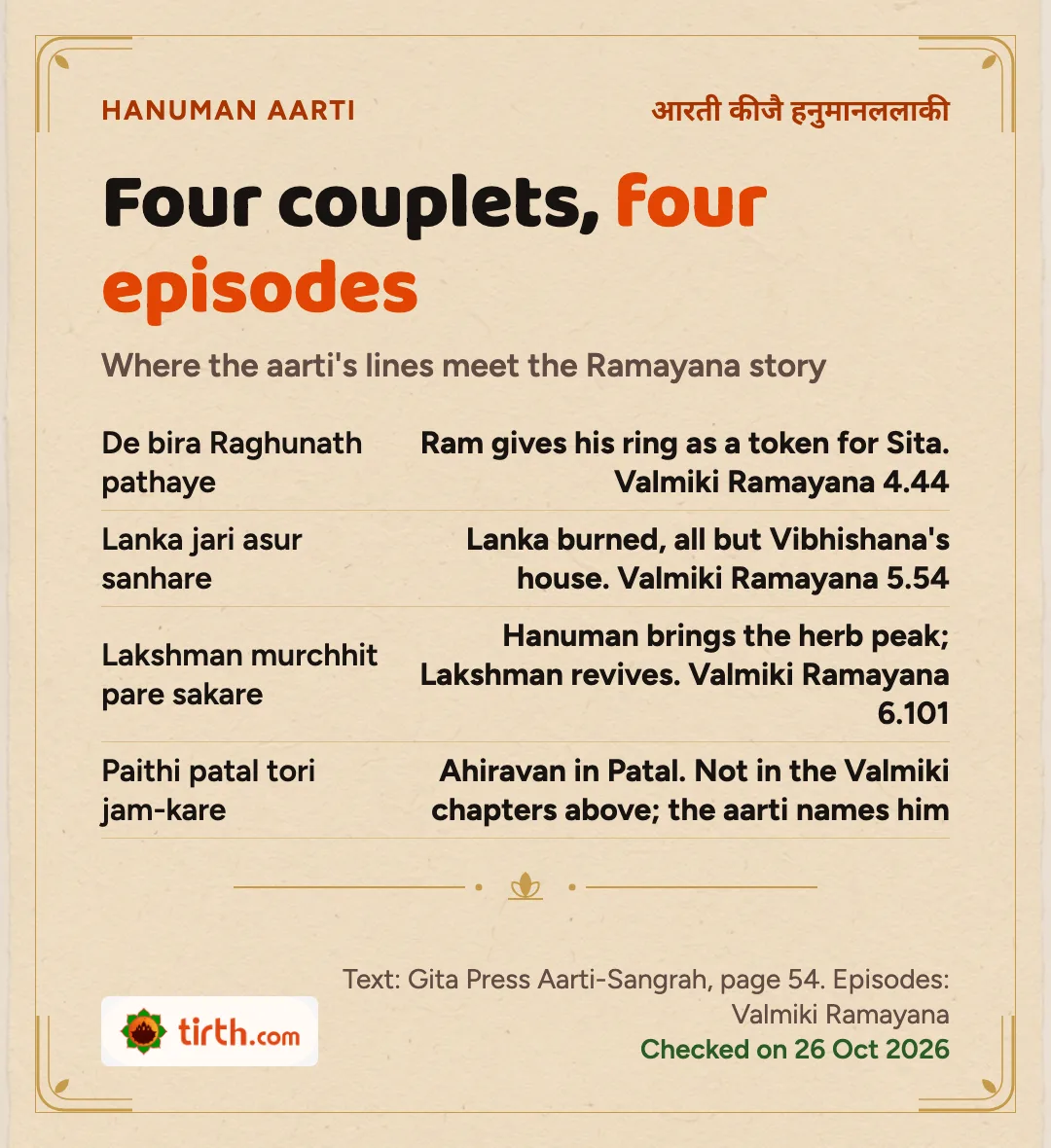
Most couplets tell a story. Three of the four episodes they name can be followed in the Valmiki Ramayana right down to the chapter, or sarga, and Lanka itself burns twice in the aarti, in couplets three and five. Ahiravan is the odd one out and does not appear in those chapters, so for him the aarti’s own couplet is the only text we quote. Anyone who enjoys an aarti that walks through the epic like this should read the Ramayan aarti next.
| Couplet | Episode | Where to read it |
|---|---|---|
| De bira Raghunath pathaye | Shri Ram gives Hanuman his ring as a token, so that Sita ji will recognise him. | Valmiki Ramayana, Kishkindha Kanda, sarga 44 |
| Lanka jari asur sanhare | His tail set ablaze, Hanuman sets fire to Lanka and burns the city, all but Vibhishana’s house. | Valmiki Ramayana, Sundara Kanda, sarga 54 |
| Lakshman murchhit pare sakare | Lakshman lies unconscious. The monkey physician Sushena sends Hanuman to the Himalayas for herbs, and when Hanuman cannot pick them out he brings back the mountain peak. Lakshman revives. | Valmiki Ramayana, Yuddha Kanda, sarga 101 (an earlier herb journey is in sarga 74) |
| Paithi patal tori jam-kare | Hanuman enters Patal and defeats Ahiravan. | Not in the Valmiki chapters above; the aarti names it in this couplet |
It is easy to mix up the two herb journeys. In sarga 74 both Ram and Lakshman have fallen to Indrajit’s Brahma weapon, and it is Jambavan who sends Hanuman off for the herbs, whereas in sarga 101 the one sending him is Sushena, and only Lakshman needs saving. The aarti has Lakshman lying senseless, which fits the second.
Jhanke or jhanpai, Siya or Siy: why your words may differ
If you learnt the aarti from a recording or a website, some words above will differ from what you sing. Gita Press reads differently from the popular version in several places, and four of them change the sound or the sense more than the rest.
- Where many sing निकट न झाँके (nikat na jhanke, “does not peep near”), Gita Press prints निकट न झाँपै (nikat na jhanpai, “does not cover or come over”). Both words exist, and they paint different pictures, illness peeping in against illness casting its shadow.
- सीय सुधि (Siy sudhi) in the Gita Press text, and सिया सुधि (Siya sudhi) in other printings.
- सीतारामजीके (Sitaramji ke), which other books print as सिया राम जी के (Siya Ram ji ke).
- सजीवन (sajivan) against संजीवन (sanjivan) elsewhere, though Platts counts the two as one word meaning life-restoring.
There is a second printed compilation worth knowing about, the Aarti Sangrah of the Manav Vikas Foundation in Mumbai, which keeps the same refrain and the same eleven couplets in the same order but spells them the popular way. At the very end it carries one couplet more, लंका विध्वंस किये रघुराई। तुलसीदास स्वामी कीर्ति गाई (Lanka vidhvans kiye Raghurai, Tulsidas swami kirti gai), and that one names Tulsidas. Gita Press leaves it out. Its page names no author at all.
The earlier version of this page used the popular readings in place of the Gita Press text. The lyrics above now follow the Gita Press page, with the popular readings kept to the differences listed in this section, because we would rather put one printed text in front of you whole, its source named, than stitch together a blend of websites. The story is the same in both.
Singing it at home with a camphor flame
The tenth couplet sets its own scene. Mother Anjana performs the aarti for her son, and on the gold plate (thar, a large flat metal plate) a camphor flame is burning.
Camphor in a plate is the only lamp this aarti describes.
Open with the refrain and return to it after each couplet. If you are leading it for your family for the first time, have the refrain by heart before anything else, since it is the line that keeps returning. The Hanuman Chalisa has its text and meaning on a page of its own.
Sing the line about illness and fault keeping away as what it is, the aarti praising Hanuman ji, and not as a promise.
For the festival itself, see our Hanuman Jayanti post. If doing the path yourself is not possible, a priest can recite it on your family’s behalf, and you can book that through the Hanuman Chalisa path in Prayagraj.
If you keep a small set of Hanuman ji’s texts close by, Tirth also has the Hanuman moola mantra, the Ram aarti and the Shani aarti for Saturdays.
Frequently asked questions
What does “Hanuman Lala” mean?
It means a boy, and more warmly a dear boy or a darling. That is how a family speaks of its own child, and it is how the aarti speaks to Hanuman ji. In the tenth couplet his mother, Anjana, is the one performing the aarti.
What does “dusht dalan Raghunath kala” mean?
The first half is simple, since dusht dalan means the crusher of the wicked. Kala is harder, because it can mean a part or portion and it can also mean any art, so “Raghunath kala” reads either as Raghunath’s portion or as Raghunath’s art, and the words will carry both.
Who wrote Aarti kijai Hanuman Lala ki?
No author is named in the Gita Press Aarti-Sangrah. Another printed compilation ends with an extra couplet naming Tulsidas, which Gita Press does not include.
Is it “nikat na jhanke” or “nikat na jhanpai”?
Each one has a printed source. Gita Press has jhanpai, to cover or overshadow, while many recordings and websites sing jhanke, to peep, and we show jhanpai here because that is the word on the Gita Press page.
What is “de bira” in the Hanuman aarti?
The bira is a roll of betel leaf, given to seal a pledge. To take it up is to take on a task. Read that way, “De bira Raghunath pathaye” tells you Raghunath handed him the bira and sent him off.
Who was Ahiravan?
Patal is where Hanuman forced his way in, and Ahiravan is the one whose arms he tore off there. That single couplet is all the aarti says about him.