
Shri Govardhan Maharaj aarti: lyrics in Hindi with meaning
Tirth editorial · 6 Jan 2026 · 7 min read
“Shri Govardhan Maharaj, o Maharaj” is how the Govardhan Maharaj aarti opens, and the king it calls out to is Govardhan Hill itself. Bhakti Bharat counts this traditional Braj aarti as the main one of Govardhan Puja. Families sing it once the puja is over and the bhog has been offered, to the hill they also call Giriraj (king of mountains).
How the puja itself is done has its own page, our Govardhan Puja guide.
Govardhan Puja in 2026: Tuesday, 10 November. Kartika Shukla Pratipada, New Delhi.
Checked on 25 Oct 2026. Govardhan Puja timings for your city
Dates and timings are calculated for New Delhi using the traditional North Indian panchang. Timings change from city to city, sometimes by more than an hour for moonrise; see the Tirth Spiritual Calendar for your location.
Govardhan Maharaj aarti lyrics, in Hindi and Roman letters
The whole aarti is a refrain and five verses.
After every verse the refrain comes round again, and the copies we checked disagree only on how much of it to repeat (Prabhat Khabar goes back to “tere mathe mukut viraj raheo” alone, while Bhakti Bharat repeats the full first line each time). Our one piece of advice for anyone leading it at home for the first time is to learn the refrain by heart and leave the verses for later, since in every copy we checked the refrain returns after each verse.
श्री गोवर्धन महाराज, ओ महाराज, तेरे माथे मुकुट विराज रहेओ।
Shri Govardhan Maharaj, o Maharaj, tere mathe mukut viraj raheo.
तोपे पान चढ़े, तोपे फूल चढ़े, तोपे चढ़े दूध की धार।
Tope paan chadhe, tope phool chadhe, tope chadhe doodh ki dhaar.
तेरी सात कोस की परिकम्मा, चकलेश्वर है विश्राम।
Teri saat kos ki parikamma, Chakleshwar hai vishram.
तेरे गले में कंठा साज रहेओ, ठोड़ी पे हीरा लाल।
Tere gale mein kantha saaj raheo, thodi pe heera laal.
तेरे कानन कुण्डल चमक रहेओ, तेरी झांकी बनी विशाल।
Tere kaanan kundal chamak raheo, teri jhanki bani vishaal.
गिरिराज धरन प्रभु तेरी शरण, करो भक्त का बेड़ा पार।
Giriraj dharan Prabhu teri sharan, karo bhakt ka beda paar.
The sources disagree in two small places. Bhakti Bharat puts the parikrama verse fourth, just before the closing line, where the text above has it second. Prabhat Khabar reads “parikrama” and “aur Chakleshwar vishram” in that same verse. So your family’s order may well differ from the one printed here, though the words hardly move.
For anyone who likes to chant first and sing after, we keep the Govardhan mantras on a page of their own.
Govardhan aarti meaning in English, line by line
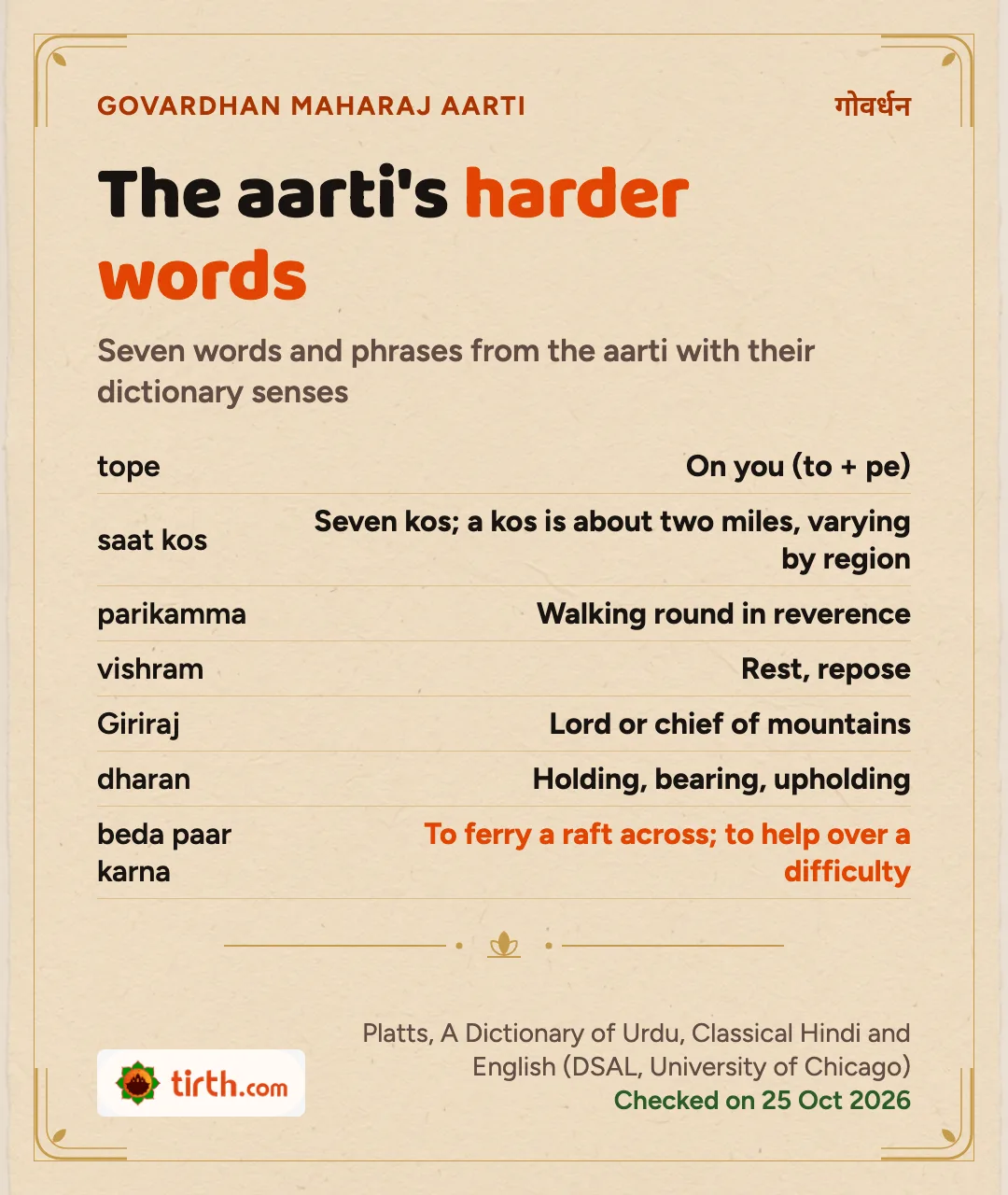
Every line speaks to the hill the way a subject speaks to a king. In Platts’ dictionary Maharaj is “great king”, and it is also a polite form of address, close to “Sir”. The meanings in the table are our own plain rendering, with each word traced back to a dictionary sense.
| Line | Plain meaning (Tirth’s rendering) |
|---|---|
| Shri Govardhan Maharaj, o Maharaj, tere mathe mukut viraj raheo. | O Shri Govardhan, great king, a crown sits in splendour on your brow. |
| Tope paan chadhe, tope phool chadhe, tope chadhe doodh ki dhaar. | Betel leaves are offered on you, flowers are offered on you, a stream of milk is offered on you. |
| Teri saat kos ki parikamma, Chakleshwar hai vishram. | The walk around you in reverence is seven kos long, and Chakleshwar is its place of rest. |
| Tere gale mein kantha saaj raheo, thodi pe heera laal. | A necklace adorns your neck, and on your chin are a diamond and a ruby. |
| Tere kaanan kundal chamak raheo, teri jhanki bani vishaal. | Large earrings sparkle in your ears, and the sight you make is grand. |
| Giriraj dharan Prabhu teri sharan, karo bhakt ka beda paar. | Giriraj dharan, Lord, in your refuge: ferry your devotee’s raft across to the far shore, that is, help your devotee over the difficulty. |
Tope trips people up, but in Braj it only means “on you”. Platts breaks it into “to”, the Braj form of tu (you) used when a postposition follows, and “pe”, meaning “on, upon”. Bhakti Bharat just writes “tum par”. Platts also keeps a second sense for two words in the refrain, “top, summit” beside “forehead” for matha and “crest, peak” beside “crown” for mukut. With kaanan, the ear (kaan) is the root we follow. There is a different kaanan in Platts that means forest, and it plainly cannot be the one meant in a line about earrings.
For Giriraj, Platts has “lord or chief of mountains” and records it as an epithet of Govardhan, and also as a name of Krishna. Dharan he gives as holding, bearing or upholding. The aarti does not settle which is meant, so our rendering leaves “Giriraj dharan” just as it is sung. The closing idiom, beda paar karna, would literally be ferrying a raft across, and people use it for helping someone over a difficulty.
What do saat kos and Chakleshwar mean in the aarti?
Saat is seven. A kos is the older measure. Platts puts it at about two English miles while noting that it was never the same length across India. Today the walk round Govardhan Hill is given as 21 km, the figure on the Ministry of Tourism’s Utsav portal and the one the district magistrate gave PTI in July 2025.
If your parents want to do the parikrama with you, plan for 21 km and not for some conversion of seven kos. The route itself is on our Govardhan Parikrama page.
Chakleshwar turns up in the same line, named as the vishram (resting place) of the parikrama. Beyond that the aarti tells us nothing about it.
Why do families worship Govardhan Hill?
For the why, go to the tenth canto of the Bhagavata Purana. In 10.24.25 to 26 Lord Krishna tells the people of Vraja that the offering they got ready for Indra should go to the cows, the brahmanas and Govardhan Hill. The Bhagavata describes the food offering in some detail, and it lists many kinds of cooked food and milk products.
Then comes the lifting. In 10.25.19 he lifts the hill with one hand, playfully, the way a child holds up a mushroom. Verse 10.25.23 then has him hold it for seven days without moving from the spot.
On Tirth you will also find two more aartis to Krishna, the Krishna aarti and Aarti Kunj Bihari Ki, and the Bhai Dooj aarti is there as well. A pandit can also perform a puja on your family’s behalf, and you can see which pujas Tirth arranges.
Frequently asked questions
Which aarti is sung on Govardhan Puja?
It is “Shri Govardhan Maharaj”, printed in full near the top of this page. Prabhat Khabar adds that it is sung after the puja and bhog, and Bhakti Bharat treats it as the main aarti of the festival.
What does “tope paan chadhe” mean?
It means betel leaves are offered on you. Paan is the betel leaf, chadhe is “is offered”, and tope is Braj for “on you”, which Bhakti Bharat glosses as “tum par”.
What is saat kos ki parikrama?
The walk around Govardhan Hill. The aarti counts it as seven kos, but a kos (about two English miles in Platts) changed from region to region, so the figure to plan by is today’s official 21 km.
Who is Giriraj?
The name means “king or chief of mountains”. Platts lists it both as an epithet of Govardhan and as a name of Krishna, and it is the word the aarti’s last line opens with.
What is Chakleshwar in the aarti?
The aarti only calls it the vishram of the seven-kos parikrama, its place to rest. The text gives nothing more.
Why is Govardhan worshipped after Diwali?
Kartika Shukla Pratipada is the festival’s day, and Bhakti Bharat puts it right after Deepavali. Why the hill gets worshipped at all goes back to the Bhagavata Purana (10.24.25 to 26), in which Krishna has Vraja turn its offering away from Indra and give it to the cows, the brahmanas and the hill.
Continue on Tirth
- Govardhan Puja 2026, timings by city, Tirth Spiritual Calendar