
Garuda Mantra: Garuda Gayatri Text, Meaning and Source
Tirth editorial · 10 Jan 2026 · 7 min read
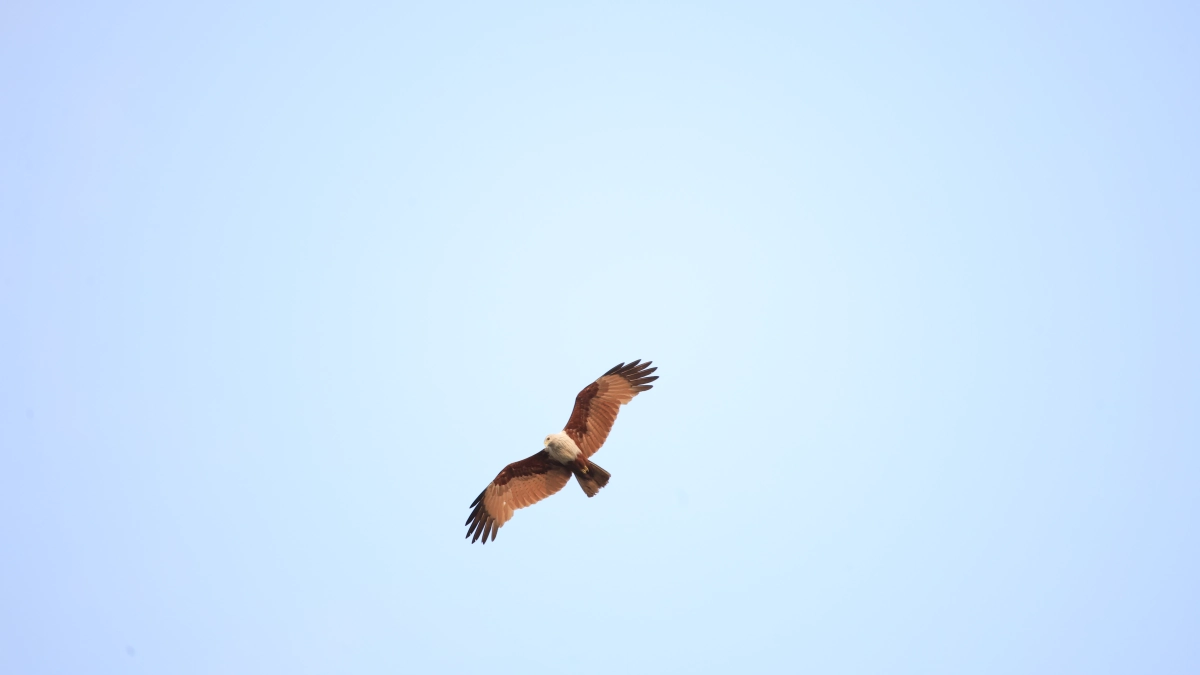
May we know that Divine Person, may we meditate on the golden-winged one, and may Garuda urge us on towards it. That is the Garuda mantra most people mean, in plain English, and in Sanskrit it is the Garuda Gayatri of the Mahanarayana Upanishad, tatpuruṣāya vidmahe suvarṇapakṣāya dhīmahi, tanno garuḍaḥ pracodayāt.
Read it slowly and the roles come clear. The prayer wants to know the Divine Person, and it asks Garuda to push the mind there. Which suits a bird that Apte’s Sanskrit dictionary calls the king of birds and the vehicle of Vishnu. Tirth has pages for both, Garuda and Bhagwan Vishnu.
One thing to settle early, because the names mislead people. The Garuda Gayatri comes from an Upanishad, and you will not find it in the Garuda Purana.
Garuda Gayatri mantra in Sanskrit and English
तत्पुरुषाय विद्महे सुवर्णपक्षाय धीमहि ।
तन्नो गरुडः प्रचोदयात् ॥
tatpuruṣāya vidmahe suvarṇapakṣāya dhīmahi
tanno garuḍaḥ pracodayāt
In plain letters: Tatpurushaya vidmahe, Suvarnapakshaya dhimahi, Tanno Garudah prachodayat.
Swami Vimalananda’s edition of the Mahanarayana Upanishad (Sri Ramakrishna Math, Madras, 1986) prints this English translation under the verse.
May we know that Divine Person. For that, may we meditate on Suvarnapaksa. May Garuda impel us towards it.
Quote it by the book in your hands, because the number moves. Vimalananda gives it as verse 27 of the Gayatri passage in Section One, while the Kamakoti edition, Essence of Maha Narayanopanishad, numbers the very same line 24 and names it the Garuda Gayatri, so a reference that says only “verse 27” can send a reader with the other book to the wrong line.
It does not stand alone, either. The passage runs through Gayatri lines for Rudra, Ganesha, Nandi, Shanmukha, Garuda, Brahma, Narayana, Narasimha, Aditya, Agni and Durga, one after another (verses 23 to 33 in Vimalananda’s Sanskrit).
Garuda’s line comes fifth in that list, just before Brahma’s (see the Brahma mantra).
The Narayan mantra page covers the Narayana line in that set, and the Vishnu mantras page gathers the lines said to Bhagwan Vishnu himself. The Gayatri Mantra, the one ending dhiyo yo naḥ pracodayāt, is a separate verse that happens to share its last word.
Vimalananda adds a short bracketed note under the verse. It presents Garuda as golden-winged, and it traces his name to the root gṝ, to swallow. The swallower of snakes, in other words.
Suvarnapaksha and the rest of the line, word by word
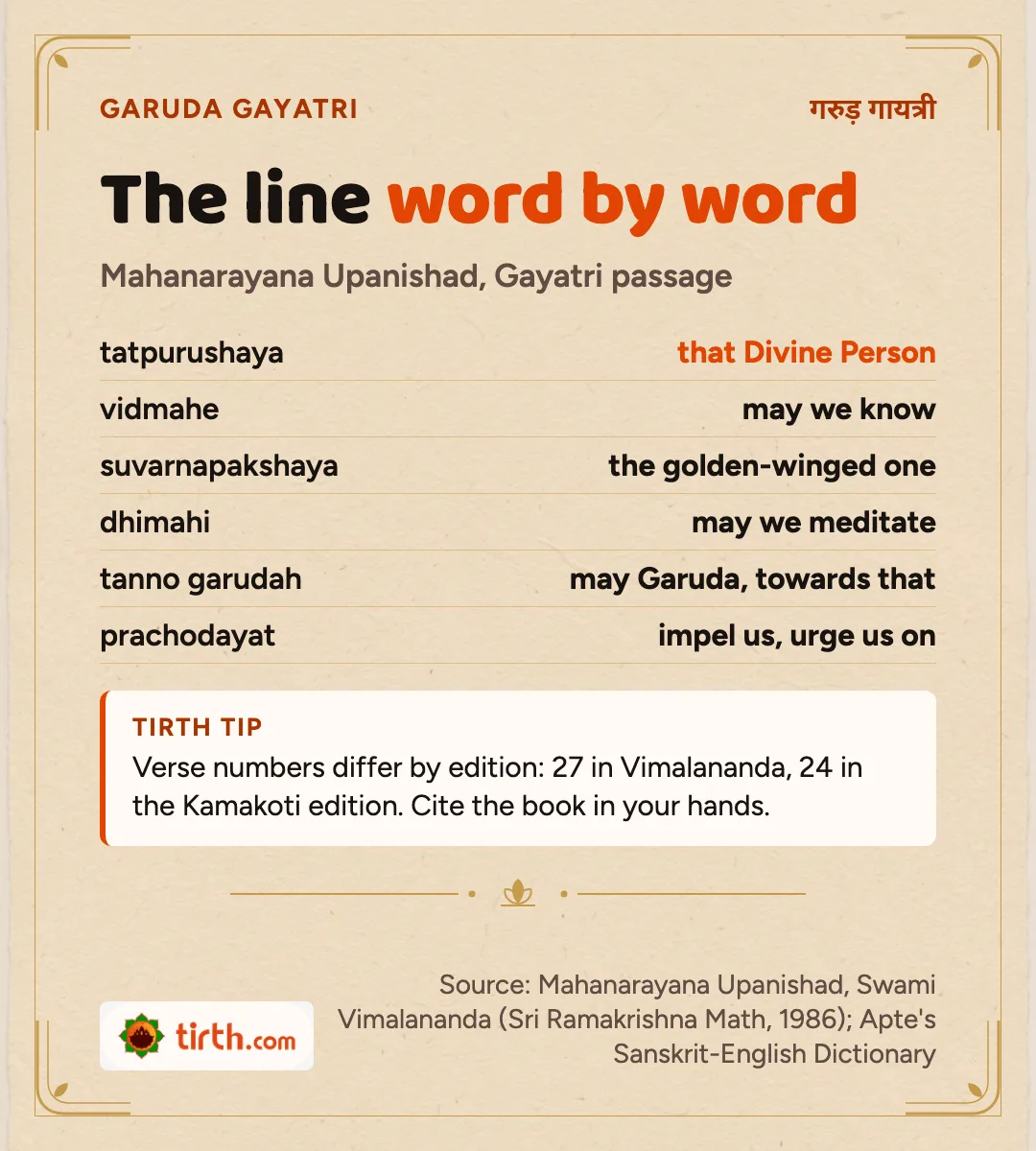
The meanings below come from Apte’s Practical Sanskrit-English Dictionary (1890), with its page numbers, and the last column shows how Vimalananda’s edition reads each word in this verse.
| Word | Meaning, with its source | How the edition reads it |
|---|---|---|
| tat-puruṣa (tatpuruṣāya) | puruṣa: man, person; the Supreme Being, God, the soul of the universe (Apte, p. 1034) | that Divine Person |
| vidmahe | from vid, to know, understand (Apte, p. 1438) | jānīma, we know |
| suvarṇa | of good colour, bright, yellow, golden (Apte, p. 1695) | with pakṣa, Suvarnapaksa |
| pakṣa | a wing (Apte, p. 945) | with suvarṇa, golden-winged |
| dhīmahi | from dhyai, to meditate upon, contemplate (Apte, p. 869) | dhyāyema, we meditate |
| tanno | tat joined with naḥ (sandhi) | the commentary reads “that” and “us”: “impel us towards it” |
| garuḍaḥ | king of birds, vehicle of Vishnu, from the root gṝ (Apte, p. 651) | Garuda |
| pracodayāt | may (he) impel, urge on; cud with pra, to impel, prompt, inspire (Apte, p. 1060) | “May Garuda impel us” |
Under that last word Apte quotes the Gayatri’s own dhiyo yo naḥ pracodayāt as his example.
Apte also lists pakṣirāja, king of birds, among the names of Garuda. Golden wings in the Upanishad, a king among birds in the dictionary, and a swallower of snakes in the editor’s note on the root, all for one bird who carries Bhagwan Vishnu and who, in this line, is asked to carry our attention somewhere higher.
What does the Garuda Purana say about Garudi vidya?
The Garuda Purana is named for Garuda, as its second chapter tells it.
In that same chapter, Garuda Purana 1.2.59 (the Acharakanda) gives a short line and calls it the gāruḍī parā vidyā, to be recited as japa.
yakṣi oṃ uṃ svāhā
The Gita Press Sankshipt Garuda Purana prints it in Hindi as यक्षि ॐ उ स्वाहा, with the middle syllable as u. So you will meet both spellings.
The chapter also says how the vidya was used. Kashyapa heard the Purana from Garuda and afterwards brought a burnt tree back to life by the Garudi vidya, and Garuda himself, the text says, revived many beings with it.
Further on, the Purana turns to snake poison. In the GRETIL Sanskrit text that is chapter 1.19, whose closing line calls it a means of removing snake poison (the prāṇeśvara vidya), and the Gita Press contents list a chapter 172 titled विषहरी गारुडी विद्या, the poison-removing Garudi vidya.
Vishnurekadashi gita tulasi, the verse Shri Krishna speaks to Garuda
One more line gets shared under Garuda’s name. It is Garuda Purana 2.2.24 to 2.2.25, in the later part of the text where Shri Krishna speaks and Garuda listens, so the words are Shri Krishna’s teaching with Garuda as the one who hears them.
viṣṇurekādaśī gītā tulasī vipradhenavaḥ
asāre durgasaṃsāre ṣaṭpadī muktidāyinī
The verse names six things. Vishnu, the Ekadashi vow, the Gita, tulsi, brahmins and cows, and it calls the six together a ṣaṭpadī that grants liberation.
The third word is gītā, the Gita. The GRETIL Sanskrit text and the Gita Press edition both read it that way, so a copy that prints Ganga in its place has misread the line.
The Gita Press edition prints the verse in the chapter on what is done for a dying person. For Ekadashi itself there is the Ekadashi Mata aarti, and for the plant the verse names fourth, the Tulsi mantra.
Saying the Garuda Gayatri at home
If you learn only one Garuda mantra, make it the Gayatri, because it is the one line on this page with an Upanishad behind it and a printed translation you can hold up against the word table above.
None of the sources here fix a count for it.
Nor a time of day or a posture. Our suggestion, and it is only that, is to sit somewhere clean and quiet, say the words clearly rather than quickly, and keep the meaning in front of you for the first few weeks (a printout of the table on the puja shelf does the job). If your father learnt it a little differently, let him say it his way, and use the printed form only to check your own.
On the same shelf you might keep the Vishnu aarti and the Shri Vishnu Chalisa. If you would like a pandit to perform a puja for the family, you can book a puja on Tirth.
Frequently asked questions
What is the Garuda Gayatri and what does it mean?
It is the line tatpurushaya vidmahe, suvarnapakshaya dhimahi, tanno garudah prachodayat. In Swami Vimalananda’s translation it asks to know that Divine Person, to meditate on Suvarnapaksa, the golden-winged, and for Garuda to impel us towards it.
Where does the Garuda mantra come from?
From the Mahanarayana Upanishad, in a set of Gayatri lines to eleven deities. It is verse 27 of that passage in the Vimalananda edition and number 24 in the Kamakoti edition, and it is not a Garuda Purana text.
What does Suvarnapaksha mean?
Golden-winged. In Apte’s dictionary suvarṇa is golden and pakṣa is a wing.
What does the Garuda Purana say about Garuda mantras?
Garuda Purana 1.2.59 calls the line yakṣi oṃ uṃ svāhā the Garudi vidya, to be recited as japa, and says Kashyapa revived a burnt tree with it. A later chapter deals with snake poison, and the Gita Press contents name one chapter as the poison-removing Garudi vidya.
Who is Garuda?
The king of birds and the vehicle of Bhagwan Vishnu, as Apte’s dictionary defines the name. His story and forms are on the Garuda page.
Is the Garuda mantra linked to snakes?
Through his name. The Vimalananda edition traces Garuda to the root gṝ, to swallow, the swallower of snakes, and the Garuda Purana has a chapter on snake poison, which the Gita Press contents call the poison-removing Garudi vidya. The Gayatri line itself asks only to know the Divine Person, and the Purana’s chapter is a text, not first aid: a snakebite needs a doctor.