
Ganesha mantras, word by word: Vakratunda, Om Gam and the Gayatri
Tirth editorial · 12 Jan 2026 · 7 min read
Which Ganesha mantras should you learn, and what does each word in them mean? Three short ones cover most of what people look for: the Vakratunda Mahakaya verse, the mool mantra Om Gam Ganapataye Namah, and the Ganesha Gayatri.
All three are addressed to Lord Ganesha by his own names, and each one is given below in Devanagari and Roman letters with every word but two glossed from the Monier-Williams Sanskrit-English Dictionary of 1899 or a named text page, so you can follow the meaning while you say the words. Two corrections come first, because this page used to get them wrong. The Gayatri ends in dantih, not danti. And the Om most people say before it is a habit of recitation, not a word of the verse as the Ganapati Atharvashirsha prints it. If you learn only one, learn the Vakratunda verse, because it is two lines long and it asks plainly for work that goes ahead without obstacles.
Vakratunda Mahakaya, a two-line prayer with no named book
No book, author or verse number is given for this verse on the text pages that print it. So it is called here what it is, a widely recited traditional prayer to Ganesha.
Printings differ on one small point. Some run the end of the first line together as suryakotisamaprabha, others split it as suryakoti samaprabha. The meaning holds either way.
| Sanskrit and Roman | Meaning (Tirth’s rendering) |
|---|---|
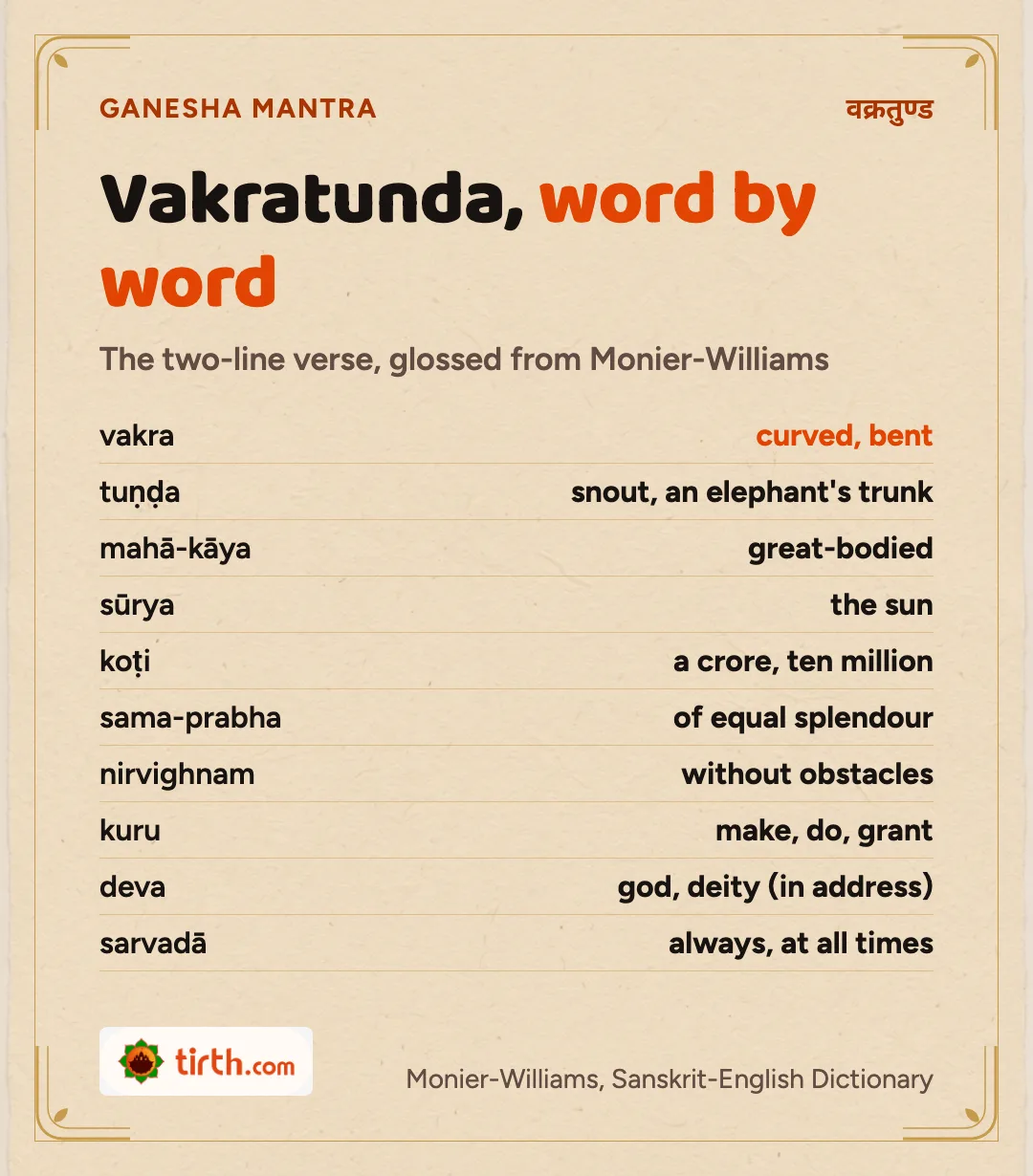
| वक्रतुण्ड महाकाय सूर्यकोटि समप्रभ। निर्विघ्नं कुरु मे देव सर्वकार्येषु सर्वदा॥ Vakratunda Mahakaya Suryakoti Samaprabha Nirvighnam Kuru Me Deva Sarvakaryeshu Sarvada | O god with the curved trunk and the great body, whose splendour equals a crore of suns, make all my undertakings free of obstacles, at all times. |
| Word | Meaning | Where the meaning comes from |
|---|---|---|
| vakra | crooked, curved, bent | Monier-Williams, p. 910 |
| tuṇḍa | beak, snout, the trunk of an elephant | Monier-Williams, p. 450 |
| vakratuṇḍa | the one with a curved trunk, a name of Ganesha | Vedadhara |
| mahā-kāya | great-bodied (mahā, great, and kāya, the body) | Monier-Williams, p. 274 |
| sūrya | the sun | Monier-Williams, p. 1243 |
| koṭi | a crore, ten million | Monier-Williams, p. 312 |
| sama-prabha | of equal splendour | Monier-Williams, p. 1152 |
| nirvighnam | without obstacles, unhindered | Monier-Williams, p. 542 |
| kuru | make, do, grant | Monier-Williams, p. 300 |
| me | for me, to me | Vedadhara |
| deva | god, deity (O God, in address) | Monier-Williams, p. 492 |
| sarva-kāryeṣu | in all works or undertakings | Vedadhara |
| sarvadā | always, at all times | Monier-Williams, p. 1189 |
Mind the dot under the n in tuṇḍa. With it, Monier-Williams gives beak, snout and an elephant’s trunk, while the plain tunda without the dot is the belly. Which is why a careful copy writes वक्रतुण्ड with ण and not with न. Koti is the other word worth a second look, since the dictionary calls it the highest number in the older system of counting.
Om Gam Ganapataye Namah, the mool mantra from the Ganapati Atharvashirsha
This one has a text you can open. The Ganapati Atharvashirsha, also called the Ganapati Upanishad, names the seer, the metre and the deity of what it calls the Ganesha vidya, and then gives the mantra.
Editions number the verses of the Atharvashirsha differently, so no verse number is printed here.
| Sanskrit and Roman | Meaning (Tirth’s rendering) |
|---|---|
| ॐ गं गणपतये नमः Om Gam Ganapataye Namah | Om. Gam. Salutation to Ganapati, the leader of the ganas. |
| Word | Meaning | Where the meaning comes from |
|---|---|---|
| oṃ | left unglossed here | no dictionary entry checked |
| gaṃ | the seed syllable (bija) of Ganesha | Wikipedia, Ganapati Atharvashirsha |
| gaṇapati | leader of the ganas (troops or attendants), a name of Ganesha | Monier-Williams, p. 343 |
| namaḥ | salutation, obeisance, reverence | Monier-Williams, p. 528 |
Four words in all.
Two of them are single syllables. The ganas are troops of lesser deities, especially those counted as the attendants of Lord Shiva, and Monier-Williams places those under Ganesha’s special charge. Gam is his seed syllable, and the Atharvashirsha itself describes that syllable at some length. We have left Om without a gloss on purpose. For a syllable with that much written about it, a printed edition’s note is the right place to look.
Ekadantaya vidmahe, and why the Ganesha Gayatri ends in dantih
The Ganesha Gayatri comes from the same Ganapati Atharvashirsha. As that text prints it, the verse has no Om in front, and the last name in it ends in h, dantih.
| Sanskrit and Roman | Meaning (Tirth’s rendering) |
|---|---|
| एकदन्ताय विद्महे वक्रतुण्डाय धीमहि। तन्नो दन्तिः प्रचोदयात्॥ Ekadantaya Vidmahe Vakratundaya Dhimahi Tanno Dantih Prachodayat | We come to know the one-tusked one, we meditate on the one with the curved trunk. May the tusked one impel and inspire. |
| Word | Meaning | Where the meaning comes from |
|---|---|---|
| ekadanta | one-tusked, one-toothed, a name of Ganesha | Monier-Williams, p. 228 |
| vidmahe | we know; in the Gayatri form, we come to know | Monier-Williams, p. 963 |
| vakratuṇḍa | the one with a curved trunk (as in the first verse) | Vedadhara |
| dhīmahi | we meditate | Monier-Williams, p. 516 |
| tat no | left unglossed here | no dictionary entry checked |
| dantiḥ | the tusked one, Ganesha | Monier-Williams, p. 469 |
| pracodayāt | may he impel, inspire | Monier-Williams, p. 400 |
This page printed Danti. If your family says Om prior to the verse, keep saying it, as long as you know that the Om is a habit of recitation and not one of the words of the verse as the Atharvashirsha prints it. The h of dantih is another matter, and we would keep it whatever else changes, because without it the word is no longer the form the Atharvashirsha uses.
Dantin, tusked, is an old name for Ganesha in its own right. Monier-Williams cites it from the Maitrayani Samhita (ii.9.1) and the Taittiriya Aranyaka (x.1.5), though the dictionary does not say those passages are this Gayatri line. For the Gayatri Mantra itself, see Tirth’s Gayatri Mantra page.
What the Atharvashirsha says about obstacles
Tradition links the Ganapati Atharvashirsha to the Atharvaveda, and near its end the text calls itself the word of the Atharvana sage. Modern scholars date it late, and one translator remarks that the Atharvan link may or may not be so.
Its closing lines carry the fruit statements, the phalashruti, and one of them says, in the Sanskrit printed on Sanskrit Wikisource, that a person who studies the text is not troubled by obstacles. That is the text speaking about itself. Tirth repeats it as the Atharvashirsha’s own word and adds no promise of its own.
The Vakratunda verse says nothing of the sort about itself. Its two lines are a request.
Saying them at home, and why Ganesha is called first
None of the sources behind this page sets a count, an hour or a posture for these three lines on their own, so follow the count your family or your guru keeps. The Vakratunda verse names its own occasion anyway, sarvakaryeshu sarvada, in all undertakings, at all times.
Why does Ganesha come before other deities at the start of a puja, from a home puja to Ganesh Chaturthi? None of the texts behind this page says why. Two of them do come back to obstacles, though. The first verse asks for every piece of work to go ahead nirvighnam, and the Atharvashirsha says the one who studies it is not troubled by obstacles.
If you are getting ready for the festival or Vinayaka Chaturthi, the festival calendar has the days for your city. For a puja done for you by a priest, see Tirth’s puja page.
Related on Tirth: the Ganesh aarti, the Jai Ganesh Deva lyrics, the Siddhivinayak aarti, and the Shiva, Vishnu and Durga mantras.
Frequently asked questions
Which is the most powerful Ganesha mantra?
None of the texts behind this page ranks them, and Tirth does not either. Om Gam Ganapataye Namah has the clearest source, the Ganapati Atharvashirsha, while the two-line Vakratunda verse is the easiest place to begin.
What is the Ganesha mool mantra and what does it mean?
It is Om Gam Ganapataye Namah, given in the Ganapati Atharvashirsha. Gam is Ganesha’s seed syllable, Ganapati means the leader of the ganas, and namah is salutation, so the line offers salutation to Ganapati.
Where does Vakratunda Mahakaya come from?
No book, author or verse number is given for it by the text pages that print it. It is a widely recited traditional prayer to Ganesha, asking him to keep every undertaking free of obstacles.
Is it Tanno Danti or Tanno Dantih in the Ganesha Gayatri?
Dantih, with the h. The Ganapati Atharvashirsha prints तन्नो दन्तिः प्रचोदयात्, with the final h, and has no Om at the start of the verse. Monier-Williams gives dantin as tusked, a name of Ganesha.
How many times should I chant Om Gam Ganapataye Namah?
The sources used for this page do not fix a number for this mantra on its own. Keep the count your family or guru follows, and say the four words clearly rather than quickly.