
Raksha Bandhan: the stories, the rakhi ritual and what it means
Tirth editorial · 7 Feb 2026 · 13 min read
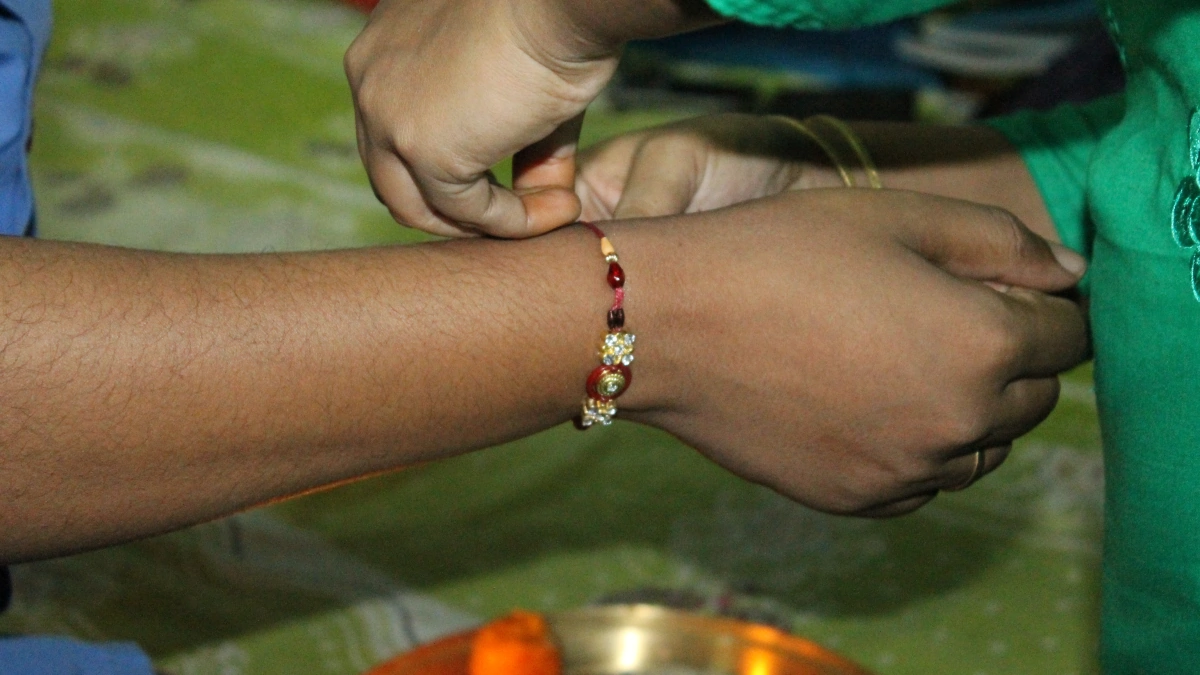
Raksha Bandhan means “the tying of the raksha”, and the meaning is literal: a protective thread bound on the wrist with a prayer. It falls on Shravana Purnima, the full moon of the month of Shravana, and in most homes today the sister puts a tilak on her brother, ties the rakhi on his right wrist and prays for his protection through the year, while he gives her a gift and promises to protect her.
Go back to the oldest account of the rite and the words said over the thread take up a single line, Yena baddho Bali raja, “with that by which King Bali was bound, I bind you.” Which is how a danava king ended up in the middle of a festival of brothers and sisters.
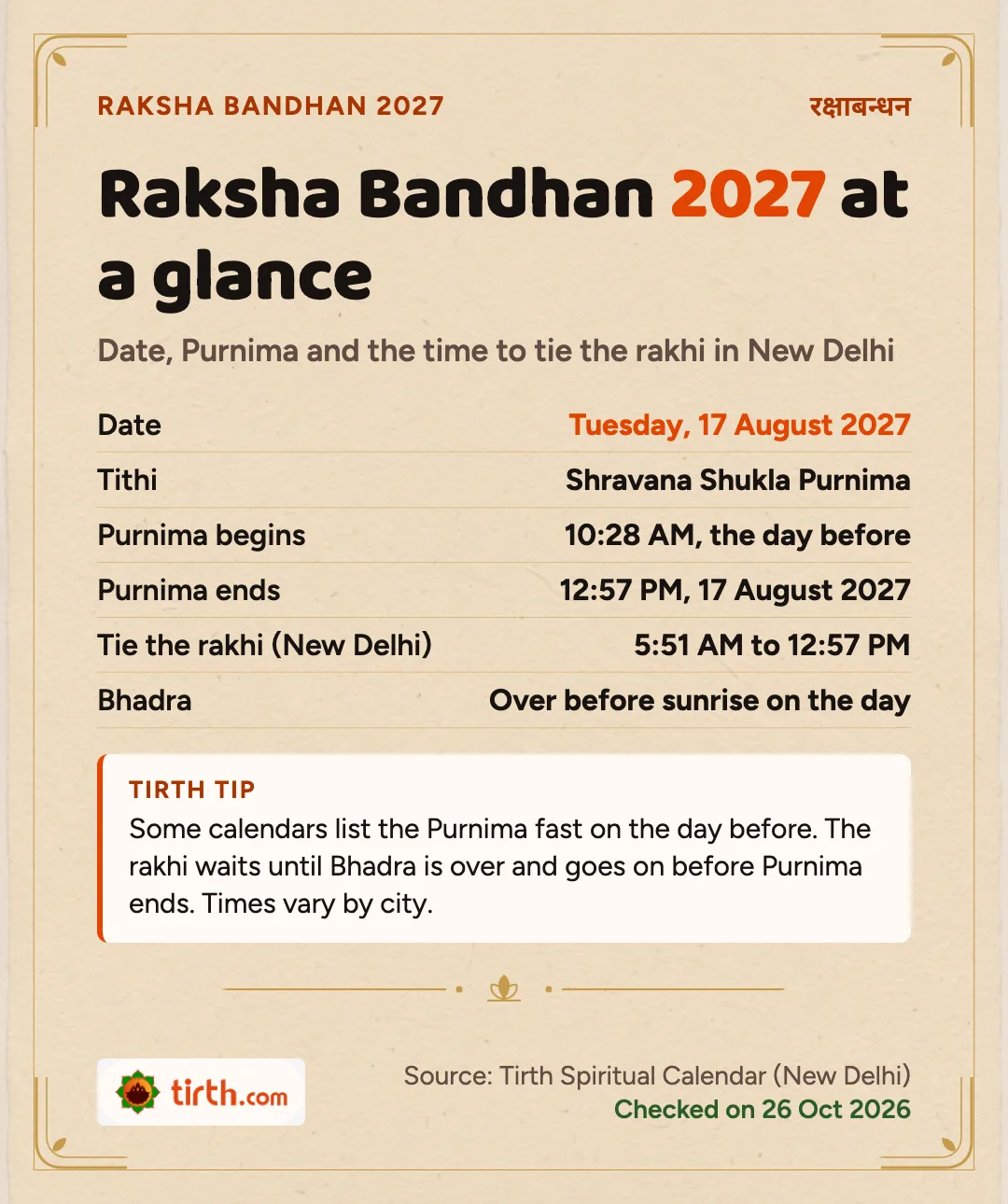
Raksha Bandhan in 2027: Tuesday, 17 August. Purnima tithi: 10:28 AM on 16 August to 12:57 PM on 17 August. Time to tie the rakhi in New Delhi: 5:51 AM to 12:57 PM (Bhadra ends before sunrise).
Because Purnima begins in the late morning of 16 August, some calendars list the Shravana Purnima fast on 16 August. The rakhi follows the Bhadra rule instead: Bhadra covers the rest of 16 August, so North Indian panchangs give 17 August for Raksha Bandhan.
Checked on 26 Oct 2026. Raksha Bandhan timings for your city in the Tirth Spiritual Calendar
Dates and timings are calculated for New Delhi using the traditional North Indian panchang. Timings change from city to city, sometimes by more than an hour for moonrise; see the Tirth Spiritual Calendar for your location.
What does the name Raksha Bandhan mean?
Raksha and bandhana are both Sanskrit words. Look up raksha in a Sanskrit-English dictionary and you get protection first, then a second sense, “a piece of thread or silk bound round the wrist” on particular occasions and worn as an amulet (page 860; bandhana is on page 721). Bandhana is the act of tying, or rather both the tying and the bond it makes.
So the name is a description of the rite, a protection you tie on, with nothing in it about siblings.
The thread has long gone from priest to patron as well. A family or village purohit would tie it on the wrists of the people he served and be given gifts in return, and an older handbook of Hindu festivals records Brahmins and purohits tying amulets on their patrons in just this way, a practice you can still see. In the Bhavishya Purana, our earliest written account of the rite, the one tying the raksha on the king is the purohit. Then there are the pairs the BAPS Swaminarayan account adds, a wife tying it on her husband in older practice and gurus who still tie it on their disciples.
Sister to brother came to be the form most homes keep.
The stories behind Raksha Bandhan, and which ones are scripture
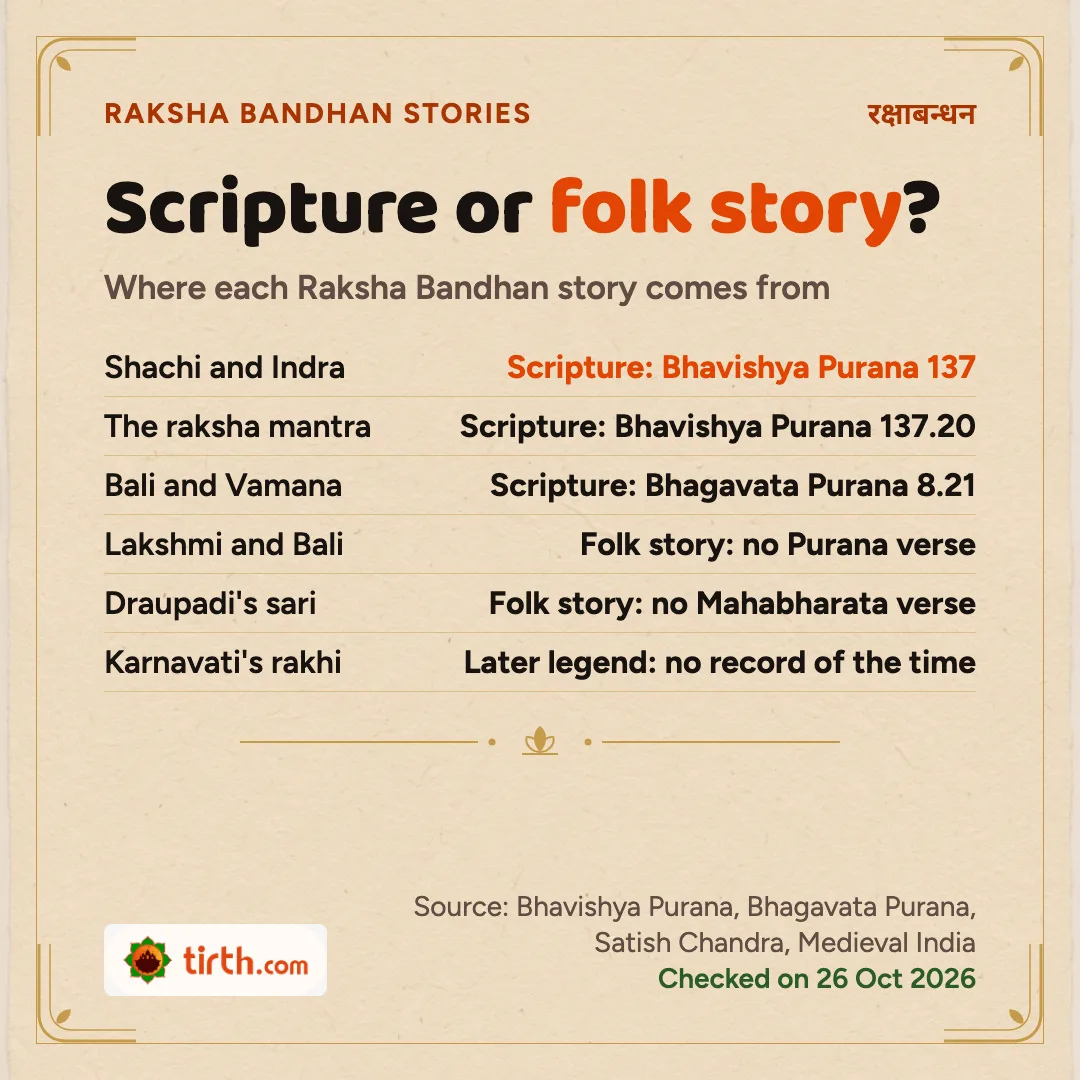
Each story has its own source, and they are not equal. Shachi’s comes from the very Purana chapter that lays out the rite, Bali’s from the Bhagavata, while the two that every child hears are popular retellings. For the festival’s history there is our companion post on why Raksha Bandhan is celebrated, so here each story gets a plain note on its origin, and when your children ask, you can tell them which is which.
Shachi and Indra, in the Bhavishya Purana
Chapter 137 of the Bhavishya Purana’s Uttara Parva, “Shravana Purnima Raksha-bandhana-vidhi”, is the fullest scriptural account we have, 23 verses spoken by Krishna to Yudhishthira. It is the defeated danavas we hear from. The gods have just won, and Shukra consoles Bali by explaining that Shachi made her husband Indra unconquerable by the power of the raksha she bound, so the danavas should wait a year (verses 2 to 5).
Popular retellings flip it, with Indra beaten, Shachi tying a holy thread on his wrist and Indra going on to win back Amaravati.
Bali, Vamana and Maa Lakshmi
King Bali loses the three worlds to Bhagwan Vishnu in his Vamana form and is bound (Bhagavata Purana 8.21). After that comes a promise. Vishnu will stay with Bali and protect him in every way (8.22.35), and Prahlada even calls the Lord durgapala, the guardian of Bali’s fort (8.23.6). The raksha mantra names this same Bali.
Many homes carry the story on. Maa Lakshmi ties a raksha on Bali, makes him her brother and asks for Vishnu’s return, and the Swaminarayan sampradaya calls the day Baleva for this reason. A much-loved story, but no Purana verse for the Lakshmi episode has been found, so tell it as a story families tell.
Draupadi and Krishna, a story families tell
Krishna cuts his finger, often at the moment Shishupala is killed, and Draupadi tears a strip from her sari to bind it, so in the version families tell he protects her ever after. Versions differ. Nobody has traced a Mahabharata verse for the finger episode, though, which puts it with the stories rather than with scripture.
Rani Karnavati and Humayun, a later legend
The Chittor queen is said to have sent Humayun a rakhi. Historians of medieval India point out that the account comes from a seventeenth-century Rajasthani text and that no writer of her own time mentions it, so we class it as a legend that grew up later.
People bring in Yama and Yamuna as well. Their story is really Bhai Dooj, the other festival of siblings, where the Bhavishya Purana tells of Yamuna feeding her brother, and you can read it in full in the Yama Dwitiya katha. Nothing written backs the rakhi version at all.
| Story | Where it comes from | What it says about the thread |
|---|---|---|
| Shachi and Indra | Bhavishya Purana, Uttara Parva 137.2 to 5 | The raksha Shachi bound made Indra unconquerable |
| Bali and Vamana | Bhagavata Purana 8.21 to 8.23 | Bali is the one “bound” in the mantra, and Vishnu promises to protect him |
| Maa Lakshmi and Bali | A story told in many homes; no Purana verse found | A sister’s raksha makes a brother of a king |
| Draupadi and Krishna | Popular retelling; no Mahabharata verse traced | A strip of cloth answered by lifelong protection |
| Karnavati and Humayun | Later legend; no contemporary writer mentions it | A rakhi sent across kingdoms |
How do you tie a rakhi at home?
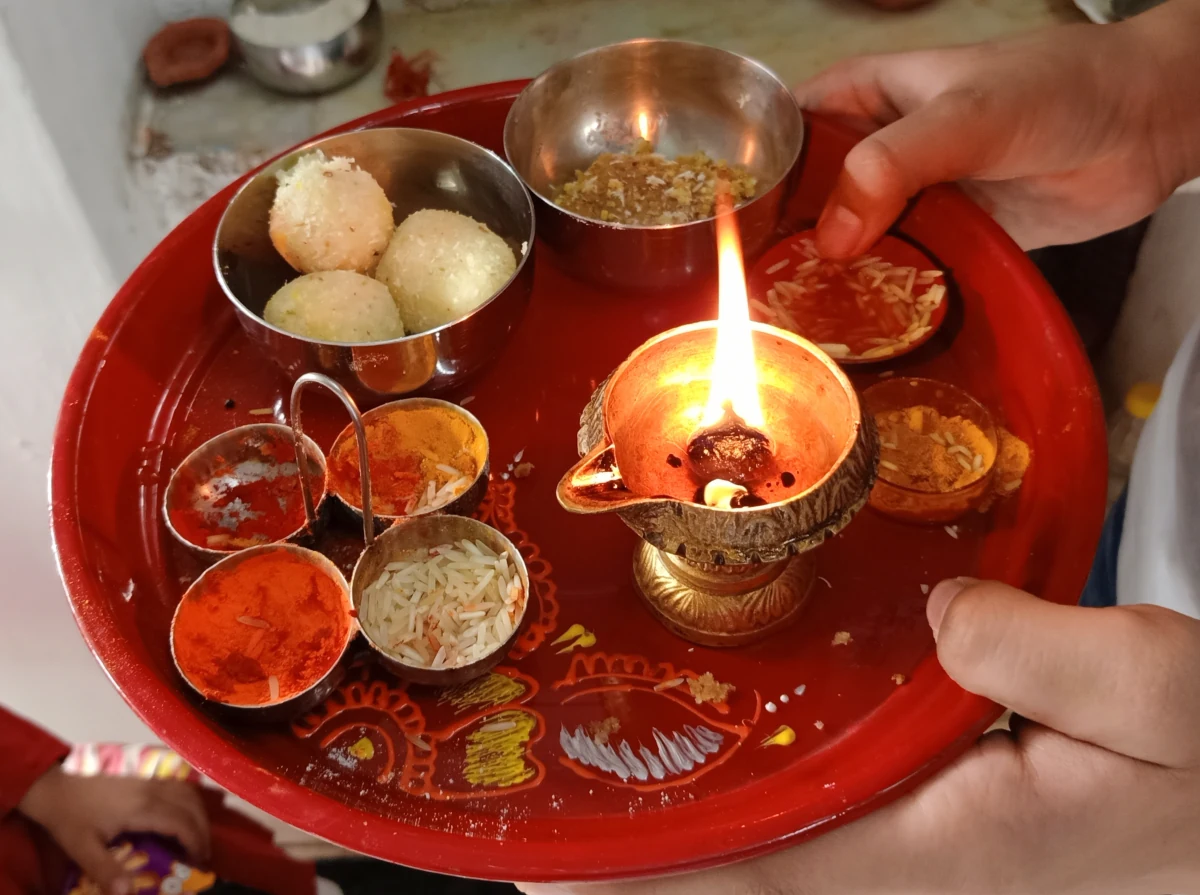
Most homes follow this order (handy if it is your first time, or if a small child keeps asking what each thing on the plate is for).
- Start with a morning bath. In the Bhavishya Purana the day opens the same way, a bath at daybreak followed by tarpan, water offered to the gods and the ancestors (verses 10 to 11).
- On the thali go the rakhi, roli or kumkum and unbroken rice (akshat), each of which you will need in a later step.
- With kumkum and rice, mark a tilak on your brother’s forehead, so that he is honoured before anything is tied.
- Now the rakhi goes on his right wrist, and while you tie it you say the raksha mantra given further down, the words that ask the thread to hold.
- Pray for his protection through the coming year.
- Then comes his half of the rite, a gift for you and his promise to protect you.
In the Purana the day runs to another order, which is worth knowing. Upakarma by the Brahmins comes first, in the morning. Afternoon is for the raksha potlis (small cloth bundles), unbroken rice, white mustard and gold wrapped in cotton or linen cloth, and only after the gods, Brahmins and auspicious women have been honoured does the purohit tie the raksha on the king with the mantra (verses 14 to 20). People of every varna may do it, says verse 21, after honouring Brahmins.
The raksha mantra, Yena baddho Bali raja, and its meaning
Verse 20 of the same chapter holds the mantra, to be said at the moment of tying.
येन बद्धो बली राजा दानवेन्द्रो महाबलः ।
तेन त्वामभिबध्नामि रक्षे मा चल मा चल ॥
Yena baddho Bali raja danavendro mahabalah,
tena tvam abhibadhnami rakshe ma chala ma chala.
Meaning: “With that by which Bali, the mighty king of the danavas, was bound, I bind you. O raksha, do not slip, do not slip.”
The Purana puts these words in the mouth of the purohit as he ties the raksha on the king, and in homes it is the sister who says them. You will find anubadhnami in the second line of some printed versions. The printed Sanskrit text and the Swaminarayan version both have abhibadhnami, and we follow the printed Sanskrit text here (so that is the reading printed above).
We would learn this one line before anything else, because the Purana gives no other wording for the tying itself. Its closing promise (verse 22) is that whoever ties the raksha this way stays free of faults and happy for a year, and we pass that on as the Purana’s own claim, in its own terms.
What do you need on the rakhi thali?
Nothing here needs a special trip to the market (a steel plate from the kitchen does the job).
| Item | What it is for |
|---|---|
| Rakhi or raksha thread | Tied on the right wrist with the mantra |
| Roli or kumkum | The tilak on the forehead |
| Unbroken rice (akshat) | Pressed onto the tilak |
You will not find any of this in the Purana. Verses 14 to 15 make the raksha out of the potli alone, unbroken rice, white mustard (siddhartha) and gold in a twist of cotton or linen cloth. The Vratraj describes much the same bundle, only with gold thread, in cotton or woollen cloth. If your family wants the older form, make a small potli like this and tie it on his wrist along with the rakhi.
Bhadra, and the right time of day to tie the rakhi
Bhadra is another name for the Vishti karana, and on Shravana Purnima it takes the first half of the tithi (a panchang lists it under karana, so do not look under tithi). Rakhi is not tied during Bhadra. The Vratraj gives the rule, and one popular telling finds no authority for the “Bhadra Mukha” and “Bhadra Punchha” exceptions that some calendars print. So the thali waits until Bhadra is over.
Aparahna, the afternoon, is the preferred time, as long as Purnima prevails. The Bhavishya Purana has the raksha potlis made tato aparahna samaye, “then, at the afternoon time” (verse 14). Many families keep Pradosh, the evening period, as the fallback. Some years the first day’s afternoon is all Bhadra, so the tying shifts to the following morning, before Purnima runs out.
Whatever the year, the thread goes on after Bhadra ends and before Purnima ends.
How wide that window is depends on the year and on your city, and the gap between cities can be large. A forwarded message was usually worked out for somewhere else, so check your own city in the Tirth Spiritual Calendar instead.
What else is kept on Shravana Purnima?
For Brahmins the same morning is Upakarma, when a new sacred thread is put on and tarpan is offered to the rishis, and the Bhavishya Purana places it on this full moon too (verse 12). In Tamil Nadu and the South the name is Avani Avittam. Upakarma dates vary with the Veda a family follows, though, so it does not always coincide with Raksha Bandhan. A Tamil family may therefore find Avani Avittam and the rakhi falling on different mornings.
Maharashtra’s coast keeps it as Narali Purnima. Koli fishing families in Mumbai, Thane and Palghar give coconuts to the sea and ask Varuna for calm waters, and the day opens a new fishing season. Across Maharashtra the same full moon is known as Rakhi Pournima too.
Odisha keeps the full moon as Gamha Purnima, the birth festival of Balabhadra, and farmers tie rakhis on their cattle. At the Jagannath temple in Puri, the large Pata Rakhis made by hereditary servitors are tied on Jagannath and Balabhadra on behalf of their sister Subhadra.
Rakhi dos and don’ts, and tying it from far away
From the texts and the panchang tradition come only a couple of rules, and both concern time. Avoid Bhadra. Finish while Purnima lasts. Custom almost everywhere says right wrist, and the Bhavishya Purana adds that the gods, Brahmins and auspicious women are honoured before the tying and that the rite is open to every varna. The colour of the thread, the size of the gift and the rest are up to each family, and families vary a great deal.
Brother in another city, or abroad? Post the rakhi early with a handwritten note and do the tying together on a video call, with him (or someone at home with him) tying it on his right wrist while you say the mantra. On a busy day keep it short, since tilak, thread, mantra and prayer make up the whole rite.
If you are the parent doing the explaining, we would start with Shachi and Indra, the one story the Purana itself tells, where the thread does exactly what its name says.
Raksha Bandhan is the full moon of Shravana, the month the Shravana Mahatmya describes. Janmashtami is the next big festival after it, and Bhai Dooj in Kartika is the other day set aside for brothers and sisters. The meaning behind other festivals’ threads, lamps and tilaks is gathered in our guides to festival customs and symbolism.
Frequently asked questions
Who tied the first rakhi?
Shachi, in the oldest written account (Bhavishya Purana, Uttara Parva 137), whose raksha made her husband Indra unconquerable. Lakshmi tying one on Bali and Draupadi binding Krishna’s finger are popular retellings with no scripture verse behind them.
Which hand should the rakhi be tied on?
Right wrist. The sister honours her brother with a tilak of kumkum and rice first, and as she ties the thread she prays for his protection through the year.
Why is rakhi not tied during Bhadra?
Bhadra is the Vishti karana that covers the first half of Purnima, and the Vratraj keeps the raksha out of it. Tie the rakhi once Bhadra is over and while Purnima still lasts, in the afternoon if the timings allow.
What mantra is said when tying a rakhi?
The Bhavishya Purana’s line, from Uttara Parva 137.20, is “Yena baddho Bali raja danavendro mahabalah, tena tvam abhibadhnami rakshe ma chala ma chala”. In English: “With that by which Bali, the mighty king of the danavas, was bound, I bind you. O raksha, do not slip, do not slip.”
Can a rakhi be tied on someone who is not a brother?
Yes. The Bhavishya Purana has the purohit tie it on the king, and family priests have long tied threads on their patrons. A wife once tied it on her husband, and gurus still tie the raksha on their disciples.
Is the story of Rani Karnavati and Humayun true?
Most likely it is a later legend. Historians have traced the account to a seventeenth-century Rajasthani text, and no writer of Karnavati’s own time mentions the rakhi she is said to have sent.
Continue on Tirth
- Raksha Bandhan in the Tirth Spiritual Calendar: the day and the rakhi time for your city.
- Bhai Dooj: the other day set aside for brothers and sisters.
- Janmashtami: the next big festival after Raksha Bandhan.
- Bhagwan Vamana on Tirth: the story behind the thread.