
Durga Mantras: Sarva Mangala, Jayanti Mangala and Durga Gayatri
Tirth editorial · 10 Jan 2026 · 6 min read
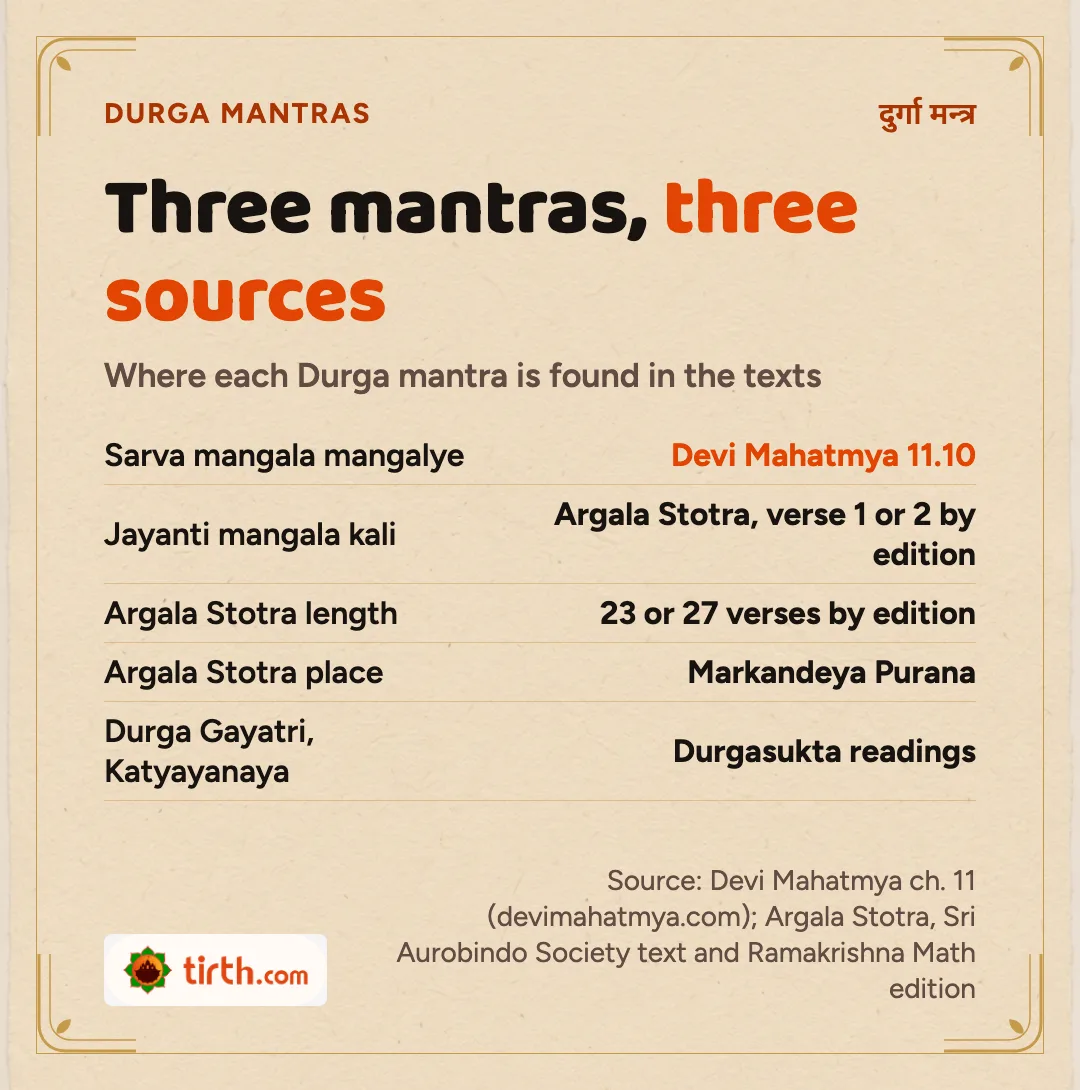
Sarva mangala mangalye is verse 10 of the hymn to the Goddess as Narayani in chapter 11 of the Devi Mahatmya, a one-line Durga mantra that calls her the giver of refuge and ends with a bow. The other two people ask for are Jayanti mangala kali, from the start of the Argala Stotra, and the Durga Gayatri, which comes with a named context but no verse number.
Each one is given below with the book it comes from.
If you would like to know Maa Durga herself first, her forms and how she is worshipped, the Maa Durga page on Tirth is the place to start.
Sarva mangala mangalye, Devi Mahatmya 11.10
The chapter 11 text on devimahatmya.com numbers this as verse 10 of the hymn to Narayani, and Vedadhara gives the same place along with word meanings. The Sri Ramakrishna Math edition, translated by Swami Jagadiswarananda, prints it as verse 10 of chapter 11 as well, on page 138.
सर्वमङ्गलमाङ्गल्ये शिवे सर्वार्थसाधिके । शरण्ये त्र्यम्बके गौरि नारायणि नमोऽस्तु ते ॥
sarvamangalamangalye shive sarvarthasadhike | sharanye tryambake gauri narayani namo’stu te
In plain English it reads, O auspiciousness of all that is auspicious, auspicious one, accomplisher of all aims, giver of refuge, three-eyed one, fair and radiant Gauri, Narayani, salutations to you.
Seven ways of addressing her come one after another, and only then the salutation.
| Word | Meaning |
|---|---|
| sarvamangalamangalye | auspiciousness of all that is auspicious |
| shive | auspicious one (an address to the Devi) |
| sarvarthasadhike | accomplisher of all aims |
| sharanye | giver of refuge |
| tryambake | three-eyed one |
| gauri | fair, radiant one |
| narayani | Narayani, the Devi |
| namo’stu te | salutations to you |
Look at sharanye, the fourth address in the line. It means the one who gives refuge, and it sits between the aim-accomplishing and the three-eyed.
The verse does not pick out any one of the Navadurga forms. It names Gauri and Narayani in the same line and calls her Shive as well, all as names of the one Devi.
Jayanti mangala kali comes at the start of the Argala Stotra
This one sits at the very start of the Argala Stotra, a hymn whose closing words place it in the Markandeya Purana. The Sri Aurobindo Society text counts 23 verses and calls this verse 1. The Ramakrishna Math edition prints 27, with an opening line to Chamunda first, so there it is verse 2.
जयन्ती मङ्गला काली भद्रकाली कपालिनी । दुर्गा क्षमा शिवा धात्री स्वाहा स्वधा नमोऽस्तु ते ॥
jayanti mangala kali bhadrakali kapalini | durga kshama shiva dhatri svaha svadha namo’stu te
It is a string of the Goddess’s names. Jayanti, Mangala, Kali, Bhadrakali, Kapalini, Durga, Kshama, Shiva and Dhatri come first (the Ramakrishna Math print has Shiva before Kshama), then the two words svaha and svadha, and the line ends as the last one did, with namo’stu te, salutations to you.
One thing gets it wrong on posters and in forwards. Jayanti is a name in this list, so reading the opening as “victory to you” changes the line.
Kali is the third name. Durga is the sixth.
So it is a hymn to the Devi under many names, with Kali among them, and if you came looking for something addressed to Maa Kali on her own, the Kali mantras are a separate page.
The closing verse of the same stotra, verse 23 in the Society text and verse 27 in the Ramakrishna Math print, asks that it be recited before the great hymn of 700 verses. The Math print names the Saptashati in that verse. So if you read both in one sitting, the Argala goes first.
One small trap with numbering. The Sri Aurobindo Society text counts the jayanti line as verse 1 and the Ramakrishna Math print as verse 2, so books do not number the Argala the same way. Check against your own copy prior to quoting a verse number to anyone.
You can book a Durga Saptashati path in Prayagraj on Tirth.
Durga Gayatri, the Katyayanaya wording
The sources we can point to give this mantra only as a reading that goes with another hymn, not as a verse of its own with a number.
The Katyayanaya wording reads as follows.
katyayanaya vidmahe kanyakumari dhimahi tanno durgih prachodayat
Hindupedia gives this form in its entry on the Durgasukta, in the readings that go with that hymn, though it names no single text as the place it comes from.
It follows the three steps of vidmahe, dhimahi and prachodayat, so the shape will feel familiar if you already say the Gayatri of another deity.
If you take up this Durga Gayatri for daily use, remember that it comes with a named context but no text of its own, and do not let anyone sell it to you as a Vedic mantra with a fixed verse number, since it has none in the sources we can point you to.
For longer prayers to her, there is the Durga Chalisa, and the Shakti mantras page gathers mantras to the Devi in her other names.
How many times should you chant a Durga mantra?
None of the texts cited here fixes a count or an hour for these three.
The only instruction any of them gives is the one in the Argala’s closing verse, about order, and it says nothing about how many rounds. So for the count, follow what your family priest or guru gave you, and if nobody gave you one, a single unhurried recitation with the meaning in your mind is a perfectly good place to begin.
About Om. It is not part of the verse as the texts print it, so a book that leaves it out has not made a mistake.
Keep a printed Saptashati beside the phone (when two websites number a verse differently, the book settles it, and it saves an argument in the family WhatsApp group).
If you are getting ready for Navratri or Durga Puja, those guides cover the festivals themselves. For mantras to other deities, there is the Surya mantra and the Maha Kaal Bhairav beej mantra.
Frequently asked questions
Which Durga mantra should I learn first?
Sarva mangala mangalye. It is a single verse with a known place, Devi Mahatmya chapter 11, verse 10, and every word of it can be checked against the table above.
What does Sarva Mangala Mangalye mean?
It addresses the Devi by seven names and titles, among them accomplisher of all aims, giver of refuge, three-eyed one, Gauri and Narayani. It ends with namo’stu te, salutations to you.
Is Jayanti Mangala Kali a mantra to Maa Kali?
It is verse 1 of the Argala Stotra in the Sri Aurobindo Society text (verse 2 in the Ramakrishna Math print), and a list of the Goddess’s names, of which Kali is one and Durga another. It is addressed to the Devi under all those names together.
What is the Durga Gayatri mantra?
Katyayanaya vidmahe kanyakumari dhimahi tanno durgih prachodayat is the wording given in readings that go with the Durgasukta. The source we can point to names no single text for it and gives it no verse number.
How many times should a Durga mantra be chanted?
The texts behind these three mantras do not set a number. So follow the count your family priest or guru has given you, and if no count was ever given, one unhurried recitation with the meaning in mind is enough to begin with.
Is Om part of these Durga mantras?
No. Om is not part of the verses as printed in the Devi Mahatmya or the Argala Stotra.