
Durga Chalisa in Hindi with meaning, line by line
Tirth editorial · 6 Jan 2026 · 11 min read
Salutations again and again to you, Durga, who gives happiness, and to you, Amba, who takes sorrow away. That is the first line of the Durga Chalisa, a Hindi hymn of praise to Maa Durga in 41 short lines, signed at the very end by a poet who calls himself Devidas.
Gita Press of Gorakhpur prints it in its small booklet numbered 1033, and that printing is the text given here, every line in Devanagari, in English letters and in plain English.
All 41 lines of the Durga Chalisa, Hindi and English side by side
Every line comes from pages 3 to 9 of that booklet, spelt the way the booklet spells it. So it is sasi, not shashi. And sakti, not shakti. The last column is Tirth’s own plain rendering, kept as close to the Hindi words as English allows.
| Line | Hindi (Gita Press text) | In English letters | Plain meaning (Tirth’s rendering) |
|---|---|---|---|
| 1 | नमो नमो दुर्गे सुख करनी। नमो नमो अंबे दुख हरनी॥ | Namo namo Durge sukh karani, namo namo Ambe dukh harani. | Salutations again and again to you, Durga, who gives happiness. Salutations again and again to you, Amba, who takes sorrow away. |
| 2 | निरंकार है ज्योति तुम्हारी। तिहूँ लोक फैली उजियारी॥ | Nirankar hai jyoti tumhari, tihun lok phaili ujiyari. | Your light has no form, and its brightness spreads through the three worlds. |
| 3 | ससि ललाट मुख महा बिसाला। नेत्र लाल भृकुटी बिकराला॥ | Sasi lalat mukh maha bisala, netra lal bhrikuti bikarala. | The moon is on your forehead and your face is vast. Your eyes are red and your brows are fierce. |
| 4 | रूप मातु को अधिक सुहावे। दरस करत जन अति सुख पावे॥ | Roop matu ko adhik suhave, daras karat jan ati sukh pave. | Mother, your form is very beautiful. People who have your darshan feel great joy. |
| 5 | तुम संसार सक्ति लय कीन्हा। पालन हेतु अन्न धन दीन्हा॥ | Tum sansar sakti lay kinha, palan hetu ann dhan dinha. | You are the power of the world and you draw it back into yourself. To sustain it, you gave grain and wealth. |
| 6 | अन्नपूर्णा हुई जग पाला। तुम ही आदि सुंदरी बाला॥ | Annapurna hui jag pala, tum hi adi sundari bala. | As Annapurna you fed the world. You are the first, the beautiful young goddess. |
| 7 | प्रलयकाल सब नासन हारी। तुम गौरी सिव संकर प्यारी॥ | Pralaykal sab nasan hari, tum Gauri Siv Sankar pyari. | At the time of dissolution you destroy everything. You are Gauri, beloved of Shiva Shankar. |
| 8 | सिवजोगी तुम्हरे गुन गावें। ब्रह्मा बिष्णु तुम्हें नित ध्यावें॥ | Sivjogi tumhre gun gaven, Brahma Bishnu tumhen nit dhyaven. | Shiva the yogi sings your qualities. Brahma and Vishnu meditate on you every day. |
| 9 | रूप सरस्वति को तुम धारा। दे सुबुद्धि ऋषि मुनिन्ह उबारा॥ | Roop Sarasvati ko tum dhara, de subuddhi rishi muninh ubara. | You took the form of Saraswati, gave good understanding and rescued the rishis and munis. |
| 10 | धरा रूप नरसिंह को अंबा। परगट भई फाड़ कर खंबा॥ | Dhara roop Narsingh ko Amba, pargat bhai phar kar khamba. | Amba, you took the form of Narasimha and appeared by tearing the pillar open. |
| 11 | रच्छा करि प्रहलाद बचायो। हिरनाकुस को स्वर्ग पठायो॥ | Rachchha kari Prahlad bachayo, Hiranakus ko swarg pathayo. | You protected Prahlad and saved him, and sent Hiranakus (Hiranyakashipu) to heaven. |
| 12 | लछमी रूप धरो जग माहीं। श्री नारायन अंग समाहीं॥ | Lachhmi roop dharo jag mahin, Shri Narayan ang samahin. | In the world you take the form of Lakshmi and dwell with Shri Narayan, as part of him. |
| 13 | छीर सिंधु में करत बिलासा। दया सिंधु दीजै मन आसा॥ | Chhir sindhu men karat bilasa, daya sindhu dijai man asa. | You take your delight in the ocean of milk. Ocean of mercy, grant what my heart hopes for. |
| 14 | हिंगलाज में तुम्हीं भवानी। महिमा अमित न जाय बखानी॥ | Hinglaj men tumhin Bhavani, mahima amit na jay bakhani. | At Hinglaj you are Bhavani. Your glory has no limit and cannot be told. |
| 15 | मातंगी धूमावति माता। भुवनेस्वरि बगला सुख दाता॥ | Matangi Dhumavati mata, Bhuvanesvari Bagla sukh data. | You are Mother Matangi and Dhumavati, and Bhuvaneshwari and Bagala, who give happiness. |
| 16 | श्री भैरव तारा जग तारिनि। छिन्नभाल भव दुःख निवारिनि॥ | Shri Bhairav Tara jag tarini, chhinnabhal bhav duhkh nivarini. | As Shri Bhairav and Tara you carry the world across. As Chhinnabhal you end the sorrows of worldly life. |
| 17 | केहरि बाहन सोह भवानी। लांगुर बीर चलत अगवानी॥ | Kehari bahan soh Bhavani, langur bir chalat agavani. | Bhavani, the lion is your splendid mount, and the hero Langur walks ahead of you. |
| 18 | कर में खप्पर खड्ग बिराजै। जाको देख काल डर भाजै॥ | Kar men khappar khadg birajai, jako dekh kal dar bhajai. | The skull bowl and the sword are in your hands. Seeing them, even Kal (Death) runs in fear. |
| 19 | सोहै अस्त्र और तिरसूला। जाते उठत सत्रु हिय सूला॥ | Sohai astra aur tirsula, jate uthat satru hiy sula. | Weapons and the trident shine in your hands, and they bring pain to the hearts of enemies. |
| 20 | नगरकोट में तुम्ही बिराजत। तिहूँ लोक में डंका बाजत॥ | Nagarkot men tumhi birajat, tihun lok men danka bajat. | You are enthroned at Nagarkot, and your drum sounds through the three worlds. |
| 21 | सुंभ निसुंभ दानव तुम मारे। रक्त बीज संखन संहारे॥ | Sumbh Nisumbh danav tum mare, Rakt Bij sankhan sanhare. | You killed the demons Shumbh and Nishumbh and destroyed Raktabij in his countless forms. |
| 22 | महिषासुर नृप अति अभिमानी। जेहि अघ भार मही अकुलानी॥ | Mahishasur nrip ati abhimani, jehi agh bhar mahi akulani. | Mahishasur was a king of great arrogance, and the earth was in distress under the weight of his sins. |
| 23 | रूप कराल काली को धारा। सेन सहित तुम तिहि संहारा॥ | Roop karal Kali ko dhara, sen sahit tum tihi sanhara. | You took the terrible form of Kali and destroyed him with his army. |
| 24 | परी गाढ़ संतन पर जब जब। भई सहाय मातु तुम तब तब॥ | Pari garh santan par jab jab, bhai sahay matu tum tab tab. | Whenever hard times fell on the saints, Mother, you came to their help. |
| 25 | अमर पुरी औरों सब लोका। तव महिमा सब रहै असोका॥ | Amar puri auron sab loka, tav mahima sab rahai asoka. | By your glory the city of the gods and all the other worlds stay free of sorrow. |
| 26 | ज्वाला में है ज्योति तुम्हारी। तुम्हें सदा पूजें नरनारी॥ | Jvala men hai jyoti tumhari, tumhen sada pujen narnari. | Your light is in Jwala, and men and women worship you always. |
| 27 | प्रेम भक्ति से जो जस गावै। दुख दारिद्र निकट नहि आवै॥ | Prem bhakti se jo jas gavai, dukh daridra nikat nahi avai. | Sorrow and poverty do not come near whoever sings your glory with love and devotion. |
| 28 | ध्यावे तुम्हें जो नर मन लाई। जन्म मरन ताको छुटि जाई॥ | Dhyave tumhen jo nar man lai, janm maran tako chhuti jai. | Whoever meditates on you with the whole mind is freed from birth and death. |
| 29 | जोगी सुर मुनि कहत पुकारी। जोग न हो बिन सक्ति तुम्हारी॥ | Jogi sur muni kahat pukari, jog na ho bin sakti tumhari. | Yogis, gods and sages say aloud that there is no yoga without your power. |
| 30 | संकर आचारज तप कीन्हो। काम क्रोध जीति सब लीन्हो॥ | Sankar acharaj tap kinho, kam krodh jiti sab linho. | Shankar Acharya did tapas and conquered desire and anger. |
| 31 | निसिदिन ध्यान धरो संकर को। काहु काल नहि सुमिरो तुमको॥ | Nisidin dhyan dharo Sankar ko, kahu kal nahi sumiro tumko. | Day and night he meditated on Shankar, but at no time did he remember you. |
| 32 | सक्ति रूप को मरम न पायो। सक्ति गई तब मन पछितायो॥ | Sakti roop ko maram na payo, sakti gai tab man pachhitayo. | He did not grasp the secret of your form as Shakti. When his strength left him, he repented. |
| 33 | सरनागत ह्वै कीर्ति बखानी। जय जय जय जगदंब भवानी॥ | Saranagat hvai kirti bakhani, jay jay jay Jagdamb Bhavani. | He came to you for refuge and sang your glory: victory, victory, victory to Jagadamba Bhavani. |
| 34 | भई प्रसन्न आदि जगदंबा। दई सक्ति नहि कीन्ह बिलंबा॥ | Bhai prasann adi Jagdamba, dai sakti nahi kinh bilamba. | The first Mother of the world was pleased and gave him strength without delay. |
| 35 | मोको मातु कष्ट अति घेरो। तुम बिन कौन हरे दुख मेरो॥ | Moko matu kasht ati ghero, tum bin kaun hare dukh mero. | Mother, great trouble surrounds me. Who but you can take my sorrow away? |
| 36 | आसा तृस्ना निपट सतावै। रिपु मूरख मोहि अति डरपावै॥ | Asa trisna nipat satavai, ripu murakh mohi ati darpavai. | Hope and craving torment me badly, and foolish enemies frighten me greatly. |
| 37 | सत्रु नास कीजै महरानी। सुमिरौं एकचित तुमहि भवानी॥ | Satru nas kijai Maharani, sumiraun ekchit tumahi Bhavani. | Great Queen, destroy my enemies. Bhavani, I remember you with a single mind. |
| 38 | करौ कृपा हे मातु दयाला। ऋद्धि सिद्धि दे करहु निहाला॥ | Karau kripa he matu dayala, riddhi siddhi de karahu nihala. | Be gracious, merciful Mother. Give riddhi and siddhi and fill me with joy. |
| 39 | जब लगि जियौं दयाफल पाऊँ। तुम्हरौ जस मैं सदा सुनाऊँ॥ | Jab lagi jiyaun dayaphal paun, tumharau jas main sada sunaun. | As long as I live, may I receive the fruit of your kindness and always tell of your glory. |
| 40 | दुर्गा चालीसा जो कोई गावै। सब सुख भोग परम पद पावै॥ | Durga chalisa jo koi gavai, sab sukh bhog param pad pavai. | Whoever sings the Durga Chalisa enjoys every happiness and reaches the highest state. |
| 41 | देवीदास सरन निज जानी। करहु कृपा जगदंब भवानी॥ | Devidas saran nij jani, karahu kripa Jagdamb Bhavani. | Knowing Devidas to be one who has come to your refuge, be gracious, Jagadamba Bhavani. |
Who wrote the Durga Chalisa, and why 41 lines if chalisa means forty?
Devidas signs it. Line 41 reads “Devidas saran nij jani”, asking Jagadamba Bhavani to be gracious to Devidas, who has come to her for refuge. The hymn itself gives no other detail about the man.
Chalisa means a set of forty. Platts’ Dictionary of Urdu, Classical Hindi and English puts it a little more formally, as “an aggregate of forty”. The Gita Press text has 41 chaupai lines, with no doha at the start or at the end. So if you count 41 and wonder whether you slipped somewhere, you did not.
Other printings change a word here and there, and three of those changes matter if you are reading along with a recording or from an older family book.
- Line 11: some books read “Hiranyaksh ko swarg pathayo” where Gita Press has “Hiranakus ko swarg pathayo”.
- Line 25: “Amarpuri aru Basav loka” in some books, “Amar puri auron sab loka” in Gita Press.
- Line 36: “Moh madadik sab binashavai” in some books, “Ripu murakh mohi ati darpavai” in Gita Press.
Where do the Narasimha and Mahishasur stories in the chalisa come from?
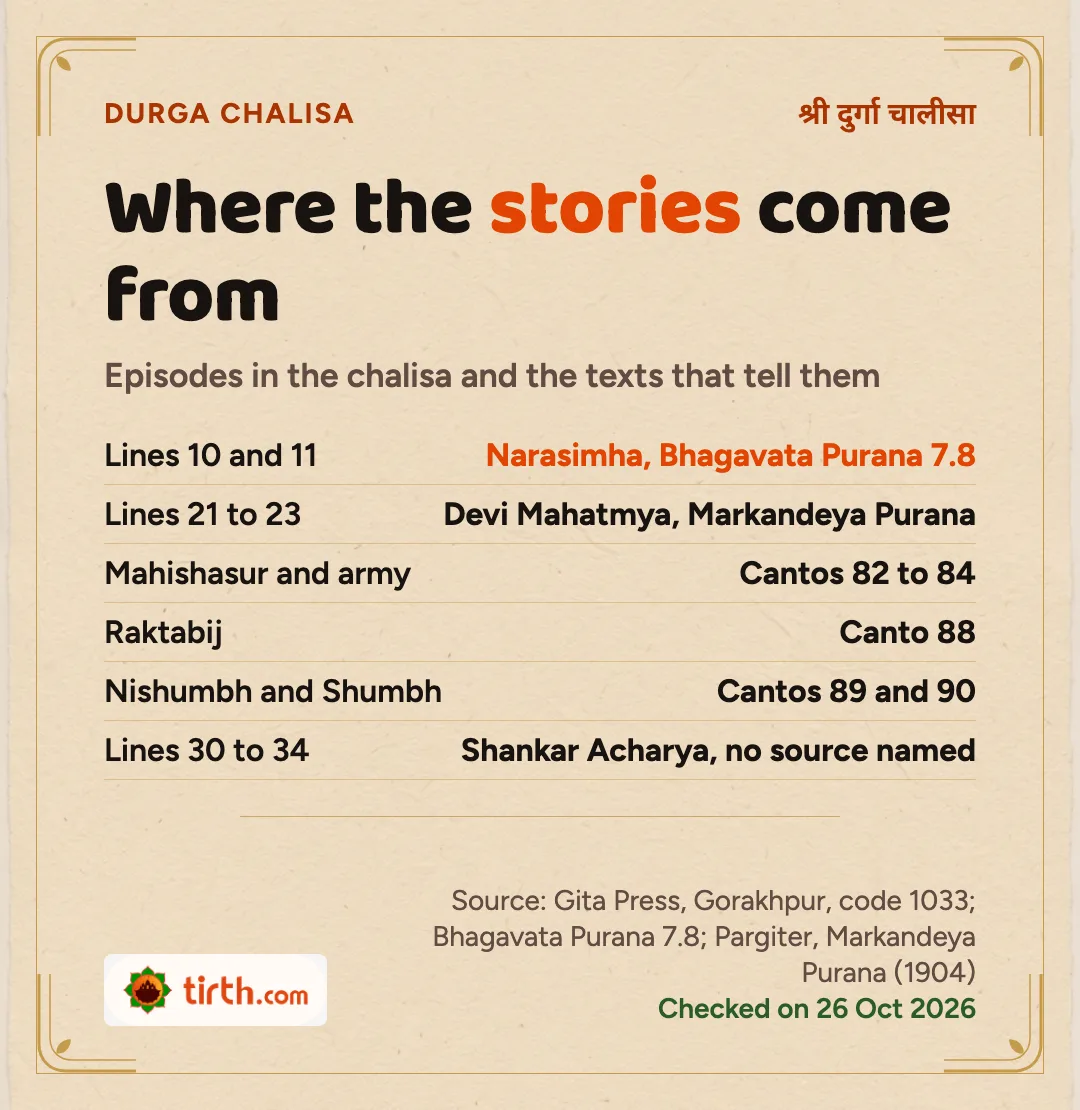
Lines 10 and 11 give the Goddess a form you might not expect. She takes the form of Narasimha, tears the pillar open and saves Prahlad. The Bhagavata Purana tells the same story in book 7, chapter 8, where Narasimha comes out of a pillar and kills Hiranyakashipu.
Lines 21 to 23 move to the battles. Mahishasur falls there with his whole army. So do Shumbh and Nishumbh, along with Raktabij in his countless forms. All of these are told at length in the Devi Mahatmya, which is cantos 81 to 93 of the Markandeya Purana in Pargiter’s translation of 1904, with Mahishasur and his army slain in cantos 82 to 84 and Raktabij in canto 88. Nishumbh falls in canto 89 and Shumbh in canto 90.
Lines 30 to 34 tell a story of their own, about Shankar Acharya. He does tapas, conquers desire and anger, and meditates on Shankar day and night without once remembering the Goddess. Then his strength leaves him. Or rather his sakti goes, the same word the hymn uses for the Goddess herself. He repents, takes refuge in her and sings her glory. She gives the strength back without delay. The chalisa names no source for this episode, so we read it as Devidas tells it and leave it there.
How should you read the Durga Chalisa the first time?
The hymn makes one promise of its own, in line 40: whoever sings the Durga Chalisa enjoys every happiness and reaches the highest state.
Our suggestion for a first reading is a small one. Say the meaning column aloud once before the Hindi, because then Matangi, Dhumavati, Bagala and the other names in lines 15 and 16 will already be familiar when you reach them in Hindi. (A recording is fine for the tune, but check its line 11 against the table first.)
For shorter prayers there are our Durga mantras. See also the Navratri guide and the Durga Ashtami page. The Kali Chalisa and the Chamunda Chalisa are on the blog as well.
Frequently asked questions
Who wrote the Durga Chalisa?
Devidas, who signs the last line. The hymn gives no other detail about him.
How many lines are in the Durga Chalisa?
The Gita Press text has 41 chaupai lines and no doha. Chalisa means a set of forty, so the name gives the count in round figures.
Is it Hiranakus or Hiranyaksh in the Durga Chalisa?
Gita Press prints “Hiranakus ko swarg pathayo”, and some other books read Hiranyaksh. In the Bhagavata Purana (7.8) the father of Prahlad whom Narasimha kills is Hiranyakashipu, and he is the king line 11 is about.
What does the Durga Chalisa say about reading it?
Line 40 says that whoever sings it enjoys every happiness and reaches the highest state. That is the hymn’s own phala line. Phala means fruit, the result a text says its reading brings.
Where do the stories of Mahishasur and Raktabij come from?
From the Devi Mahatmya, which is cantos 81 to 93 of the Markandeya Purana. In Pargiter’s translation Mahishasur falls in cantos 82 to 84 and Raktabij in canto 88.