
Diwali: the five days, the stories and how families celebrate
Tirth editorial · 9 Feb 2026 · 13 min read
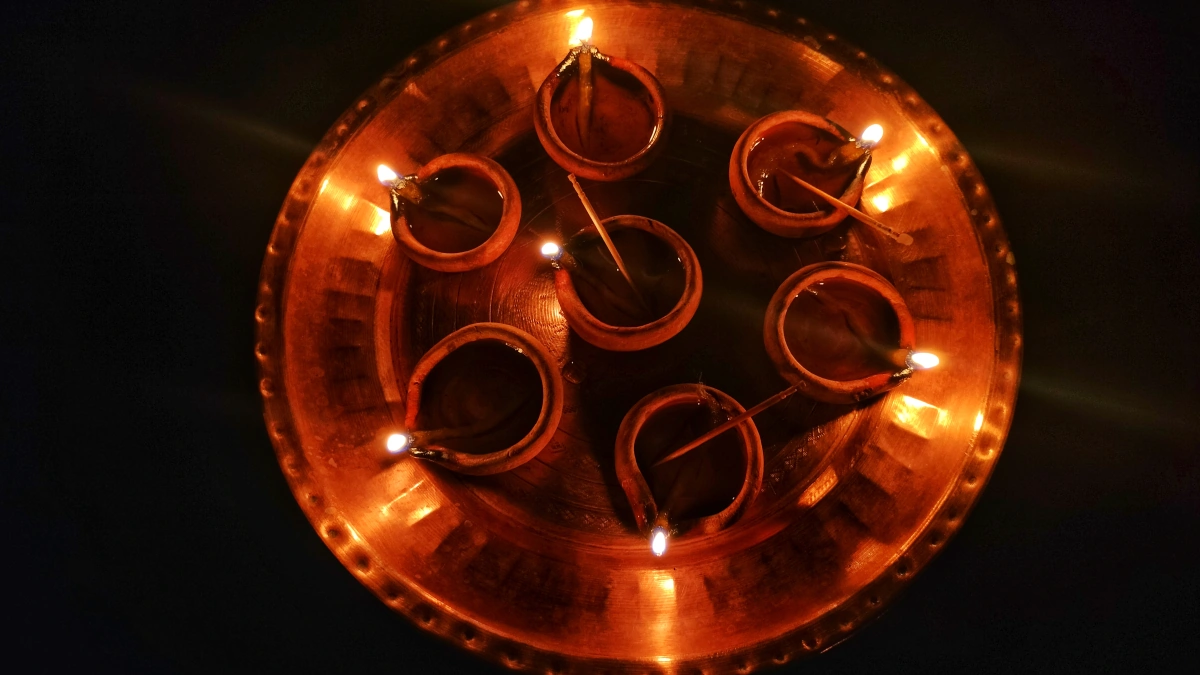
Five days of worship gather around the Kartika new moon, from Dhanteras at one end to Bhai Dooj at the other, and the Lakshmi Puja on the new-moon night itself is the centre of Diwali. Deepavali, the older name, means “rows of lights” (a deepa is a lamp, an avali a row). Every day brings a story of its own. And a rite to go with it at home.
Diwali in 2026: Sunday, 8 November. Amavasya tithi begins at 11:27 AM. Lakshmi Puja muhurat in New Delhi: 5:54 PM to 7:50 PM (the Vrishabha lagna, inside pradosh kaal). Naraka Chaturdashi (Choti Diwali) falls on the same day.
Checked on 25 Oct 2026. Timings for your city in the Tirth Spiritual Calendar
Dates and timings are calculated for New Delhi using the traditional North Indian panchang. Timings change from city to city; see the Tirth Spiritual Calendar for your location.
What the festival stands for in most homes is simple, good over evil and light over darkness. The story families put first changes with the map. Up North it is Shri Ram coming home to Ayodhya. Tamil families tell of Narakasura and his defeat by Lord Krishna, while Bengal gives the new moon to Maa Kali. If you want the longer history of the name and the festival, the history and meaning of Deepavali has it.
Why the five days of Diwali don’t sit in a neat row
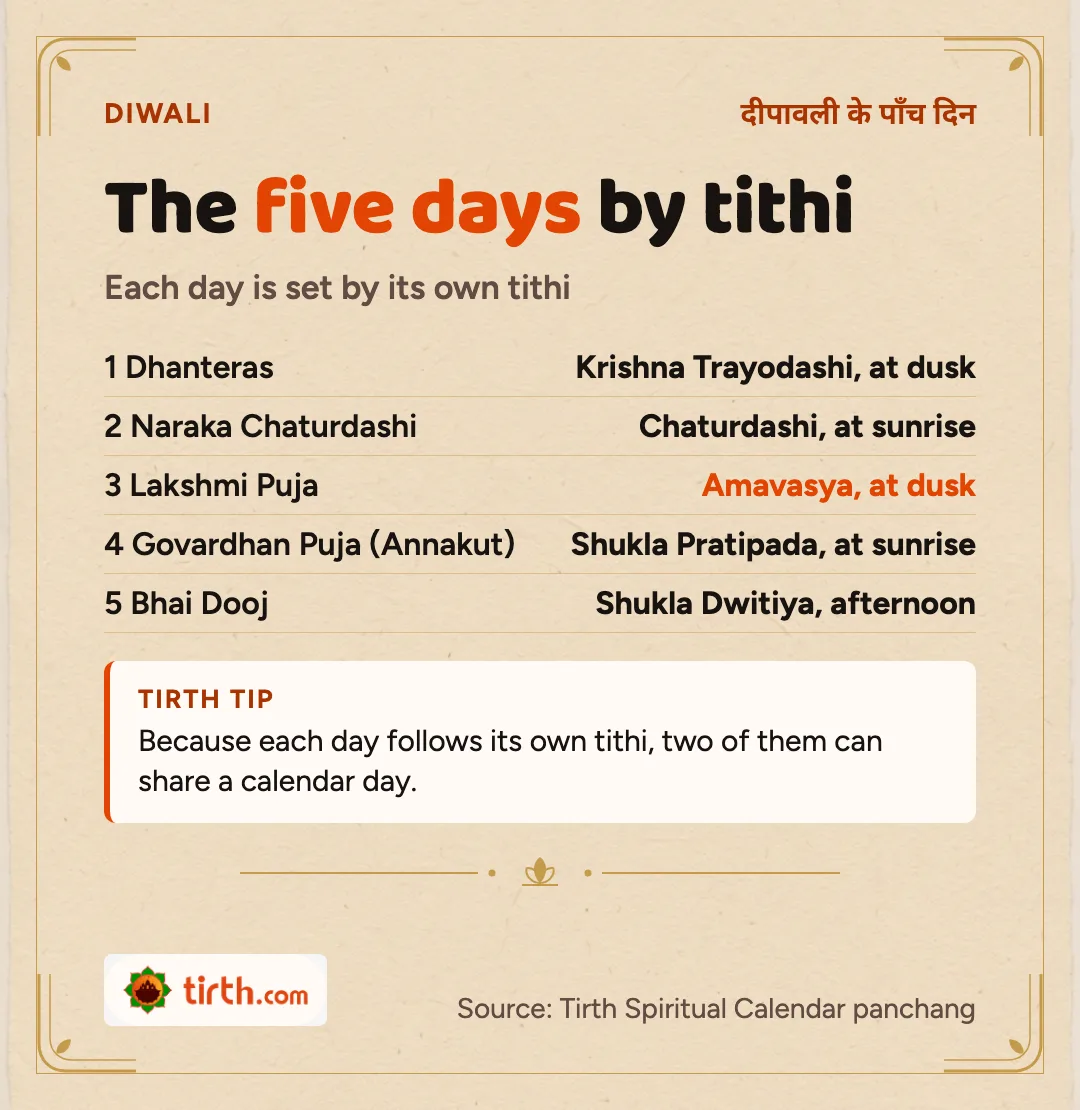
Every day belongs to a tithi (lunar day). The catch is that each tithi gets tested at a different hour, dusk for one day, sunrise for another and the afternoon for Bhai Dooj, so the five days do not always land on five calendar days one after the other.
| Day | Name | Tithi, and when it must hold | What families do |
|---|---|---|---|
| 1 | Dhanteras (Dhantrayodashi) | Kartika Krishna Trayodashi, at dusk | Buy gold, silver or new utensils; worship Lakshmi and Kubera; light a lamp outside for Yama |
| 2 | Naraka Chaturdashi (Choti Diwali, Roop Chaudas) | Chaturdashi, at sunrise | Oil bath before sunrise (Abhyang Snan) |
| 3 | Lakshmi Puja | Amavasya, at dusk (pradosh) | Lakshmi and Ganesha puja, lamps through the night |
| 4 | Govardhan Puja (Annakut) | Kartika Shukla Pratipada, at sunrise | A Govardhan of cow dung or a mountain of cooked food, cows worshipped |
| 5 | Bhai Dooj (Yama Dwitiya) | Shukla Dwitiya, in the afternoon (aparahna) | Sisters put a tilak on their brothers and pray for their long life |
Naraka Chaturdashi is read at sunrise, Lakshmi Puja at dusk. When Chaturdashi is still running as the sun comes up and hands over to Amavasya later that morning, both fit inside one long day, with the oil bath at dawn and the Lakshmi Puja in the evening.
The same pattern can open a gap further on. In some years Amavasya is still running at the next sunrise, so Pratipada only holds at sunrise the morning after and Govardhan Puja moves one more day along. That leaves an in-between day, which many families use only for the Diwali bath and Devpuja. Bengal goes by midnight instead. Its Kali Puja is kept on whichever night has Amavasya at midnight, which in most years is the same night as Lakshmi Puja.
People abroad often trip over the month name. North India’s Purnimanta calendar calls the Diwali new moon Kartika Amavasya, while the Amanta calendar used in Gujarat, Maharashtra and the South calls it Ashwin Amavasya. Same night, two names for the month.
Dhanteras, the day Dhanvantari rose with the amrit
You will also hear it called Dhantrayodashi, or Dhanvantari Trayodashi, and that second name holds the story. When the gods and asuras churned the ocean, says the Bhagavata Purana (Canto 8, chapter 8), Dhanvantari came up out of it holding a jug full of amrit, the nectar of immortality. The same text calls him a partial incarnation of Bhagwan Vishnu, well versed in medicine, and lists him as the twelfth incarnation (1.3.17). Ayurveda honours him as its teacher. Families pray to him for good health on this day, which is also kept as Dhanvantari Jayanti.
Maa Lakshmi rose from that same churning. Her choice of husband was Vishnu (Mukunda), and she showed it with a garland of lotuses, so the Bhagavata tells it. Lakshmi and Kubera share the worship on Dhanteras, and many families come home that day with jewellery, gold, silver or new utensils.
Yama Deepam is a lamp for Yama, the god of death, set outside the home once darkness falls, and the prayer that goes with it asks that nobody in the family meets an untimely death. There is more on Dhanteras, the first day, and the Dhanteras aarti is there if you want to sing it at the evening puja.
Why is the Choti Diwali bath taken before sunrise?
Names pile up on the second day. North India says Choti Diwali, “small Diwali”, and also Roop Chaudas or Roop Chaturdashi, while Tamil Nadu and most South Indian states call it Deepavali itself and keep it as the most important of the five days.
For the story, turn to Canto 10, chapter 59 of the Bhagavata Purana. Naraka (Bhauma is his other name) had stolen Aditi’s earrings and Varuna’s umbrella, and Aditi is the mother of the gods. Lord Krishna set out on Garuda, Satyabhama with him, for Pragjyotishapura, Naraka’s fortified capital. The moat had a guard, Mura, a demon with five heads, and Krishna killed him first before taking Naraka’s head off with the Sudarshana chakra. Inside, sixteen thousand royal maidens had been imprisoned by Naraka, and Krishna set them free, sent them on to Dwarka and married them. The Vishnu Purana has it too.
Tradition holds that Krishna bathed with oil at Brahma muhurat after the battle. The Abhyang Snan is that bath, with sesame oil and ubtan (a paste of herbs and flour), and it belongs before sunrise, while Chaturdashi is still running. That is the key rite of the day. A twig of apamarga is moved around the head in some homes during the bath, with a prayer to be free of sin and of the fear of Naraka. Of the three Diwali bath days, Chaturdashi, Amavasya and Pratipada, many families count this one the most important.
Flowers and mango leaves go up on doors and windows too. In Goa, large effigies of Narakasura are burnt before dawn, which is how the day begins there.
Lakshmi Puja night, and what Valmiki says about Ram’s return
Of the five, the third day, the Amavasya, matters most. For North India it is the night that marks the return of Shri Ram to Ayodhya with Sita ji and Lakshmana, fourteen years of exile behind him and Ravan defeated, as the tradition tells it.
Read the welcome itself in the Valmiki Ramayana, Yuddha Kanda, sarga 127. Bharata orders the road from Nandigrama levelled. The ground is sprinkled with water and strewn with parched grain and flowers, flags line the streets, and Bharata walks out to meet his brother carrying Ram’s sandals on his head. Valmiki does not mention lamps. The lamps for Ram on the new-moon night come from tradition, and families light rows of diyas to remember that homecoming. Say so to your children.
Lakshmi and Lord Ganesha are worshipped together at dusk, Ganesha for good beginnings and Lakshmi for wealth and prosperity. Their images are installed and offered flowers, sweets, silver or gold coins and lit diyas. A fuller sequence of pujas is set out step by step in our Lakshmi Puja guide linked below. Its advice is a muhurat where a fixed (sthir) lagna, pradosh and Amavasya all meet. It also allows the puja to start a little earlier, so that the Lakshmi part falls inside. For New Delhi, that window is in the card at the top.
Leave the puja lamp burning all night. Reading the Shri Suktam and other Lakshmi mantras after the puja is recommended, and so is staying awake if you can manage it. The step-by-step order, samagri included, is in how to do Lakshmi Puja at home.
Govardhan Puja and Annakut, the mountain of food
Kartika Shukla Pratipada brings Govardhan Puja, also known as Annakut Puja, in honour of Lord Krishna and Govardhan hill. The Bhagavata Purana tells it in Canto 10, chapters 24 and 25. In them Krishna asks Nanda why Vraja worships Indra. Then he talks the cowherds round, and everything gathered for Indra’s sacrifice goes to the cows, the brahmanas and the hill instead. They cooked sweet rice, vegetable soups, baked and fried cakes and every kind of milk product. Everyone was fed. Even the dogs. Krishna took a huge form, declared “I am Govardhana” and ate the offerings.
Indra was angry. He sent the Samvartaka clouds to flood Vraja, and up went Govardhan in one hand of Krishna’s, as easily as a child holds a mushroom, with the people and the cattle sheltering under it for seven days until Indra called his clouds back. Many retellings say “little finger” and “many days”. The Bhagavata says one hand and seven days.
At home a Govardhan is shaped from cow dung, usually as a reclining figure, and worshipped in the evening with kheel and batasha. Annakut means “a mountain of food”. Families far from the real hill heap cooked grains into a small Govardhan of their own, because anna (food) is held sacred. Once the puja is done, the family goes round it seven times while one person pours a thin stream of water and another scatters kheel or barley along the path. The cattle get their share of worship too, cows, calves and bulls alike, and a cow at home is dressed up in red and yellow and fed the first portion of the day’s cooking. The Govardhan Puja story and Annakut has more.
Bali Pratipada falls on that Pratipada as well. Bhagwan Vishnu as Vamana sent King Bali, generous but proud, down to the netherworld (the Vamana story is in the Bhagavata Purana, Canto 8, chapters 18 to 23), and the day remembers the visit to the earth that Bali is believed to make once a year. Maharashtra calls it Bali Padva, or Diwali Padwa. Gujarat keeps it as the New Year, Bestu Varas, and the old account books are closed that day and new ones opened.
Bhai Dooj and Yama’s meal at his sister’s home
Bhai Dooj comes on Kartika Shukla Dwitiya, and Maharashtra knows it as Bhau Beej, Bengal as Bhai Phonta. It is Yama Dwitiya too. At the centre of its story is Yama, the god of death. His sister Yamuna asked him home for a meal. He was so pleased that he granted a boon, that whoever eats at his sister’s home on this day is spared the torments of Yamaloka.
That is the reason sisters put a tilak on their brothers’ foreheads on Bhai Dooj and pray that they live long, happy lives, while brothers give them gifts. The same day is also Chitragupta Puja, and the full day has its own page, Bhai Dooj.
Kali Puja, Chopda Pujan and the other Diwalis of India
It is one new moon. What people do on it changes from state to state.
- In North India the evening belongs to Lakshmi Puja and to the memory of Shri Ram’s return.
- West Bengal, Odisha and Assam keep Kali Puja (Shyama Puja) in place of Lakshmi Puja, and Maa Kali is worshipped at midnight.
- Gujarat’s business families start their new account books (chopda) at the Lakshmi Puja, so there it is Chopda Pujan, with Sharada Puja that evening too.
- The next day, Bali Pratipada, Maharashtra marks King Bali’s yearly return as Bali Padva.
- For Tamil Nadu and most of the South, Deepavali is Naraka Chaturdashi and its oil bath at dawn.
Jains keep this night for Mahavira’s nirvana. The Kalpa Sutra says he died in the last night of the fifteenth day of the dark half of Kartika, at Pava, and that the eighteen confederate kings lit an illumination, saying that since the light of intelligence was gone they would make a light of material things. For Sikhs it is Bandi Chhor Divas. Guru Hargobind was released from Gwalior prison that day, along with 52 Hindu kings, and the Harmandir Sahib in Amritsar is lit up.
How should a family plan the five days?
The house is cleaned and whitewashed or painted, new clothes and household things are bought, and sweets are made at home. Don’t try to clean the whole house in one go. A room or a cupboard at a time, over several days, works fine (nobody wants to be scrubbing the kitchen on the evening of the Lakshmi Puja). If parents or children have to travel home, plan the travel and the leave around the Lakshmi Puja night.
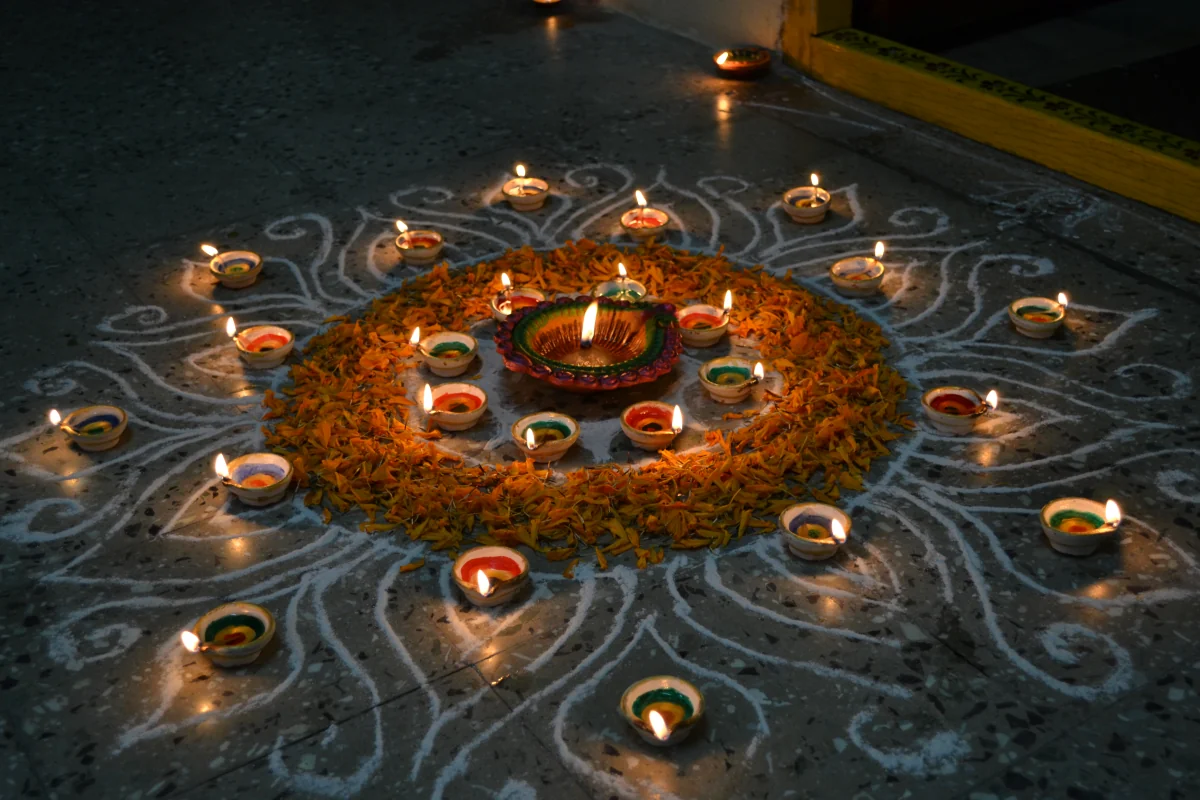
Do only what your household can manage on each day, and do it properly. A lamp for Yama on Dhanteras. The dawn bath on Choti Diwali. On the main night, rangoli at the door to welcome Lakshmi, often with Lakshmi Pada (her footprints) worked into the design. Govardhan Puja can be Annakut or simply the cow’s first portion, and Bhai Dooj is the tilak. We would rather see one Lakshmi Puja done slowly inside its muhurat than five days rushed, because the Amavasya puja is the one the whole festival turns on.
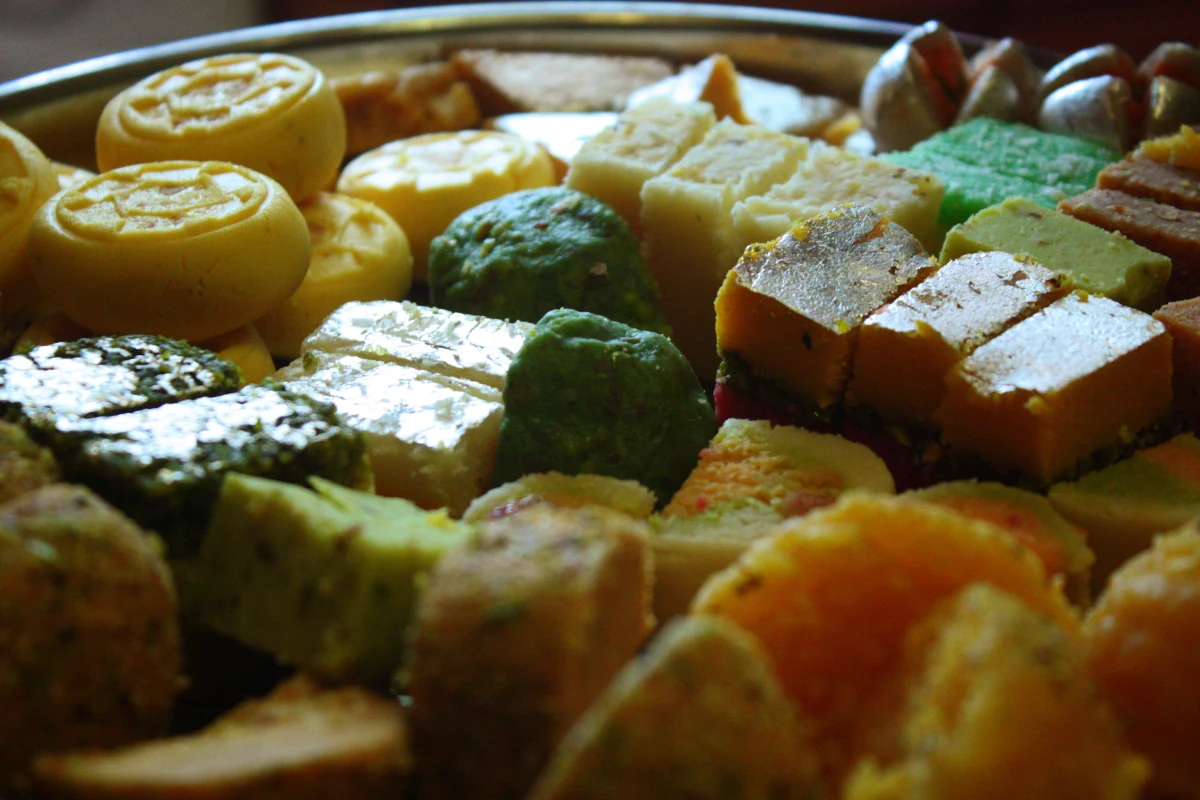
Each rite goes better with its story told first, to the children especially, so Dhanvantari and the amrit jug, Krishna and Narakasura, Bharata with the sandals, the hill held up for seven days and Yamuna’s meal all get their turn. Keep spending modest. What you share with relatives and neighbours, sweets, dry fruits and gifts, counts for more than the size of the bill. Firecracker hours on Diwali night are limited in many cities now. Check yours.
Open the Diwali page in the Tirth Spiritual Calendar for timings in your own city before you plan the evenings.
Frequently asked questions
What are the 5 days of Diwali?
Dhanteras, Naraka Chaturdashi (Choti Diwali), Lakshmi Puja on the new moon, Govardhan Puja (Annakut) and Bhai Dooj. Each follows its own tithi. So two can fall on one calendar day, and a quiet day can sit between two of them.
Why is Diwali celebrated?
For North India it is Shri Ram coming back to Ayodhya after fourteen years of exile, Ravan defeated. The South remembers Krishna’s victory over Narakasura. The night is Lakshmi’s too, the goddess who rose out of the churned ocean.
Why are Choti Diwali and Diwali sometimes on the same day?
Two different clocks. Choti Diwali needs Chaturdashi at sunrise, while Lakshmi Puja needs Amavasya at dusk, so a Chaturdashi that ends in the morning followed by an Amavasya that lasts into the evening puts both on one day.
Which day of Diwali is the most important?
For most of India, Lakshmi Puja on the Amavasya, the third day. Bengal, Odisha and Assam keep that new moon as Kali Puja, and in Tamil Nadu and most South Indian states the big day is Naraka Chaturdashi, kept as Deepavali itself.
Why is a lamp lit for Yama on Dhanteras?
The prayer with the Yama Deepam, lit outside the home after dark, is that nobody in the family meets an untimely death. Yama turns up again on the last day, Bhai Dooj, as the brother who ate at his sister Yamuna’s home.
Do Jains and Sikhs celebrate Diwali?
Yes. For Jains it is the night of Mahavira’s nirvana at Pava. Sikhs keep it as Bandi Chhor Divas, the day Guru Hargobind was released from Gwalior prison, and the Harmandir Sahib in Amritsar is lit up.