
Dhanvantari mantra in Sanskrit and English, with word-by-word meaning
Tirth editorial · 13 Jan 2026 · 8 min read
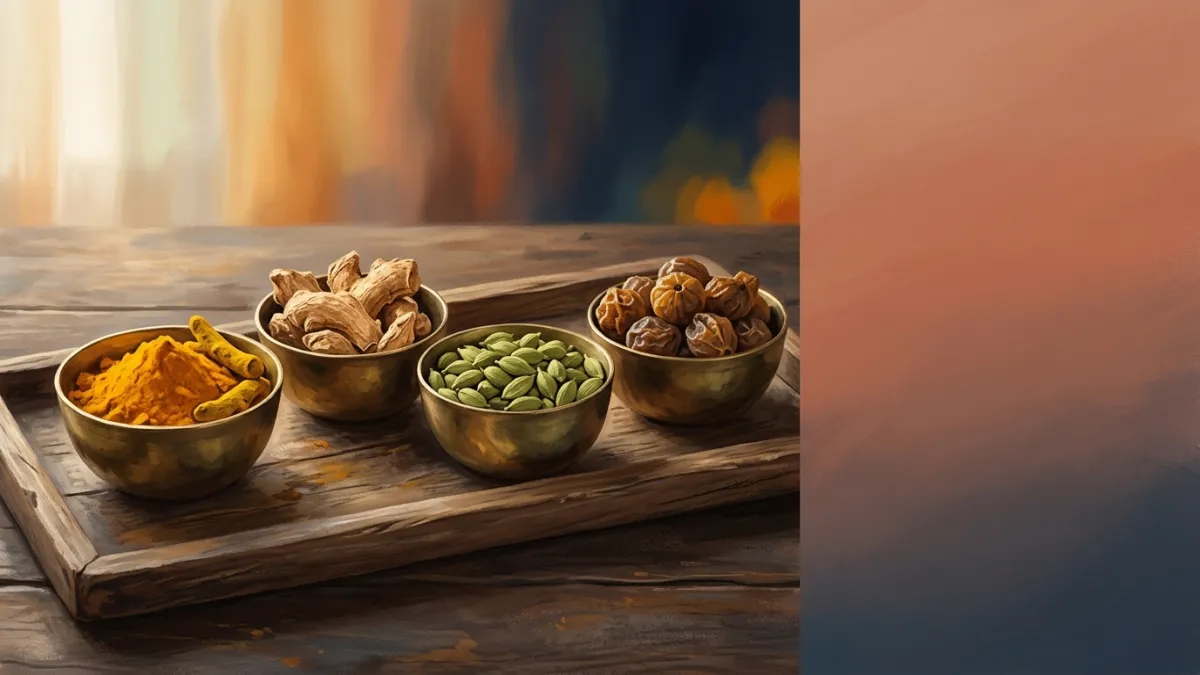
The Dhanvantari mantra is a salutation to Dhanvantari, the physician of the gods. Its common form opens “Om namo bhagavate Vasudevaya Dhanvantaraye”, then names him as the one who holds the pot of amrita in his hand, the destroyer of all diseases and the lord of the three worlds, and it ends with a bow to Shri Mahavishnu, the great Vishnu.
That pot comes from the churning of the ocean. In the Bhagavata Purana’s telling, Dhanvantari rises out of the ocean carrying a pot full of amrita, and when the asuras see it they seize the pot by force (8.8.35). The verse just before, 8.8.34, calls him a partial incarnation of Vishnu. “A portion of a portion”, in its words.
Om namo bhagavate Vasudevaya Dhanvantaraye in Sanskrit and English
We have taken the text from the published form, which gives the mantra in Devanagari and in Roman letters, in the form with Vasudevaya.
ॐ नमो भगवते वासुदेवाय धन्वन्तरये अमृतकलश हस्ताय सर्वामय विनाशनाय त्रैलोक्यनाथाय श्री महाविष्णवे नमः
Om namo bhagavate Vasudevaya Dhanvantaraye amritakalasha-hastaya sarvamaya-vinashanaya trailokya-nathaya Shri Mahavishnave namah
In plain English: Om. Salutations to the blessed one, to Vasudeva, to Dhanvantari, to the one holding the pot of amrita in his hand, to the destroyer of all diseases, to the lord of the three worlds, to Shri Mahavishnu, the great Vishnu.
Your own book may read a little differently. The Dhanvantari Stotram opens and closes with this same mantra minus one word, Vasudevaya, so its line starts “Om namo bhagavate dhanvantaraye” instead.
There is a third form as well, and it ends in svaha. It comes from a different text, the Dhanvantari Mantra, which was encoded and proofread from published sources.
ॐ नमो भगवते धन्वन्तरये अमृतकलशहस्ताय सर्वामयविनाशनाय त्रिलोकनाथाय विष्णवे स्वाहा
Om namo bhagavate dhanvantaraye amritakalashahastaya sarvamayavinashanaya trilokanathaya vishnave svaha
The text itself calls this a 41-syllable mantra, and its notes say this form is shorter than the versions in popular use. Around the mantra the edition sets out the usual frame. A rishi is named. Trishtubh is the metre, Dhanvantari the deity, Om the bija and Svaha the shakti, with the dhyana (meditation) verse put in just ahead of the mantra itself.
If nobody at home has taught you a form, we would start with the first, the one with Vasudevaya, because the form with Vasudevaya is printed in full and gives a meaning for every word. Or rather, start there unless you already have one. One that came from your family or your teacher is the one to keep.
What each word of the Dhanvantari mantra means
All the meanings in the table come from one book, the Monier-Williams Sanskrit-English Dictionary (1899), which we read in the Cologne Digital Sanskrit Dictionaries. Its printed page sits in the last column (useful if a word in your copy looks different and you want to open the entry yourself).
| Word | Meaning | Monier-Williams page |
|---|---|---|
| om (ॐ) | Sacred syllable; a word of solemn affirmation, uttered before any prayer, also a particle of auspicious salutation | 235 |
| namo, namah (नमो, नमः) | Salutation, bow, obeisance | 528 |
| bhagavate (भगवते) | To the Lord, the blessed or adorable one. Bhagavat means glorious, divine, adorable, venerable; as a noun, “the divine or adorable one”, a name of Vishnu-Krishna | 743 |
| Vasudevaya (वासुदेवाय) | To Vasudeva, a patronymic of Krishna (son of Vasudeva) | 948 |
| Dhanvantaraye (धन्वन्तरये) | To Dhanvantari, “the physician of the gods” | 509 |
| amrita (अमृत) | The nectar of immortality produced at the churning of the ocean | 82 |
| kalasha (कलश) | Pot, pitcher, jar | 260 |
| hastaya (हस्ताय) | From hasta, hand. At the end of a compound it means holding in the hand, so amritakalasha-hastaya is “to the one holding the pot of amrita” | 1294 |
| sarva (सर्व) | All, every, whole | 1184 |
| amaya (आमय) | Sickness, disease | 146 |
| vinashanaya (विनाशनाय) | From vinashana: removal, destruction; as an adjective, destroying, a destroyer. Sarvamaya-vinashanaya is “to the destroyer of all diseases” | 969 |
| trailokya (त्रैलोक्य) | The three worlds | 462 |
| nathaya (नाथाय) | To the lord or protector, so trailokya-nathaya is “to the lord of the three worlds” | 534 |
| Shri (श्री) | Honorific prefix to the names of deities (“sacred”, “holy”); also radiance, glory | 1098 |
| Mahavishnave (महाविष्णवे) | To Mahavishnu, the great Vishnu (maha: great) | 800 |
One grammar note, also from Monier-Williams. With namah you will often see the dative case, the way ramaya namah means “salutation to Rama”.
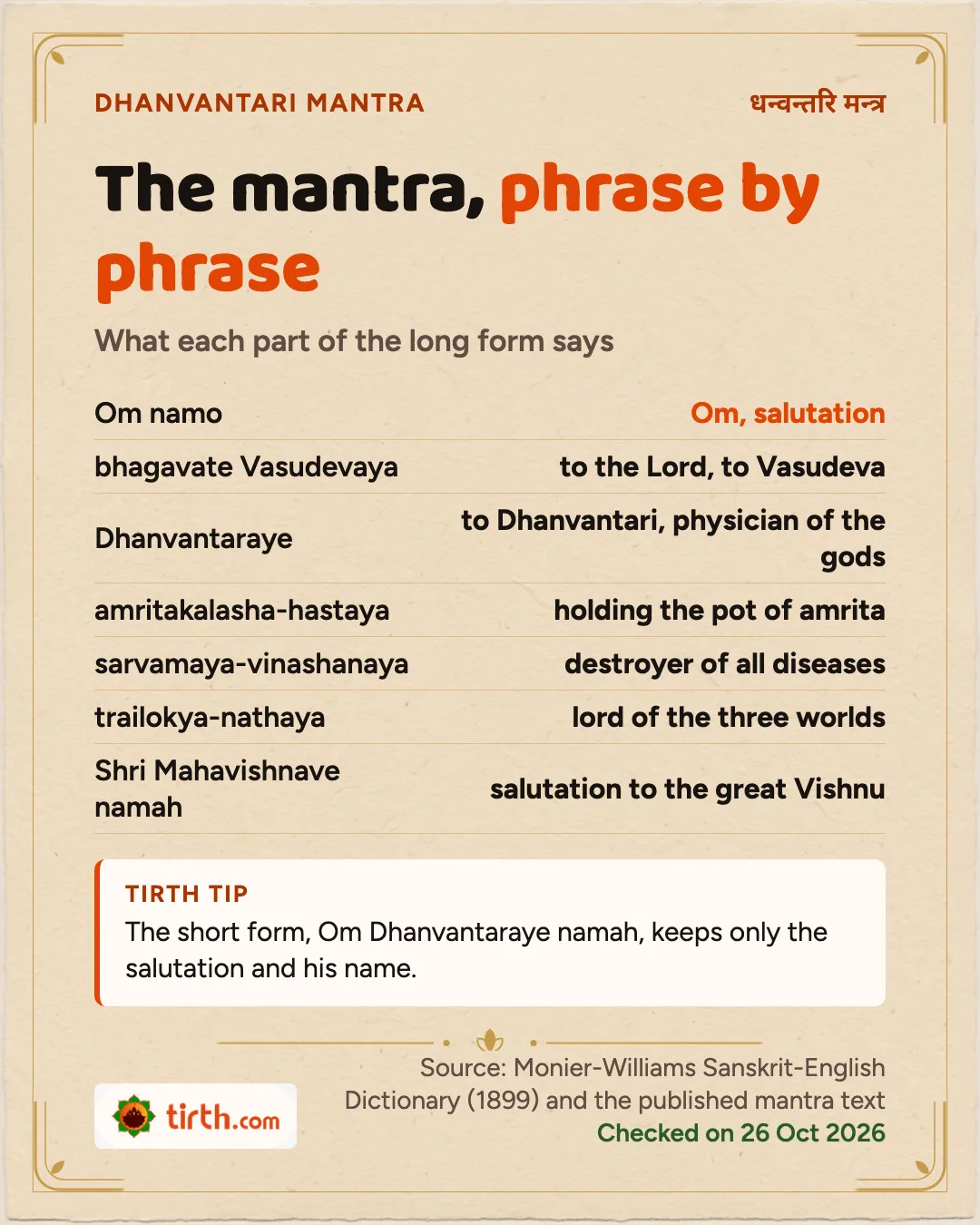
The short form, Om Dhanvantaraye namah
ॐ धन्वन्तरये नमः
Om Dhanvantaraye namah
In plain English: Om, salutation to Dhanvantari.
Open the Dhanvantari Ashtottara Shatanamavali, the list of his 108 names, and this short name mantra is the very first. You will meet it again in the Dhanvantari Sahasranamavali, his 1,000 names. If your mother or father finds the long line hard going, give them this one, since it carries the same name and the same salutation.
Who is Dhanvantari in the Bhagavata Purana and the Sushruta Samhita?
This page quotes two passages of the Bhagavata Purana. The eighth book has him at the churning of the ocean (8.8.34) as a partial incarnation of Vishnu, a being entitled to a share of the sacrificial offerings who knows medicine well. The verse’s own word for that is ayur-veda-drik.
The other passage is 2.7.21, in the second book. By his very name alone, it says, Dhanvantari quickly takes away the diseases of those who suffer from many illnesses. Those are the Purana’s words about his name. In the same verse he wins long life and a share of sacrifices for the gods, then comes down to the world to teach ayushya-veda, the science of life.
For his form, the printed dhyana verses give him four arms, holding a conch, a discus, leeches and a pot of amrita. Another dhyana changes the hands, with a divine herb in the right and the pot of amrita and the leeches held together in the left. Vishnu himself has the Bhagwan Vishnu page, and the Vishnu mantras on Tirth gather more prayers to him.
The Sushruta Samhita has a different account. Its Sutrasthana opens, in Chapter 1, with Dhanvantari born as Divodasa, king of Kashi, and with sons of sages arriving to ask him for the teaching of Ayurveda. Sushruta is one of them. The chapter also follows the knowledge back. Brahma passed it to Prajapati, the chapter says, and Prajapati to the Ashvins, who gave it to Indra, who gave it to Dhanvantari. Monier-Williams has the later birth too. Under Dhanvantari it names Divodasa, king of Kashi, as his later existence.
Is the Dhanvantari mantra chanted on Dhanteras?
Dhanteras is Dhanvantari’s day in the panchang, and his puja is done that day, but the puja vidhi we read does not print this mantra, and none of the sources on this page ties this exact mantra to the day.
Of the five days of Diwali, Dhanteras is day one, and the Diwali Lakshmi Puja comes two days after it. In the panchang it is Trayodashi, the 13th lunar day, of the Krishna paksha (waning moon), in Kartika as North India’s purnimanta calendar counts the months. It has a second name, Dhanvantari Trayodashi.
Dhanteras in 2026: Friday, 6 November. Kartika Krishna Trayodashi, New Delhi. Diwali follows on 8 November.
We work out dates and timings for New Delhi on the traditional North Indian panchang and then check them against published panchangs. Your city will differ, so look up your own place in the Tirth Spiritual Calendar.
On this day many families worship Dhanvantari and pray for good health, and for anyone who practises Ayurveda it is a very significant day. The Dhanvantari Puja Vidhi keeps a fixed order, beginning with achamana and then the sankalpa, in which the day is named as Kartika Krishna Trayodashi, followed by self-purification, dhyana on Dhanvantari with a ghee lamp lit, avahana, and a pushpanjali of five flowers with a welcome. Padya and arghya come next, and after them sandal paste, flowers, incense, the lamp, naivedya, water, tambula and dakshina. To finish there is pradakshina, pushpanjali with a salutation, sashtanga pranam and kshama prarthana, and the kshama prarthana ends by offering the whole puja to Dhanvantari. You will not find a repetition count in that vidhi, and it does not print the Om namo bhagavate mantra at all.
Many people seeking relief from illness chant it, and so do practitioners of Ayurvedic medicine.
If you are saying it for someone in the family who is unwell, keep this in mind. Say it alongside treatment. It does not replace medical care.
The Dhanteras aarti covers the rest of the day’s worship. Two days on, at the Lakshmi Puja, you will want the Lakshmi mantras. A pandit can also do the puja for your family if you book a puja through Tirth.
The day has a government link too. India’s Ayurveda Day used to be held on Dhanteras every year, in honour of Dhanvantari, until a Gazette notification of the Government of India gave it a fixed day of its own.
Two more places to go from here are the Maha Mrityunjay mantra and the whole mantra collection on Tirth.
Frequently asked questions
How many times is the Dhanvantari mantra chanted?
None of the sources here gives a number. The Dhanvantari puja vidhi is silent on it, and so are the texts this page quotes.
Is Dhanvantari an avatar of Vishnu?
Yes, a partial one, in the words of the Bhagavata Purana at 8.8.34.
What is the difference between the long and the short Dhanvantari mantra?
They differ in length and in titles. Om Dhanvantaraye namah is just his name with a bow, while the long mantra adds what he holds, what he destroys and what he rules, then finishes with Shri Mahavishnu.
Why does one version end in svaha instead of namah?
It follows the edition that names the rishi and the metre, which prints svaha and gives Svaha as the shakti of the mantra. Both the Stotram and the form with Vasudevaya close on namah.
Who was Divodasa?
Kashi’s king, in the Sushruta Samhita. That text has Dhanvantari taking birth as Divodasa, with Sushruta among the pupils who asked him for Ayurveda.
Is Dhanvantari Trayodashi the same day as Dhanteras?
Yes. It is one day with two names.
Continue on Tirth
- Dhanteras: the day, the customs and the story.
- Lakshmi mantras with meaning, for the days after Dhanteras.
- Vishnu mantras on Tirth.
- Book a puja with a Tirth Pandit for your family.