
Dhanteras: why it is celebrated, Dhanvantari puja and the Yama Deepam
Tirth editorial · 10 Feb 2026 · 10 min read
Dhanteras is the evening when families worship Maa Lakshmi with Kubera, the god of wealth, after sunset. They also honour Dhanvantari, physician of the gods, and set a lamp outside the door for Yama. The date is Krishna Trayodashi of Kartika, the 13th day of the waning moon, and with it the main days of Diwali begin. Its other name is Dhantrayodashi.
That month name needs a word. North Indian panchangs count the day in Kartika, while the amanta calendar calls the very same day Ashwin Krishna Trayodashi. The evening decides the date. Dhanteras is kept on the day Trayodashi is still running at pradosh kaal, the window that opens at sunset, and so the Lakshmi-Kubera puja and the lamp for Yama both belong to dusk, even in a year when the tithi starts only a few hours before the puja.
Dhanteras in 2026: Friday, 6 November. Trayodashi tithi: 10:29 AM on 6 November to 10:47 AM on 7 November. Sunset in New Delhi: 5:32 PM, when pradosh kaal begins.
Checked on 26 Oct 2026. Dhanteras timings for your city in the Tirth Spiritual Calendar
Dates and timings are calculated for New Delhi using the traditional North Indian panchang. Timings change from city to city, sometimes by more than an hour for moonrise; see the Tirth Spiritual Calendar for your location.
What does Dhanteras mean, word by word?
Split the word in two. Dhan is wealth, teras is thirteenth, and thirteenth here means the Trayodashi tithi, the 13th lunar day of the fortnight, so the name carries both the wish and the day of the month. Look in a panchang and you will also find the day listed as Dhantrayodashi, Dhanvantari Trayodashi and Dhanvantari Jayanti, the last two because Dhanvantari’s birth anniversary is kept on this same Trayodashi.
Hear only the money in it and most of the evening slips past you. Lakshmi and Kubera are asked for wealth, but Dhanvantari is the physician of the gods, and the lamp set out for Yama carries a prayer that no one in the family is taken before their time.
Why do we keep Dhanteras?
Three figures are honoured that evening, and what we know about each of them has come down from a different place. The Bhagavata Purana tells the stories of two, Dhanvantari and Lakshmi, without naming a day for either of them. Yama, the third, gets a rite the panchangs set for this evening. It helps to know which is which.
Dhanvantari rises with the nectar
In the Bhagavata Purana (8.8.33 to 35) the ocean is churned and Dhanvantari rises out of it holding a jug of nectar. He is, in the text’s words, a portion of a portion of Vishnu, and he knows ayurveda, the science of medicine. The asuras grabbed the jug off him straight away.
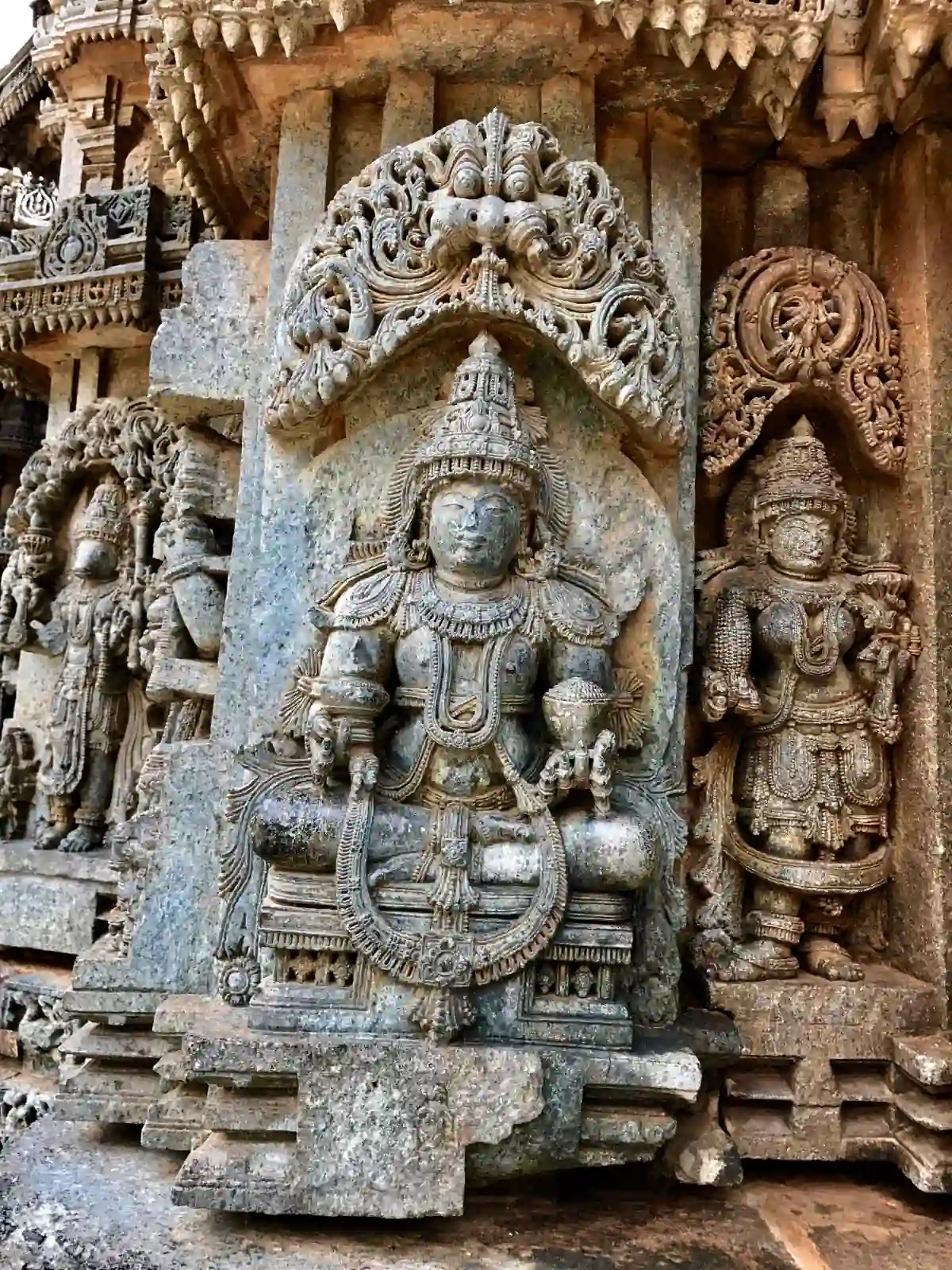
Search the Bhagavata for a tithi or a month and you will not find one. The tie to Kartika Krishna Trayodashi comes from the festival calendar, which holds by tradition that this is the day he rose from the ocean, so the day is kept as Dhanvantari Jayanti and people who practise Ayurveda mark it in particular. (When you tell the story at home, say both things plainly. The Purana gives the event and the festival calendar gives the day.) One prayer to him is the Dhanvantari mantra.
Lakshmi, the churning and the Kubera puja
Lakshmi comes up out of the same churning, in the same chapter (8.8.8, and 8.8.23 to 24). She is called Rama there, and she chooses Vishnu and garlands him, but again the text names no tithi for any of it. The festival’s own tradition does join her rising to Dhanteras. That joining is the festival’s own reading of the story, and you will not find it in the Bhagavata.
Her Dhanteras puja is with Kubera, the god of wealth, once the sun is down and pradosh kaal has begun. Many families rate the Lakshmi Puja two days on, at Amavasya, as the more significant one. Our guide to Lakshmi Puja on Diwali walks through that night step by step.
A lamp outside the door for Yama
Yama Deepam, or Yama deepdaan, is the third rite. Someone in the house lights a lamp outside at sandhya, the evening twilight of Trayodashi, and offers it to Yama, the god of death. With it goes a prayer that no member of the family meets an untimely death.
Later in the Diwali week Yama has a katha of his own, and you can read it in the Yama Dwitiya katha.
How do you do the Dhanteras puja at home?
Think of the day in three parts. Dhanvantari earlier in the day. Lakshmi and Kubera at dusk, and last of all the lamp for Yama outside the door. The three steps below follow that order, with the time of day for each.
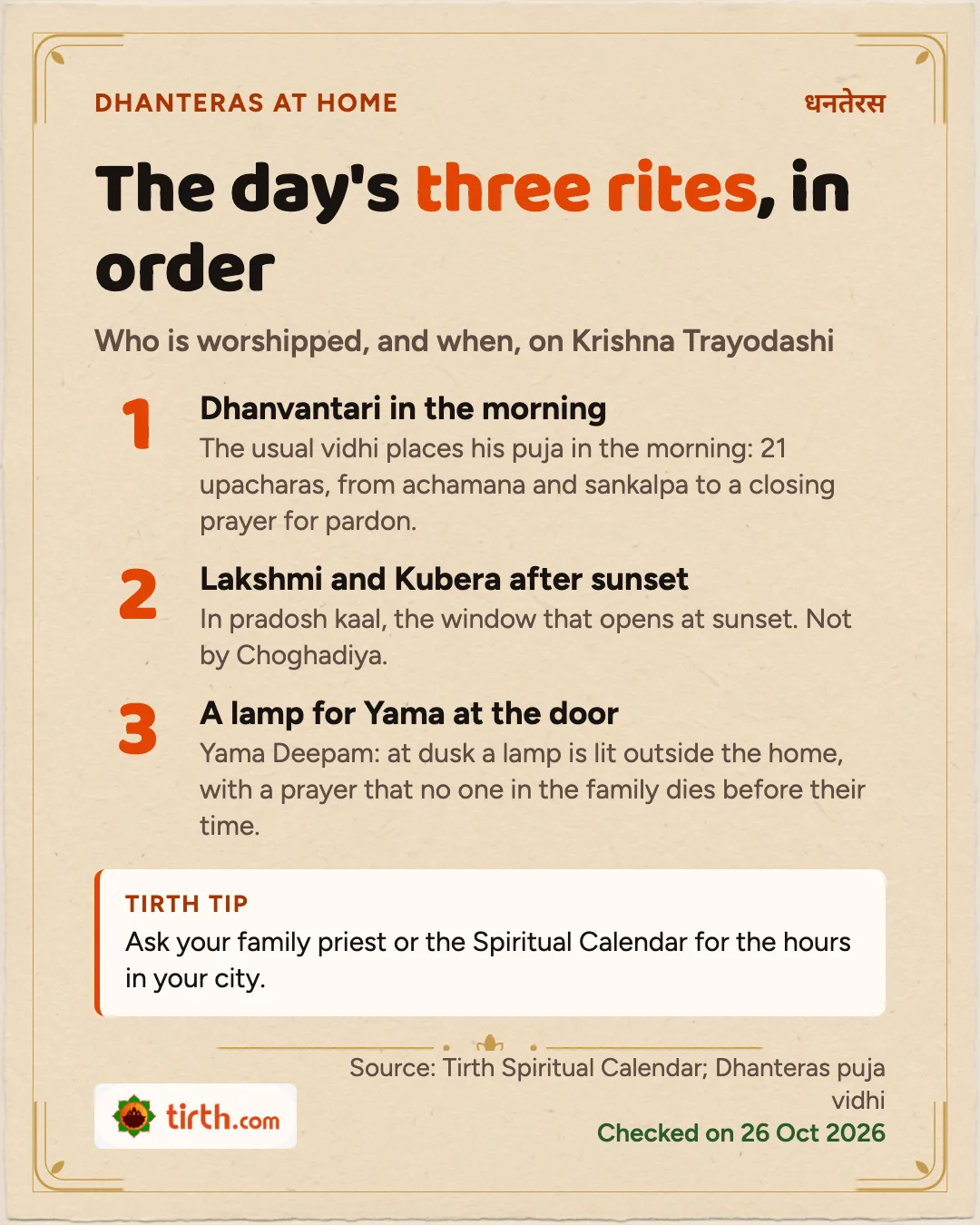
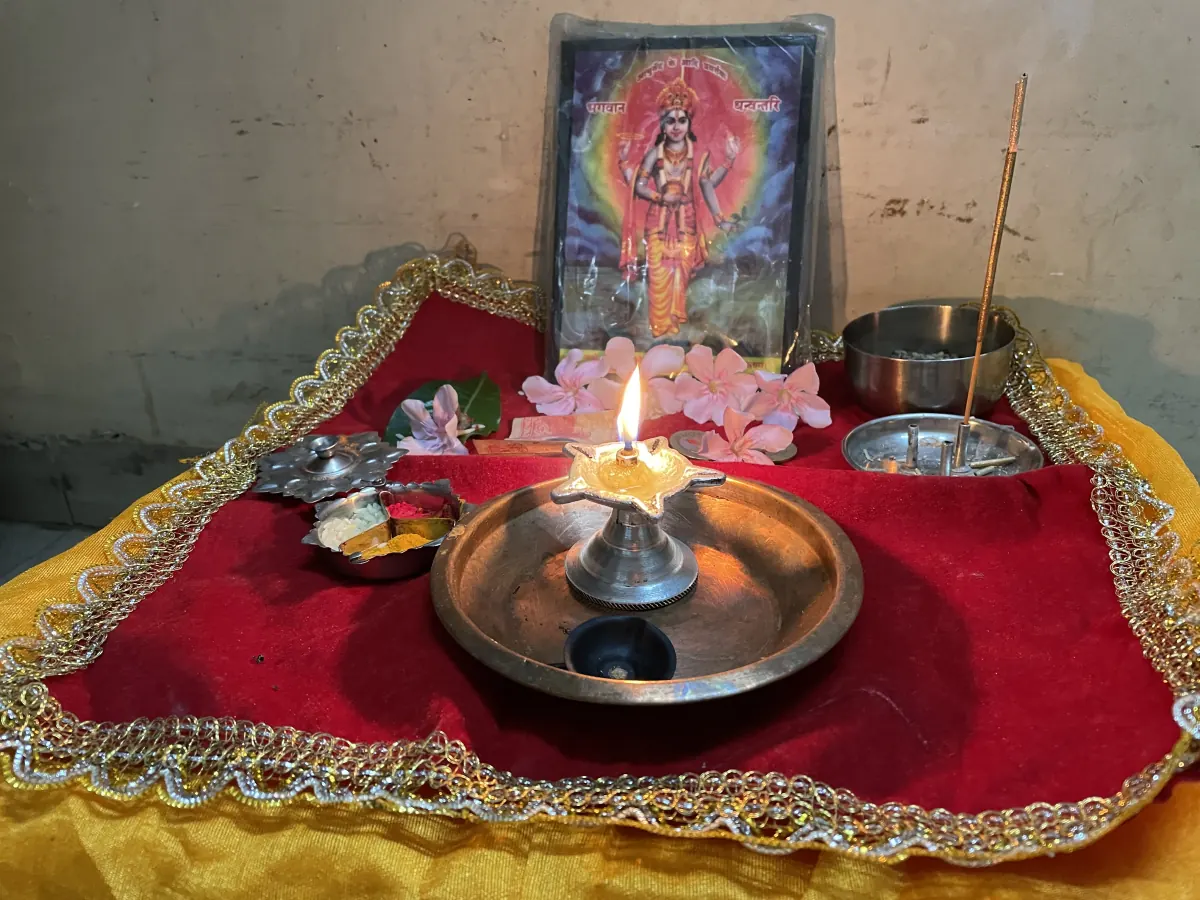
- Begin with Dhanvantari. His puja belongs to the morning (pratahkala) of Dhanvantari Trayodashi in the usual vidhi, which stops short of a clock time, so your family priest or the Spiritual Calendar for your city will have to settle the hour. The puja goes through the upacharas, the offerings you would make to an honoured guest. In order, they are achamana and sankalpa (sipping water and stating your intention), atma-shodhan (purifying yourself), dhyana before a ghee lamp, avahana (inviting him), five flowers offered as his seat, a welcome, water to wash his feet (padya), arghya (water offered with sandal, flowers and rice), sandal paste, flowers, incense and the lamp. Next he is offered naivedya (sweets, curd, milk and ghee) and water to sip once more, followed by tambula (betel leaf and areca nut), dakshina, pradakshina (walking around the altar), flowers with a prayer, a full prostration, and last a prayer asking pardon for any mistake. Counted out, that is the usual 21 steps, listed in this order. If you want to end with the Dhanteras aarti (Jai Dhanvantari Deva), its words are on a separate page.
- After sunset, in pradosh kaal, worship Lakshmi and Kubera. Pradosh kaal is the evening window that opens at sunset. The box at the top has the New Delhi sunset, and the Spiritual Calendar has yours. Don’t go by Choghadiya for this one. Choghadiya is a travel reckoning, and the usual advice is to leave it out of this puja.
- Finish at the door with Yama. When dusk comes, a lamp goes outside as your offering to him, and the prayer is that nobody in the family dies before their time. (Choose a spot where it can burn itself out safely, clear of curtains, rangoli powder and small feet.)
Tirth also lists a samuhik (collective) Mahalakshmi-Kuber puja and havan in Ayodhya for Dhanteras.
What you need for the Dhanvantari puja and the Yama lamp
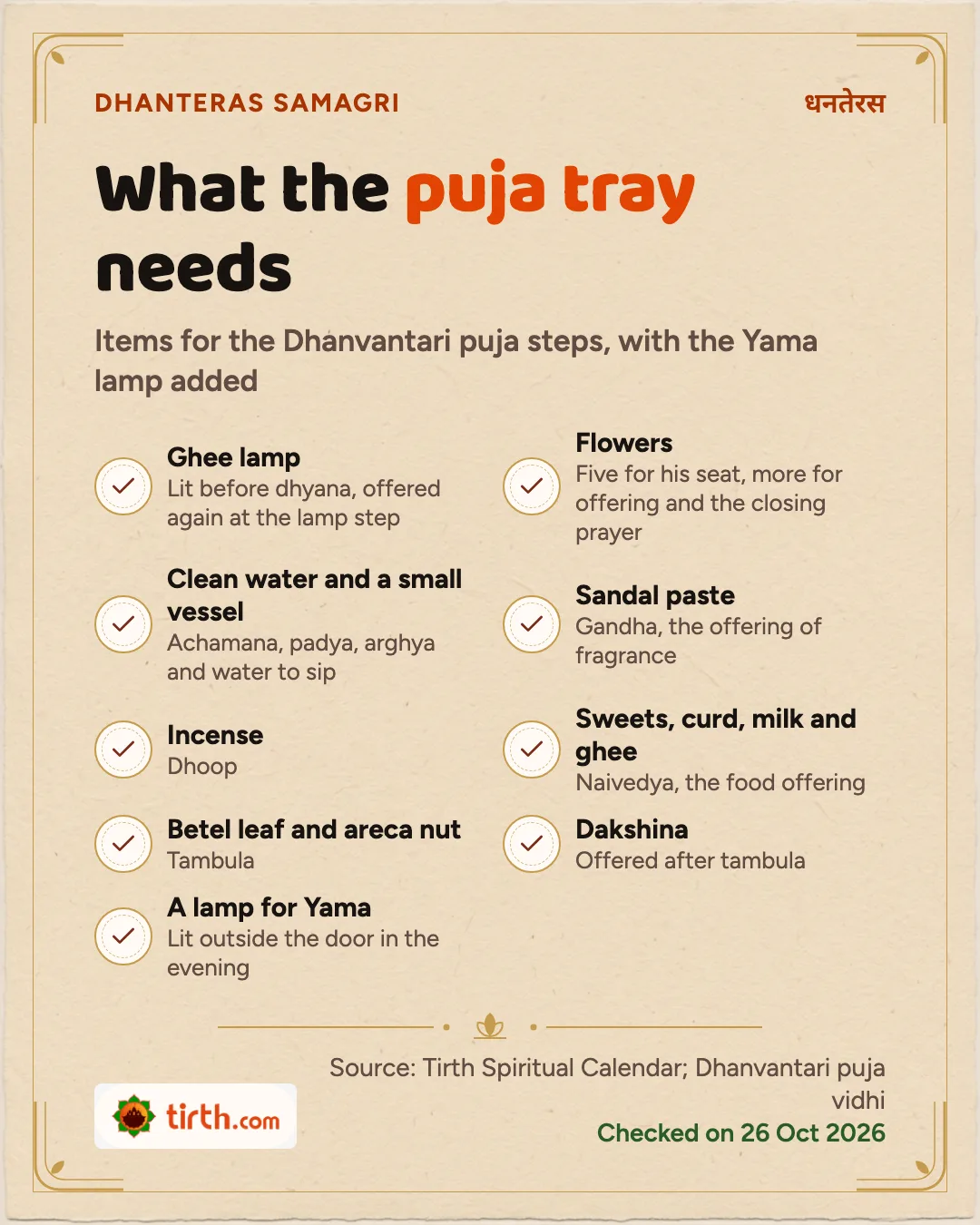
Nothing here is new to a puja cupboard: a lamp, flowers, incense and the usual offerings. The list simply follows the upacharas above, with the Yama lamp added at the end.
| Item | Where it is used |
|---|---|
| Ghee lamp | Lit before dhyana, and offered again at the lamp step |
| Flowers (five for the seat, more for offering) | Pushpanjali as his seat, the flower offering and the closing prayer |
| Clean water and a small vessel | Achamana, padya, arghya and water to sip after naivedya |
| Sandal paste | Gandha, the offering of fragrance |
| Incense | Dhoop |
| Sweets, curd, milk and ghee | Naivedya, the food offering |
| Betel leaf and areca nut | Tambula |
| Dakshina | The offering made after tambula |
| A lamp for Yama | Yama Deepam, lit outside the door in the evening |
Must you buy gold or a new vessel on Dhanteras?
You don’t. Gold, silver and new metal utensils are a widely kept Dhanteras custom, yet none of the three rites needs them and every puja of the day is complete without a purchase.
The panchangs do back the custom strongly. Many families put Dhanteras just after Pushya Nakshatra as the most significant day to buy gold, rate it as auspicious for it as Akshaya Tritiya, and say that buying gold at Diwali is like inviting Lakshmi into the home. Families who keep the custom understand it that way, as a matter of faith.
Our own view is plain. A Yama lamp lit with care and an evening puja given its full time matter more to us than a coin that stretches the month’s budget. If you buy anyway, pick something the house will use (a steel vessel for the kitchen, say) and get it home before dusk, so the evening is left for the puja.
How does the Dhanteras week change from region to region?
It is the days on either side of Dhanteras whose names and weight shift as you travel. Maharashtrian homes worship the cow and her calf the day before, on Vasu Baras (Govatsa Dwadashi). Gujarat keeps Kali Chaudas the day after Dhanteras. Chopda Pujan there, placing the new account books before Lakshmi, is done on Diwali itself and not on Dhanteras.
Head south or east and the pattern moves once more. Deepavali in Tamil Nadu is kept on Narak Chaturdashi, while families in Bengal, Odisha and Assam give the Diwali Amavasya to Kali Puja.
Is National Ayurveda Day still on Dhanteras?
Not any more. For years Ayurveda Day was tied to Dhanteras, Dhanvantari Jayanti. The trouble was that the festival moves, and by the Ministry of Ayush’s count it would land anywhere between mid-October and mid-November over the coming decade, so a Gazette notification dated 23 March 2025 fixed Ayurveda Day to 23 September every year, while Dhanvantari Jayanti stays on Dhanteras.
What comes before and after Dhanteras in Diwali week?
Count the five days of Diwali and Dhanteras is near the front. Then come Narak Chaturdashi and the Diwali Lakshmi Puja on Amavasya (some years both land on one calendar day). Govardhan Puja comes after Diwali, with Bhai Dooj last of all. The tithis shift the exact days a little each year, so check the Spiritual Calendar for where each one lands in your city.
Frequently asked questions
Which god is worshipped on Dhanteras?
Three of them. Lakshmi together with Kubera, the god of wealth, after sunset. Dhanvantari, physician of the gods and a form of Vishnu, because it is his Jayanti. And Yama, who is offered a lamp outside the home.
Why do we light a diya for Yama on Dhanteras?
Yama is the god of death, and the lamp is offered to him with a prayer that no one in the family meets an untimely death. Panchangs list it as Yama Deepam, and it is lit outside the home at dusk on the Trayodashi evening.
Is it necessary to buy gold or utensils on Dhanteras?
No. Many families treat Dhanteras as a very good day to buy gold, and it is a popular custom. The pujas themselves do not depend on buying anything.
Is Dhanteras the same as Dhanvantari Jayanti?
Same day, two names. Think of Dhanteras as the whole festival. Dhanvantari Jayanti, or Dhanvantari Trayodashi, is the same Trayodashi kept as his birth anniversary, and practitioners of Ayurveda observe it in particular. His rising from the ocean is in the Bhagavata Purana, which names no tithi. The link with this day comes from the festival calendar.
What is the difference between Dhanteras and the Diwali Lakshmi Puja?
Dhanteras falls on Krishna Trayodashi, and its Lakshmi worship is with Kubera, in pradosh kaal. The main Lakshmi Puja is two days later on Amavasya, the night of Diwali. Many families call that one the more significant.
Continue on Tirth
- Dhanteras in the Tirth Spiritual Calendar, Tirth, for the tithi and sunset in your city.